Hybrid Framework in Selenium
A Hybrid Framework in Selenium is an automation framework that combines the strengths of multiple framework types into one practical architecture. Instead of relying only on Page Object Model, only data-driven testing, only modular design, or only keyword-driven execution, a hybrid framework brings together the useful parts of several approaches. It commonly includes Page Object Model, modular organization, data-driven testing, reusable utilities, DriverFactory, configuration management, logging, reporting, TestNG, Maven, listeners, and CI/CD integration.
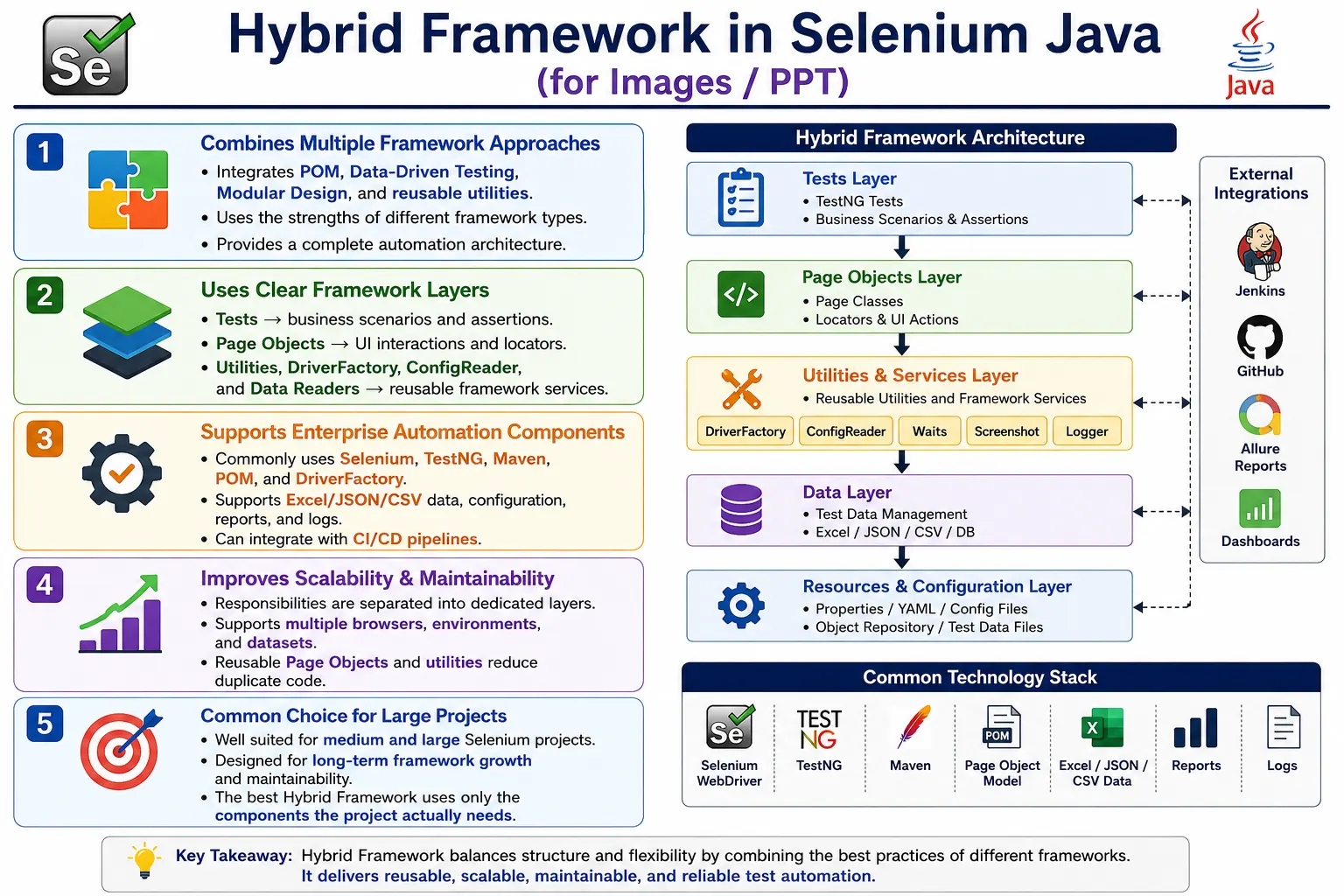
Today, Hybrid Frameworks are the standard choice for medium and large Selenium automation projects because real applications are not simple. A project may need to run hundreds or thousands of tests across multiple browsers, environments, user roles, and datasets. One framework style cannot handle all of those needs cleanly. A hybrid framework solves this by assigning a clear responsibility to each layer and combining the layers into a maintainable automation system.
1. What Is a Hybrid Framework?
A Hybrid Framework combines two or more automation framework types to use their advantages while reducing their limitations. Page Object Model gives page abstraction. Data-driven testing separates input data from test logic. Modular design organizes the framework by feature. Utility classes prevent repeated technical code. Configuration management controls environment settings. Reporting and logging provide execution visibility. CI/CD integration makes automation repeatable in pipelines.
Page Object Model
  Data-Driven Testing
    Modular Design
      Utilities
        Configuration
          Reports and Logs
            CI/CD
              Hybrid Framework
The key point is that a hybrid framework is not one single technique. It is a full automation architecture. It chooses the right tool or pattern for each problem instead of forcing one pattern to solve everything.
2. Why Do We Need a Hybrid Framework?
Large applications contain many pages, workflows, users, data combinations, environments, and browsers. A login flow may be reused across many tests. A checkout flow may need different address and payment data. A test suite may need to run in QA, UAT, staging, and production-like environments. A single script style or a single framework type cannot handle this complexity well.
For example, Page Object Model can make page interactions clean, but it does not automatically handle Excel data, JSON data, reports, logs, browser configuration, or CI execution. Data-driven testing can handle multiple datasets, but it does not automatically organize pages. Modular design can group features, but it does not automatically manage drivers or reports. A hybrid framework combines these capabilities into one structure.
3. Core Idea
The core idea of a hybrid framework is to combine best features rather than depend on one framework type. Each layer solves one responsibility. Tests describe scenarios. Page objects handle UI interactions. Data readers supply test data. Utilities perform reusable technical operations. DriverFactory manages browser lifecycle. ConfigReader supplies environment settings. Reports and logs explain execution results.
Best Features
  Combined Together
    Clear Responsibilities
      Enterprise Automation Framework
This makes the framework scalable because new features can be added without rewriting the whole architecture. A new page object can be added for a new page. A new utility can be added for a repeated technical action. A new data source can be added through the data layer. The test layer stays focused on business verification.
4. Typical Components
A practical Hybrid Framework usually contains several common components. The exact tools may differ by company, but the responsibilities remain similar. Java is commonly used as the programming language. Selenium WebDriver handles browser automation. TestNG handles test execution. Maven handles dependencies and build commands. Page Object Model handles page abstraction. Data readers support Excel, CSV, JSON, or database data. Properties files handle configuration. Extent Reports or Allure handle reporting. Log4j or SLF4J handles logs. Jenkins or another CI tool runs suites automatically.
- Page Object Model for page abstraction.
- Modular Framework structure for feature organization.
- Data-Driven Framework approach for external test data.
- DriverFactory for browser lifecycle management.
- ConfigReader for environment and execution settings.
- Utility classes for waits, screenshots, JavaScript, files, alerts, and windows.
- TestNG for execution, grouping, assertions, and suites.
- Maven for dependencies and command-line execution.
- Reports and logs for debugging and visibility.
- CI/CD integration for repeatable pipeline execution.
5. Framework Architecture
A clean architecture keeps each responsibility separate. TestNG tests call page objects and assertions. Page objects interact with elements. Utilities support repeated technical actions. DriverFactory creates and manages the WebDriver instance. ConfigReader reads browser, URL, timeout, and environment values. Data readers supply test data. Reports and logs capture execution evidence.
TestNG Tests
  Page Object Model
    Utilities
      DriverFactory
        Configuration
          Test Data
            Reports
              Logs
                Selenium WebDriver
                  Browser
This architecture makes debugging easier. If a browser setup issue occurs, check DriverFactory. If a locator changes, check the page object. If a dataset is wrong, check the data layer. If environment selection fails, check configuration. Each problem has a likely home.
6. Real Project Architecture
In a real project, the framework has folders and packages for each major concern. Test classes are separate from page objects. Driver setup is separate from tests. Utilities are separate from page logic. Reports and logs are generated outside business logic. Configuration and test data are stored in controlled resource folders.
Automation Framework
  Test Classes
  Page Objects
  DriverFactory
  Utilities
  Test Data
  Config Files
  Reports
  Logs
  Listeners
  TestNG XML
  Selenium WebDriver
This separation prevents the common beginner problem where everything is written inside one large test class. Enterprise frameworks need clear ownership because many engineers may work on the same framework over time.
7. Page Object Model Layer
The Page Object Model layer contains page classes. Each page class represents a page or major component of the application. It stores locators and exposes meaningful methods. A login page may have methods such as enterUsername, enterPassword, clickLogin, and login. A cart page may have addProduct, removeProduct, updateQuantity, and getCartTotal.
public HomePage login(String username, String password) {
    userField.sendKeys(username);
    passwordField.sendKeys(password);
    loginButton.click();
    return new HomePage(driver);
}
The test should not contain raw locator details. The test should call business-level page methods. This makes tests readable and reduces maintenance when UI locators change.
8. Data Layer
The data layer stores and supplies test data. It may use Excel, CSV, JSON, databases, APIs, or TestNG DataProviders. Login users, product names, search keywords, addresses, payment data, and expected messages belong in the data layer. The test method receives values, but it should not care where those values came from.
Excel, CSV, JSON, Database, or API
  Data Reader
    DataProvider
      Test Method
This layer is especially important for regression testing because the same flow may need to run with many datasets. A good hybrid framework makes it easy to add data without copying test code.
9. Configuration Layer
The configuration layer stores execution settings such as browser, URL, environment, timeout, headless mode, download path, screenshot path, grid URL, and report location. These values should not be hardcoded in test classes. They should be read from properties files, environment variables, command-line parameters, or CI pipeline variables.
browser=chrome
url=https://qa.example.com
timeout=20
headless=false
environment=qa
Configuration management allows the same tests to run in different environments with minimal changes. A test should not need to be rewritten to run in UAT instead of QA.
10. Driver Management Layer
The driver management layer controls browser creation, browser options, driver lifecycle, and browser cleanup. In simple scripts, engineers may create ChromeDriver directly inside test methods. In a hybrid framework, browser creation is centralized through DriverFactory or a similar class.
DriverFactory may read the browser name from configuration, create Chrome, Firefox, Edge, or remote WebDriver, apply browser options, maximize the window, set timeouts, and return the driver. It may also support parallel execution by storing drivers per thread.
ConfigReader
  DriverFactory
    Browser Options
      WebDriver Instance
        Test Execution
          Driver Cleanup
Centralized driver management makes the framework easier to expand when new browsers, headless mode, Selenium Grid, or cloud execution is needed.
11. Utility Layer
The utility layer contains reusable technical helpers. These helpers prevent duplicate code across page objects and tests. Common utilities include WaitUtil, ScreenshotUtil, ExcelUtil, JsonUtil, CsvUtil, JavaScriptUtil, AlertUtil, WindowUtil, FileUtil, DateUtil, and ReportUtil.
Utilities should be focused. A wait utility should handle waits. A screenshot utility should handle screenshots. A file utility should handle file operations. One giant utility class with unrelated methods becomes hard to maintain. Focused utilities keep the framework cleaner.
12. Reporting Layer
The reporting layer generates readable execution results. A good report shows passed tests, failed tests, skipped tests, failure reasons, screenshots, environment, browser, execution time, and logs or links to logs. Extent Reports, Allure Reports, TestNG reports, and custom HTML reports are common options.
Reports are not only for managers. They are debugging tools. When a test fails in CI, the engineer should be able to open the report and understand what failed, where it failed, and what evidence was captured.
13. Logging Layer
Logging records technical execution details. Logs can show browser started, URL opened, login successful, product added, order placed, screenshot captured, and test passed or failed. Log4j, SLF4J, and java.util.logging are common logging options in Java projects.
Reports usually summarize results, while logs explain the flow in more technical detail. Together, reports and logs make failures easier to diagnose.
14. Test Layer
The test layer contains test scenarios, assertions, and business flow. A test class should not be filled with low-level Selenium commands. It should call page objects, pass data, and assert expected behavior. This keeps tests readable and focused on validation.
@Test
public void verifyLogin() {
    HomePage homePage = loginPage.login(username, password);
    Assert.assertEquals(homePage.getPageTitle(), "Dashboard");
}
This style makes the test intention clear. The technical details of typing username, clicking buttons, waiting for pages, and locating elements remain inside page objects and utilities.
15. Folder Structure
A typical enterprise hybrid framework uses a folder structure that separates framework layers. The exact package names can vary, but the responsibilities should stay clear.
AutomationFramework
  pages
  tests
  base
  utilities
  driver
  listeners
  reports
  logs
  config
  testdata
  resources
  testng.xml
This structure helps new team members understand where to add code. New pages go under pages. New tests go under tests. New readers and helpers go under utilities. Browser lifecycle code goes under driver. Execution hooks go under listeners.
16. Framework Execution Flow
The execution flow begins when TestNG starts the suite. Configuration is loaded. DriverFactory creates the browser. Test data is supplied. Page objects perform actions. Utilities support waits, screenshots, JavaScript, and other repeated actions. Reports and logs capture status. Browser cleanup happens after execution.
TestNG
  ConfigReader
    DriverFactory
      Page Object
        Test Data
          Utilities
            Browser
              Reports
                Logs
This flow demonstrates why the framework is called hybrid. Several techniques cooperate during one execution.
17. Complete Login Flow
In a complete login flow, the test starts from TestNG. ConfigReader reads the application URL and browser. DriverFactory creates the browser. Excel or JSON supplies the username and password. LoginPage performs the UI actions. The browser displays the result. Extent Report records status. Log files capture detailed steps.
LoginTest
  ConfigReader
    DriverFactory
      LoginPage
        Excel or JSON Data
          Browser
            Extent Report
              Log File
This same pattern can be used for search, cart, checkout, payment, reports, user management, and many other workflows.
18. Advantages
A Hybrid Framework is highly scalable because it is designed for large test suites. It is maintainable because responsibilities are separated. It supports code reuse through page objects and utilities. It supports many browsers and environments through configuration and driver management. It supports large datasets through data-driven testing. It is CI/CD friendly because it can run through Maven and TestNG commands.
- Highly scalable for large applications.
- Easier maintenance through clear layers.
- Excellent code reuse through POM and utilities.
- Supports multiple browsers and environments.
- Supports multiple data sources.
- Enterprise-ready architecture.
- CI/CD friendly execution.
- Better debugging through reports and logs.
- Clear project structure for team collaboration.
19. Disadvantages
The main disadvantage is initial complexity. A hybrid framework requires good design. It has more classes, layers, utilities, configuration files, and supporting tools than a simple Selenium script. Team members need to understand the framework before they can contribute effectively.
- Higher initial development effort.
- Requires strong framework design.
- More classes and utilities to maintain.
- Team members need framework knowledge.
- Poor design can create unnecessary complexity.
- Over-engineering can slow down small projects.
A hybrid framework should be practical, not decorative. Add layers because the project needs them, not because every tool must be included.
20. Hybrid Framework vs Data-Driven Framework
A Data-Driven Framework mainly focuses on separating test data from test logic. A Hybrid Framework includes data-driven testing as one part of a larger architecture. It also includes POM, utilities, reports, configuration, driver management, logging, and CI/CD support.
| Hybrid Framework | Data-Driven Framework |
|---|---|
| Combines multiple framework types. | Focuses mainly on external test data. |
| Includes POM, utilities, reports, config, and driver management. | Separates test data from test logic. |
| Complete enterprise architecture. | One important architectural aspect. |
21. Hybrid Framework vs Keyword-Driven Framework
A Keyword-Driven Framework is driven primarily by external keywords such as CLICK, TYPE, SELECT, and VERIFY. A Hybrid Framework may include keyword-driven concepts, but it is not limited to them. It is more flexible because it combines multiple approaches.
| Hybrid Framework | Keyword-Driven Framework |
|---|---|
| Uses multiple techniques. | Driven primarily by keywords. |
| Flexible layered architecture. | Action interpreter architecture. |
| Common in modern projects. | Less common as a standalone design today. |
22. Hybrid Framework vs POM
Page Object Model is a design pattern. A Hybrid Framework is a full automation framework. POM focuses on page abstraction. A hybrid framework includes POM and adds execution, configuration, data, reports, logs, utilities, listeners, and CI/CD integration.
| Hybrid Framework | Page Object Model |
|---|---|
| Complete automation framework. | Design pattern. |
| Includes multiple layers. | Focuses on page abstraction. |
| Enterprise automation architecture. | One important component of hybrid design. |
23. Common Technologies Used
A common Selenium Hybrid Framework stack uses Java, Selenium WebDriver, TestNG, Maven, Page Object Model, Apache POI for Excel, Jackson or Gson for JSON, properties files for configuration, WebDriverManager for driver binaries, Extent Reports or Allure for reporting, Log4j for logging, Git for version control, Jenkins for CI, and optionally Docker or Selenium Grid for distributed execution.
Java
  Selenium
    TestNG
      Maven
        Page Object Model
          Apache POI
            Jackson
              Properties File
                WebDriverManager
                  Extent Reports
                    Log4j
                      Git
                        Jenkins
The exact stack can change, but the architecture goal remains the same: reusable, maintainable, configurable, and repeatable automation.
24. Real Enterprise Folder Structure
A more detailed enterprise folder structure may include base setup, driver management, page objects, reusable components, utilities, listeners, reports, logs, config files, test data, tests, and TestNG XML files.
AutomationFramework
  base
    BaseTest.java
  driver
    DriverFactory.java
  pages
    LoginPage.java
    HomePage.java
    CartPage.java
  components
    HeaderComponent.java
    MenuComponent.java
  utilities
    ExcelUtil.java
    JsonUtil.java
    WaitUtil.java
    ScreenshotUtil.java
  listeners
    TestListener.java
  reports
  logs
  config
    config-qa.properties
    config-uat.properties
  testdata
    Login.xlsx
    Products.json
  tests
    LoginTest.java
    CheckoutTest.java
  testng.xml
This structure is understandable because each package has one purpose. It also gives teams a consistent place to add new code.
25. Common Beginner Mistakes
Beginners often call a framework hybrid just because it has many files. A real hybrid framework has clear responsibility separation. Common mistakes include mixing all responsibilities into one class, skipping Page Object Model, hardcoding test data, ignoring configuration management, duplicating Selenium code, and creating unnecessary complexity for a small project.
- Mixing setup, test logic, page logic, and utilities in one class.
- Not using Page Object Model for page abstraction.
- Hardcoding URLs, browsers, credentials, and test data.
- Creating duplicate Selenium actions across pages.
- Ignoring reporting and logging.
- Adding too many layers without real need.
- Not designing for CI/CD execution.
- Not documenting framework conventions.
26. Best Practices
Use Page Object Model for page interactions. Separate test data from test logic. Keep configuration in properties files or environment variables. Use DriverFactory for browser management. Centralize reusable utilities. Integrate reporting and logging. Support multiple environments. Design for command-line and CI/CD execution. Keep the framework modular and easy to extend.
- Keep tests readable and business-focused.
- Keep page objects focused on UI interaction.
- Keep utilities focused and reusable.
- Keep configuration externalized.
- Keep test data separate from code.
- Use listeners for screenshots and reporting hooks.
- Support parallel execution carefully.
- Add new features without modifying core framework classes unnecessarily.
27. Real Enterprise Workflow
A real enterprise workflow usually starts when code is pushed to Git. Jenkins or another CI tool starts a pipeline. Maven builds the project. TestNG runs the selected suite. DriverFactory creates the browser. Page objects execute actions. Test data comes from Excel, JSON, CSV, or database. Selenium WebDriver controls the browser. Reports and logs are generated at the end.
Developer Pushes Code
  Git Repository
    Jenkins Pipeline
      Maven Build
        TestNG Suite
          DriverFactory
            Page Objects
              Test Data
                Selenium WebDriver
                  Browser
                    Extent Report
                      Log Files
This workflow is repeatable and suitable for CI/CD. It does not depend on one engineer running tests manually from an IDE.
28. Hybrid Framework Components Summary
| Component | Responsibility |
|---|---|
| TestNG | Test execution, grouping, assertions, and suites. |
| POM | Page interactions and locator abstraction. |
| DriverFactory | Browser lifecycle management. |
| ConfigReader | Environment configuration. |
| Excel, JSON, or CSV | External test data. |
| Utilities | Common reusable methods. |
| Log4j | Logging execution details. |
| Extent Reports | Readable execution reports. |
| Listeners | Test event handling. |
| Maven | Dependency and build management. |
| Jenkins | Continuous Integration execution. |
29. Parallel Execution Considerations
Modern hybrid frameworks often support parallel execution. This requires careful driver management, data isolation, report handling, and thread safety. If tests share one static driver, parallel execution will fail. If tests use the same data records, collisions may occur. If screenshots use the same file name, evidence may be overwritten.
A scalable framework isolates WebDriver instances per test or thread, uses unique data where needed, names artifacts clearly, and writes reports safely. Parallel execution is not only a TestNG setting. It must be supported by the framework architecture.
30. Test Data Strategy
A Hybrid Framework should have a clear test data strategy. Test data may come from Excel, CSV, JSON, database, API, or TestNG DataProvider, but the framework should not use all sources without purpose. Login data, product data, address data, payment data, and expected messages should be organized so that test failures can be understood quickly. Data should be meaningful, stable, and easy to update.
Large frameworks usually separate positive data, negative data, boundary data, role-based data, and environment-specific data. For example, smoke tests may use a small stable set of users and products, while regression tests may use larger datasets. Payment tests may use controlled test cards. Registration tests may generate unique emails. Without a data strategy, a hybrid framework can fail for reasons unrelated to application defects.
Data cleanup is also part of the strategy. Tests that create orders, tickets, accounts, files, or transactions should either clean them up or use isolated test environments. If the framework keeps creating data without cleanup, future executions become unstable. Good hybrid design treats test data as a first-class part of automation, not as an afterthought.
31. Reporting and Failure Diagnosis
Reporting in a Hybrid Framework must go beyond pass and fail counts. A useful report should show the test name, module, browser, environment, dataset, failure reason, screenshot, execution duration, and logs. If a CI build fails, the engineer should be able to identify whether the failure came from a locator change, bad test data, environment issue, assertion mismatch, application defect, or framework problem.
Listeners are commonly used to connect reporting with test execution events. When a test fails, the listener can capture a screenshot, attach logs, mark the report status, and include exception details. This reduces manual debugging effort. A framework without strong reporting may execute tests, but it will not be trusted by the team because failures take too long to analyze.
32. Framework Maintainability
Maintainability is the main reason to build a Hybrid Framework. Every design decision should reduce long-term maintenance cost. If a locator changes, one page object should be updated. If the browser changes, configuration should be updated. If the waiting strategy changes, a wait utility should be updated. If a new environment is introduced, a new config file or pipeline parameter should be enough.
Tests should remain readable. A test method should describe the business scenario, not low-level Selenium details. Page objects should hide locators and browser actions. Utilities should hide repeated technical behavior. Configuration should hide environment differences. This separation makes the framework easier to scale because each type of change has a clear location.
Maintainability also requires coding standards. Naming conventions, package structure, method style, assertion strategy, logging style, and data file format should be consistent. Without standards, a hybrid framework becomes a collection of different coding styles, which is difficult for teams to maintain.
33. Framework Governance
Enterprise hybrid frameworks need governance. Governance means the team agrees on how framework code should be written, reviewed, extended, and maintained. Not every engineer should add new utilities, new base classes, new driver logic, or new reporting behavior without review. Otherwise, the framework becomes inconsistent over time.
Good governance includes code reviews, framework documentation, reusable examples, naming rules, locator strategy, data strategy, branching practices, and ownership of shared components. Framework changes should be treated carefully because one shared change can affect hundreds of tests. A strong review process protects the automation suite from accidental instability.
34. CI/CD Readiness
A hybrid framework should run from command line without relying on an IDE. Maven commands should trigger TestNG suites. Browser, environment, headless mode, and suite selection should be configurable. Reports should be generated automatically. The process should return a correct build status to the CI tool.
CI/CD readiness is one reason hybrid frameworks are common in enterprise projects. Automation must support repeated execution across builds, branches, environments, and browsers. A framework that works only on one local machine is not production-ready automation.
A CI-ready framework also supports selective execution. The team may run smoke tests on every pull request, critical regression tests nightly, and full regression before release. TestNG groups, XML suites, Maven profiles, and pipeline parameters can support this strategy. This flexibility is one of the practical strengths of hybrid architecture.
35. Scaling a Hybrid Framework
A Hybrid Framework should be designed to grow gradually. In the beginning, the suite may contain only a few page objects and tests. Later, it may contain hundreds of page classes, reusable components, utility classes, data files, and CI jobs. Scaling works well only when the original architecture is disciplined. New tests should follow existing patterns. New utilities should not duplicate old utilities. New page objects should use the same naming and locator strategy as existing pages.
Scaling also means avoiding unnecessary framework changes for normal feature work. Adding a new test should usually require adding a page class, a test class, and data if needed. It should not require changing DriverFactory, base classes, listeners, or reporting code unless there is a genuine framework-level requirement. This stability is what makes a hybrid framework suitable for long-term automation ownership.
36. Interview Perspective
A short interview answer is: a Hybrid Framework combines multiple automation framework types such as Page Object Model, Data-Driven Testing, Modular Framework, configuration management, reusable utilities, reporting, and logging into a single architecture. It is the most commonly used framework in enterprise Selenium automation.
A stronger real-time answer is: in my Selenium automation framework, I use a Hybrid Framework that combines Page Object Model for page abstraction, TestNG for execution, Maven for dependency management, DataProviders with Excel and JSON for test data, properties files for environment configuration, DriverFactory for browser management, reusable utility classes for waits and screenshots, Extent Reports for reporting, and Log4j for logging. The framework is integrated with CI/CD tools such as Jenkins, allowing the same test suite to run across multiple browsers and environments with minimal changes.
In interviews, it is useful to explain that hybrid means practical combination, not random complexity. Each layer must solve a real maintenance, execution, or scalability problem.
37. Key Takeaway
A Hybrid Framework is the industry-standard Selenium automation architecture for medium and large projects. It combines proven design patterns and reusable components into one scalable framework. Rather than depending on one framework style, it integrates Page Object Model, data-driven testing, modular design, configuration management, DriverFactory, utilities, reporting, logging, TestNG, Maven, and CI/CD execution.
Page Object Model
  Data-Driven Testing
    Configuration Management
      DriverFactory
        Reusable Utilities
          Reporting
            Logging
              TestNG
                CI/CD
                  Hybrid Framework
The best hybrid framework is not the most complicated one. It is the framework that fits the application, team, and long-term maintenance needs. For enterprise Selenium projects, a well-designed hybrid framework gives the best balance of readability, reuse, scalability, maintainability, reporting, and repeatable execution.