Base Test Class in Selenium Framework
A Base Test Class is a parent class that contains common setup and teardown logic shared by all test classes in a Selenium automation framework. Instead of writing browser initialization, configuration loading, URL navigation, wait initialization, screenshot hooks, and browser cleanup in every test class, these common operations are placed in one reusable class, usually named BaseTest. Every test class extends this class and automatically receives the common framework behavior.
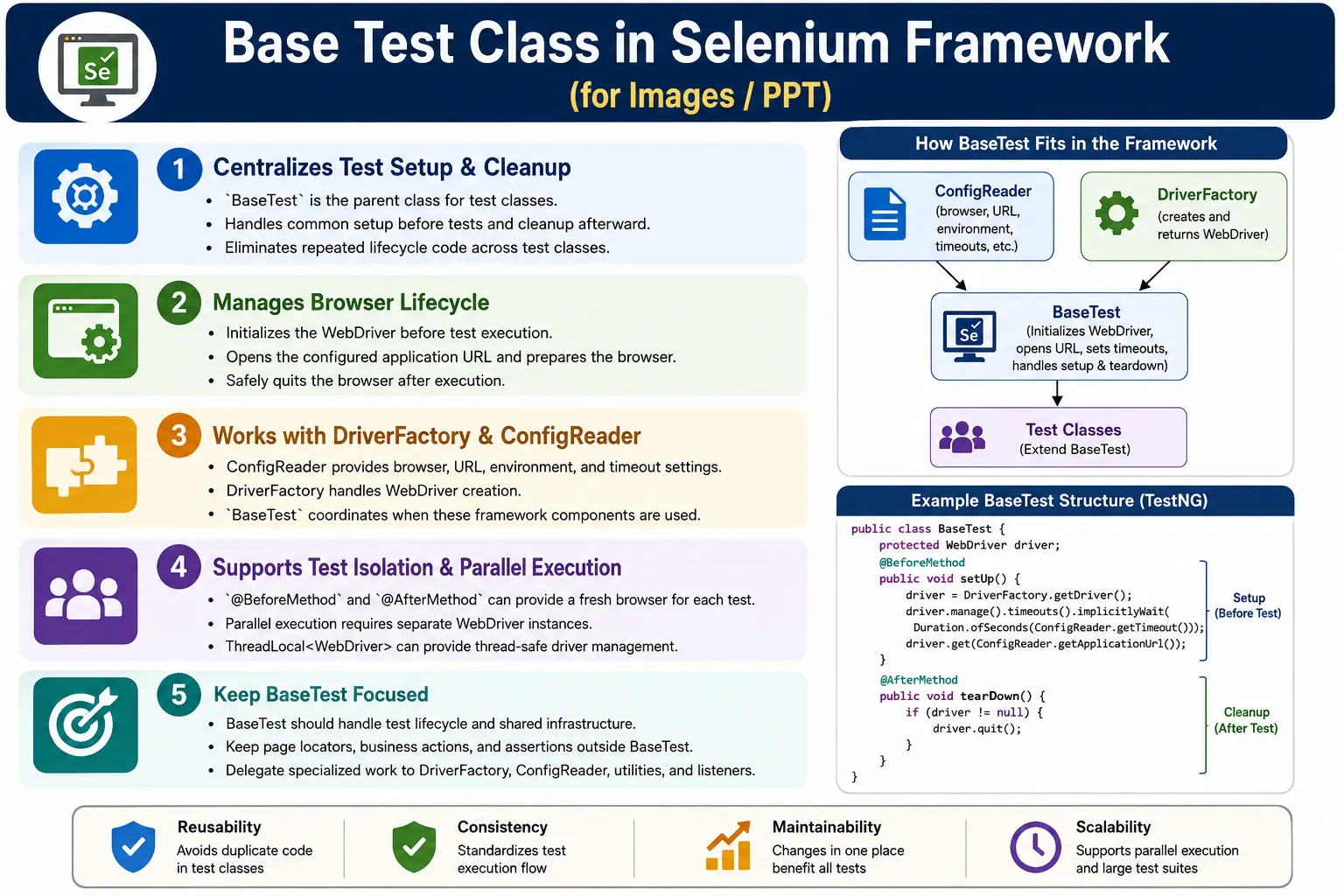
The Base Test Class is one of the fundamental building blocks of a Selenium Hybrid Framework. It is not responsible for business validation, page locators, or feature-specific steps. Its responsibility is the test lifecycle. It prepares the browser before the test starts and cleans up resources after the test finishes. When designed well, it removes duplication, improves consistency, supports configuration, and gives every test a predictable starting point.
1. What Is a Base Test Class?
A Base Test Class is a superclass that provides common functionality required before and after test execution. In Selenium Java frameworks, it usually contains TestNG setup annotations, browser creation, driver cleanup, configuration loading, URL launch, and reusable shared objects such as WebDriverWait. Test classes inherit this behavior by extending BaseTest.
The idea is simple: every test needs a browser, an application URL, some setup, and proper cleanup. Those tasks should not be repeated in every test class. Repetition creates maintenance problems. A Base Test Class centralizes the repeated lifecycle code so that all tests follow the same setup and teardown process.
- Browser initialization.
- Driver lifecycle management.
- Configuration loading.
- Application URL navigation.
- Browser window setup.
- Common wait initialization.
- Browser cleanup after execution.
2. Why Do We Need a Base Test Class?
Imagine a framework with one hundred test classes. Without BaseTest, every class may create ChromeDriver, maximize the browser, open the URL, run the test, and quit the browser. That code is repeated again and again. If the browser setup changes later, every test class may need to be updated. If one class forgets to quit the driver, browser processes may remain open. If another class uses a different timeout, test behavior becomes inconsistent.
Without BaseTest
  LoginTest creates browser
  SearchTest creates browser
  CheckoutTest creates browser
  PaymentTest creates browser
  Every class repeats setup and cleanup
With a Base Test Class, common lifecycle logic is written once. LoginTest, SearchTest, CheckoutTest, and PaymentTest all extend BaseTest. Each test receives the same setup and cleanup. This makes the framework easier to maintain and more predictable.
With BaseTest
  BaseTest handles setup
  Test classes execute business checks
  BaseTest handles cleanup
3. Problems Without BaseTest
Without a Base Test Class, Selenium projects often become inconsistent. One test may use ChromeDriver directly. Another may use EdgeDriver. One may maximize the browser, another may not. One may open the QA URL, another may accidentally open a staging URL. Some tests may use implicit waits. Others may use explicit waits. This inconsistency creates debugging problems.
driver = new ChromeDriver();
driver.manage().window().maximize();
driver.get(url);
driver.quit();
If this code is repeated across many test classes, even a small change becomes expensive. For example, if the team decides to run tests in headless mode, many classes may need updates. If the application URL changes, duplicated hardcoded URLs must be replaced. BaseTest prevents this by placing common setup in one place.
4. Core Idea
The core idea is lifecycle centralization. Every test follows the same broad flow: setup, execution, and cleanup. The test class should focus on execution and assertions. BaseTest should handle setup and cleanup. This gives each class a clear responsibility.
BaseTest
  Common Setup
    Test Class Execution
      Common Cleanup
This separation also improves readability. When someone opens a test class, they can focus on what the test verifies. They do not need to read browser setup code in every method. The technical lifecycle code is handled by the framework.
5. Architecture
In a framework architecture, BaseTest usually sits above test classes and coordinates with DriverFactory, ConfigReader, utilities, listeners, reports, and logs. It may not implement every feature directly, but it starts the chain that prepares the test environment.
BaseTest
  Driver Initialization
  Configuration
  Browser Launch
  Browser Cleanup
  Shared Utilities
    LoginTest
    SearchTest
    CheckoutTest
BaseTest should not become a dumping ground. It should coordinate common lifecycle work, while specialized behavior remains in focused classes. Browser creation belongs in DriverFactory. Configuration reading belongs in ConfigReader. Screenshots and reporting hooks often belong in listeners or utilities.
6. Typical Responsibilities
A Base Test Class usually loads configuration, initializes WebDriver, launches the browser, maximizes the window, opens the application URL, initializes waits, and closes the browser after execution. In some frameworks, it also creates page objects or initializes common test context. In more mature frameworks, screenshot capture and report updates are handled by TestNG listeners instead of placing everything directly in BaseTest.
- Load configuration values for browser, URL, timeout, and environment.
- Call DriverFactory to create the correct WebDriver instance.
- Apply browser window settings and timeouts.
- Open the application URL before each test.
- Initialize reusable waits or test context objects.
- Quit the browser after each test.
- Release driver references safely.
7. Basic BaseTest Example
A simple BaseTest can create ChromeDriver before each test method and quit it after each method. This is enough to show the concept, even though real enterprise frameworks usually add DriverFactory and configuration management.
public class BaseTest {

    protected WebDriver driver;

    @BeforeMethod
    public void setUp() {
        driver = new ChromeDriver();
        driver.manage().window().maximize();
        driver.get("https://example.com");
    }

    @AfterMethod
    public void tearDown() {
        if (driver != null) {
            driver.quit();
        }
    }
}
The driver is marked protected so child test classes can use it. The setup method runs before each test method. The teardown method runs after each test method. This gives test isolation because each test starts with a fresh browser session.
8. Extending BaseTest
A test class extends BaseTest to inherit browser setup and cleanup. The test class does not need to create the driver directly. It can use the inherited driver and focus on its actual validation.
public class LoginTest extends BaseTest {

    @Test
    public void verifyLogin() {
        System.out.println(driver.getTitle());
    }
}
When LoginTest runs, TestNG executes the setup method from BaseTest first. Then the test method runs. After that, teardown runs and closes the browser. The test class automatically receives the lifecycle behavior.
9. Using DriverFactory
Directly creating ChromeDriver inside BaseTest works for simple examples, but enterprise frameworks usually use DriverFactory. DriverFactory handles browser creation based on configuration. This keeps BaseTest cleaner and makes it easier to support Chrome, Firefox, Edge, remote browsers, Selenium Grid, or cloud providers.
driver = DriverFactory.getDriver(browser);BaseTest controls when the driver is needed. DriverFactory controls how the driver is created. This separation is important. If the team later adds Firefox or headless Chrome, DriverFactory changes, while test classes remain unchanged.
10. Loading Configuration
Configuration should usually be loaded before driver setup. The framework may need to know browser, URL, environment, timeout, headless mode, and download path before creating the browser. BaseTest often calls ConfigReader during suite setup or method setup.
@BeforeSuite
public void loadConfig() {
    ConfigReader.loadConfig("qa");
}driver.get(ConfigReader.get("url"));This allows the same framework to run against QA, UAT, staging, or other environments without changing test code. Environment differences belong in configuration, not in test methods.
11. Browser Selection
Browser selection should be externalized. The browser name may come from a properties file, TestNG XML parameter, Maven command-line property, or CI pipeline variable. BaseTest reads that value and asks DriverFactory to create the matching browser.
String browser = ConfigReader.get("browser");
driver = DriverFactory.getDriver(browser);
A switch statement can also be used in simple examples, but it is usually better inside DriverFactory than BaseTest. BaseTest should not grow into a large browser creation class.
12. Initializing Waits
Many tests need explicit waits. Instead of creating WebDriverWait repeatedly in every test class, BaseTest can initialize a protected wait object. Page objects can also create waits through a utility class or receive the driver and use a common wait helper.
protected WebDriverWait wait;

@BeforeMethod
public void setUp() {
    driver = new ChromeDriver();
    wait = new WebDriverWait(driver, Duration.ofSeconds(20));
}
Centralized wait configuration helps avoid inconsistent timeout behavior across tests. However, waits should still be used thoughtfully. BaseTest can initialize wait support, while page objects decide what conditions to wait for.
13. Maximizing Browser and Opening URL
Browser window setup and URL navigation are common setup steps. Placing them in BaseTest ensures every test starts consistently. The browser may be maximized, set to a specific size, or run headless depending on configuration.
driver.manage().window().maximize();
driver.get(ConfigReader.get("url"));
Opening the URL from configuration allows easy environment switching. The test should not need to know whether it runs in QA or UAT. It should simply start from the configured application URL.
14. Browser Cleanup
Cleanup is one of the most important responsibilities of BaseTest. The browser should be closed even when tests fail. If cleanup is skipped, browser windows and driver processes remain open. Over time, this can slow down the machine, break CI agents, or cause random execution failures.
@AfterMethod(alwaysRun = true)
public void tearDown() {
    if (driver != null) {
        driver.quit();
    }
}
Using alwaysRun = true is helpful in TestNG because cleanup should execute even when earlier setup or test steps fail. Cleanup code should be defensive and check whether the driver exists before quitting.
15. Complete BaseTest Example
A more complete BaseTest loads configuration, reads browser, creates driver through DriverFactory, maximizes the browser, opens the URL, and quits the driver after the test. This structure is common in hybrid frameworks.
public class BaseTest {

    protected WebDriver driver;

    @BeforeMethod
    public void setUp() {
        ConfigReader.loadConfig("qa");
        String browser = ConfigReader.get("browser");
        driver = DriverFactory.getDriver(browser);
        driver.manage().window().maximize();
        driver.get(ConfigReader.get("url"));
    }

    @AfterMethod(alwaysRun = true)
    public void tearDown() {
        if (driver != null) {
            driver.quit();
        }
    }
}
This version is still understandable, but it is already better than direct setup in every test class.
16. Project Structure
BaseTest usually lives in a base package. DriverFactory lives in a driver package. ConfigReader lives in a config or utilities package. Page objects and tests remain separate. This structure keeps the framework organized.
AutomationFramework
  base
    BaseTest.java
  driver
    DriverFactory.java
  config
    ConfigReader.java
  pages
  tests
    LoginTest.java
    SearchTest.java
  utilities
When the framework grows, this organization helps engineers find the correct place for changes. Browser lifecycle changes go to BaseTest or DriverFactory. Page behavior changes go to page classes. Test logic changes go to test classes.
17. Test Flow
In TestNG, the lifecycle may start with @BeforeSuite to load global configuration. Then @BeforeMethod initializes the browser before each test. The test method executes. Then @AfterMethod quits the browser. This gives each test a clean browser session.
@BeforeSuite
  Load Config
    @BeforeMethod
      Initialize Driver
        Launch Browser
          Open URL
            Execute Test
              @AfterMethod
                Quit Browser
Some frameworks use @BeforeClass instead of @BeforeMethod, but @BeforeMethod gives stronger test isolation because every test method starts with a fresh browser. The right choice depends on execution time, test independence, and project strategy.
18. Integration with Page Object Model
Page Object Model works naturally with BaseTest. BaseTest creates the driver. The test class passes that driver to page objects. Page objects use the driver to interact with elements. This keeps driver lifecycle in BaseTest and UI behavior in page classes.
public class LoginTest extends BaseTest {

    private LoginPage loginPage;

    @BeforeMethod
    public void initializePage() {
        loginPage = new LoginPage(driver);
    }

    @Test
    public void verifyLogin() {
        loginPage.login("admin", "admin123");
    }
}
The driver comes from BaseTest, while LoginPage handles login interactions. This is a clean separation of responsibilities.
19. Integration with Hybrid Framework
In a Hybrid Framework, BaseTest coordinates framework initialization. It works with ConfigReader, DriverFactory, Page Objects, utilities, reports, logs, and listeners. It is the starting point for execution, but it should not contain every framework feature directly.
BaseTest
  ConfigReader
    DriverFactory
      Page Objects
        Utilities
          Reports
            Logs
              Browser
A mature BaseTest is focused. It knows the lifecycle. It delegates specialized work. This keeps the framework extensible.
20. Screenshot on Test Failure
Many frameworks capture screenshots when tests fail. This can be done in BaseTest through @AfterMethod with ITestResult, or better, through a TestNG listener. The important rule is that the screenshot must be captured before the browser is quit.
@AfterMethod(alwaysRun = true)
public void tearDown(ITestResult result) throws IOException {
    if (result.getStatus() == ITestResult.FAILURE && driver != null) {
        captureScreenshot(result.getName());
    }

    if (driver != null) {
        driver.quit();
    }
}
For enterprise frameworks, listeners are often cleaner because BaseTest remains focused on setup and cleanup while listeners handle reporting events.
21. ThreadLocal for Parallel Execution
Parallel execution changes driver management. A single static driver is unsafe when tests run concurrently. One test may overwrite another test's driver. To avoid this, frameworks often use ThreadLocal<WebDriver>. Each thread gets its own driver instance.
private static final ThreadLocal<WebDriver> driver = new ThreadLocal<>();

protected WebDriver getDriver() {
    return driver.get();
}
With ThreadLocal, tests should use getDriver instead of directly accessing a shared driver variable. After execution, the driver should be quit and removed from ThreadLocal to prevent memory leaks.
22. Complete Framework-Style BaseTest
A framework-style BaseTest can use TestNG parameters, optional defaults, ThreadLocal driver storage, timeout setup, explicit wait initialization, screenshot capture, and safe cleanup. The exact implementation varies, but the structure below shows the concept.
public class BaseTest {

    private static final ThreadLocal<WebDriver> driver = new ThreadLocal<>();
    protected WebDriverWait wait;

    protected WebDriver getDriver() {
        return driver.get();
    }

    @Parameters({"browser", "url"})
    @BeforeMethod
    public void setUp(
            @Optional("chrome") String browser,
            @Optional("https://example.com") String url) {

        WebDriver webDriver = DriverFactory.getDriver(browser);
        driver.set(webDriver);

        getDriver().manage().window().maximize();
        getDriver().manage()
                .timeouts()
                .pageLoadTimeout(Duration.ofSeconds(30));

        wait = new WebDriverWait(getDriver(), Duration.ofSeconds(10));
        getDriver().get(url);
    }

    @AfterMethod(alwaysRun = true)
    public void tearDown(ITestResult result) throws IOException {
        try {
            if (result.getStatus() == ITestResult.FAILURE && getDriver() != null) {
                captureScreenshot(result.getName());
            }
        } finally {
            if (getDriver() != null) {
                getDriver().quit();
                driver.remove();
            }
        }
    }
}
This style is closer to enterprise usage because it supports parameterization, cleanup safety, and parallel execution.
23. Common Beginner Mistakes
A common mistake is creating the driver in every test class. Another is forgetting to quit the driver. Some engineers hardcode URLs in BaseTest and then struggle to switch environments. Others put page-specific logic, business actions, or assertions into BaseTest. That makes BaseTest too large and tightly coupled to application behavior.
- Creating WebDriver directly in every test class.
- Forgetting to quit the browser after tests.
- Hardcoding environment URLs.
- Mixing test logic with setup logic.
- Creating driver instances inside page objects.
- Using one static driver for parallel tests.
- Putting page-specific locators in BaseTest.
- Capturing screenshots after quitting the browser.
24. Best Practices
Keep only common setup and cleanup in BaseTest. Use DriverFactory instead of directly creating browser instances. Load configuration in a controlled way. Open the application URL from configuration. Initialize reusable objects centrally. Keep test-specific setup inside test classes when needed. Use listeners for screenshots and reporting when possible. Ensure driver.quit always executes, even when tests fail.
- Keep BaseTest focused on lifecycle and shared infrastructure.
- Use @BeforeMethod and @AfterMethod for test isolation.
- Use ThreadLocal when running tests in parallel.
- Capture failure evidence before quitting the browser.
- Use alwaysRun = true for cleanup methods.
- Read browser, URL, timeout, and environment values from configuration.
- Avoid page-specific locators and business logic in BaseTest.
- Delegate specialized responsibilities to DriverFactory, utilities, and listeners.
25. BaseTest vs DriverFactory
BaseTest and DriverFactory are related but not the same. BaseTest controls the test lifecycle. DriverFactory creates WebDriver instances. BaseTest decides when a browser is needed. DriverFactory decides how to create that browser.
| BaseTest | DriverFactory |
|---|---|
| Controls test lifecycle. | Creates WebDriver instances. |
| Uses TestNG annotations. | Contains browser creation logic. |
| Loads or uses configuration. | Returns appropriate browser driver. |
| Opens URL and performs cleanup. | Does not execute tests. |
26. BaseTest vs Page Object
BaseTest prepares the test environment. Page Objects interact with application pages. BaseTest should not know how to click the login button or verify cart totals. Page Objects should not create browsers or quit drivers. Keeping these roles separate makes the framework maintainable.
| BaseTest | Page Object |
|---|---|
| Framework initialization. | Page interactions. |
| Browser lifecycle. | Locators and business methods. |
| Setup and cleanup. | Click, type, select, and verify page behavior. |
| Shared by all tests. | Represents one page or component. |
27. Real Enterprise Workflow
In an enterprise workflow, configuration is loaded at suite level. Before each method, BaseTest asks DriverFactory to create WebDriver. The browser opens and navigates to the configured URL. The test executes using page objects and data. If the test fails, listeners or BaseTest capture evidence. Finally, the browser is quit.
@BeforeSuite
  Load Configuration
    @BeforeMethod
      DriverFactory
        Create WebDriver
          Open Browser
            Navigate to URL
              Execute Test
                @AfterMethod
                  Capture Failure Evidence
                    Quit Browser
This workflow gives every test a consistent start and a clean end.
28. BaseTest and Test Isolation
Test isolation is one of the biggest reasons to use BaseTest correctly. A test should not depend on browser state left behind by a previous test. If one test logs in and another test assumes the same session is still active, the suite becomes order-dependent. Order-dependent tests are difficult to run in parallel, difficult to debug, and unreliable in CI/CD pipelines. A good BaseTest helps avoid this by creating a clean browser session before each test method and cleaning it after execution.
Using @BeforeMethod and @AfterMethod is common when every test needs a fresh browser. This approach may take more time than sharing one browser for an entire class, but it gives better independence. If execution speed becomes a concern, the team can optimize later with parallel execution, browser reuse strategies, or API-based test setup. The first priority should be reliable tests.
29. BaseTest and Listeners
BaseTest and TestNG listeners work together in many enterprise frameworks. BaseTest prepares and cleans up the browser. Listeners react to test events such as test start, test success, test failure, and test skip. When a test fails, the listener can capture a screenshot, attach logs, update the report, and record failure details. This keeps BaseTest cleaner because reporting logic does not need to be mixed into setup and teardown methods.
A common design is to expose the driver through a getDriver method so listeners can access the current test's browser instance when needed. In parallel execution, this is especially important because the listener must capture the screenshot from the correct thread's driver. If the framework uses ThreadLocal driver management, listeners should also use the same driver access method.
30. BaseTest and Configuration Strategy
Configuration strategy matters because BaseTest is usually the first class that consumes configuration values. Browser name, environment, application URL, timeout, headless mode, download path, grid URL, and report path may all influence setup. Hardcoding these values in BaseTest makes the framework rigid. Externalizing them makes the framework flexible.
Configuration can come from properties files, TestNG XML parameters, Maven system properties, environment variables, or CI pipeline variables. A practical framework may use default values from properties files and allow command-line or pipeline parameters to override them. This allows the same test suite to run locally, in QA, in UAT, or in CI without code changes.
31. BaseTest in CI/CD
In CI/CD pipelines, BaseTest must be stable and repeatable. The build machine may not have the same browser state as a developer laptop. The framework may need headless execution, fixed window size, remote WebDriver, or containerized browser execution. BaseTest should support these needs through configuration and DriverFactory rather than manual code edits.
CI also makes cleanup critical. If driver sessions are not closed properly, later pipeline runs may fail because of orphaned processes or exhausted resources. A defensive teardown method with null checks, alwaysRun cleanup, and ThreadLocal removal helps keep CI agents healthy. BaseTest is therefore not just a local setup helper; it is part of framework reliability.
32. When BaseTest Becomes Too Large
One warning sign in Selenium frameworks is an oversized BaseTest. If BaseTest contains browser setup, login logic, page object methods, test data readers, screenshots, report formatting, database queries, and business assertions, it has too many responsibilities. Large BaseTest classes become difficult to understand and risky to modify because every test depends on them.
The solution is delegation. Driver creation should move to DriverFactory. Configuration reading should move to ConfigReader. Screenshots should move to ScreenshotUtil or listeners. Test data reading should move to ExcelUtil, JsonUtil, or DataProvider classes. Page actions should move to page objects. BaseTest should remain the coordinator of setup and cleanup, not the owner of every framework feature.
33. Choosing TestNG Annotation Scope
Choosing the right TestNG annotation scope is an important BaseTest design decision. @BeforeSuite runs once before the entire suite. It is useful for loading configuration, initializing global report setup, or preparing suite-level resources. @BeforeClass runs once before all methods in a test class. It can be useful when all tests in that class share expensive setup, but it may reduce test isolation. @BeforeMethod runs before every test method and is commonly used for browser creation because it gives each test a clean session.
The same thinking applies to cleanup. @AfterMethod is commonly used to quit the browser after every test method. @AfterClass may be used when a browser is intentionally shared across a class, but that design requires extra discipline because tests can affect each other. @AfterSuite is useful for closing reports or releasing suite-level resources. For most Selenium UI automation, @BeforeMethod and @AfterMethod are the safest defaults because UI tests are more reliable when each test starts fresh.
There is no single annotation choice for every project. If tests are independent and stability matters most, method-level setup is usually better. If execution speed is the highest priority and tests are carefully designed, class-level setup may be considered. In interviews and real projects, it is important to explain the trade-off: method-level setup improves isolation, while class-level setup may reduce execution time but increases dependency risk.
34. Driver Access Pattern
Another important design choice is how test classes and page objects access WebDriver. In simple frameworks, BaseTest exposes a protected driver variable. Test classes can use it directly, and page objects receive it through constructors. This is easy to understand, but it is not always suitable for parallel execution. In parallel frameworks, a getDriver method backed by ThreadLocal is safer because each thread retrieves its own driver instance.
The framework should use one consistent driver access pattern. Mixing direct driver variables, static driver references, new driver instances in page objects, and ThreadLocal access creates confusion. A test should not create its own browser if BaseTest already manages the lifecycle. A page object should not call new ChromeDriver. A utility should not secretly replace the driver. WebDriver ownership should be clear: BaseTest and DriverFactory manage the driver, while tests and page objects use the driver.
This consistency becomes critical when the suite grows. If every class accesses the driver differently, debugging failures becomes difficult. A clean driver access pattern makes reports, screenshots, waits, page objects, and listeners all work against the same browser session. That is one of the practical reasons BaseTest is treated as a backbone class in hybrid Selenium frameworks.
35. Interview Perspective
A short interview answer is: a Base Test Class is a parent class that contains common setup and teardown logic such as browser initialization, configuration loading, URL navigation, wait setup, and browser cleanup. All test classes extend it to avoid duplicate code.
A stronger real-time answer is: in my Selenium framework, I use a BaseTest class that loads environment configuration, creates the browser through DriverFactory, opens the application URL, and initializes shared resources such as WebDriverWait. All test classes extend BaseTest, so they automatically receive browser setup and cleanup without duplicating code. Reporting and screenshots are handled through TestNG listeners, while BaseTest remains focused on framework initialization and the test lifecycle.
36. Key Takeaway
The Base Test Class centralizes common test lifecycle operations. It eliminates duplicate initialization code, integrates with DriverFactory and ConfigReader, simplifies browser management, supports consistent setup and cleanup, and forms the backbone of most Selenium Hybrid Frameworks.
BaseTest
  Configuration
  DriverFactory
  Browser Setup
  Wait Initialization
  URL Navigation
  Browser Cleanup
    All Test Classes
The most important rule is to keep BaseTest focused. It should manage test lifecycle and shared infrastructure, not page-specific behavior or business validations. A clean BaseTest makes Selenium automation easier to maintain, extend, debug, and execute across different browsers, environments, and CI/CD pipelines.