Wrapper Classes in Java
In Java, one of the first important distinctions developers learn is the difference between primitive data types and objects. Primitive types such as int, double, char, and boolean are simple, fast, and memory-efficient. They store values directly and are ideal for basic calculations and decision-making. However, Java is also an object-oriented language, and many important features such as collections, generics, frameworks, APIs, reflection, and data binding are built around objects. Wrapper classes exist to bridge this gap between primitive values and object-based programming.
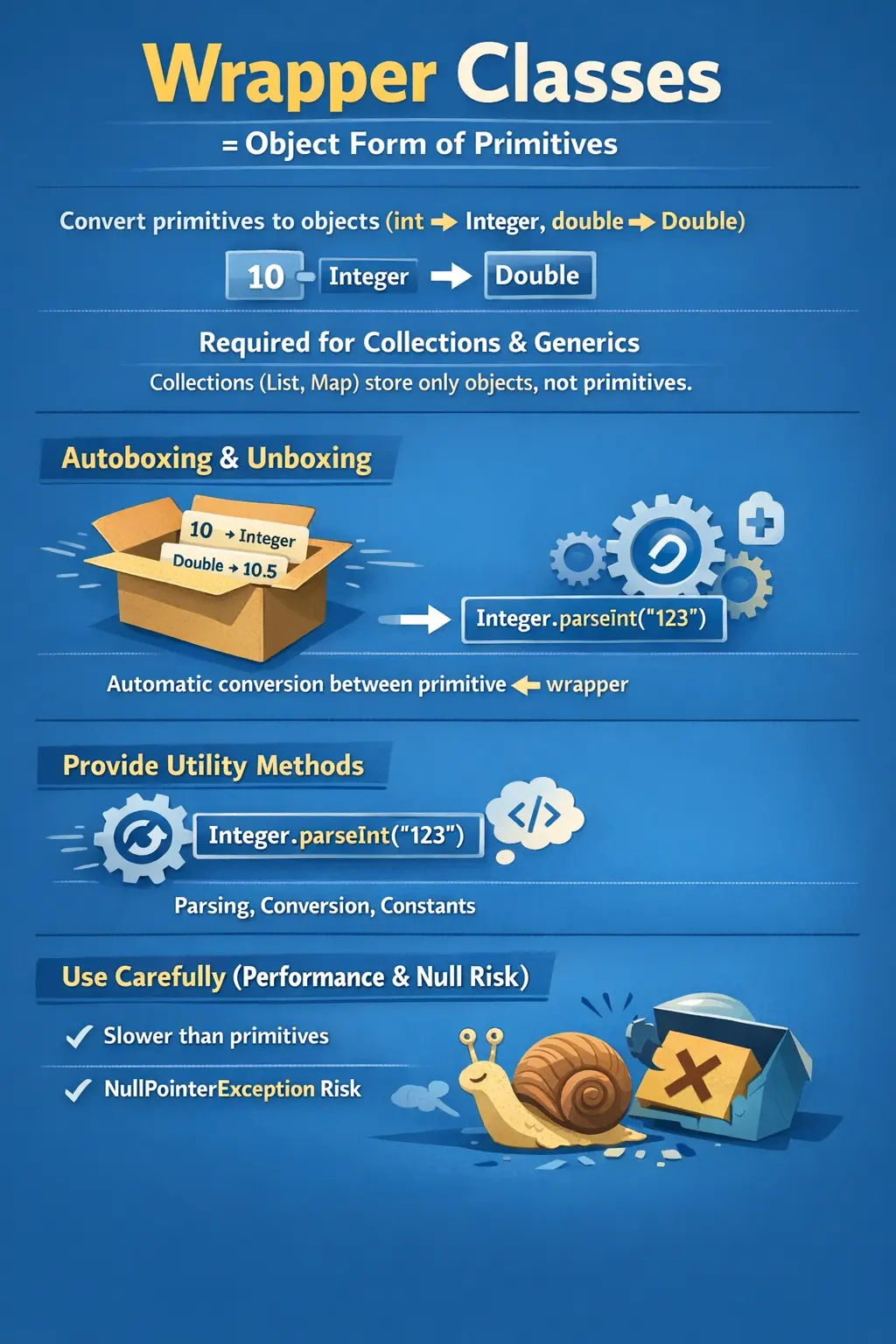
A wrapper class is an object representation of a primitive data type. It wraps a primitive value inside an object so that the value can be used where Java expects an object. For example, int is a primitive type, while Integer is its wrapper class. The primitive value is efficient, but the wrapper object provides methods, null handling, compatibility with collections, and integration with object-based APIs.
Wrapper classes are not an optional side topic in Java. They are used constantly in real applications. Whenever you store numbers in an ArrayList, read form values from a framework, parse numbers from strings, handle nullable database fields, or work with generic types, wrapper classes are involved. A strong understanding of wrapper classes helps developers avoid bugs related to null values, object comparison, autoboxing, unboxing, and performance overhead.
What Are Wrapper Classes?
Wrapper classes are classes that represent primitive values as objects. Each primitive data type in Java has a corresponding wrapper class in the java.lang package. Because java.lang is automatically imported, wrapper classes can be used without writing an explicit import statement.
int primitiveValue = 10;
Integer wrapperValue = 10;
In this example, primitiveValue is an int, so it stores the value directly. The variable wrapperValue is an Integer, so it is a reference to an object that represents the value 10. The syntax looks similar because Java supports automatic conversion, but the memory behavior and object behavior are different.
A primitive variable does not have methods. You cannot call intValue(), compareTo(), or toString() directly on a primitive int. A wrapper object, however, belongs to a class and provides useful methods. This is one reason wrapper classes are important in object-oriented Java programming.
Primitive to Wrapper Mapping
Java provides one wrapper class for each primitive type. The mapping is fixed and should be memorized by every Java beginner. The wrapper class for byte is Byte. The wrapper for short is Short. The wrapper for int is Integer. The wrapper for long is Long. The wrapper for float is Float. The wrapper for double is Double. The wrapper for char is Character. The wrapper for boolean is Boolean.
byte    -> Byte
short   -> Short
int     -> Integer
long    -> Long
float   -> Float
double  -> Double
char    -> Character
boolean -> Boolean
Most wrapper class names are simply the primitive type name with the first letter capitalized. The exceptions are int, whose wrapper is Integer, and char, whose wrapper is Character. These two names are frequently asked in interviews because beginners often guess Int and Char, which are incorrect.
Why Wrapper Classes Are Needed
Wrapper classes are needed because many parts of Java work with objects, not primitives. The most common example is the collection framework. Collections such as ArrayList, HashSet, and HashMap store objects. They cannot store primitive values directly.
ArrayList<Integer> numbers = new ArrayList<>();
numbers.add(10);
numbers.add(20);
The list stores Integer objects, not primitive int values. When 10 is added, Java automatically converts the primitive value into an Integer object. This automatic conversion is called autoboxing. Without wrapper classes, primitives could not be used conveniently in collections and generics.
Wrapper classes are also needed when a value may be absent. A primitive int always has a value such as 0, but an Integer can be null. This is useful when working with databases, APIs, forms, and JSON data where missing values must be represented separately from actual numeric zero.
Another reason wrapper classes are needed is utility functionality. Wrapper classes provide parsing methods, conversion methods, comparison methods, constants, and helper operations. For example, Integer.parseInt("100") converts text into a primitive integer, while Integer.MAX_VALUE provides the maximum value of an int.
Creating Wrapper Objects
There are several ways to create wrapper objects. In older Java code, constructors were commonly used, such as new Integer(10). This style is now deprecated and should be avoided in modern Java because it creates unnecessary objects and is less efficient.
Integer oldStyle = new Integer(10); // deprecated, avoidThe recommended explicit way is to use the valueOf() method. This method may use internal caching for some wrapper types and values, making it more efficient than always creating a new object.
Integer number = Integer.valueOf(10);
Double amount = Double.valueOf(20.5);
In everyday Java, the most common approach is autoboxing. Autoboxing allows a primitive value to be assigned directly to a wrapper variable, and the compiler handles the conversion automatically.
Integer count = 10;
Boolean active = true;
Character grade = 'A';
This syntax is concise and readable, but developers should remember that wrapper objects are still involved. Convenience does not remove the memory and null-handling differences between primitives and wrappers.
Autoboxing
Autoboxing is the automatic conversion of a primitive value into its corresponding wrapper object. It was introduced to reduce boilerplate code and make collections and generics easier to use with primitive-like values.
int x = 10;
Integer y = x;
Here, Java automatically converts x into an Integer object. Conceptually, the compiler treats it similarly to Integer.valueOf(x). This conversion is convenient, especially when adding primitive values to collections.
List<Integer> scores = new ArrayList<>();
scores.add(95);
The value 95 is a primitive integer literal, but the list requires Integer objects. Autoboxing makes the code clean by automatically wrapping the value.
Unboxing
Unboxing is the reverse of autoboxing. It converts a wrapper object back into its corresponding primitive value. Java performs unboxing automatically when a primitive value is required.
Integer wrapper = 20;
int primitive = wrapper;
The Integer object is automatically converted into an int. Unboxing also happens during arithmetic operations involving wrapper objects.
Integer a = 10;
Integer b = 20;
int sum = a + b;
Before addition, Java unboxes a and b into primitive int values. The arithmetic operation is performed on primitives, and the result is stored in sum.
Null Risk During Unboxing
The biggest danger of unboxing is null handling. A wrapper reference can be null, but a primitive cannot. If Java tries to unbox a null wrapper, it throws NullPointerException.
Integer value = null;
// int result = value; // NullPointerException
This is a common real-world bug. It often occurs when data comes from databases, JSON payloads, forms, or APIs where a numeric field may be missing. The code may compile successfully but fail at runtime when automatic unboxing occurs.
To avoid this problem, check for null before unboxing or provide a default value intentionally.
Integer value = null;
int result = value != null ? value : 0;
This code safely uses 0 when the wrapper is null. The correct default depends on the business meaning. Sometimes zero is valid, and sometimes a missing value should be handled as an error instead.
Wrapper Classes in Collections
Collections are one of the most important reasons wrapper classes exist. Java generics work with reference types, not primitive types. Therefore, a list of integers must use Integer, not int.
ArrayList<Integer> ids = new ArrayList<>();
ids.add(101);
ids.add(102);
When values are added, autoboxing converts primitive literals into wrapper objects. When values are retrieved and assigned to primitive variables, unboxing may occur.
int firstId = ids.get(0);The method get(0) returns an Integer, and Java unboxes it into an int. This makes collections convenient, but developers should remember that objects are being stored internally.
Utility Methods in Wrapper Classes
Wrapper classes provide many useful utility methods. One common use is parsing strings into primitive values. This is needed when reading user input, configuration values, CSV files, JSON fields, or request parameters.
int age = Integer.parseInt("25");
double price = Double.parseDouble("99.99");
boolean enabled = Boolean.parseBoolean("true");
The parseXxx() methods return primitive values. For example, Integer.parseInt() returns an int, while Double.parseDouble() returns a double. If the text is not valid for the target type, numeric parsing methods throw NumberFormatException.
// int number = Integer.parseInt("abc"); // NumberFormatExceptionWrapper classes also provide valueOf() methods. These usually return wrapper objects rather than primitives.
Integer number = Integer.valueOf("100");
Double amount = Double.valueOf("45.67");
Other useful wrapper features include constants such as Integer.MIN_VALUE, Integer.MAX_VALUE, Double.NaN, and Boolean.TRUE. These constants are commonly used in validations, boundaries, and algorithms.
Wrapper Object Comparison
Wrapper classes are objects, so comparison must be handled carefully. The == operator compares object references when both operands are wrapper objects. It does not reliably compare values in all cases.
Integer a = 200;
Integer b = 200;
System.out.println(a == b);      // false in many cases
System.out.println(a.equals(b)); // true
The correct way to compare wrapper object values is usually equals(). The expression a.equals(b) compares the numeric values, while a == b checks whether both references point to the same object.
Beginners become confused because == sometimes appears to work for small integer values. This happens because Java caches some wrapper objects.
Integer x = 100;
Integer y = 100;
System.out.println(x == y); // true
For Integer, values from -128 to 127 are commonly cached. When autoboxing values in this range, Java may reuse the same object, so == returns true. But outside the cache range, separate objects may be created.
Integer x = 200;
Integer y = 200;
System.out.println(x == y); // false
This is why relying on == for wrapper values is unsafe. Use equals() for value comparison, and reserve == for cases where reference identity is intentionally being checked.
Wrapper vs Primitive Comparison
When a wrapper is compared with a primitive using ==, Java usually unboxes the wrapper and compares primitive values.
Integer a = 10;
int b = 10;
System.out.println(a == b); // true
Here, a is unboxed into an int, so the comparison is between primitive values. This can be convenient, but it can also be dangerous if the wrapper is null.
Integer a = null;
int b = 10;
// System.out.println(a == b); // NullPointerException
The comparison requires unboxing a, but a is null. This produces a runtime exception. This is another reason null checks are important when working with wrappers.
Wrapper Classes and Nullability
One of the practical differences between primitives and wrappers is nullability. A primitive always has a value. An int field defaults to 0, a double defaults to 0.0, and a boolean defaults to false. A wrapper reference, however, defaults to null if it is an instance or static field and not initialized.
class User {
    int age;          // 0
    Integer score;    // null
}
This difference is useful when zero and missing value have different meanings. For example, a test score of 0 may mean the user scored zero, while null may mean the test was not attempted. A primitive cannot express that distinction by itself.
However, nullability must be handled carefully. Wrapper classes provide flexibility, but they also introduce the possibility of NullPointerException. Developers should choose wrappers when null is meaningful and primitives when a value must always exist.
Performance Considerations
Wrapper classes are less memory-efficient than primitives because wrapper objects require object overhead in addition to the stored value. A primitive int stores a direct value, while an Integer involves an object reference and object metadata.
Autoboxing and unboxing can also create overhead. In small programs, this overhead is usually not important. In large loops, numeric-heavy processing, high-frequency calculations, or large collections, it can matter.
List<Integer> values = new ArrayList<>();
for (int i = 0; i < 1_000_000; i++) {
    values.add(i); // autoboxing occurs repeatedly
}
Each added value must become an Integer object. This can increase memory usage and garbage collection pressure. If a program needs high-performance numeric processing, primitive arrays or specialized libraries may be better than wrapper-heavy collections.
The practical rule is simple: use primitives for simple calculations and performance-sensitive code; use wrapper classes when object behavior, collections, generics, nullability, or APIs require them.
Wrapper Classes and Immutability
Wrapper classes are immutable. Once a wrapper object is created, its stored value cannot be changed. If a different value is needed, a new wrapper object is used or another cached object may be returned.
Integer x = 10;
x = 20;
This code does not modify the original Integer object. It changes the reference x so that it refers to an object representing 20. The wrapper object representing 10 remains unchanged.
Immutability makes wrapper objects safer to share, cache, and use as values in collections. It also supports predictable behavior when wrapper objects are passed around in an application.
Parsing vs Casting
Parsing and casting are different concepts. Wrapper classes often provide parsing methods, but parsing is not the same as type casting. Casting converts between compatible types. Parsing interprets text and creates a numeric or boolean value from it.
int number = Integer.parseInt("123");This code parses the string "123" into the primitive integer value 123. It is not casting because a String cannot be directly cast to an int.
// int number = (int) "123"; // invalidThis distinction is important in interviews and real-world code. Data from forms, APIs, files, and databases often arrives as text. Wrapper parsing methods convert that text into usable values, but invalid text must be handled properly.
Real-World Usage
Wrapper classes are heavily used in database applications. A database column may allow null, and a wrapper type such as Integer or Double can represent that missing value in Java. A primitive type cannot represent null.
They are also common in web APIs and JSON processing. A JSON field may be absent, null, or present with a value. Wrapper types allow Java models to express that difference more accurately than primitives.
Frameworks such as Spring, Hibernate, and validation libraries often use wrapper classes for binding request data, entity fields, optional values, and generic APIs. Collections and maps also rely on wrappers whenever numeric or boolean primitive-like values need to be stored.
Wrapper classes are also used in configuration handling. A string value from a properties file may be parsed into an Integer, Boolean, or Double before being used by the application.
Common Beginner Mistakes
One common mistake is comparing wrapper objects using ==. This may appear to work for small cached values but fails for many larger values. Use equals() for value comparison.
Another mistake is ignoring null before unboxing. If an Integer is null and Java tries to convert it to int, the program throws NullPointerException.
A third mistake is overusing wrappers when primitives would be better. If a value is always required and no object behavior is needed, a primitive is simpler and more efficient.
A fourth mistake is using deprecated wrapper constructors. Modern Java code should use autoboxing or valueOf() instead of new Integer(10).
A fifth mistake is confusing parsing with casting. Integer.parseInt("10") is parsing text, not casting. Understanding this distinction prevents incorrect code and weak interview answers.
Best Practices
Use primitives when the value is always present and performance matters. Counters, indexes, loop variables, simple calculations, and required numeric values are usually good candidates for primitives.
Use wrapper classes when working with collections, generics, APIs, frameworks, nullable values, or utility methods. If the value may be missing, a wrapper can represent that with null, but it must be handled carefully.
Use equals() for wrapper object comparison. Avoid relying on == unless you intentionally want reference comparison or you are comparing a wrapper with a primitive and have already handled null risk.
Check for null before unboxing when the wrapper value may come from an external source. Database fields, API payloads, forms, and configuration values should not be blindly unboxed.
Prefer valueOf() or autoboxing over deprecated constructors. This keeps code modern and allows Java to use caching where applicable.
Interview Perspective
In interviews, wrapper classes can be explained as object representations of primitive data types. They allow primitive values to be used in object-based contexts such as collections, generics, APIs, and frameworks.
A strong answer should include the primitive-to-wrapper mapping, especially int to Integer and char to Character. It should also mention autoboxing and unboxing.
Interviewers often test null unboxing. If Integer x = null; and the code tries int y = x;, a NullPointerException occurs. This is one of the most important practical points.
Another common interview question is wrapper comparison. Integer a = 200; and Integer b = 200; may produce false with a == b because == compares references. Use equals() for value comparison. Small values such as 100 may appear to work with == because of caching, but relying on that is bad practice.
Key Takeaway
Wrapper classes bridge the gap between Java primitives and object-oriented programming. They allow primitive values to be treated as objects, used in collections, passed to generic APIs, represented as nullable values, parsed from strings, compared, and converted through utility methods.
Primitives are faster and more memory-efficient, while wrappers are more flexible and object-friendly. Good Java developers know when to use each. Use primitives for simple required values and performance-sensitive calculations. Use wrappers when object behavior, nullability, collections, generics, or framework integration is required.
The golden rule is simple: wrapper classes are powerful, but they come with object semantics. Handle null carefully, compare values with equals(), avoid unnecessary boxing, and choose wrapper classes only when their object behavior is actually needed.