Thread Safety Basics
Thread safety means that a program behaves correctly and predictably when accessed by multiple threads simultaneously. A thread-safe component maintains data consistency and correctness regardless of execution interleavings. This is a foundational concept for Java concurrency and a high-frequency interview topic.
In a single-threaded program, execution is usually easy to follow. One statement runs, then the next statement runs, and the state of the program changes in a mostly predictable order. In a multithreaded program, several threads may run at the same time, pause at different moments, resume on different CPU cores, and access the same objects in different orders. Thread safety is the discipline that keeps the program correct even when the actual execution order is not under the developer's direct control.
The most important idea is shared mutable state. If data is shared but never changes, there is usually no thread-safety problem. If data changes but belongs to only one thread, there is also usually no thread-safety problem. Risk appears when multiple threads can read and write the same changing data. A counter, a cache, a list of active users, a shared WebDriver instance, a report object, or a payment status field can all become unsafe if several threads use them without a clear protection strategy.
Thread safety is not only a Java keyword or a syntax rule. It is a design property. A class is thread-safe when callers can use it from multiple threads without adding extra locking around every call. A system is thread-safe when its shared data remains consistent, its operations produce correct results, and its behavior does not depend on lucky timing. This is why thread safety is discussed in architecture, code reviews, performance testing, automation frameworks, and production incident analysis.
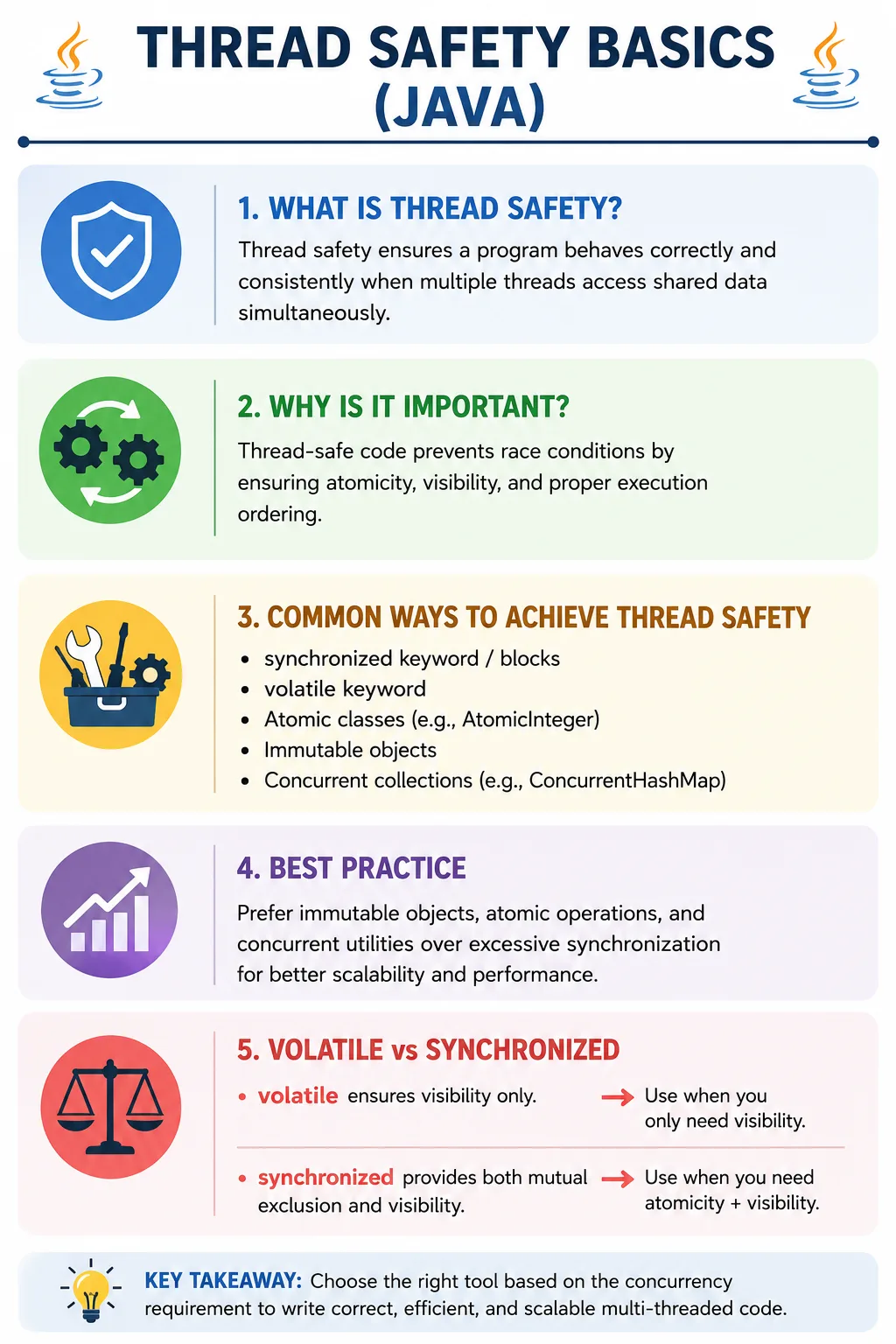
What Is Thread Safety?
A class or method is thread-safe if it continues to produce correct results when used by multiple threads. It should not corrupt shared state, lose updates, expose half-written data, or require callers to understand its internal locking rules. Ideally, the class protects its own invariants so that callers can use it safely through its public methods.
A class or method is thread-safe if:
- It produces correct results when used by multiple threads
- It does not corrupt shared state
- It requires no external synchronization by callers (ideally)
A simple example is a counter. If two threads call increment() at the same time, the final value
should reflect both increments. If the final value reflects only one increment, the class is not thread-safe.
The method may look correct in a single-threaded test, but it fails when the operation is interleaved with
another thread's operation.
Thread safety also means preserving business meaning. In a banking application, two withdrawal requests should not allow an account to go below the permitted balance because both threads read the same old amount. In an e-commerce system, two checkout threads should not reserve the last item in stock at the same time. In a test automation framework, two parallel tests should not overwrite each other's screenshots, reports, browser sessions, or test data.
Why Thread Safety Matters
Thread-safety problems matter because they are often intermittent. A normal defect may fail every time the same input is used. A concurrency defect may fail once in a thousand runs, only on a busy machine, only in production, or only when multiple users perform actions at the same moment. This makes the defect expensive to reproduce and difficult to prove without careful analysis.
Without thread safety, concurrent programs can suffer from:
- Race conditions
- Lost updates
- Inconsistent reads
- Data corruption
- Hard-to-reproduce bugs
A race condition occurs when the result depends on which thread wins a timing race. Lost updates happen when two threads read the same value, both calculate a new value, and one write overwrites the other. Inconsistent reads happen when one thread sees part of an update but not the complete state. Data corruption happens when a shared structure is modified in an unsafe way, leaving it in a state that no valid sequence of operations should produce.
These problems are especially serious in server-side Java, where a single application instance may process many requests at the same time. They are also common in automation code when teams enable parallel execution without isolating drivers, test data, reports, and helper objects. Thread safety is therefore not an advanced topic only for library developers. It directly affects real project reliability.
Common Causes of Thread-Safety Issues
- Shared mutable state
- Non-atomic operations
- Lack of visibility guarantees
- Improper synchronization
Example (Not Thread-Safe)
class Counter {
    int count = 0;
    void increment() {
        count++; // read-modify-write (not atomic)
    }
}
Multiple threads → incorrect count.
The problem with count++ is that it looks like one operation but is actually a read-modify-write
sequence. The thread reads the current value, adds one, and writes the result back. If two threads read the
same old value before either one writes the new value, one increment is lost. This is the classic beginner
example because it shows that code can be logically simple but still unsafe under concurrent execution.
Core Concepts Behind Thread Safety
1) Atomicity
Atomicity means an operation is treated as one indivisible unit from the point of view of other threads. If an operation is atomic, no other thread can observe it halfway through. If an operation is not atomic, another thread may interfere between the read and write portions of the operation.
Operations should be indivisible.
- count++ ❌ (not atomic)
- AtomicInteger.incrementAndGet() ✔
2) Visibility
Visibility means that changes made by one thread must become visible to other threads at the correct time. Modern processors and JVM optimizations may cache values, reorder instructions, or keep data in registers. Without a visibility guarantee, one thread may update a variable while another thread continues reading an old value.
Changes made by one thread must be visible to others.
Achieved via:
- synchronized
- volatile
- java.util.concurrent utilities
3) Ordering (Happens-Before)
Ordering is about the relationship between operations. Java's memory model defines happens-before rules that tell when one operation's effects are guaranteed to be visible to another operation. Synchronization, volatile reads and writes, thread start, thread join, and several concurrent utilities create such relationships.
Ensures a defined execution order so reads see the latest writes.
• synchronized and volatile establish happens-before relationships.
Ways to Achieve Thread Safety in Java
1️⃣ Synchronization (synchronized)
Synchronization is the most direct way to protect shared mutable state. When a thread enters a synchronized method or block, it acquires a monitor lock. Other threads that need the same lock must wait until the first thread exits the synchronized section. This provides mutual exclusion, meaning only one thread can execute the protected code at a time.
Ensures mutual exclusion + visibility.
synchronized void increment() {
    count++;
}
2️⃣ Volatile Variables
The volatile keyword is useful when one thread writes a value and other threads need to see the
latest value quickly. It is commonly used for simple flags such as running, stopped,
or initialized. However, volatile does not make compound operations atomic. A volatile counter
can still lose updates if multiple threads perform x++.
Ensures visibility, not atomicity.
volatile boolean running = true;
Use for flags, not counters.
3️⃣ Atomic Classes
Atomic classes such as AtomicInteger, AtomicLong, and
AtomicBoolean provide thread-safe operations for common single-variable use cases. They are
useful for counters, sequence numbers, flags, and simple state transitions. They avoid explicit synchronized
blocks for many small operations and can be clearer than manual locking when the shared state is simple.
Lock-free, thread-safe primitives.
AtomicInteger count = new AtomicInteger(0);
count.incrementAndGet();
4️⃣ Immutable Objects
Immutability is often the safest approach because immutable objects do not change after creation. If an object has final fields, does not expose mutable internal data, and does not provide methods that modify its state, multiple threads can safely share it. There is no race to update the object because no update is allowed.
No state changes → inherently thread-safe.
final class User {
    private final String name;
    User(String name) { this.name = name; }
}
5️⃣ Thread-Local State
Thread-local state avoids sharing by giving each thread its own value. This is useful when each thread needs a separate context, such as a date formatter, user context, transaction identifier, browser driver, or temporary test data holder. Because each thread has its own copy, one thread does not overwrite another thread's value.
Each thread gets its own copy.
ThreadLocal<Integer> tl = ThreadLocal.withInitial(() -> 0);
6️⃣ Concurrent Collections
Concurrent collections are designed for shared access under concurrency. They are usually preferred over
manually synchronizing ordinary collections because their behavior is clearly defined and their implementation
is optimized for common access patterns. For example, ConcurrentHashMap supports safe concurrent
updates, and BlockingQueue supports producer-consumer workflows without custom wait/notify code.
Designed for safe concurrent access.
Examples:
- ConcurrentHashMap
- CopyOnWriteArrayList
- BlockingQueue
Thread-Safe vs Not Thread-Safe (Examples)
Java contains both thread-safe and non-thread-safe classes. This does not mean one group is always better than the other. Non-thread-safe classes are often faster and simpler when they are used by one thread or protected by surrounding design. Thread-safe classes are useful when sharing is expected. The correct choice depends on ownership, mutation, and access pattern.
| Component | Thread-Safe |
|---|---|
| String | ✔ (immutable) |
| StringBuilder | ❌ |
| StringBuffer | ✔ (synchronized) |
| ArrayList | ❌ |
| Vector | ✔ (legacy, synchronized) |
| HashMap | ❌ |
| ConcurrentHashMap | ✔ |
Thread Safety vs Synchronization
Thread safety and synchronization are related, but they are not the same thing. Synchronization is one tool used to achieve thread safety. Thread safety is the broader goal. A class can be thread-safe because it is immutable, because it uses atomic variables, because it uses concurrent collections, because it avoids shared state, or because it uses synchronized blocks correctly.
| Aspect | Thread Safety | Synchronization |
|---|---|---|
| Goal | Correct concurrent behavior | Mutual exclusion |
| Scope | Design-level property | Implementation tool |
| Overhead | Varies | Can be high |
| Always required | ❌ | ❌ |
Best Practices (Production-Grade)
The best thread-safety strategy is usually the simplest one that preserves correctness. If shared mutable
state can be avoided, avoid it. If an object can be immutable, make it immutable. If a value belongs to one
thread, keep it local or use ThreadLocal when appropriate. If several threads must update shared
state, choose a clear concurrency tool instead of relying on timing or informal assumptions.
- Prefer immutability where possible
- Minimize shared mutable state
- Keep synchronized sections small
- Use atomic classes for counters
- Prefer concurrent collections over manual locking
- Avoid exposing internal mutable state
Keeping synchronized sections small is important, but the section must still include the complete critical operation. Splitting a read and write across separate locks or separate synchronized blocks can reintroduce a race condition. The goal is not simply to use fewer locks. The goal is to protect the exact state transition that must be consistent.
Avoid exposing internal mutable state because it allows callers to bypass the class's protection. Returning a direct reference to an internal list, map, or array can make a carefully synchronized class unsafe. If outside code can modify the internal object without the same lock, the class no longer controls its own invariants. Defensive copies, immutable views, or concurrent collections are often better choices.
Common Beginner Mistakes
Many beginner mistakes come from confusing visibility, atomicity, and synchronization. A developer may mark a
variable as volatile and assume all operations on it are safe. Another developer may synchronize one method
but read the same value from another unsynchronized method. Someone else may replace HashMap with
ConcurrentHashMap but still perform unsafe check-then-act logic around it.
- Assuming volatile makes code fully thread-safe
- Synchronizing too much (performance hit)
- Using HashMap in concurrent code
- Sharing mutable objects without protection
- Ignoring visibility issues
Another common mistake is making everything synchronized without understanding the access pattern. This may hide race conditions, but it can also create poor performance, lock contention, or deadlocks. Thread safety is not achieved by adding locks everywhere. It is achieved by identifying shared mutable state and applying the right control at the right boundary.
How to Identify Shared Mutable State
A practical review begins with a simple question: what data can change, and who can access it? Local variables inside a method are usually safe because each thread has its own stack. Instance variables can be unsafe if the same object is shared. Static variables can be especially risky because they are shared across all instances of the class. Collections, caches, counters, and configuration objects deserve careful review.
After identifying mutable state, check whether it is truly shared. An object created inside a request and used only by that request may not need synchronization. The same object stored in a singleton service, static helper, shared queue, or test framework base class may need protection. Thread safety depends less on the type of object and more on how the object is owned and used.
This is why copying code from one context to another can be dangerous. An ArrayList is fine as a
local temporary list inside one method. The same ArrayList can be unsafe if it is stored as a
shared field and updated by several request-handling threads. The class name does not tell the whole story.
Ownership and access pattern matter.
Race Conditions in Business Workflows
Race conditions are not limited to simple counters. They appear in business workflows whenever two operations depend on the same current state. If two users try to book the last available seat, the system must ensure that only one booking succeeds. If two approval threads update the same request, the final status must reflect a valid business transition. If two payment callbacks arrive close together, the order processing logic must avoid duplicate fulfillment.
In such cases, thread safety may require more than Java object locking. The application may need database transactions, unique constraints, optimistic locking, idempotency keys, message queues, or distributed locks. Java synchronization protects memory inside one JVM. It does not automatically protect shared database rows, multiple application instances, or external services. A strong engineer understands the boundary of each tool.
For interviews, it is useful to mention this distinction. Basic Java thread safety explains how to protect shared objects inside a program. Real enterprise thread safety often extends to persistence, messaging, deployment topology, and retry behavior. The same principles still apply: define the shared state, define the valid transitions, and ensure concurrent operations cannot violate them.
Thread Safety in Test Automation Frameworks
Thread safety is especially visible when test automation suites move from sequential execution to parallel execution. A framework may work perfectly when one test runs at a time, then fail unpredictably when multiple tests run together. The product may not be broken at all. The framework itself may be sharing state incorrectly.
Common automation examples include a static WebDriver field, shared test data files, common
screenshot names, global report objects, mutable configuration maps, and reusable page objects with stateful
fields. If two tests overwrite the same driver reference, one test may click in another test's browser. If two
tests write the same report node, the final report may show incorrect evidence. If two tests use the same user
account and change its state, one test may fail because another test changed the precondition.
A safer automation design gives each parallel test its own browser session, its own test data where possible, and its own execution context. Shared utilities should be stateless, immutable, synchronized, or backed by concurrent collections. This is why Java concurrency concepts are useful even for testers. Parallel execution speed is valuable only when the framework remains predictable.
Thread Safety and Performance Tradeoffs
Thread safety and performance must be balanced carefully. Adding synchronization can protect data, but it can also reduce concurrency because only one thread can execute the protected section at a time. If the protected section is large, slow, or frequently used, many threads may spend time waiting for the same lock. This is called lock contention.
The answer is not to avoid synchronization entirely. Incorrect fast code is still incorrect. The better
approach is to reduce shared mutable state, choose the correct data structure, keep critical sections focused,
and use concurrent utilities where they express the problem clearly. For a simple counter,
AtomicInteger may be better than a synchronized method. For a producer-consumer workflow,
BlockingQueue may be better than manual wait/notify. For read-heavy lists,
CopyOnWriteArrayList may be useful, but it is not suitable for heavy write traffic.
Performance decisions should be based on the real access pattern. A class that is rarely used does not need an elaborate lock-free design. A hot path used by hundreds of threads may need more careful design. Thread safety should come first, and performance should be improved with evidence rather than guesswork.
Thread-Safe Class Design Checklist
A practical class design checklist starts with ownership. Decide whether the class owns its state or merely receives values from outside. If it owns mutable state, decide whether that state can be made private and final, replaced rather than modified, or guarded by a clear lock. Public fields should be avoided because they allow uncontrolled access.
Next, define invariants. An invariant is a rule that must always remain true, such as "balance must not be negative," "size must match the number of stored elements," or "a report entry must belong to one test case." Thread safety means these rules remain true even when multiple threads call methods concurrently. A method should not expose a temporary state where the invariant is broken.
Then, review compound operations. Read-then-write, check-then-act, get-then-remove, and iterate-then-modify
operations often need special care. Even when individual methods are thread-safe, a sequence of calls may not
be thread-safe as a group. For example, checking whether a map contains a key and then adding a value is unsafe
if another thread can change the map between those two calls. Methods such as putIfAbsent() exist
to make the compound action atomic.
Debugging and Reviewing Thread-Safety Problems
Thread-safety defects are difficult because the failing line is not always the cause. A counter may show the wrong value at the end of execution, but the real problem happened earlier when two threads interleaved their read and write operations. A report may show the wrong screenshot, but the real issue may be a shared static file name or shared driver reference. Debugging concurrency requires looking at ownership and timing, not only at the final symptom.
In code review, start with mutable fields. Ask whether the object can be used by more than one thread. Then check whether every access to the field follows the same rule. If writes are synchronized but reads are not, the class may still have visibility problems. If one method uses a lock and another method uses a different lock for the same data, the protection is incomplete. If a mutable object is returned directly, callers may modify it without any protection at all.
Logging can help, but excessive logging may change timing and hide the issue temporarily. This is why concurrency bugs sometimes disappear when debug statements are added. A better approach is to create focused stress tests, run the code repeatedly, increase the number of threads, and inspect the shared state after each run. Tools such as thread dumps and profilers can help identify blocked threads, long-held locks, and contention points.
For testers, the most useful contribution is often a clear reproduction pattern. Instead of reporting only that a feature failed once, capture the number of parallel users or tests, the data involved, the sequence of actions, the frequency of failure, and whether the issue disappears when execution becomes sequential. This information helps developers distinguish a product logic defect from a concurrency and thread-safety defect.
How to Talk About Thread Safety in Interviews
A strong interview answer should not stop at "use synchronized." Start by defining thread safety as correct behavior under concurrent access. Then explain that most issues come from shared mutable state. After that, mention the three core concerns: atomicity, visibility, and ordering. This structure shows that you understand the problem before naming the tools.
Once the problem is clear, describe the tools. Synchronization provides mutual exclusion and visibility. Volatile provides visibility for simple flags but not atomicity for compound operations. Atomic classes provide safe single-variable updates. Immutable objects are naturally safe because they do not change. Concurrent collections are preferred for many shared collection use cases. ThreadLocal can isolate per-thread context.
Finally, add a practical note. The best solution depends on the data, the access pattern, and the business
rule. For a counter, use an atomic class or synchronized method. For a shared map, use
ConcurrentHashMap and atomic map operations. For configuration values, prefer immutability. For
test automation parallel execution, avoid shared static state. This kind of answer sounds grounded in real
work rather than memorized from a definition.
Interview-Ready Answers
Short Answer
Thread safety ensures correct behavior when multiple threads access shared data concurrently.
Detailed Answer
Thread safety in Java ensures that shared mutable state is accessed in a controlled way using synchronization, immutability, volatile variables, atomic classes, or concurrent collections. It prevents race conditions, ensures visibility, and maintains data consistency in multithreaded programs.
Key Takeaway
Thread safety is a design property, not just a keyword.
Use the right tool for the problem—immutability, atomic operations, or synchronization—to achieve correctness without unnecessary overhead.
Thread Safety Examples (Quick Reference)
1) Non-Thread-Safe Increment (Race Condition)
class Counter {
    int count = 0;

    void inc() {
        count++;
    }

    public static void main(String[] args) throws Exception {
        Counter c = new Counter();
        Thread t1 = new Thread(() -> { for (int i = 0; i < 1000; i++) c.inc(); });
        Thread t2 = new Thread(() -> { for (int i = 0; i < 1000; i++) c.inc(); });
        t1.start(); t2.start();
        t1.join(); t2.join();
        System.out.println(c.count);
    }
}
Result
Often < 2000 → not thread-safe
2) Making It Thread-Safe with synchronized
class Counter {
    int count = 0;

    synchronized void inc() {
        count++;
    }
}
Why
Mutual exclusion on the object lock
3) Thread-Safe Using Synchronized Block (Preferred)
class Counter {
    int count = 0;

    void inc() {
        synchronized (this) {
            count++;
        }
    }
}
Why
Smaller critical section → better performance
4) Thread-Safe with AtomicInteger (Lock-Free)
import java.util.concurrent.atomic.AtomicInteger;

class Demo {
    static AtomicInteger count = new AtomicInteger();

    public static void main(String[] args) {
        count.incrementAndGet();
        System.out.println(count.get());
    }
}
Why
Atomic operations, no explicit locks
5) Visibility Issue (Not Thread-Safe)
class Flag {
    boolean running = true;

    public static void main(String[] args) {
        Flag f = new Flag();
        new Thread(() -> {
            while (f.running) {}
            System.out.println("Stopped");
        }).start();

        f.running = false;
    }
}
Problem
Update may not be visible to other thread
6) Fix Visibility with volatile
class Flag {
    volatile boolean running = true;
}
Why
Guarantees visibility, not atomicity
7) Immutable Object (Inherently Thread-Safe)
final class User {
    private final int id;

    User(int id) {
        this.id = id;
    }

    int getId() {
        return id;
    }
}
Why
State never changes
8) Thread-Local Variables (Per-Thread State)
class Demo {
    static ThreadLocal<Integer> tl = ThreadLocal.withInitial(() -> 0);

    public static void main(String[] args) {
        new Thread(() -> {
            tl.set(10);
            System.out.println(tl.get());
        }).start();

        new Thread(() -> {
            System.out.println(tl.get());
        }).start();
    }
}
Output
10
0
9) Non-Thread-Safe Collection
import java.util.*;

class Demo {
    public static void main(String[] args) {
        List<Integer> list = new ArrayList<>();
        // Concurrent modification can break
    }
}
10) Thread-Safe Collection (Synchronized Wrapper)
import java.util.*;

class Demo {
    public static void main(String[] args) {
        List<Integer> list =
            Collections.synchronizedList(new ArrayList<>());
        list.add(1);
        System.out.println(list);
    }
}
11) Thread-Safe Collection (Concurrent)
import java.util.concurrent.*;

class Demo {
    public static void main(String[] args) {
        CopyOnWriteArrayList<Integer> list =
            new CopyOnWriteArrayList<>();
        list.add(1);
        System.out.println(list);
    }
}
Why
Safe iteration without locking
12) Thread-Safe Read-Modify-Write (Wrong Way)
class Demo {
    volatile int x = 0;

    void inc() {
        x++; // ❌ not atomic
    }
}
Trap
volatile ≠ atomic
13) Thread-Safe Read-Modify-Write (Correct)
class Demo {
    int x = 0;

    synchronized void inc() {
        x++;
    }
}
14) Object Escape (Breaks Thread Safety)
class Escape {
    public Escape() {
        new Thread(() -> System.out.println(this)).start();
    }
}
Problem
this escapes before construction finishes
15) Thread-Safe Singleton (Double-Checked Locking)
class Singleton {
    private static volatile Singleton instance;

    private Singleton() {}

    static Singleton getInstance() {
        if (instance == null) {
            synchronized (Singleton.class) {
                if (instance == null)
                    instance = new Singleton();
            }
        }
        return instance;
    }
}
16) Thread-Safe with ReentrantLock
import java.util.concurrent.locks.*;

class Counter {
    int count = 0;
    Lock lock = new ReentrantLock();

    void inc() {
        lock.lock();
        try {
            count++;
        } finally {
            lock.unlock();
        }
    }
}
17) Thread-Safe Initialization with static
class Demo {
    static final int X = init();

    static int init() {
        return 10;
    }
}
Why
Class loading is thread-safe
18) Check-Then-Act Race Condition
if (!map.containsKey(k)) {
    map.put(k, v); // ❌ race
}
Fix
map.putIfAbsent(k, v);
19) Thread Safety vs Performance (Concept)
// More locks → safer
// More locks → slower
Rule
Synchronize minimum necessary code
20) Interview Summary – Thread Safety Basics
Thread safety = Correct behavior under concurrent access
Key Points
- Atomicity + Visibility + Ordering
- synchronized → mutual exclusion
- volatile → visibility only
- Immutability → safest
- Prefer concurrent utilities over manual locking