this Keyword
The this keyword in Java is a reference variable that refers to the current object of a class. It is primarily used to resolve ambiguity, improve code clarity, and support constructor chaining. This is a high-frequency interview topic and essential for clean object-oriented design.
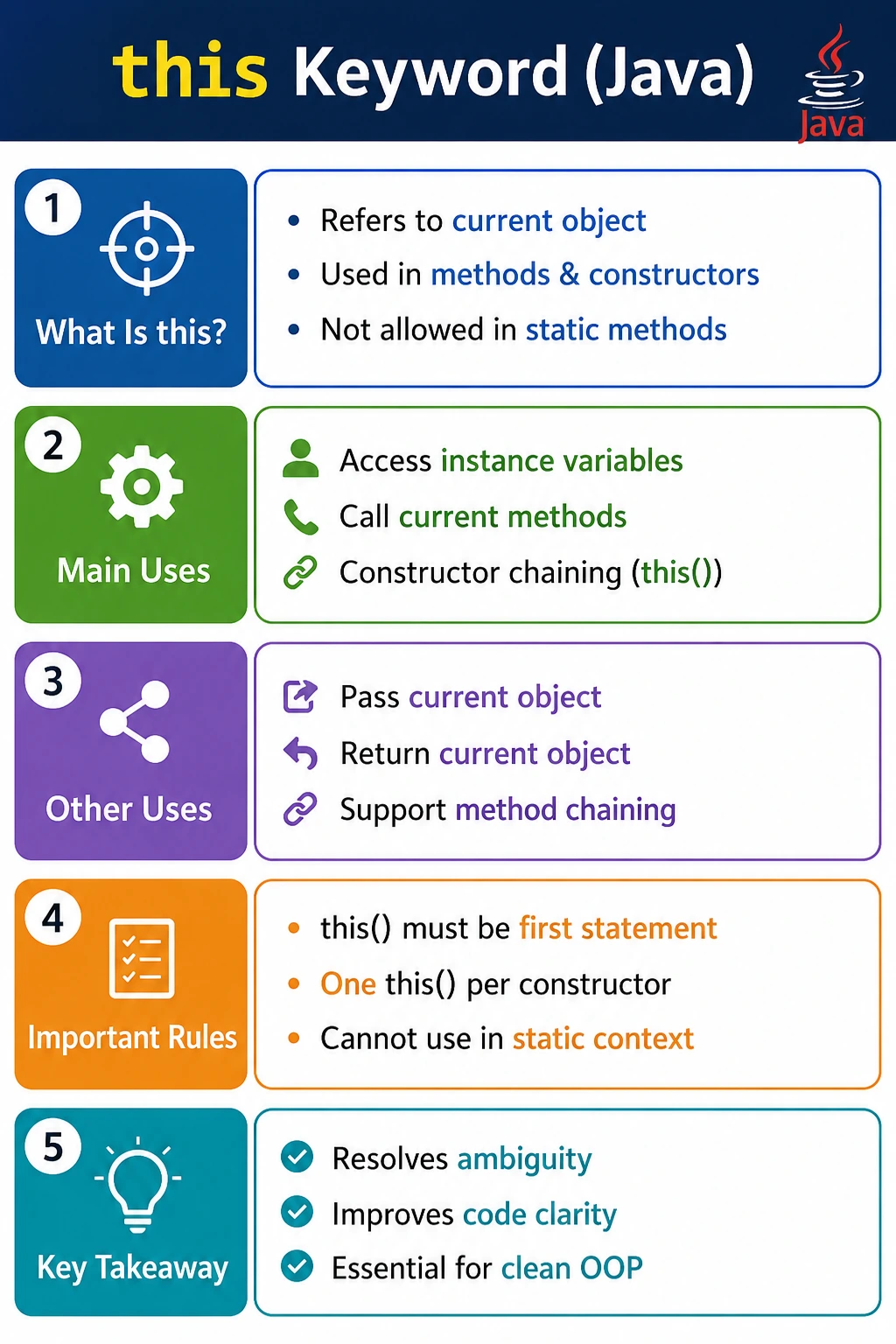
What Is this?
The this keyword in Java is a reference to the current object. It is available inside instance methods, constructors, and instance initialization contexts because those places are connected to a specific object. When an object calls an instance method, Java knows which object is currently executing that method. The keyword this points to that object.
This concept is simple, but it is central to object-oriented programming. A class defines structure and behavior, but an object holds actual state. When a method reads or updates an instance variable, it is usually working with the current object's state. The this keyword makes that current-object relationship explicit. It tells the reader and the compiler that the member belongs to the object currently being constructed or used.
The basic syntax is straightforward:
this.variableName
You will commonly see this used with fields, methods, constructor calls, and return statements. It is not used for static members because static members belong to the class rather than a specific object. Since this means "current object," it has no meaning in a static context where no current object is guaranteed to exist.
Why this Keyword Is Needed
The most common reason to use this is to resolve ambiguity between instance variables and local variables or parameters. In constructors and setter methods, developers often use parameter names that match field names because the names are meaningful. For example, a Student class may have an age field, and the constructor may receive an age parameter. Without this, the parameter shadows the instance variable.
class Student {
    int age;
    Student(int age) {
        age = age; // ambiguous
    }
}
In this example, the assignment does not update the instance variable. Both age names refer to the constructor parameter, so the parameter is assigned to itself. The object field remains at its default value, which is 0 for an int. This bug is easy to miss because the code compiles, but the object state is wrong.
The solution is to use this:
class Student {
    int age;
    Student(int age) {
        this.age = age;
    }
}
Here, this.age clearly refers to the instance variable of the current object, while age refers to the parameter. The assignment is now correct. This is one of the most practical and frequent uses of this in Java.
Understanding Current Object Context
Every object has its own copy of instance variables. If three Student objects are created, each object has its own age field. When a method runs on one of those objects, this points to that particular object. If s1.display() is called, this refers to s1 inside display. If s2.display() is called, this refers to s2 inside the same method body. The method code is shared, but the current object changes depending on the reference used for the call.
This is why instance methods can access instance variables without writing this every time. Java implicitly uses the current object. Writing age inside an instance method usually means this.age unless a local variable or parameter with the same name shadows it. In many cases, this is optional. But when names conflict, this becomes necessary.
Understanding this current-object context makes many Java topics easier. Constructors initialize the current object. Instance methods operate on the current object. Method chaining returns the current object. Passing this as an argument sends the current object to another method. These are different use cases, but they all depend on the same idea.
Using this to Refer to Instance Variables
The most important use of this is referring to instance variables. Instance variables represent object state. Constructor parameters and method parameters often carry incoming values. When both have the same name, this separates the object field from the local parameter.
this.age = age;
This style is common because it keeps names clean. Instead of using unclear parameter names such as a or studentAgeValue, the constructor can use age. The field is also named age. The this keyword clarifies which one is the object field.
Using this for field assignment also improves maintainability. A future reader can immediately see that the object's state is being updated. In classes with many fields, this style reduces confusion and makes constructor logic easier to review.
Using this to Invoke Current Class Methods
The this keyword can also be used to call another instance method of the current class. In many cases this is optional because Java automatically looks for instance methods on the current object. However, writing this.methodName() can improve clarity when you want to emphasize that the method belongs to the current object.
void display() {
    System.out.println("Display");
}
void show() {
    this.display();
}
In this example, this.display() and display() would produce the same result. The explicit this is a readability choice. Some teams use it sparingly only when required. Other teams prefer it when calling object methods from inside the same class. The important point is that this works only for instance methods, not static methods.
Explicit method calls through this can also help when code contains inherited methods, overridden methods, or local helper methods. It reminds the reader that the call happens on the current object and may use current object state.
Constructor Chaining Using this()
The expression this() has a special meaning inside constructors. It calls another constructor of the same class. This is called constructor chaining. It allows one constructor to reuse another constructor's initialization logic instead of duplicating code.
class Test {
    Test() {
        this(10);
        System.out.println("No-arg");
    }
    Test(int a) {
        System.out.println("Parameterized: " + a);
    }
}
In this example, the no-argument constructor calls the parameterized constructor first. After the parameterized constructor completes, the no-argument constructor continues. Java requires this() to be the first statement in a constructor. This rule is strict. You cannot print a message, assign a field, or call another method before this().
Only one direct this() call is allowed in a constructor. A constructor can call another constructor, and that called constructor may call another one, but a single constructor body cannot contain two separate this() constructor calls. This keeps constructor flow predictable and avoids confusing initialization paths.
Why this() Must Be First
The this() constructor call must be first because Java object initialization must follow a controlled order. A constructor is responsible for creating valid object state. If one constructor delegates to another, that delegation must happen before the current constructor performs additional initialization. Otherwise, fields might be assigned before the main initialization path runs, creating confusing or overwritten state.
This rule also connects to super(). Every constructor must eventually call a parent constructor, either explicitly with super() or implicitly through Java's automatic behavior. If a constructor calls this(), the called constructor handles the parent constructor call in that chain. Because this() and super() must both be first when used, a constructor cannot directly use both as separate statements.
For interview purposes, the rule is simple: this() calls another constructor in the same class and must be the first statement in the constructor. If it is not first, the code fails at compile time.
Passing Current Object as an Argument
The this keyword can be passed as an argument to another method. This means the current object is sent to a method that expects an object reference. This is useful when another method needs to inspect, register, validate, or process the object currently executing code.
void show(Student s) {
    System.out.println(s.age);
}
void call() {
    show(this);
}
Here, call passes the current Student object to show. Inside show, the parameter s refers to the same object that this referred to in call. This pattern appears in callback designs, event handling, listener registration, validation helpers, and object collaboration.
For example, an object may register itself with a manager by calling manager.add(this). A page object may pass itself to a logging helper. A validator may receive this so it can inspect the current object's fields. The idea is always the same: this represents the current object reference.
Returning Current Object
A method can return this. This means the method returns the current object reference to the caller. Returning this is often used to support method chaining, where several method calls are written one after another on the same object.
Student getObject() {
    return this;
}
In fluent APIs, methods often update object state and then return this so the caller can continue with another method call. For example, a builder-style object might allow user.setName("John").setAge(20).setCity("Chennai"). Each setter returns the same current object. This creates a readable chain.
Method chaining should be used carefully. It can make simple configuration readable, but very long chains can become hard to debug. Returning this is powerful when the object is designed for fluent behavior. It should not be used merely to make every method chainable without design purpose.
Where this Cannot Be Used
The this keyword cannot be used in a static context. Static methods belong to the class, not to any specific object. Since this means the current object, there is no current object inside a static method unless an object is explicitly created or passed in.
static void test() {
    // this.x = 10; // Compile-time error
}
This is why this cannot be used inside the main method unless main creates an object and uses that object reference. The main method is static because the JVM starts execution without creating an object of the class. Since no current object exists automatically, this has no meaning there.
The same rule applies to static blocks and static variables. Static code belongs to class-level execution. Object-level references such as this require an instance context. If object data is needed in static code, create an object or pass an object reference explicitly.
this vs super
The this and super keywords are related but not the same. The this keyword refers to the current object from the current class perspective. The super keyword refers to the parent class part of the current object. Both are used in instance contexts, and both are not allowed in static contexts.
Use this to access current class fields, current class methods, or another constructor in the same class. Use super to access parent class members or call a parent constructor. The distinction becomes important in inheritance, especially when parent and child classes have fields or methods with the same names.
| Feature | this | super |
|---|---|---|
| Refers to | Current class object | Parent class object |
| Accesses | Current class members | Parent class members |
| Constructor call | this() | super() |
| Static context | Not allowed | Not allowed |
this in Real Java Design
In real Java projects, this is most visible in constructors, setters, builder methods, and fluent APIs. Constructor assignments such as this.name = name are standard. Setter methods often use the same pattern. Builder-style methods return this to support readable configuration. These patterns appear in domain classes, test automation page objects, service helpers, and data transfer objects.
In a Selenium Page Object Model class, this may be used to store a driver passed into the constructor. In a domain object, this may assign business values. In a builder, this may return the current builder object after each configuration method. The keyword is small, but it supports clear object ownership throughout the class.
Good use of this makes code easier to read. Overuse can become noisy if every field and method is prefixed unnecessarily. Underuse can create bugs when parameters shadow fields. The practical balance is to use this where it improves clarity or where the compiler requires it.
Common Beginner Mistakes
The most common mistake is forgetting this in constructors when parameter names match field names. The code may compile but fail to update the instance variable. This creates objects with default values and can cause confusing behavior later.
Another common mistake is trying to use this inside static methods. Static methods do not belong to objects, so this is not available. If a static method needs object state, it must receive an object reference or create an object first.
Beginners also place this() somewhere other than the first statement in a constructor. Java does not allow that. Constructor chaining must happen before other constructor logic. Confusing this with super is another frequent issue. this refers to the current object from the current class perspective, while super refers to the parent part of the current object.
A subtler mistake is returning this from methods that should not be chainable. Method chaining is useful when the class is designed for fluent usage. It should not be added randomly because it may encourage unclear calling patterns.
Best Practices
Use this when a parameter or local variable shadows an instance variable. This is the clearest and most necessary use. It allows meaningful parameter names without losing access to object fields. Use this() for constructor chaining when it reduces duplication and keeps initialization centralized.
Use this in method calls when it improves readability, especially in complex classes where object context matters. Do not feel forced to write this before every instance member if the code is already clear. Java allows implicit current-object access, so explicit this should serve clarity.
When returning this for method chaining, make sure the class is designed for chaining. Chained methods should have predictable behavior and should return the same object deliberately. If methods perform unrelated actions, chaining can make code harder to understand.
this and Encapsulation
The this keyword supports encapsulation because it helps methods work clearly with the current object's internal state. Encapsulation means keeping data and behavior together while controlling access to that data. When a constructor or setter writes this.name = name, the class is deliberately updating its own field using a value supplied from outside. The field remains part of the object, and the assignment happens through controlled class logic.
For example, a setter can validate input before assigning it to the current object's field. The statement this.email = email may appear simple, but it can be part of a larger rule: reject null values, trim spaces, or normalize case before assignment. The this keyword makes it clear that the method is updating object state, not just working with a local variable.
This clarity matters in classes that protect important business rules. An Account object should update its own balance carefully. A User object should update its own profile fields consistently. A Page Object in automation should store its current driver, locators, or page context. The keyword this helps communicate that the code is acting on the current instance.
this in Setter Methods
Setter methods are one of the most common places where this appears. A setter receives a value as a parameter and assigns that value to an instance variable. Since the parameter name often matches the field name, this is required to distinguish the field from the parameter.
void setName(String name) {
    this.name = name;
}
This pattern is simple, readable, and widely used. It allows the parameter to be named name instead of using artificial names such as n or newName. The left side refers to the current object's field. The right side refers to the incoming value.
Setters can also return void or return this. Traditional setters return void. Fluent setters return the current object so calls can be chained. Both styles are valid when used consistently. The important design question is whether chaining improves readability for the class.
this in Builder and Fluent APIs
Builder classes often rely on returning this. A builder collects values step by step and finally creates an object. Each builder method sets one value and returns the same builder object. This allows a chain such as builder.name("John").age(20).city("Chennai").build(). The chain reads naturally because every method returns the current builder.
Returning this is also common in fluent configuration APIs. For example, a test helper may allow new RequestBuilder().withHeader("token").withBody(data).send(). Each method modifies the current builder state and returns the same object. This is a deliberate design style, not just a syntax trick.
Fluent APIs should be designed carefully. Methods should have clear names, predictable side effects, and a natural order. If returning this makes the API readable, it is useful. If it hides complicated behavior inside long chains, it can make debugging harder. The this keyword enables fluent design, but good naming and focused behavior make it maintainable.
this and Object Collaboration
Passing this to another method allows the current object to collaborate with another object or utility. This is common when an object needs to register itself, validate itself, or provide its current state to another component. For example, a screen object may pass itself to a navigation manager, or a listener may pass itself to an event source.
This pattern is powerful because it sends the current object reference without requiring the caller to supply it separately. Inside the receiving method, the parameter points to the same object. Any accessible fields or methods can then be used according to normal Java access rules.
However, passing this from a constructor should be done carefully. If the object is still under construction, another component may observe it before initialization is complete. This can create subtle bugs. In general, it is safer to pass this after the object is fully constructed unless there is a clear design reason and the code is controlled.
Implicit this vs Explicit this
Java often uses this implicitly. Inside an instance method, writing display() is usually equivalent to writing this.display(). Writing age is usually equivalent to this.age unless a local variable or parameter named age exists. This implicit behavior keeps Java code concise.
Explicit this is useful when clarity is needed. It is required when a field is shadowed by a parameter. It is helpful when returning the current object. It is part of the special constructor call this(). It may also improve readability in longer methods where local variables and fields are both present.
There is no universal rule that this must be written everywhere or avoided everywhere. Many teams choose a style and follow it consistently. For learners, the most important rule is to know when this is required and why it exists. After that, usage becomes a matter of clarity and coding convention.
Debugging Problems Related to this
Problems involving this often appear as incorrect object state. The program creates an object, passes values to the constructor, and later prints default values instead of the expected values. When that happens, one of the first things to check is whether constructor parameters are shadowing instance variables. If the constructor contains name = name or age = age, the field is probably not being updated. The fix is this.name = name or this.age = age.
Another debugging clue is a compile-time error inside static code. If Java reports that a non-static variable cannot be referenced from a static context, or that this cannot be used in a static context, the code is trying to use object-level behavior from class-level code. The solution is not always to make everything static. Often the correct solution is to create an object and use that object reference, or move the logic into an instance method.
Constructor chaining errors are also common. If this() is not the first statement, the compiler rejects the constructor. If two constructors call each other in a cycle, the code also fails because recursive constructor invocation is not allowed. Constructor chains should be simple and should move toward one main initialization path.
Common Interview Traps
Interviewers often test this with small code snippets that compile but produce unexpected output. The classic example is a constructor where x = x is written instead of this.x = x. The output is usually 0 because the instance variable was never assigned. Explaining this correctly shows that you understand shadowing, constructor parameters, and object state.
Another common trap asks whether this can be used in the main method. Since main is static, this cannot be used directly inside it. However, main can create an object and then call instance methods on that object. The distinction is important: this is not available in static context, but object references can still be used there.
A third trap compares this() and super(). Both are constructor calls when written with parentheses, and both must be first if used. A constructor cannot directly call both this() and super() as separate statements. If this() is used, the constructor it calls will eventually call super() or another this() in the chain. This rule keeps object initialization ordered and predictable.
Interview-Ready Answers
Short Answer
The this keyword refers to the current object of a class.
Detailed Answer
In Java, the this keyword is a reference to the current object. It is used inside instance methods and constructors to access current object fields and methods, resolve ambiguity between parameters and instance variables, call another constructor of the same class using this(), pass the current object as an argument, and return the current object for method chaining. It cannot be used in static context because static members belong to the class, not to any object.
A strong interview answer should include at least one example, usually this.age = age in a constructor. It should also mention that this() must be the first statement in a constructor and that this is different from super. These details show practical understanding beyond memorizing the definition.
this Keyword Examples (Interview-Focused)
1. Referring to Instance Variable (Shadowing Fix)
class Demo {
    int x;

    Demo(int x) {
        this.x = x;
    }

    public static void main(String[] args) {
        Demo d = new Demo(10);
        System.out.println(d.x);
    }
}
Explanation: this.x refers to instance variable.
Output: 10
2. Shadowing Bug Without this
class Demo {
    int x;

    Demo(int x) {
        x = x;   // wrong
    }

    public static void main(String[] args) {
        Demo d = new Demo(20);
        System.out.println(d.x);
    }
}
Explanation: Parameter shadows instance variable.
Output: 0
3. Using this to Call Another Constructor (this())
class Demo {
    int x;

    Demo() {
        this(5);
    }

    Demo(int x) {
        this.x = x;
    }

    public static void main(String[] args) {
        Demo d = new Demo();
        System.out.println(d.x);
    }
}
Explanation: Constructor chaining.
Output: 5
4. this() Must Be First Statement
class Demo {
    Demo() {
        // System.out.println("Hi");
        // this(10);  // Compile-time error
    }

    Demo(int x) {}
}
Explanation: this() must be first line in constructor.
5. Using this to Call Instance Method
class Demo {
    void show() {
        System.out.println("Show");
    }

    void display() {
        this.show();
    }

    public static void main(String[] args) {
        new Demo().display();
    }
}
Explanation: Calls current object method.
Output: Show
6. Calling Instance Method Without this
class Demo {
    void show() {
        System.out.println("Show");
    }

    void display() {
        show();   // implicitly this.show()
    }

    public static void main(String[] args) {
        new Demo().display();
    }
}
Explanation: this is implicit.
Output: Show
7. Passing this as Method Argument
class Demo {
    void print(Demo d) {
        System.out.println(d);
    }

    void call() {
        print(this);
    }

    public static void main(String[] args) {
        new Demo().call();
    }
}
Explanation: Passes current object reference.
Output: object reference string
8. Passing this to Another Class
class Test {
    Test(Demo d) {
        System.out.println("Received object");
    }
}

class Demo {
    void send() {
        new Test(this);
    }

    public static void main(String[] args) {
        new Demo().send();
    }
}
Explanation: Common in callbacks.
Output: Received object
9. Returning this from Method (Method Chaining)
class Demo {
    int x;

    Demo set(int x) {
        this.x = x;
        return this;
    }

    public static void main(String[] args) {
        Demo d = new Demo().set(10).set(20);
        System.out.println(d.x);
    }
}
Explanation: Enables chaining.
Output: 20
10. this with Multiple Instance Variables
class Demo {
    int a, b;

    Demo(int a, int b) {
        this.a = a;
        this.b = b;
    }

    public static void main(String[] args) {
        Demo d = new Demo(1, 2);
        System.out.println(d.a + " " + d.b);
    }
}
Explanation: Distinguishes instance vs parameters.
Output: 1 2
11. Using this Inside Setter Method
class User {
    String name;

    void setName(String name) {
        this.name = name;
    }

    public static void main(String[] args) {
        User u = new User();
        u.setName("Admin");
        System.out.println(u.name);
    }
}
Explanation: Common real-world usage.
Output: Admin
12. this in Instance Block
class Demo {
    int x;

    {
        this.x = 10;
    }

    public static void main(String[] args) {
        Demo d = new Demo();
        System.out.println(d.x);
    }
}
Explanation: Instance block has access to this.
Output: 10
13. this Cannot Be Used in Static Context
class Demo {
    static void test() {
        // System.out.println(this); // Compile-time error
    }
}
Explanation: this belongs to object, not class.
14. Differentiating Two Objects Using this
class Demo {
    int x;

    void set(int x) {
        this.x = x;
    }

    public static void main(String[] args) {
        Demo d1 = new Demo();
        Demo d2 = new Demo();

        d1.set(5);
        d2.set(10);

        System.out.println(d1.x + " " + d2.x);
    }
}
Explanation: this refers to calling object.
Output: 5 10
15. this in Copy Constructor
class User {
    String name;

    User(String name) {
        this.name = name;
    }

    User(User u) {
        this.name = u.name;
    }

    public static void main(String[] args) {
        User u1 = new User("Admin");
        User u2 = new User(u1);
        System.out.println(u2.name);
    }
}
Explanation: Copies state from another object.
Output: Admin
16. this with Method Overloading
class Demo {
    void show() {
        System.out.println("No args");
    }

    void show(int x) {
        this.show();
        System.out.println(x);
    }

    public static void main(String[] args) {
        new Demo().show(10);
    }
}
Explanation: Calls overloaded method.
Output:
No args
10
17. this vs Local Object Reference
class Demo {
    void test() {
        Demo d = this;
        System.out.println(d == this);
    }

    public static void main(String[] args) {
        new Demo().test();
    }
}
Explanation: Both point to same object.
Output: true
18. this with Fluent API Style
class Builder {
    int x;

    Builder add(int v) {
        this.x += v;
        return this;
    }

    public static void main(String[] args) {
        Builder b = new Builder().add(5).add(10);
        System.out.println(b.x);
    }
}
Explanation: Fluent design pattern.
Output: 15
19. Common Interview Trap
class Demo {
    int x;

    Demo(int x) {
        this.x = x;
        x = 50;
    }

    public static void main(String[] args) {
        Demo d = new Demo(10);
        System.out.println(d.x);
    }
}
Explanation: Instance variable already set.
Output: 10
20. Interview Summary – this Keyword
class Demo {
    int x;

    Demo set(int x) {
        this.x = x;
        return this;
    }

    public static void main(String[] args) {
        System.out.println(new Demo().set(25).x);
    }
}
Explanation: Refers to current object, resolves shadowing, enables chaining.
Output: 25
Key Takeaway
The this keyword provides clarity, correctness, and control in object-oriented programming. Proper use of this leads to cleaner and more maintainable Java code.