String Immutability
String immutability is one of the most frequently asked Core Java interview topics because it connects several important areas of the language: object behavior, memory management, the String Pool, security, thread safety, HashMap key behavior, and performance. A beginner may answer this topic by saying that a String cannot be changed after creation, but a stronger interview answer explains why Java made that design choice and how it affects real applications. Interviewers ask this topic because it quickly reveals whether a candidate understands objects and references or only memorizes syntax.
The most important foundation is this: String immutability applies to the object, not to the reference variable. A variable can stop pointing to one String object and start pointing to another, but the original String object's character content does not change. When code appears to modify a String, Java is actually creating or returning another String object. Once you understand that difference between reference reassignment and object modification, almost every String immutability question becomes easier to answer.
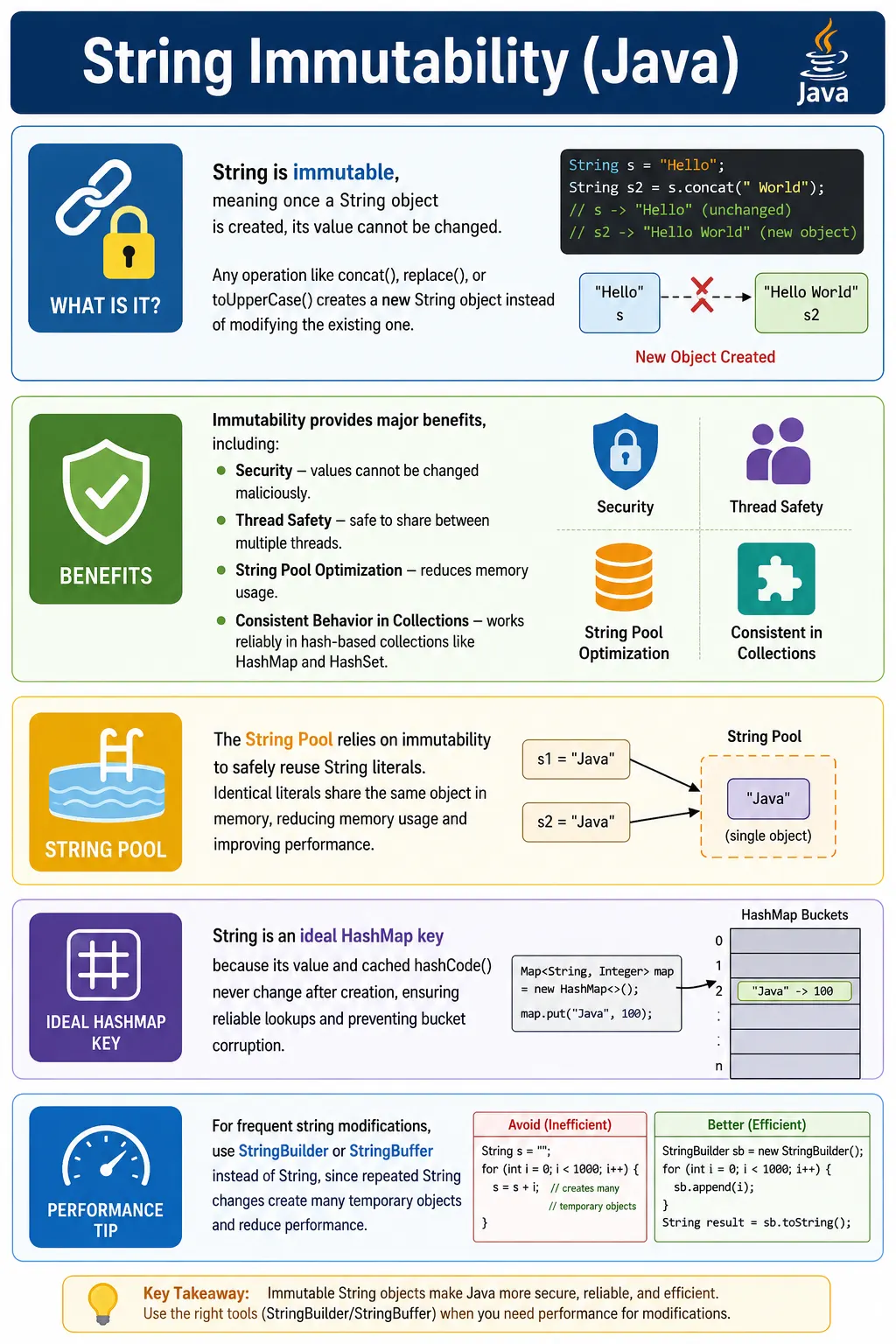
This article presents high-frequency interview questions on String immutability in a connected, practical way.
Each answer is written so you can speak it clearly in an interview, but the explanations go beyond one-line
memorization. The goal is to help you explain the concept with confidence, connect it to Java design, and avoid
common traps around concatenation, equals(), hashCode(), StringBuilder, reflection,
and hash-based collections.
1. What is String immutability in Java?
String immutability means once a String object is created, its value cannot be changed. Any modification
creates a new String object or returns a different existing String object. The original object remains exactly
the same in memory. This is why methods such as concat(), replace(),
trim(), substring(), and toUpperCase() do not modify the original
String. They return a result, and your code must use that returned result.
String s = "Java";
s = s.concat(" World"); // new object created
In this example, the variable s first points to the String object "Java". The
concat() operation produces "Java World", and then the reference s is
reassigned to the new value. The original "Java" object was not edited. A crisp interview answer
is: String is immutable in Java, so its content cannot be changed after creation; any apparent modification
creates or returns another String object.
2. Why are Strings immutable in Java?
Strings are immutable because Java uses String values everywhere: class names, file paths, URLs, database connection strings, API endpoints, configuration keys, error messages, log entries, map keys, and user-visible text. If such a widely used class were mutable, Java programs would become harder to secure, harder to optimize, and harder to reason about. Immutability gives Java a stable text type that can be safely shared, cached, pooled, and used as a reliable key.
Strings are immutable for:
- Security (class loading, file paths, URLs)
- Thread safety (safe sharing between threads)
- String pool optimization
- Hash-based collection consistency
In interviews, do not stop at only one reason. A stronger answer groups the reasons clearly: security, thread safety, String Pool reuse, and reliable hash code behavior. These are design benefits, not random restrictions. String immutability is one reason the Java ecosystem can use String so heavily without forcing every API to make defensive copies or synchronize every text access.
3. How does String immutability improve security?
Sensitive data like file paths, database URLs, and class names cannot be modified after creation, preventing malicious changes at runtime.
Consider a program that validates a file path before opening a file. If the String object representing that path could be changed after validation, another part of the program could modify the path and redirect the operation to a different file. The validation would no longer protect the actual operation. Because String is immutable, the value that was validated cannot be silently changed through another reference.
The same idea applies to class loading and network access. Java class names, package names, URLs, and resource locations often travel through many layers of an application. Immutability ensures that once a String value is created and passed around, its content remains stable. This does not mean String is the best container for every secret, especially passwords that may remain in memory until garbage collection, but immutability still gives strong protection against accidental or malicious in-place modification.
4. How does immutability help in multithreading?
Immutable objects are inherently thread-safe because their state cannot change after construction. Multiple threads can read the same String at the same time without synchronization because there is no risk that one thread will alter the characters while another thread is reading them.
Immutable objects are inherently thread-safe because:
- No synchronization required
- No race conditions
- Same object can be shared safely
This is a major practical benefit. Mutable shared objects often require locks, synchronization, volatile
fields, or careful concurrent data structures. String avoids that complexity by design. If one thread has a
reference to "Java" and another thread has the same reference, neither thread can change that
object. If a thread needs a modified value, it receives a different String object. That separation makes text
sharing safe and predictable in concurrent code.
5. What is the String Pool and how is it related to immutability?
The String Pool stores unique String literals.
Immutability allows safe reuse of pooled Strings without risk of modification.
String s1 = "Java";
String s2 = "Java"; // same object from pool
In this example, both variables can refer to the same pooled object because the object cannot be changed. If
String were mutable, pooling would be dangerous. Changing s1 would also affect s2
because both references could point to the same object. Immutability makes pooling safe. Java can reuse common
literals and reduce memory usage without risking accidental data corruption.
This is also why interviewers connect String immutability with memory optimization. The pool is useful only
because shared String literals are stable. A literal such as "Java" may appear in many places in
an application, but Java does not need to create a new object every time. Reuse is safe because no code can
modify the pooled value.
6. Can String be made mutable?
No. String itself cannot be made mutable in normal Java programming. The String class is designed to be immutable, and its public API does not expose methods that change the internal value. If you need mutable text behavior, use a different class instead of trying to change String.
Use:
- StringBuilder (not thread-safe)
- StringBuffer (thread-safe)
StringBuilder is usually preferred when building text inside a single thread, especially in loops. StringBuffer provides synchronized methods and can be used when mutable text must be shared across threads, though modern designs often avoid sharing mutable builders. The interview point is simple: String is immutable by design; StringBuilder and StringBuffer are the mutable alternatives.
7. Why is String class declared as final?
To prevent inheritance and method overriding, ensuring:
- Immutability is preserved
- Security guarantees are not broken
If String could be subclassed, a child class might override important methods and behave differently from a normal String. That would weaken the guarantees Java expects from String objects. By declaring String as final, Java prevents inheritance and keeps String behavior consistent. This supports security, reliable pooling, and predictable equality behavior.
Be careful with the wording in interviews. The final class declaration helps protect String's
design, but final alone does not automatically make every object immutable. A final class can
still contain mutable fields. String is immutable because of a combination of design choices: final class,
private internal state, no mutating methods, and safe handling of internal data.
8. Why does String override equals() and hashCode()?
Because String is frequently used as:
- HashMap key
- HashSet element
Immutability ensures:
- hashCode() never changes
- Hash-based collections remain consistent
The default equals() method from Object compares references, but String needs content comparison.
When two different String objects contain the same characters, most business logic expects them to be equal.
Therefore, String overrides equals() to compare character content. It also overrides
hashCode() so equal strings produce the same hash code.
Immutability makes this especially powerful. Since the String content cannot change, the hash code remains stable after it is computed. That stability is critical for HashMap and HashSet. If a key's hash code changed after insertion, the collection might not find the key in the correct bucket. String avoids this problem and is therefore a safe and popular map key.
9. What happens when you modify a String?
A new String object is created in memory.
String s = "Java";
s = s + " World";
Memory:

"Java"        → original
"Java World"  → new object
The word "modify" is slightly misleading for String. Java does not modify the existing String object. Instead, an operation produces a new String value, and the reference may be updated to point to it. If no reference points to the old object and it is not retained in the String Pool, the old object becomes eligible for garbage collection. If it is a pooled literal, it may remain available for reuse.
This is why code such as s.trim(); often causes bugs. The method returns a trimmed String, but if
the result is ignored, the original reference still points to the untrimmed value. Correct code should either
assign the result or use it directly, such as s = s.trim(); or if
(s.trim().equals("Java")).
10. Why is String preferred as HashMap key?
Because String is:
- Immutable
- Has cached hashCode
- Safe for hash-based collections
String is preferred as a HashMap key because its value does not change after insertion. HashMap uses the key's hash code to locate the bucket where the entry is stored. If a key changed after insertion, its hash code might change, and the map could fail to find the entry later. Since String content is immutable, the hash code is stable, and bucket placement remains reliable.
String also caches its hash code after the first calculation. That makes repeated lookups efficient. In real applications, strings are used as keys for request parameters, configuration values, JSON field names, localization labels, session attributes, and many other lookup scenarios. The combination of content equality, stable hash code, and immutability makes String a natural and dependable HashMap key.
11. Is String truly immutable? What about reflection?
Conceptually yes, but using reflection immutability can be broken.
// Reflection can modify String (not recommended)
A practical interview answer should say that String is immutable by design and should be treated as immutable in all normal Java programming. Reflection or unsafe internal access can sometimes break encapsulation, but that is outside normal safe usage and should not be used as a reason to call String mutable. Such techniques violate the assumptions of the Java platform and can create unpredictable behavior.
In modern Java versions, strong encapsulation and module restrictions also make such manipulation harder. Interviewers usually ask this question to see whether you understand the difference between language design and unsafe tricks. The correct professional answer is: String is immutable in normal Java usage; reflection-based mutation is unsafe, unsupported for application logic, and breaks JVM guarantees.
12. Difference between String and StringBuilder in immutability context
| Aspect | String | StringBuilder |
|---|---|---|
| Mutability | Immutable | Mutable |
| Thread-safe | ✔ Yes | ❌ No |
| Performance | Slower | Faster |
| Memory | More objects | Fewer objects |
String represents stable text. StringBuilder represents text under construction. If you have a value that will
be read, compared, stored, passed to APIs, or used as a key, String is the correct choice. If you are repeatedly
appending, inserting, or deleting characters while building a result, StringBuilder is usually more efficient.
The final result can then be converted back to String using toString().
Do not say StringBuilder is always better because it is faster. It is faster for repeated modification, but it does not provide the same immutability guarantees as String. String is safer for sharing and storage. StringBuilder is useful during construction. Knowing when to use each one is more important than memorizing a simple faster/slower label.
13. Why is String concatenation slow in loops?
Each concatenation creates a new object, leading to:
- Excessive memory usage
- Performance degradation
When String concatenation happens repeatedly inside a loop, each step may create an intermediate String. For a small number of concatenations, this is not a serious issue and the compiler may optimize simple cases. But for large loops or dynamic text building, repeated String creation increases memory pressure and garbage collection work.
StringBuilder solves this by modifying a mutable internal buffer while the result is being built. Instead of
creating a new String after every append, the builder grows and changes internally. When construction is
complete, toString() produces the final immutable String. A good interview answer is: String
concatenation inside loops can create many temporary objects, so StringBuilder should be used for repeated
dynamic construction.
14. How does immutability affect performance?
- Positive:
- Reuse via String Pool
- Cached hashCode
- Negative:
- Multiple objects during frequent modifications
Immutability has both performance benefits and costs. The benefits are significant: pooled literals can be reused, hash codes can be cached, strings can be shared safely, and APIs can avoid defensive copying in many situations. These optimizations matter because String is one of the most commonly used classes in Java.
The cost appears when code repeatedly changes text. Since each modification creates a new value, heavy dynamic construction can create unnecessary objects. The practical conclusion is not that String is slow. The correct conclusion is that String is excellent for stable text, while StringBuilder is better for repeated text construction.
15. Can we change String value using char[]?
No. In normal Java usage, a String cannot be changed through a character array. Java does not expose mutable access to the internal storage of a String. When a String is created from a character array, it protects its own value so later changes to the original array do not change the String content.
This is part of defensive design. If String directly reused an external mutable array without protection, any caller holding that array could change the String after creation. That would break immutability. The exact internal representation has changed across Java versions, but the public guarantee remains the same: String content cannot be modified through normal API access.
16. What happens to old String objects after modification?
When a String operation creates a new String and the reference moves to the new object, the old object remains unchanged. If no references point to the old object, it becomes eligible for garbage collection. If the old object is a string literal in the String Pool, it may remain available for reuse. The exact lifetime is managed by the JVM.
The important interview point is that old String objects are not modified. They either remain referenced, remain pooled, or eventually become eligible for garbage collection. This explains why repeated String concatenation can create many temporary objects and why builders are preferred in loops.
17. Is StringBuilder immutable?
No. StringBuilder is mutable and not thread-safe. Its purpose is to allow efficient modification of character
sequences. Methods such as append(), insert(), delete(), and
reverse() change the builder's internal state instead of creating a new object for every change.
This is why StringBuilder is useful for constructing dynamic text. However, because it is mutable, it does not have the same sharing guarantees as String. Do not use a shared StringBuilder across threads without proper control. If thread-safe mutable text is required, StringBuffer offers synchronized methods, though many modern designs prefer avoiding shared mutable builders altogether.
18. How does immutability help caching?
Because value never changes:
- Safe reuse
- Cached hashCode
- Predictable behavior
Caching works best when cached values are stable. If a value can change unexpectedly, the cache may return stale, inconsistent, or corrupted data. String immutability makes strings safe to cache and reuse. A cached String cannot be altered by one consumer in a way that affects another consumer.
Hash code caching is a specific example. String can compute its hash code once and reuse it because the underlying characters will never change. This improves repeated lookups in hash-based structures. String Pool reuse is another caching-like optimization: repeated literals can point to the same stable object.
19. What is cached hashCode in String?
String caches its hashCode after the first computation because immutability guarantees the value will not change. The hash code of a String is based on its characters. If the characters cannot change, the hash code will always be the same. There is no need to recalculate it again and again for the same object.
This matters because strings are often used as keys in HashMap and elements in HashSet. A program may perform many lookups using the same String key. Cached hash code reduces repeated computation and supports fast collection performance. If String were mutable, cached hash code would become dangerous because the cached value might no longer match the changed content.
20. One-line interview summary of String immutability
String immutability ensures security, thread safety, efficient memory usage, and reliable behavior in hash-based collections.
If time is limited in an interview, say: String is immutable in Java, meaning its value cannot be changed after creation; any modification creates a new object, which supports String Pool reuse, security, thread safety, and stable hash-based collection behavior. This sentence covers the definition, behavior, and major reasons in a compact way.
Common Interview Traps
The first trap is confusing reference reassignment with object mutation. In s = s + " World", the
reference changes, but the original String does not. The second trap is ignoring return values from methods
like trim() and replace(). These methods return new values; they do not edit the
original object.
The third trap is using == for content comparison. String Pool examples can make
== appear to work for literals, but content comparison should use equals(). The fourth
trap is saying StringBuilder is a replacement for String in all cases. StringBuilder is useful while building
text, but String is better for stable values, keys, sharing, and API boundaries.
The fifth trap is saying the final keyword alone makes String immutable. String immutability is
supported by multiple design choices, not just the final class declaration. A final reference, final class, and
immutable object are related ideas, but they are not the same thing. Interviewers often test this distinction.
How to Structure Your Interview Answer
A strong answer should move in layers. Start with the definition: String is immutable, so its content cannot change after creation. Then clarify reference behavior: a String variable can be reassigned to a new object, but the original object remains unchanged. After that, explain the reasons: security, thread safety, String Pool optimization, and stable hash code behavior.
Then give a small example. Use String s = "Java"; s.concat(" World"); and explain that
s still points to "Java" unless the returned value is assigned. This example proves
the concept quickly. Finally, connect the idea to performance: String is good for stable text, but StringBuilder
is preferred for repeated concatenation in loops.
This structure sounds natural and complete. It avoids sounding like a memorized list. It also gives the interviewer multiple follow-up paths: String Pool, HashMap keys, StringBuilder, thread safety, or garbage collection. If you can handle those follow-ups, String immutability becomes a strength rather than a risky topic.
Practical Coding Guidelines
In real code, treat String methods as value-returning methods. If the changed value matters, assign it or
return it. For example, write name = name.trim(); rather than name.trim();. Use
equals() or equalsIgnoreCase() for content comparison depending on the business rule.
Avoid unnecessary new String() creation for literals because it creates extra objects without
benefit in normal code.
Use constants for repeated fixed values, such as status names, environment names, keys, and labels. Use StringBuilder when building dynamic content in loops, report messages, large SQL fragments, or generated text. Convert to String once the construction is complete. This gives you efficient construction followed by safe immutable output.
When handling sensitive data, remember that String immutability helps prevent in-place modification, but it also means the value cannot be cleared manually. For passwords or highly sensitive secrets, a character array may be preferred in some designs because it can be overwritten after use. This is an advanced security nuance, but mentioning it carefully can strengthen your answer if the interviewer asks about security limitations.
String Immutability and Garbage Collection
Garbage collection is another area where String immutability often appears in interviews. When a String operation creates a new object, the old object does not disappear immediately. It remains in memory as long as it is reachable through at least one reference or retained by the runtime as a pooled literal. If there are no active references to a non-pooled String object, it becomes eligible for garbage collection. The JVM decides when to reclaim that memory.
This behavior explains why repeated String concatenation can create memory pressure. A loop that keeps building a String by reassigning the same variable may leave many temporary intermediate String objects behind. Those temporary objects eventually become garbage, but creating and collecting them still costs CPU and memory resources. StringBuilder reduces that cost by using one mutable builder during construction and producing one final String at the end.
In an interview, keep the garbage collection explanation balanced. Do not say every String modification always causes a permanent memory leak. That is incorrect. The JVM can collect unreachable temporary objects. The real concern is unnecessary object creation and garbage collection overhead during frequent modifications. This distinction shows practical understanding.
String Immutability and Content Comparison
String immutability is often discussed together with == and equals(). The
== operator checks whether two references point to the same object. The equals()
method checks whether two String objects contain the same character sequence. Because String overrides
equals(), content comparison works even when two String objects are stored at different memory
locations.
The String Pool sometimes makes == return true for two literals, such as "Java" and
another "Java". That happens because both references may point to the same pooled object. But if a
String comes from user input, a database, a file, an API response, or new String("Java"), it may
be a different object with the same content. Therefore, the professional rule is simple: use
equals() for String content comparison.
Immutability makes this comparison reliable because the content being compared will not change during the comparison or after being used as a key. This is especially important in collections. A String used as a map key remains stable, so lookups based on content continue to work as expected. A mutable key with changing content would be much riskier.
How to Answer Follow-Up Questions
Interviewers often start with "What is String immutability?" and then ask follow-up questions to test depth. If they ask why String is final, explain that it prevents subclassing from breaking String's guarantees. If they ask about the String Pool, explain that immutability allows multiple references to share one literal safely. If they ask about HashMap keys, explain stable hash code and reliable bucket lookup.
If they ask whether String immutability hurts performance, avoid a one-sided answer. Say that immutability improves performance through pooling, safe sharing, and cached hash codes, but repeated modification can create temporary objects. Then mention StringBuilder as the practical solution for loops and dynamic construction. This balanced answer sounds much stronger than simply saying String is slow or StringBuilder is always better.
If they ask about thread safety, explain that immutable objects can be shared safely because their state cannot change. If they ask about security, mention file paths, URLs, class names, and configuration values. If they ask about reflection, say that unsafe reflection may break encapsulation, but String is immutable by design and should be treated as immutable in normal Java programs.
Real-World Example for Testers and Developers
String immutability matters in testing and automation as much as it matters in application development.
Testers often read actual text from web pages, APIs, logs, files, or databases and compare it with expected
values. If the code calls actualText.trim(); without assignment, the actual value is not changed,
and the comparison may fail because of leading or trailing spaces. The correct approach is to compare
actualText.trim() directly or assign the result back to a variable.
Developers face the same issue while processing input. A method may receive a username, clean it using
trim(), normalize it using toLowerCase(), and store the result. Each transformation
returns a new String value. The method must intentionally capture each result. This makes text processing
explicit and reduces accidental side effects, but it requires awareness that String methods do not mutate the
original object.
A practical summary for real work is: use String for final or stable values, use StringBuilder while building
large dynamic values, use equals() for content comparison, and always use the return value of
String transformation methods. These simple habits prevent many beginner bugs and make interview explanations
easier because they are based on real coding behavior.
Ultra-Short Interview Answer When Time Is Limited
String is immutable in Java, meaning its value cannot be changed after creation. This ensures security, thread safety, efficient string pooling, and reliable hash-based collection behavior.
Key Takeaway (Must Remember)
String immutability is a design choice, not a limitation. It enables security, performance optimizations, and correctness across the Java ecosystem.
The complete idea can be remembered this way: String objects do not change; references can change. This simple distinction explains concatenation, String Pool reuse, hashCode caching, thread safety, and why StringBuilder exists. If you can explain that clearly with one example and connect it to security and collections, you are ready for most String immutability interview questions.