Static Methods in Java
In Java, static methods represent one of the most fundamental yet frequently misunderstood concepts in object-oriented programming. While Java is primarily an object-oriented language, it also supports class-level behavior through the use of the static keyword. Static methods belong to the class itself rather than any specific instance, allowing them to be invoked without creating objects. This seemingly simple concept has deep implications for memory management, execution flow, design patterns, and interview discussions.
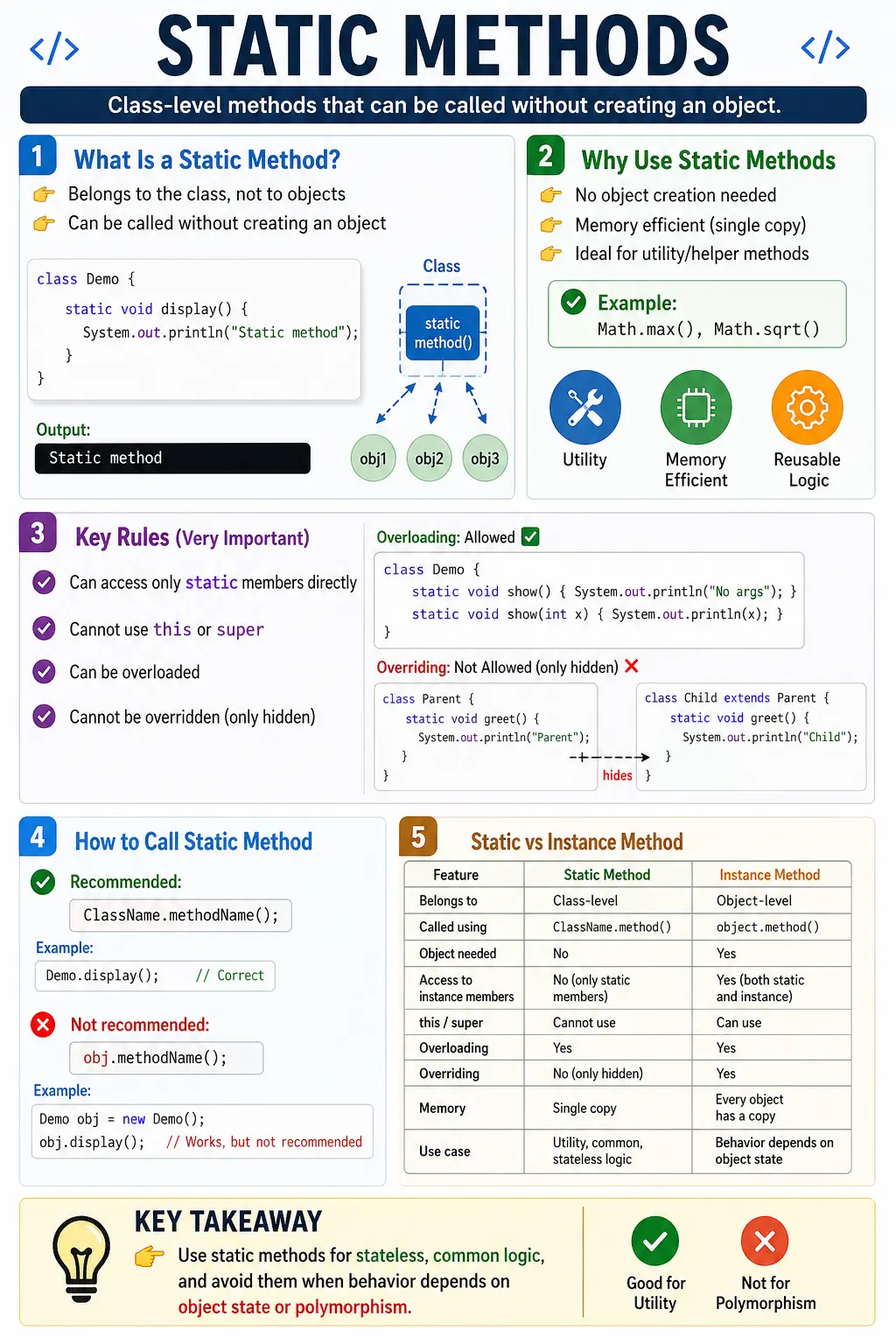
Understanding static methods is not just about syntax, it is about understanding class-level behavior vs object-level behavior, memory allocation, and design intent. Static methods are widely used in real-world applications for utility operations, helper functions, and stateless logic, making them essential for both developers and testers.
What Is a Static Method?
A static method is a method that is declared using the static keyword and is associated with the class rather than instances of the class. Unlike instance methods, which require an object to be invoked, static methods can be called directly using the class name.
For example:
static void display() {
    System.out.println("Static method");
}
This method does not belong to any object. Instead, it belongs to the class definition itself and exists independently of object creation.
From a conceptual perspective, static methods represent behavior that is common to all objects or does not depend on object state at all.
Key Characteristics of Static Methods
Static methods have several defining properties that distinguish them from instance methods.
First, they belong to the class rather than objects. This means there is only one copy of the method in memory, regardless of how many objects are created.
Second, they can be invoked using the class name:
MyClass.show();
This is the recommended approach because it clearly indicates that the method is class-level.
Third, static methods are loaded into memory when the class is loaded by the JVM. This happens before any objects are created, making static methods available early in the application lifecycle.
Finally, static methods do not require object instantiation, which makes them efficient and suitable for utility operations.
Why Use Static Methods?
Static methods exist to solve specific design problems. They are particularly useful when behavior does not depend on object state.
One major advantage is that they eliminate the need for object creation. For example, mathematical operations do not require an object instance:
Math.max(10, 20);
Math.sqrt(25);
These methods are static because their behavior is independent of any object.
Static methods are also memory-efficient. Since only one copy exists, they reduce overhead compared to instance methods, which are tied to object instances.
Another important use case is utility or helper functionality. Classes like Collections, Arrays, and Math provide static methods for common operations, allowing developers to reuse logic without instantiating objects.
Syntax of Static Methods
The syntax of a static method follows the standard Java method structure, with the addition of the static keyword:
accessModifier static returnType methodName(parameters) {
    // method body
}
Each component has a specific role:
- The access modifier defines visibility
- The static keyword defines class-level behavior
- The return type specifies the output
- The method name identifies the method
- Parameters allow input
This structure ensures consistency with instance methods while introducing class-level semantics.
Calling Static Methods
Static methods can be called in two ways, but only one is considered best practice.
Using Class Name (Recommended)
MyClass.show();
This approach is clear and aligns with the design intent of static methods.
Using Object (Not Recommended)
MyClass obj = new MyClass();
obj.show();
Although this works, it is misleading because it suggests that the method belongs to the object. In reality, the method is still class-level.
Example Program
A simple example illustrates how static methods are used:
class Calculator {
    static int add(int a, int b) {
        return a + b;
    }

    public static void main(String[] args) {
        int result = Calculator.add(10, 20);
        System.out.println(result);
    }
}
In this example:
- The add method is static and belongs to the Calculator class
- It is called using the class name
- No object is created
This demonstrates the efficiency and simplicity of static methods.
Rules of Static Methods
Understanding the rules governing static methods is essential because most beginner confusion comes from mixing class-level and object-level thinking. A static method exists in relation to a class, so Java does not automatically provide it with an object context. When an instance method runs, it is called on a particular object, and that object becomes the current object for the method. Because of that, the instance method can naturally refer to instance variables, call other instance methods, and use this to refer to the current object. A static method does not have that current object. It can run before any object is created, so Java cannot allow it to depend directly on object-specific data.
This rule is not a limitation added randomly by the language. It is a direct consequence of what static means. Static members belong to the class, and instance members belong to objects created from the class. If a class has ten objects, each object may have different values in its instance variables. A static method cannot know which object values it should use unless an object reference is explicitly provided. This is why Java allows static methods to directly access static variables and static methods, but not instance variables or instance methods.
Access to Static Members Only
Static methods can directly access only static variables and other static methods:
static int x = 10;
int y = 20;

static void show() {
    System.out.println(x);   // Valid
    // System.out.println(y); // Compile-time error
}
This restriction exists because static methods do not belong to any object, so they cannot access instance-level data directly. The variable x is static, so it has one class-level copy and can be accessed from show. The variable y is non-static, so it belongs to individual objects. If Java allowed show to access y directly, it would have no reliable way to decide which object's y value should be used.
A static method can still work with instance data, but it must do so through an object reference. For example, if show receives an object as a parameter or creates an object inside the method, it can access instance members through that object. What is not allowed is direct access without an object. This distinction is important because many interview questions are designed around exactly this point.
No Use of this or super
Static methods cannot use this or super:
static void test() {
    // this.x = 10; // Not allowed
}
The reason is straightforward: this refers to the current object, and static methods are not associated with any current object. Similarly, super refers to the parent portion of the current object. Since a static method is not running inside an object context, neither keyword has meaning there. If code inside a static method needs an object, it must receive one, create one, or obtain one from some other valid source.
This rule also explains why the main method is static. When the JVM starts a program, it does not create an object of your class before calling main. It simply loads the class and invokes the static entry point. Because main is static, it cannot directly use instance variables or instance methods unless it creates an object first.
Static Methods Can Be Overloaded
Static methods support method overloading:
static void show() { }
static void show(int a) { }
This allows multiple methods with the same name but different parameters. Overloading is resolved at compile time based on the argument list, so it works the same basic way for static and instance methods. A utility class may provide several overloaded static methods to support different input types while keeping one clear operation name.
Static Methods Cannot Be Overridden (Method Hiding)
Static methods are not overridden; they are hidden.
class A {
    static void show() {
        System.out.println("A");
    }
}

class B extends A {
    static void show() {
        System.out.println("B");
    }
}
Here, the method call depends on the reference type, not the object type. This behavior differs from instance method overriding, which is resolved at runtime. Static methods are resolved using the class reference available at compile time, so they are hidden rather than overridden. This matters in interviews because many learners incorrectly assume that all inherited methods behave polymorphically. In Java, runtime polymorphism applies to instance methods, not static methods.
Static Method vs Instance Method
The difference between static and instance methods is fundamental in Java. Static methods belong to the class and do not require objects. Instance methods belong to objects and normally require instantiation. A static method represents behavior that is independent of object state. An instance method represents behavior that usually depends on the state of a specific object.
Consider a BankAccount class. A method such as calculateInterestRateForAccount may need the account type, balance, customer category, and account age. That kind of behavior depends on the details of a particular account object, so it belongs naturally in an instance method. On the other hand, a method that validates whether a routing number has a valid format may not depend on a particular BankAccount object. It simply checks an input value and returns a result. That method may be a reasonable static utility method.
Static methods cannot access instance variables directly, while instance methods can access both static and non-static members. Static methods do not use this, while instance methods commonly rely on it, even when it is not written explicitly. Static methods cannot be overridden, while instance methods support runtime polymorphism. Understanding this distinction is critical for designing clean and maintainable code because it helps you decide whether behavior belongs to the class as a whole or to an individual object.
A useful design question is this: does the method need object memory to do its work? If the answer is yes, prefer an instance method. If the answer is no and the method simply operates on parameters or class-level state, a static method may be appropriate. This question prevents random use of static and keeps the design intentional.
The main() Method as a Static Method
The main method in Java is always declared as static:
public static void main(String[] args)
The reason is that the JVM must invoke this method without creating an object. Since the program starts before any objects exist, the entry point must be static. This design ensures that the application can begin execution immediately after class loading. Once execution begins, the main method can create objects, call constructors, invoke instance methods, and start the normal object-oriented flow of the program.
This is also why main is one of the best examples for understanding static context. Inside main, you can call another static method in the same class directly, but you cannot call a non-static method directly unless you first create an object. Beginners often see the compiler error "non-static method cannot be referenced from a static context" while writing code inside main. That message means the program is trying to use object-level behavior from a class-level method without providing an object.
How Static Methods Fit into Class Loading
Static methods become available when the class is loaded. The JVM loads class metadata, static variables, and method definitions before objects are created. This does not mean that static methods are continuously executing or that they consume a separate copy per object. It means the method belongs to the class definition and can be invoked through the class name whenever the class is available.
This class-loading behavior is useful for shared operations. A utility method such as Math.max does not need a Math object. The JVM can load the Math class, and the method can be called whenever required. That is why Java developers commonly write utility classes with private constructors and public static methods. The private constructor prevents accidental object creation, and the static methods provide reusable behavior.
However, availability at class level should not be confused with good design in every situation. Static methods make sense when the operation is stateless or class-wide. They become problematic when developers use them to avoid object design, dependency management, or proper responsibility assignment. Static is a tool, not a shortcut for all method calls.
Static Methods and Object State
The most important conceptual boundary is object state. Object state means the data held inside a particular object through its instance variables. If two Student objects exist, one may store the name "Anu" and another may store the name "Ravi". An instance method called printDetails can print different information depending on which Student object calls it. A static method has no automatic connection to either object, so it cannot naturally represent that object-specific behavior.
When a static method receives all required data as parameters, it can still be useful. For example, a method named calculatePercentage(int marks, int total) can be static because it does not need to know anything about a Student object. It simply calculates a value from inputs. But a method named updateStudentGrade may need to modify a specific student's grade field. That should usually be an instance method because it changes object state.
This distinction helps prevent design mistakes. If a class becomes full of static methods that pass around data manually, it may indicate procedural code written inside Java syntax. Java supports procedural-style code, but its strength comes from modeling data and behavior together where appropriate. Use static methods when the behavior is truly class-level or stateless. Use instance methods when the behavior belongs to a specific object.
Utility Methods and Stateless Logic
The cleanest use of static methods is utility logic. Utility logic performs a general operation without depending on stored object state. Examples include converting strings, formatting dates, validating input patterns, calculating values, sorting arrays, or comparing objects using a standard rule. Java's standard library contains many examples of this pattern.
The Math class is a classic example. Methods such as Math.max, Math.min, Math.sqrt, and Math.round operate only on the values supplied to them. Creating a Math object would not add value because there is no object state to maintain. The Arrays class and Collections class also provide static helper methods for common operations. These classes demonstrate a practical design idea: if the method is a general tool and does not need an instance, static can make the API simpler.
In real projects, teams often create utility classes such as DateUtils, StringUtils, ValidationUtils, FileUtils, or TestDataUtils. These classes can be useful when they remain focused and stateless. A ValidationUtils.isValidEmail method, for example, can accept an email address and return true or false. It does not need an object with a life cycle. It simply performs one reusable operation.
The danger appears when utility classes grow too large and become a dumping ground for unrelated behavior. A class named CommonUtils with hundreds of static methods is usually a sign of weak design. Static utility methods should still have clear responsibility, meaningful names, and limited scope.
Static Methods in Java Libraries
Java libraries use static methods heavily where they simplify common operations. Math, Arrays, Collections, Integer, Double, Boolean, String, and Objects all expose static methods for operations that do not require a custom object instance. Integer.parseInt, for example, converts a string into an integer. The method belongs to the Integer class because it creates or returns integer-related information from a supplied value. It does not need an Integer object to already exist.
Static factory methods are another important library pattern. Methods such as LocalDate.now, List.of, Set.of, Optional.of, and String.valueOf create or return objects using readable class-level calls. A constructor always has the same name as the class, but a static factory method can have a meaningful name that explains intent. For example, LocalDate.now clearly says that it returns today's date, while LocalDate.of clearly says that it creates a date from supplied values.
This pattern is useful because static methods can hide object creation details, return cached objects, choose subclasses, validate inputs before construction, or provide more expressive names. Not every static method is a simple utility method. Some static methods act as controlled entry points for creating objects or obtaining shared resources.
When to Use Static Methods
Static methods should be used when behavior is independent of object state. A good static method can usually be understood by looking at its parameters and return value. It does not secretly depend on a particular object. It does not require a meaningful life cycle. It does not need to be overridden for different object types. It performs one class-level or utility-level operation clearly.
Common use cases include:
- Utility and helper methods
- Mathematical operations
- Common validation logic
- Factory methods
- Shared functionality across instances
For example, a method that validates email format does not need object state and is a good candidate for static implementation. A method that converts kilometers to miles, checks whether a number is prime, returns a formatted message, or creates a default object can also be suitable. These operations are clear, reusable, and independent.
Static methods are also useful for named constructors or factory-style creation. A class may provide methods such as createDefaultUser, fromCsvLine, of, valueOf, or getInstance. These names communicate intent better than a constructor in some situations. The key is that the static method is part of the class's public API and improves readability.
When NOT to Use Static Methods
Static methods are not suitable for all scenarios. They should not be used simply because calling a method without creating an object feels convenient. Convenience can create long-term design problems when behavior actually belongs to an object. If a method needs object state, updates object fields, participates in inheritance behavior, or depends on replaceable services, an instance method is usually a better choice.
They should be avoided when:
- Behavior depends on instance variables
- Polymorphism or overriding is required
- Object-specific logic is involved
- The method depends on external services or environment-specific resources
- The method makes testing difficult because dependencies cannot be replaced easily
Overusing static methods can lead to procedural-style code, reducing the benefits of object-oriented design. It can also increase coupling because many parts of the application directly call the same utility methods. When static methods hold or modify shared static data, the risk becomes higher because shared mutable state can create unexpected behavior, especially in larger applications and multi-threaded environments.
A practical warning sign is a static method that needs many parameters from the same object. If a method receives name, age, email, address, role, and status from a User object, the behavior may belong inside User or a related service instead. Too many parameters often indicate that the method is separated from the data it actually uses.
Common Beginner Mistakes
Several mistakes are commonly made when working with static methods. One frequent error is trying to access non-static variables directly from static methods, which leads to compile-time errors. The fix is not always to make the variable static. Sometimes the correct fix is to create an object or move the logic into an instance method. Turning everything static just to remove compiler errors usually creates weaker design.
Another mistake is attempting to use this inside a static method, which is not allowed. The keyword this has meaning only when a method is executing for a specific object. If the method has no object context, this cannot exist. The same reasoning applies to super.
Developers also often call static methods using objects, which is syntactically valid but conceptually incorrect. The compiler may allow it, but the code becomes misleading. A reader may assume that the method depends on the object, even though it belongs to the class. Calling static methods using the class name keeps intent clear.
Another common mistake is confusing static method hiding with overriding. If a parent and child class both define a static method with the same signature, Java does not use runtime polymorphism. The method selected depends on the reference type. This is why static methods should not be used when dynamic behavior across subclasses is required.
Finally, beginners sometimes use static methods to avoid learning object creation, constructors, and instance behavior. This may work for small programs but becomes a problem in real projects. Java is designed around objects, responsibilities, and collaboration between classes. Static methods should support that design, not replace it entirely.
Static Methods in Real-World Design
In real-world applications, static methods are widely used in utility classes. These classes often contain only static methods and are not meant to be instantiated. A well-designed utility class usually has a clear name, a narrow purpose, and no mutable shared state. It may also include a private constructor so that no one accidentally creates an object from it.
For example:
- Math class for mathematical operations
- Collections class for collection utilities
- Arrays class for array manipulation
These classes demonstrate how static methods can provide reusable functionality across an application. They are successful because their methods are predictable and stateless. Calling Arrays.sort on an array or Collections.emptyList for an empty list has clear behavior. The method call does not depend on a hidden object state that changes from one call to another.
Business applications also use static methods in constants classes, conversion helpers, validation helpers, and factory methods. For example, an insurance application might use a static method to calculate whether a date falls within a policy term, while the policy object itself handles stateful behavior such as renewal, cancellation, and premium updates. This separation keeps simple reusable logic easy to call while preserving object-oriented modeling where it matters.
Best Practices for Static Methods
The first best practice is to call static methods using the class name. This is simple but important because it communicates ownership. Math.max is clearer than creating a Math object or calling a static method through an instance reference. The class name tells the reader immediately that the behavior is class-level.
The second best practice is to keep static methods stateless whenever possible. A static method that takes input, computes a result, and returns output is easy to understand and test. A static method that changes shared static variables can create hidden side effects. Shared mutable state should be treated carefully because it can make behavior depend on call order.
The third best practice is to avoid using static methods for business behavior that naturally belongs to an object. If the behavior reads like something an object does, such as customer.activate, order.cancel, account.deposit, or invoice.markPaid, it should usually be an instance method. Static helper logic can support those methods, but it should not take over the object's responsibilities.
The fourth best practice is to keep utility classes cohesive. Do not place unrelated methods in one large helper class. A class named DateUtils should handle date-related operations. A class named StringUtils should handle string-related operations. A class named CommonUtils usually becomes difficult to maintain because it lacks a clear responsibility.
The fifth best practice is to be careful with testing and dependency replacement. Pure static methods are easy to unit test because the same input gives the same output. Static methods that read the file system, call APIs, create database connections, or access global configuration are harder to test. In those cases, instance-based services with injected dependencies often produce cleaner and more flexible code.
Static Methods and Interview Thinking
In interviews, static methods are used to check whether you understand Java execution and object-oriented fundamentals. A strong answer should not stop at "static methods can be called without objects." That is true, but it is only the starting point. A better answer explains that static methods belong to the class, are loaded with the class, can directly access only static members, cannot use this or super, can be overloaded, and are hidden rather than overridden.
Interviewers may also ask why main is static. The correct explanation is that the JVM needs a starting point before creating objects. Since main is static, the JVM can invoke it using the class name. From main, the program can create objects and begin normal execution.
Another common interview question asks whether a static method can access a non-static variable. The precise answer is that it cannot access a non-static variable directly, but it can access one through an object reference. This detail shows deeper understanding. For example, a static method can create a Student object and then read student.name if the access modifier allows it. What it cannot do is simply read name without an object.
A third common question asks whether static methods can be overridden. The answer is no. If a subclass defines a static method with the same signature, it hides the parent method. Static method calls are resolved based on reference type, while overridden instance methods are resolved based on actual object type at runtime.
Interview Perspective
Static methods are a common interview topic, often used to test understanding of object-oriented principles. A short answer would be: a static method belongs to the class and can be called without creating an object. A detailed answer would include the rules that make this possible. Static methods are class-level methods that can access only static members directly. They are available after class loading, cannot use this or super, and are commonly used for utility, helper, validation, conversion, and factory-style functionality. They cannot be overridden but can be overloaded.
A strong interview explanation should also include judgment. Static methods are useful when logic does not depend on object state, but they should not be overused for object-specific behavior. If a method represents what a particular object does, it should usually be an instance method. If it represents a general operation related to a class or domain, and all required data can be passed as input, static may be appropriate.
Key Takeaway
Static methods provide a way to define behavior that belongs to the class rather than instances. They are efficient, readable, and ideal for stateless operations, utility logic, common validation, and class-level factory methods. Their power comes from clear ownership: the behavior belongs to the class, not to a specific object.
At the same time, static methods must be used carefully. They cannot directly access instance data, cannot use this or super, and do not support runtime overriding. Overusing them can weaken object-oriented design and make code less flexible. The best approach is to use static methods where the logic is truly independent of object state and use instance methods where behavior belongs to a specific object.
One-Line Insight
Static methods define class-level behavior; use them when logic does not depend on object state.
1. Basic Static Method Call
class Demo {
static void greet() {
System.out.println("Hello Java");
}
public static void main(String[] args) {
greet();
}
}
Explanation
- Called without object
- Belongs to class
- Output: Hello Java
2. Calling Static Method Using Class Name
class Demo {
static void show() {
System.out.println("Static Method");
}
public static void main(String[] args) {
Demo.show();
}
}
Explanation
- Recommended syntax
- Output: Static Method
3. Static Method with Parameters
class Demo {
static int add(int a, int b) {
return a + b;
}
public static void main(String[] args) {
System.out.println(add(3, 7));
}
}
Explanation
- Parameters behave normally
- Output: 10
4. Static Method Returning Value
class Demo {
static String tool() {
return "Selenium";
}
public static void main(String[] args) {
System.out.println(tool());
}
}
Explanation
- Can return any type
- Output: Selenium
5. Static Method Accessing Static Variable
class Demo {
static int x = 10;
static void show() {
System.out.println(x);
}
public static void main(String[] args) {
show();
}
}
Explanation
- Static method can access static data directly
- Output: 10
6. Static Method Cannot Access Non-Static Variable
class Demo {
int x = 10;
static void show() {
// System.out.println(x); // Compile-time error
}
}
Explanation
- Static context cannot access instance members directly
7. Accessing Non-Static Members from Static Method (Using Object)
class Demo {
int x = 10;
static void show() {
Demo d = new Demo();
System.out.println(d.x);
}
public static void main(String[] args) {
show();
}
}
Explanation
- Object required
- Output: 10
8. Static Method and this Keyword (❌ Not Allowed)
class Demo {
static void test() {
// this.x = 10; // Compile-time error
}
}
Explanation
- this refers to object
- Static methods have no object context
9. Static Method Overloading
class Demo {
static void show() {
System.out.println("No args");
}
static void show(int a) {
System.out.println("With arg");
}
public static void main(String[] args) {
show();
show(5);
}
}
Explanation
- Static methods can be overloaded
- Output:
No args
With arg
10. Static Method Hiding (Not Overriding)
class A {
static void show() {
System.out.println("A");
}
}
class B extends A {
static void show() {
System.out.println("B");
}
public static void main(String[] args) {
A.show();
B.show();
}
}
Explanation
- Static methods are hidden, not overridden
- Output:
A
B
11. Calling Static Method via Object (Allowed but Discouraged)
class Demo {
static void test() {
System.out.println("Static");
}
public static void main(String[] args) {
Demo d = new Demo();
d.test();
}
}
Explanation
- Compiles
- Bad practice
- Output: Static
12. Static Method Inside Utility Class
class MathUtil {
static int square(int x) {
return x * x;
}
}
class Demo {
public static void main(String[] args) {
System.out.println(MathUtil.square(4));
}
}
Explanation
- Common real-world use
- Output: 16
13. Static Method and Static Block
class Demo {
static {
System.out.println("Static Block");
}
static void show() {
System.out.println("Static Method");
}
public static void main(String[] args) {
show();
}
}
Explanation
- Static block runs first
- Output:
Static Block
Static Method
14. Static Method with Varargs
class Demo {
static void sum(int... nums) {
int total = 0;
for (int n : nums) total += n;
System.out.println(total);
}
public static void main(String[] args) {
sum(1, 2, 3);
}
}
Explanation
- Varargs supported
- Output: 6
15. Static Method Returning Object
class Demo {
static StringBuilder getBuilder() {
return new StringBuilder("Java");
}
public static void main(String[] args) {
System.out.println(getBuilder());
}
}
Explanation
- Can return objects
- Output: Java
16. Static Method and Inheritance Call
class A {
static void show() {
System.out.println("A");
}
}
class B extends A {
public static void main(String[] args) {
show();
}
}
Explanation
- Static methods are inherited
- Output: A
17. Static Method as Entry Point
class Demo {
public static void main(String[] args) {
System.out.println("Entry Point");
}
}
Explanation
- JVM starts execution from static main
- Output: Entry Point
18. Static Method vs Non-Static Method
class Demo {
static void s() {
System.out.println("Static");
}
void ns() {
System.out.println("Non-static");
}
public static void main(String[] args) {
s();
new Demo().ns();
}
}
Explanation
- Static means class
- Non-static means object
- Output:
Static
Non-static
19. Static Method and Thread Safety (Stateless)
class Demo {
static int add(int a, int b) {
return a + b;
}
}
Explanation
- Stateless static methods are thread-safe
- Common interview point
20. Interview Summary – Static Methods
class Demo {
static int calc(int x) {
return x * 2;
}
public static void main(String[] args) {
System.out.println(calc(5));
}
}
Explanation
- Belongs to class
- No object required
- Output: 10