Recursive Methods in Java
Recursion is one of the most intellectually rich and conceptually elegant techniques in programming. In Java, a recursive method is a method that calls itself to solve a problem by reducing it into smaller, more manageable subproblems. This approach mirrors how many mathematical definitions and natural processes work, making recursion a powerful tool for expressing complex logic in a concise and structured way.
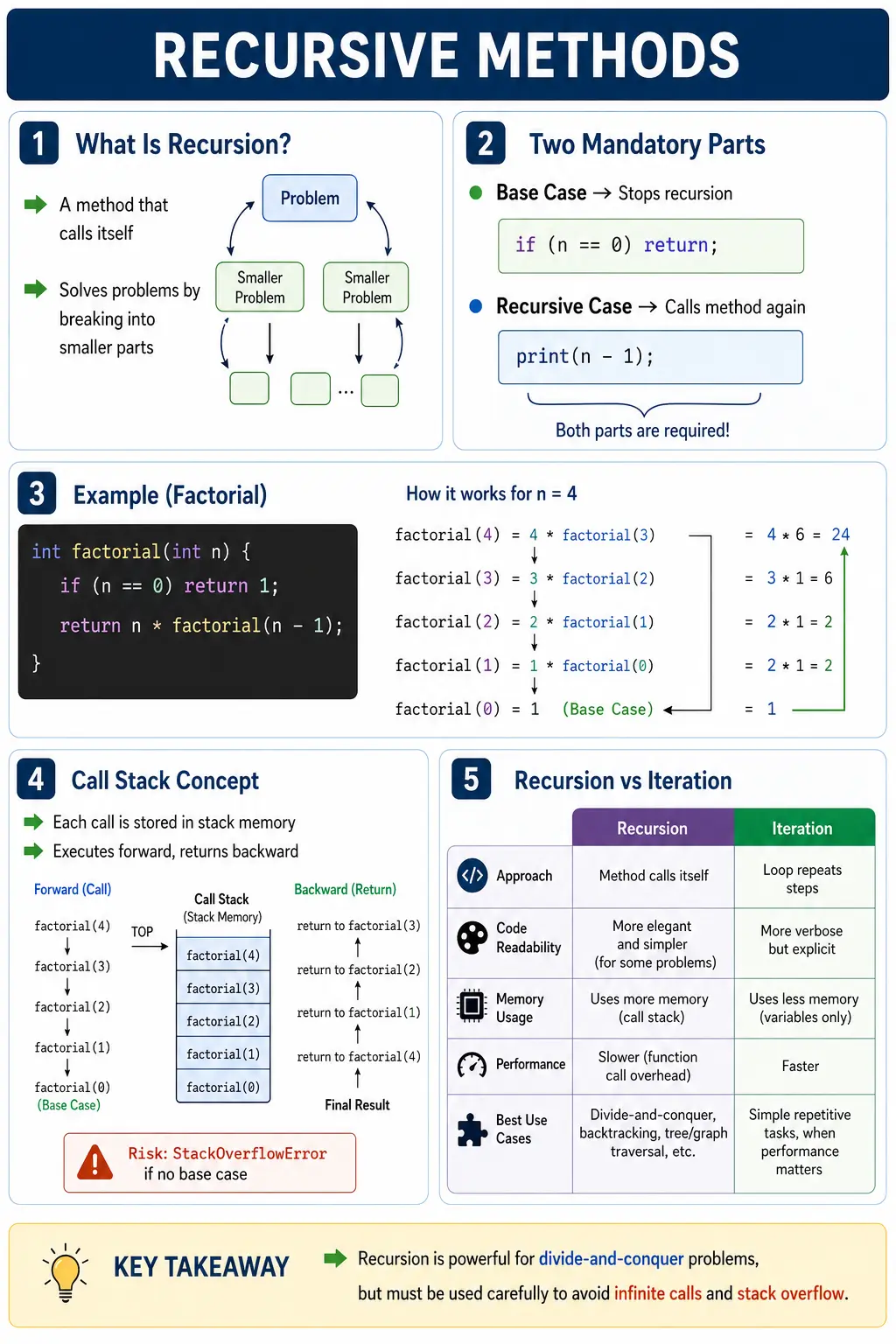
Although recursion can appear deceptively simple, mastering it requires a solid understanding of execution flow, stack behavior, termination conditions, and performance implications. It is a staple in technical interviews and forms the backbone of many algorithmic paradigms such as divide-and-conquer, backtracking, and tree traversal. A developer who understands recursion deeply can approach problems with clarity and confidence, especially those involving hierarchical or self-similar structures.
What Is a Recursive Method?
A recursive method is a method that invokes itself during execution. Instead of solving a problem in one large step, it solves a smaller version of the same problem and relies on repeated reduction until the simplest case is reached. This is what makes recursion different from an ordinary method call. The method is not calling a different helper; it is calling itself with modified input.
At a conceptual level, recursion answers an important question: can this problem be expressed in terms of a smaller version of itself? If the answer is yes, recursion may be a natural fit. Factorial is defined in terms of a smaller factorial. A directory contains files and other directories. A tree node can contain child nodes, and each child node can itself be treated as a smaller tree. These structures fit recursion because the same logic applies repeatedly at different levels.
The simplest recursive method can be written in only a few lines, but that does not mean it is correct:
void recursiveMethod() {
    recursiveMethod();
}
This code shows the syntax of self-calling, but it has no stopping condition. The method keeps calling itself until the program runs out of stack space and fails. A real recursive method must always include a condition that stops the chain of calls. Without that condition, recursion becomes infinite repetition rather than controlled problem solving.
The Two Mandatory Components of Recursion
Every correct recursive solution has two mandatory components: a base case and a recursive case. The base case is the condition where the method stops calling itself. The recursive case is the part where the method calls itself with a smaller or simpler input. These two parts must work together. A base case without a meaningful recursive case does not solve a larger problem. A recursive case without a reliable base case does not terminate.
Base Case
The base case is the simplest version of the problem that can be solved directly. It prevents the method from calling itself forever. In a countdown method, the base case may be n == 0. In a factorial method, the base case may be n == 0 or n == 1. In a tree traversal, the base case may be node == null. The exact condition depends on the problem, but the purpose is always the same: stop recursion safely.
if (n == 0) {
    return;
}
A good base case should be easy to understand and should represent a valid stopping point. It should not be added randomly just to avoid errors. If the base case does not match the problem definition, the method may stop too early, return the wrong result, or miss important data.
Recursive Case
The recursive case reduces the problem and calls the same method again. The reduction is critical. Each call must move the input closer to the base case. If the method calls itself with the same input again and again, it will never terminate. If the method moves in the wrong direction, it may run indefinitely or fail for certain values.
print(n - 1);
Here, n - 1 moves the problem toward zero. That small change is what gives recursion progress. The recursive case should make the problem smaller in a way that matches the logic of the solution. In a tree, this may mean visiting child nodes. In a string, it may mean processing the remaining substring. In an array, it may mean moving to the next index.
How Recursive Execution Actually Works
Recursive execution is easier to understand when you separate two phases: the calling phase and the returning phase. During the calling phase, the method keeps invoking itself with smaller input. During the returning phase, the base case has been reached and the method calls begin to complete one by one. This returning phase is often called unwinding.
Consider a method that prints numbers from 1 to n:
void print(int n) {
    if (n == 0) {
        return;
    }
    print(n - 1);
    System.out.println(n);
}
When print(3) is called, the method first calls print(2), then print(1), then print(0). At print(0), the base case returns immediately. After that, execution resumes in print(1), then print(2), and finally print(3). Because the print statement is written after the recursive call, the numbers are printed during the unwinding phase.
1
2
3
This is one of the most important lessons in recursion. The position of the recursive call changes the order of behavior. Code before the recursive call runs while going deeper. Code after the recursive call runs while returning. Many recursion problems become easier once this order is understood.
Recursion and the Call Stack
To truly understand recursion, you must understand the call stack. Each time a method is called, Java creates a stack frame for that method call. The stack frame stores the method's parameters, local variables, and the position where execution should resume after the method returns. In recursion, each self-call creates a new stack frame, even though the same method name is used.
For example, factorial(3) creates a chain of calls:
- factorial(3)
- factorial(2)
- factorial(1)
- factorial(0)
Each call waits for the next call to return. When factorial(0) returns, factorial(1) can complete. Then factorial(2) can complete. Finally, factorial(3) can complete. The call stack makes this possible by remembering the state of each unfinished method call.
This also explains why recursion consumes memory. Every recursive call adds another stack frame. For small or moderate input sizes, this is usually fine. For very deep recursion, the stack can become full and the program can throw StackOverflowError.
Factorial Using Recursion
Factorial is a classic recursion example because the mathematical definition is naturally recursive. The factorial of n is n multiplied by the factorial of n - 1. The simplest factorial is 0!, which equals 1. That gives both the recursive case and the base case.
- n! = n * (n - 1)!
- 0! = 1
int factorial(int n) {
    if (n == 0) {
        return 1;
    }
    return n * factorial(n - 1);
}
When factorial(3) runs, Java does not immediately know the final answer. It must first calculate factorial(2), which must calculate factorial(1), which must calculate factorial(0). Once the base case returns 1, the results multiply back upward. The final result becomes 3 * 2 * 1 * 1.
This example shows why recursion is expressive. The Java method closely resembles the mathematical definition. However, the method still needs input validation in production code. Factorial is not defined for negative integers in this simple form, so a real method should handle negative input deliberately.
Fibonacci and Repeated Work
The Fibonacci sequence is another famous recursive problem. It is defined using two previous values:
- fib(0) = 0
- fib(1) = 1
- fib(n) = fib(n - 1) + fib(n - 2)
int fib(int n) {
    if (n == 0 || n == 1) {
        return n;
    }
    return fib(n - 1) + fib(n - 2);
}
This solution is elegant, but it is inefficient for large values because it recalculates the same values many times. For example, fib(5) calls fib(4) and fib(3). The fib(4) call also calls fib(3). As n increases, repeated work grows quickly. This teaches an important lesson: recursion can be clear, but clarity alone does not guarantee performance.
Optimized recursive approaches use memoization to store results that have already been calculated. Another option is to use iteration. The best solution depends on the problem, input size, and performance requirement. Recursion should be chosen with understanding, not just because it looks elegant.
Direct and Indirect Recursion
Most beginner examples show direct recursion, where a method calls itself directly. Factorial, Fibonacci, and countdown examples follow this pattern. There is also indirect recursion, where one method calls another method, and that second method eventually calls the first method again. The recursion still exists, but the cycle is spread across multiple methods.
Indirect recursion can appear in real applications when processing states, traversing structures, or coordinating related operations. It requires extra care because the stopping condition may not be visible in one method alone. If multiple methods participate in a recursive cycle, the developer must ensure that the complete cycle still moves toward termination.
For learning and interviews, direct recursion is easier to explain. For production code, indirect recursion should be used sparingly and documented clearly because it can be harder to trace during debugging.
Recursion vs Iteration
Recursion and iteration are two ways to repeat logic. Iteration uses loops such as for, while, and do-while. Recursion uses repeated method calls. Both can solve many of the same problems, but they express the solution differently and have different trade-offs.
Iteration is often more memory-efficient because it does not create a new stack frame for each repetition. Simple counting, summing array values, searching a list, and printing numbers are usually better with loops. The logic is straightforward, and iteration avoids stack overhead.
Recursion often becomes more readable when the problem itself is hierarchical or self-similar. Tree traversal is a good example. Each node can be processed the same way: visit the node, then recursively visit its children. Backtracking problems, such as generating permutations or solving puzzles, also fit recursion because the method explores one choice, recurses, and then returns to try another choice.
The practical rule is simple: use iteration when the problem is linear and simple; consider recursion when the problem naturally breaks into smaller versions of itself. If recursion makes the solution clearer and the depth is safe, it can be an excellent choice. If recursion only makes a simple loop harder to read, use iteration.
StackOverflowError and Recursion Depth
A StackOverflowError occurs when the call stack exceeds its limit. In recursion, this usually happens for one of two reasons: the base case is missing or the recursion depth is too large. A missing base case causes infinite recursion. An incorrect base case may stop too late or not at all for certain inputs. Large input can also create too many calls even when the base case is correct.
StackOverflowError is not handled like a normal business exception in most applications. It usually indicates a serious programming problem or an input size that the algorithm cannot safely support. The right fix is normally to correct the base condition, reduce recursion depth, use iteration, or redesign the algorithm.
Developers should also watch for recursion that moves in the wrong direction. If the base case is n == 0 but the recursive call uses n + 1, the method moves away from the base case. If the recursive call accidentally passes n instead of n - 1, the problem never gets smaller. These small mistakes are common and can be difficult to spot without tracing the values carefully.
Tail Recursion in Java
Tail recursion is a form of recursion where the recursive call is the final operation in the method. In some programming languages, compilers can optimize tail recursion by reusing stack frames, making it behave like iteration internally. Java does not guarantee tail call optimization, so tail-recursive methods still consume stack space.
void print(int n) {
    if (n == 0) {
        return;
    }
    System.out.println(n);
    print(n - 1);
}
Here, the recursive call is the last action. The method prints first, then calls itself. Although this style can be clean, it should not be assumed to avoid stack growth in Java. If the input can be very large, an iterative loop may be safer.
Recursive Thinking Process
Many beginners struggle with recursion because they try to mentally execute every call at once. A better approach is to trust the recursive definition after proving the base case and reduction. Ask three questions: what is the simplest case, how can the problem become smaller, and how does the current call combine its result with the smaller result?
For factorial, the simplest case is 0! = 1. The smaller problem is factorial(n - 1). The current call combines results by multiplying n with factorial(n - 1). For tree traversal, the simplest case is a null node. The smaller problems are the left and right subtrees. The current call combines behavior by processing the current node and then processing the children.
This thinking process keeps recursion manageable. You do not need to manually expand every call for every problem. You need to define the base case, the reduction, and the combination step correctly. After that, the call stack handles the repetition.
Recursion in Real Java Problems
Recursion appears in many real Java problems beyond classroom examples. File system traversal is recursive because folders can contain folders. Tree-based data structures are recursive because each node can have child nodes that are also nodes. Parsing nested expressions often uses recursion because expressions can contain smaller expressions. Backtracking problems use recursion to explore combinations, choices, and alternatives.
In data structures and algorithms, recursion is central to merge sort, quicksort, binary tree traversals, depth-first search, permutations, combinations, subset generation, and many dynamic programming solutions. Even when the final optimized solution becomes iterative, recursive thinking often helps reveal the structure of the problem.
In application code, recursion should be used with care. Recursive traversal of comments, categories, menus, organizational hierarchies, or nested JSON may be natural. But for simple business loops, iteration is often clearer and safer. The goal is not to use recursion everywhere. The goal is to recognize where recursion expresses the problem more naturally.
Recursive Helper Methods
Many clean Java recursion solutions use a public method and a private helper method. The public method gives callers a simple interface. The private helper carries extra information needed during recursion, such as the current index, current depth, accumulated total, or path being explored. This pattern keeps the public API readable while giving the recursive logic everything it needs.
For example, a public method named sum(int[] numbers) should not force the caller to provide an index. The caller only wants the sum. Internally, the method can call a private helper such as sum(numbers, 0). The helper receives the array and the current index. Each recursive call moves the index forward until it reaches the end of the array. This design hides implementation details from callers and keeps recursion organized.
Helper methods are also useful for validation. The public method can check whether the input is null, empty, or invalid before recursion begins. Once the input is safe, the private recursive method can focus only on the recursive logic. This separation is common in production-quality code because it avoids repeating validation on every recursive call.
Memoization and Avoiding Repeated Work
Some recursive solutions repeat the same calculations many times. Fibonacci is the standard example, but the same issue appears in path counting, grid traversal, subset problems, and dynamic programming questions. Memoization is a technique where previously computed results are stored and reused. Instead of solving the same subproblem again, the method checks a cache and returns the saved result.
Memoization keeps the recursive structure but improves performance. A plain recursive Fibonacci solution has exponential time complexity because it branches repeatedly and recalculates values. With memoization, each value is computed once and reused later. The result is usually much faster while preserving a recursive way of thinking.
In Java, memoization can be implemented with an array, HashMap, or other collection depending on the problem. If the input is a simple integer range, an array is often enough. If the input is a combination of values, a map with a suitable key may be better. The important idea is that recursion and optimization are not opposites. Recursion can be made practical when repeated work is identified and controlled.
Tracing Recursive Methods
Tracing is one of the best ways to debug recursion. Start with a small input and write each method call on paper or in comments. Track the input value, the base case decision, the recursive call, and the returned result. For factorial(3), trace factorial(3), factorial(2), factorial(1), and factorial(0). Then trace the return path back upward.
When debugging in an IDE, use breakpoints carefully. Step into the recursive call and watch how the call stack grows. Most debuggers show a call stack panel where the same method appears multiple times with different parameter values. This is normal in recursion. Each entry represents a different active call.
Adding temporary logging can also help, but the logs should show depth or indentation. Without indentation, recursive logs become hard to read. With indentation, the calling and returning phases become visible. This makes it easier to identify whether the method is failing to reach the base case, returning the wrong value, or executing statements in an unexpected order.
When to Use Recursion
Recursion is useful when a problem has self-similarity, hierarchy, branching, or a natural divide-and-conquer structure. It works well when each recursive call handles a smaller portion of the same kind of problem. Tree traversal, graph exploration, nested folder traversal, parsing, backtracking, and mathematical definitions are common examples.
Recursion is also useful when it makes code easier to reason about than an equivalent loop. A recursive tree traversal may be only a few lines, while an iterative version may require an explicit stack and more bookkeeping. In such cases, recursion improves readability and reduces accidental complexity.
However, recursion should still be evaluated against input size and performance needs. A clean recursive solution that fails on large input is not production-ready. Good developers balance elegance with reliability.
When Not to Use Recursion
Recursion is not always the best choice. Avoid it when the input size can be very large and the recursion depth is not controlled. Avoid it when a simple loop expresses the logic more clearly. Avoid it when performance is critical and recursive calls add unnecessary overhead. Avoid it when team members are likely to misunderstand the flow and maintainability would suffer.
Some problems look recursive but can be solved more safely with iteration. Summing an array, printing numbers, counting characters, and scanning a list are usually better with loops. Recursion may work for these problems, but it does not add much value and can introduce stack risk.
When recursion is required but repeated work is a concern, consider memoization or dynamic programming. When stack depth is a concern, consider an iterative solution with an explicit stack or queue. These alternatives preserve correctness while improving performance or safety.
Common Beginner Mistakes
Recursion is prone to several common errors. The most frequent mistake is forgetting the base case. Without a base case, the method never stops calling itself. Another common mistake is writing a base case that does not cover all valid stopping conditions. This can cause incorrect output or runtime failure for edge inputs.
A second mistake is failing to move toward the base case. A recursive method must reduce the problem on every path. If some branch does not reduce the input, that branch can cause infinite recursion. This is especially common in methods with multiple conditions or multiple recursive calls.
A third mistake is misunderstanding execution order. Code before the recursive call runs while going deeper. Code after the recursive call runs while unwinding. If output appears reversed, the issue is often the placement of the recursive call.
A fourth mistake is assuming recursion is always faster. Recursive code can be elegant, but it often uses more memory than iteration. Fibonacci is the classic warning: the simple recursive version is easy to read but inefficient because it repeats work. Efficiency must be evaluated separately from readability.
Finally, beginners may ignore invalid input. Factorial with a negative number, recursion over a null structure, or traversal over cyclic data can fail if not handled. Strong recursive methods define base cases and input rules carefully.
Best Practices
Start every recursive solution by identifying the base case. Write it clearly and test it first. Then define how each call makes the problem smaller. If you cannot explain the reduction in one sentence, the recursion is probably not clear enough yet.
Keep recursive methods focused. A method should not mix too many responsibilities while also managing recursive flow. When needed, separate public validation from private recursive logic. For example, a public method can check input and then call a private helper method with additional parameters such as index, depth, or accumulated result.
Trace small inputs manually. Values like 0, 1, 2, and 3 reveal most recursion mistakes quickly. Check both the calling phase and the unwinding phase. Also test edge cases such as empty arrays, null nodes, single-element structures, and maximum expected depth.
Use recursion where it improves clarity, but do not force it. If an iterative solution is simpler, use iteration. If recursion is elegant but too deep for production input, redesign it. Good recursion is not just short code; it is correct, terminating, understandable, and safe for the expected data size.
Interview Perspective
Recursion is a favorite interview topic because it tests both conceptual understanding and problem-solving ability. A concise definition is: a recursive method is a method that calls itself to solve a problem by breaking it into smaller subproblems. A stronger answer also mentions the base case, recursive case, call stack, and the risk of StackOverflowError.
Interviewers commonly ask candidates to explain factorial, Fibonacci, palindrome checking, binary search, tree traversal, or sum of digits using recursion. In each case, the answer should identify the base case first, then explain how the input becomes smaller. For Fibonacci, it is also important to mention repeated work and possible optimization through memoization.
A good interview explanation does not simply write code. It explains why the recursion stops, how each call progresses, what happens on the call stack, and what trade-offs exist compared to iteration. This shows practical understanding rather than memorization.
Key Takeaway
Recursive methods provide a powerful and expressive way to solve problems that can be broken down into smaller, similar subproblems. They are especially useful for hierarchical structures, divide-and-conquer algorithms, and backtracking problems. A correct recursive method needs a clear base case, a recursive case that moves toward that base case, and careful attention to stack usage.
Recursion is not automatically better than iteration. It is a design choice. Use it when it matches the shape of the problem and improves clarity. Avoid it when a loop is simpler or when recursion depth creates risk. Once the base case, reduction step, and call stack behavior are understood, recursion becomes a predictable and practical tool in Java.
One-Line Insight
Recursion solves a problem by solving smaller versions of the same problem until it reaches a base case.
1. Basic Recursion (Countdown)
class Demo {
static void countDown(int n) {
if (n == 0) return;
System.out.println(n);
countDown(n - 1);
}
public static void main(String[] args) {
countDown(3);
}
}
Explanation
- Base case: n == 0
- Output:
3
2
1
2. Recursion Without Base Case (Dangerous)
class Demo {
static void test() {
test();
}
public static void main(String[] args) {
// test(); // StackOverflowError
}
}
Explanation
- No stopping condition
- Causes StackOverflowError
3. Factorial Using Recursion
class Demo {
static int factorial(int n) {
if (n == 1) return 1;
return n * factorial(n - 1);
}
public static void main(String[] args) {
System.out.println(factorial(5));
}
}
Explanation
- Classic interview question
- Output: 120
4. Factorial with n == 0 Base Case
class Demo {
static int factorial(int n) {
if (n == 0) return 1;
return n * factorial(n - 1);
}
public static void main(String[] args) {
System.out.println(factorial(0));
}
}
Explanation
- Mathematically correct base case
- Output: 1
5. Fibonacci Series (Recursive)
class Demo {
static int fib(int n) {
if (n <= 1) return n;
return fib(n - 1) + fib(n - 2);
}
public static void main(String[] args) {
System.out.println(fib(6));
}
}
Explanation
- Time complexity: exponential
- Output: 8
6. Print Fibonacci Series Using Recursion
class Demo {
static int fib(int n) {
if (n <= 1) return n;
return fib(n - 1) + fib(n - 2);
}
public static void main(String[] args) {
for (int i = 0; i < 6; i++) {
System.out.print(fib(i) + " ");
}
}
}
Explanation
- Output: 0 1 1 2 3 5
7. Sum of Natural Numbers
class Demo {
static int sum(int n) {
if (n == 1) return 1;
return n + sum(n - 1);
}
public static void main(String[] args) {
System.out.println(sum(5));
}
}
Explanation
- Output: 15
8. Power of a Number (x^n)
class Demo {
static int power(int x, int n) {
if (n == 0) return 1;
return x * power(x, n - 1);
}
public static void main(String[] args) {
System.out.println(power(2, 4));
}
}
Explanation
- Output: 16
9. Reverse a String Using Recursion
class Demo {
static String reverse(String s) {
if (s.length() == 0) return s;
return reverse(s.substring(1)) + s.charAt(0);
}
public static void main(String[] args) {
System.out.println(reverse("JAVA"));
}
}
Explanation
- Output: AVAJ
10. Check Palindrome Using Recursion
class Demo {
static boolean isPalindrome(String s, int start, int end) {
if (start >= end) return true;
if (s.charAt(start) != s.charAt(end)) return false;
return isPalindrome(s, start + 1, end - 1);
}
public static void main(String[] args) {
System.out.println(isPalindrome("madam", 0, 4));
}
}
Explanation
- Output: true
11. Count Digits Using Recursion
class Demo {
static int countDigits(int n) {
if (n == 0) return 0;
return 1 + countDigits(n / 10);
}
public static void main(String[] args) {
System.out.println(countDigits(12345));
}
}
Explanation
- Output: 5
12. Sum of Digits Using Recursion
class Demo {
static int sumDigits(int n) {
if (n == 0) return 0;
return (n % 10) + sumDigits(n / 10);
}
public static void main(String[] args) {
System.out.println(sumDigits(123));
}
}
Explanation
- Output: 6
13. Recursion with Array Traversal
class Demo {
static void printArray(int[] arr, int index) {
if (index == arr.length) return;
System.out.print(arr[index] + " ");
printArray(arr, index + 1);
}
public static void main(String[] args) {
int[] a = {1, 2, 3};
printArray(a, 0);
}
}
Explanation
- Output: 1 2 3
14. Find Maximum Element in Array (Recursion)
class Demo {
static int max(int[] arr, int index) {
if (index == arr.length - 1) return arr[index];
return Math.max(arr[index], max(arr, index + 1));
}
public static void main(String[] args) {
int[] a = {4, 9, 2};
System.out.println(max(a, 0));
}
}
Explanation
- Output: 9
15. Binary Search Using Recursion
class Demo {
static int binarySearch(int[] arr, int low, int high, int key) {
if (low > high) return -1;
int mid = (low + high) / 2;
if (arr[mid] == key) return mid;
if (key < arr[mid]) return binarySearch(arr, low, mid - 1, key);
return binarySearch(arr, mid + 1, high, key);
}
public static void main(String[] args) {
int[] a = {1, 3, 5, 7, 9};
System.out.println(binarySearch(a, 0, a.length - 1, 7));
}
}
Explanation
- Output: 3
16. Recursive Method Calling Another Recursive Method
class Demo {
static void a(int n) {
if (n == 0) return;
b(n - 1);
}
static void b(int n) {
if (n == 0) return;
a(n - 1);
}
public static void main(String[] args) {
a(3);
}
}
Explanation
- Indirect recursion
- Common interview concept
17. Tail Recursion Example
class Demo {
static void tail(int n) {
if (n == 0) return;
System.out.println(n);
tail(n - 1);
}
public static void main(String[] args) {
tail(3);
}
}
Explanation
- Recursive call is last statement
- JVM does not optimize tail calls
18. Recursion vs Loop (Factorial Comparison)
class Demo {
static int factorial(int n) {
if (n == 1) return 1;
return n * factorial(n - 1);
}
static int factorialLoop(int n) {
int result = 1;
for (int i = 1; i <= n; i++) {
result *= i;
}
return result;
}
}
Explanation
- Loop is more memory-efficient
- Recursion uses call stack
19. Recursion Stack Trace Order
class Demo {
static void test(int n) {
if (n == 0) return;
System.out.println("Before " + n);
test(n - 1);
System.out.println("After " + n);
}
public static void main(String[] args) {
test(2);
}
}
Explanation
- Output:
Before 2
Before 1
After 1
After 2
20. Interview Summary – Recursive Methods
class Demo {
static int sum(int n) {
if (n == 0) return 0;
return n + sum(n - 1);
}
public static void main(String[] args) {
System.out.println(sum(4));
}
}
Explanation
- Must have base case
- Uses call stack
- Output: 10