Polymorphism
Polymorphism means "many forms." In Java, it is the object-oriented programming principle that allows the same operation, method name, or reference type to behave differently depending on the context in which it is used. The idea is simple but powerful: one common interface can represent multiple specific implementations. A method call may look the same from the caller's side, but the actual behavior can change based on the arguments supplied or the object that receives the call.
Polymorphism is one of the core reasons object-oriented programming is flexible. It allows developers to
write code that depends on general types instead of hardcoding every specific class. A payment module can
work with a general Payment reference while the actual object may be a credit card payment,
wallet payment, UPI payment, or bank transfer payment. The caller sends the same message, such as
pay(), and each object responds in its own way. This keeps code cleaner, easier to extend, and
less dependent on long condition checks.
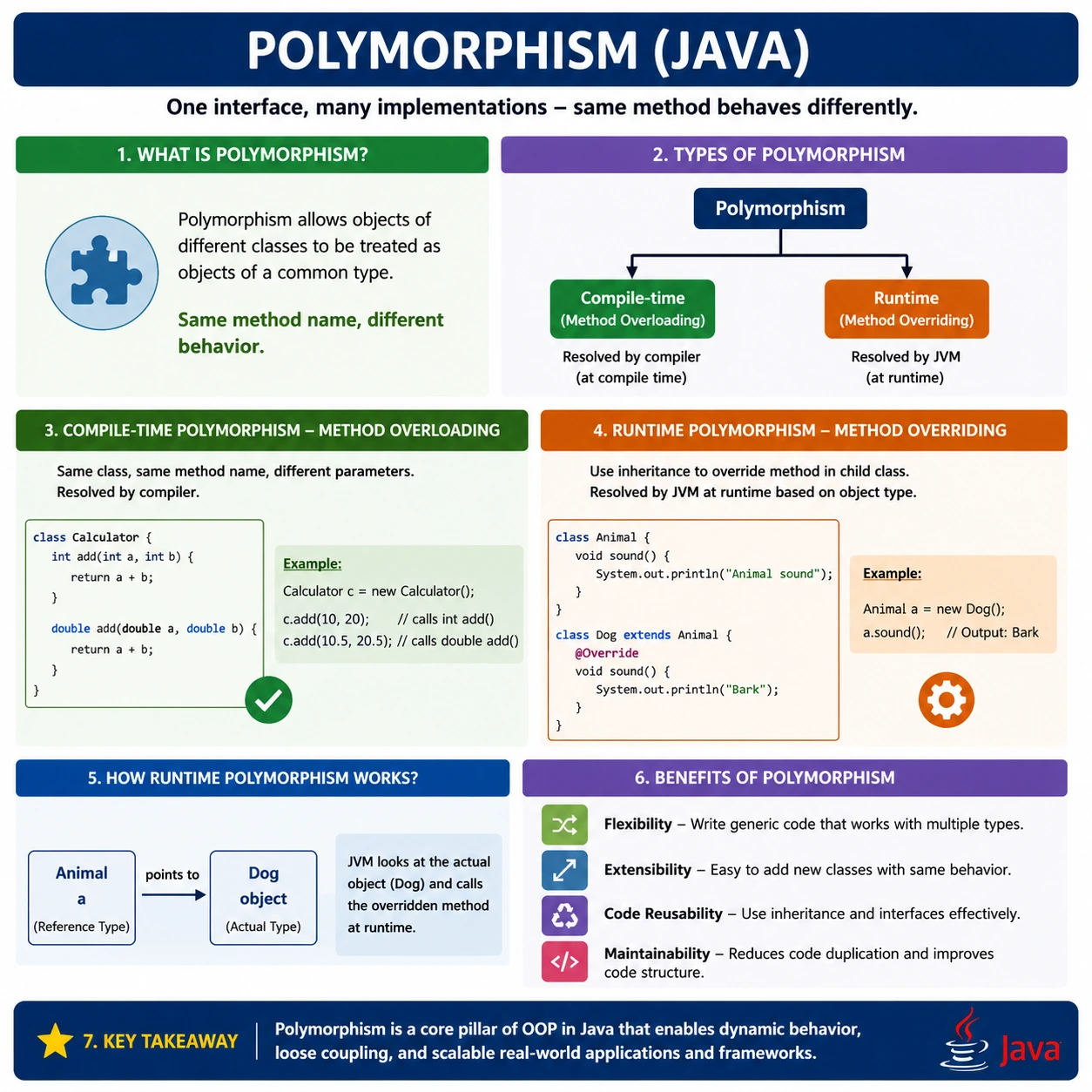
Java supports two major forms of polymorphism. Compile-time polymorphism is also called static polymorphism or static binding. It is achieved mainly through method overloading, where multiple methods share the same name but have different parameter lists. Runtime polymorphism is also called dynamic polymorphism or dynamic binding. It is achieved through inheritance and method overriding, where the method implementation is chosen at runtime based on the actual object type.
Both forms are important, but they solve different problems. Compile-time polymorphism improves convenience and readability by allowing the same method name to support different inputs. Runtime polymorphism improves flexibility and extensibility by allowing different child objects to respond differently through a common parent reference or interface reference.
What Is Polymorphism?
Polymorphism in Java means one name or one type can represent multiple behaviors. In method overloading, the same method name can perform similar work for different parameter combinations. In method overriding, the same method declared in a parent class can behave differently when implemented by different child classes. In interface-based design, the same interface reference can point to different implementation objects.
A useful way to understand polymorphism is to think in terms of messages. The caller sends a message, such as
draw(), pay(), print(), or sound(). The object receiving
the message decides how to respond. A Circle draws itself differently from a
Rectangle. A CreditCardPayment processes payment differently from a
WalletPayment. A Dog makes a different sound from a Cat. The method
name is common, but the behavior is specific.
This design promotes loose coupling. The caller does not need to know every implementation detail. It only needs to know the common parent class or interface. This makes code easier to maintain because new types can often be added without changing the code that uses the general type.
Compile-time Polymorphism (Static Polymorphism)
Compile-time polymorphism is achieved using method overloading. The method call is resolved at compile time based on the method signature, which includes the method name and parameter list. The compiler looks at the arguments passed to the method and decides which overloaded version should be called before the program runs.
Key Characteristics
Compile-time polymorphism does not require inheritance. A single class can contain several methods with the same name as long as their parameter lists are different. The difference may be the number of parameters, the type of parameters, or the order of parameter types. Return type alone is not enough to overload a method because the compiler must be able to choose the method from the call expression itself.
This form of polymorphism is often considered faster and simpler because method binding happens before execution. The compiler knows exactly which method will be called. There is no need for runtime method dispatch. However, compile-time polymorphism is less flexible than runtime polymorphism because the method decision is based on declared parameters, not on the actual object behavior.
Example: Method Overloading
class Calculator {
    int add(int a, int b) {
        return a + b;
    }
    int add(int a, int b, int c) {
        return a + b + c;
    }
    double add(double a, double b) {
        return a + b;
    }
}
This is compile-time polymorphism because the compiler decides which add() method to call based
on the arguments. If two integer values are passed, the two-argument integer method is selected. If three
integers are passed, the three-argument version is selected. If two double values are passed, the double
version is selected. The method name remains the same, but the parameter list controls the selection.
Compile-time Polymorphism Rules
The rules for compile-time polymorphism are direct. The methods must have the same name, but their parameter lists must differ. A method with the same name and same parameters but only a different return type is not valid overloading because the compiler cannot decide which method to call from the arguments alone. Binding happens before execution, so overloading is also called static binding.
Runtime Polymorphism (Dynamic Polymorphism)
Runtime polymorphism is achieved using method overriding and inheritance. The method call is resolved at runtime based on the actual object, not merely the reference type. This is the form of polymorphism most closely associated with object-oriented design because it allows a parent reference or interface reference to work with many child implementations.
Key Characteristics
Runtime polymorphism requires an IS-A relationship. A child class extends a parent class or implements an interface, and the child class provides its own implementation of a method. The reference type determines what methods are available to call, but the actual object type determines which overridden method implementation runs. This is called dynamic method dispatch.
Runtime polymorphism is especially useful when a system needs to support new behavior over time. Instead of changing existing caller code for every new type, developers can create a new class that follows the same parent contract and overrides the required methods. Existing code that works with the parent type can often use the new object without modification.
Example: Method Overriding
class Animal {
    void sound() {
        System.out.println("Animal sound");
    }
}
class Dog extends Animal {
    @Override
    void sound() {
        System.out.println("Dog barks");
    }
}

Animal a = new Dog();
a.sound();   // Dog barks
In this example, the reference type is Animal, but the object type is Dog. The
compiler allows the method call because sound() exists in the Animal class. At
runtime, the JVM sees that the actual object is Dog, so it executes the overridden
Dog implementation. This is runtime polymorphism in action.
Why Runtime Polymorphism Works
Runtime polymorphism works because the JVM uses dynamic method dispatch for overridden instance methods. The compiler checks the method against the reference type, but the JVM selects the actual implementation during execution. This creates plug-and-play behavior. A method can accept a parent type, and any valid child object can be passed to it. The method call remains the same, but the behavior changes according to the object.
Compile-time vs Runtime Polymorphism (Interview Favorite)
The difference between compile-time and runtime polymorphism is one of the most common Java interview areas. Compile-time polymorphism is based on method overloading and is resolved by the compiler. Runtime polymorphism is based on method overriding and is resolved by the JVM during execution. Compile-time polymorphism is mainly about using the same method name for different inputs. Runtime polymorphism is about using the same parent contract for different object behaviors.
| Aspect | Compile-time | Runtime |
|---|---|---|
| Also called | Static Polymorphism | Dynamic Polymorphism |
| Achieved by | Method Overloading | Method Overriding |
| Binding time | Compile time | Runtime |
| Inheritance required | No | Yes |
| Method signature | Different | Same |
| Performance | Faster | Slightly slower |
| Flexibility | Limited | High |
A good interview answer should not simply memorize this table. It should explain the design impact. Method overloading makes APIs easier to use because one method name can support multiple input styles. Method overriding makes applications easier to extend because new subclasses can provide new behavior behind the same parent type.
Polymorphism with Parent Reference
Parent references are central to runtime polymorphism. When a parent reference points to a child object, Java allows the object to be treated as its parent type. This is safe because every child object is also a valid parent object in an IS-A relationship. However, the reference type and object type play different roles.
Parent p = new Child();
The reference type decides which methods can be called directly. If a method is declared only in the child class and not in the parent class, the parent reference cannot call it without casting. But when a method is declared in the parent class and overridden by the child class, the method call is allowed through the parent reference and the child implementation runs at runtime.
Polymorphism Limitations
Polymorphism in Java has clear limitations. Static methods are not overridden because they belong to the
class, not to objects. If a child class defines a static method with the same signature as a parent static
method, it is method hiding, not overriding. Final methods cannot be overridden because the
final keyword prevents subclasses from changing the method implementation. Private methods are
not overridden because they are not visible to child classes.
Variables also do not participate in runtime polymorphism. Field access is resolved by reference type, not by actual object type. This is why a parent reference pointing to a child object may still access the parent field value when both parent and child define a field with the same name.
class A {
    int x = 10;
}
class B extends A {
    int x = 20;
}
A obj = new B();
System.out.println(obj.x); // 10
This example is a common interview trap. The object is B, but the reference type is
A. Since fields are not polymorphic, obj.x resolves to the field declared in
A. If x were accessed through an overridden method, the method behavior would be
resolved at runtime, but direct field access is different.
Real-World Example (Very Interview-Friendly)
A payment system is one of the clearest real-world examples of polymorphism. Every payment type performs a payment operation, but each type handles it differently. A credit card payment may validate card details and contact a card network. A UPI payment may validate a virtual payment address. A wallet payment may check wallet balance. The caller should not need a separate block of code for every payment type.
class Payment {
    void pay() {
        System.out.println("Generic payment");
    }
}
class CreditCard extends Payment {
    void pay() {
        System.out.println("Credit card payment");
    }
}
class UPI extends Payment {
    void pay() {
        System.out.println("UPI payment");
    }
}

Payment p = new CreditCard();
p.pay(); // Credit card payment
This design makes it easy to add new payment types. If a new payment class extends Payment and
overrides pay(), existing code that works with Payment can use it. This supports
the Open-Closed Principle: code is open for extension but closed for unnecessary modification.
Benefits of Polymorphism
Polymorphism reduces coupling because callers depend on general contracts instead of specific implementations. A method can accept a parent class or interface and work with many concrete objects. This makes the code easier to test, extend, and refactor. It also avoids repeated conditional logic because each object owns its own behavior.
Polymorphism improves abstraction. The caller focuses on what operation is needed, not how every object performs it. This is important in large systems where implementation details change frequently. If the contract remains stable, implementations can evolve behind the same method name or interface.
It also improves maintainability. When behavior is placed in the correct subclass, changes are localized. A new report type, payment type, notification type, or shape type can be added by writing a new implementation instead of modifying many existing branches of logic.
Common Beginner Mistakes
A common beginner mistake is confusing overloading with overriding. Overloading uses the same method name with different parameters and is resolved at compile time. Overriding uses the same method signature in a parent-child relationship and is resolved at runtime. Remembering this distinction makes most polymorphism questions easier.
Another mistake is expecting variables to behave polymorphically. They do not. If both parent and child classes declare a field with the same name, the field accessed depends on the reference type. Runtime polymorphism applies to overridden instance methods, not direct field access.
Developers also sometimes think static methods are overridden. Static methods are hidden, because they
belong to classes rather than objects. Another frequent issue is forgetting to use the
@Override annotation. Without it, a small signature mistake may create an overloaded method
instead of an overridden one, causing runtime behavior to differ from expectations.
Polymorphism in Good Object-Oriented Design
Good polymorphic design starts with a stable common contract. The parent class or interface should describe
behavior that all implementations genuinely share. The child classes should provide specific implementations
without violating the meaning of the contract. If an interface says send(), every
implementation should send something, even if email, SMS, and push notification implementations do it
differently.
This matters because polymorphism allows one reference type to represent many object types. If some implementations behave in unexpected or unrelated ways, the caller cannot safely rely on the contract. The program may compile, but the design becomes difficult to trust. In practical projects, polymorphism works best when class names, method names, and behavior all match the domain meaning.
Polymorphism is also closely related to interfaces. In many modern Java applications, interfaces are used to
define contracts, and classes provide implementations. A service may depend on an interface such as
NotificationSender, while the actual object may be EmailSender,
SmsSender, or PushSender. This gives applications flexibility because the
implementation can be changed without rewriting the caller.
Interview Explanation Strategy
In interviews, explain polymorphism in layers. Start with the meaning: polymorphism means many forms, where the same method name or reference type can show different behavior. Then describe the two types in Java: compile-time polymorphism through method overloading and runtime polymorphism through method overriding. After that, explain the key difference: compile-time polymorphism is resolved by the compiler, while runtime polymorphism is resolved by the JVM based on the actual object.
A strong answer should include a small example such as Animal a = new Dog(); a.sound();. This
shows that the reference type is parent, the object type is child, and the child method runs. You should also
mention the limitations: static methods, private methods, final methods, and variables do not behave like
overridden instance methods.
Finally, connect the concept to design value. Polymorphism supports loose coupling, extensibility, cleaner code, and the Open-Closed Principle. This shows that you understand not only the syntax but also why Java developers use polymorphism in real systems.
Polymorphism with Interfaces
Although inheritance with classes is a common way to explain runtime polymorphism, interfaces are often the cleaner and more common approach in modern Java applications. An interface defines a capability without forcing a class inheritance hierarchy. Different classes can implement the same interface even when they are not naturally related by a parent class. This allows polymorphism based on behavior rather than shared ancestry.
For example, EmailSender, SmsSender, and PushNotificationSender may
all implement a NotificationSender interface. These classes may not need a common superclass,
but they share the ability to send a notification. A service can depend on NotificationSender
and call send(). At runtime, the actual object determines whether the notification is sent by
email, SMS, or push message.
Interface-based polymorphism supports loose coupling especially well. The caller depends on the interface, not the implementation class. This makes substitution easier. In testing, a mock implementation can replace a real implementation. In production, one implementation can be swapped for another without changing the calling code, as long as the interface contract remains stable.
Polymorphism and Loose Coupling
Loose coupling means one part of the program knows as little as possible about another part's internal details. Polymorphism supports loose coupling because code can depend on a parent type or interface instead of a concrete class. The caller knows what operation is available, but it does not need to know how the operation is implemented.
This is valuable when requirements change. Suppose a system originally supports only credit card payments.
If the code is written directly against CreditCardPayment, adding wallet payment or bank
transfer payment may require changes in many places. If the code is written against a Payment
abstraction, new payment types can be added with fewer changes. Each new implementation provides its own
behavior through overriding or interface implementation.
Loose coupling also makes code easier to test. A method that depends on an interface can receive a simple fake or test implementation during unit testing. The method does not care whether the implementation talks to a database, sends a network request, or simply records a value for verification. This flexibility is one of the practical business benefits of polymorphism.
Polymorphism, Casting, and Type Safety
Polymorphism often works with upcasting and downcasting. Upcasting happens when a child object is assigned to
a parent reference. This is safe and automatic because every child object is also a parent type. For example,
a Dog object can be assigned to an Animal reference. This is the normal foundation
of runtime polymorphism.
Downcasting moves in the opposite direction. It converts a parent reference back to a child reference. This
is not always safe because not every parent object is actually that child type. If an Animal
reference points to a Dog object, casting it to Dog is valid. If the same reference
points to a plain Animal object or a different child type, the cast fails at runtime with a
ClassCastException.
The instanceof operator helps protect against invalid casts. It checks whether an object is an
instance of a particular type before casting. In good design, excessive downcasting is often a warning sign.
If code frequently needs to ask what specific child type it has, the design may not be using polymorphism
fully. Ideally, common behavior should be declared in the parent type or interface so callers can avoid
type-specific checks.
When Polymorphism Should Not Be Forced
Polymorphism is powerful, but it should not be forced into every design. If classes do not share a meaningful contract, creating a parent type only to make the code look object-oriented can make the system harder to understand. A common parent or interface should represent real shared behavior. Otherwise, implementations may contain empty methods, unsupported operations, or confusing behavior that violates caller expectations.
Another problem appears when polymorphism hides important differences that the business actually cares about. A general abstraction is useful only when callers can safely treat different implementations in a common way. If every implementation requires unique handling in the caller, the abstraction may be too broad or poorly designed. In that case, separating responsibilities or using composition may be clearer.
Good polymorphism is not about reducing all code to one parent type. It is about finding the right level of common behavior. When the common contract is meaningful and stable, polymorphism makes the design elegant. When the contract is vague, polymorphism can create confusion.
Polymorphism in Frameworks and Libraries
Many Java frameworks depend heavily on polymorphism. A framework often defines an interface or base class, and developers provide implementations. The framework then calls those methods at the correct time. This is common in web frameworks, testing frameworks, persistence frameworks, and dependency injection containers.
For example, a testing framework may define lifecycle methods that can be overridden by test classes. A web framework may call controller methods through common abstractions. A persistence framework may work with repository interfaces while the actual implementation is supplied at runtime. In all these cases, the framework code does not need to know every application-specific class in advance. It relies on a contract and lets polymorphism deliver the correct behavior.
This is why understanding polymorphism helps beyond basic Java syntax. It explains how large Java applications remain extensible. Frameworks are built around stable contracts, and application code plugs in specific behavior through subclasses or interface implementations.
Polymorphism Examples (Compile-Time vs Runtime)
1. Polymorphism via Method Overriding (Core Example)
class Animal {
    void sound() {
        System.out.println("Animal sound");
    }
}

class Dog extends Animal {
    void sound() {
        System.out.println("Dog barks");
    }

    public static void main(String[] args) {
        Animal a = new Dog();
        a.sound();
    }
}
Explanation
- Parent reference points to a child object
- Runtime method binding
Output: Dog barks
2. Compile-Time Polymorphism (Method Overloading)
class Calc {
    int add(int a, int b) {
        return a + b;
    }

    int add(int a, int b, int c) {
        return a + b + c;
    }

    public static void main(String[] args) {
        Calc c = new Calc();
        System.out.println(c.add(2, 3));
        System.out.println(c.add(2, 3, 4));
    }
}
Explanation
- Method resolved at compile time
Output:
5
9
3. Runtime Polymorphism with Multiple Child Classes
class Shape {
    void draw() {
        System.out.println("Drawing shape");
    }
}

class Circle extends Shape {
    void draw() {
        System.out.println("Drawing circle");
    }
}

class Square extends Shape {
    void draw() {
        System.out.println("Drawing square");
    }
}

class Test {
    public static void main(String[] args) {
        Shape s1 = new Circle();
        Shape s2 = new Square();

        s1.draw();
        s2.draw();
    }
}
Explanation
- Same reference type, different behaviors
Output:
Drawing circle
Drawing square
4. Polymorphism Using Method Parameter
class Printer {
    void print(String msg) {
        System.out.println(msg);
    }
}

class Test {
    static void call(Printer p) {
        p.print("Hello");
    }

    public static void main(String[] args) {
        call(new Printer());
    }
}
Explanation
- Method accepts parent type
- Behavior depends on actual object
5. Polymorphism Using Return Type
class Animal {
    void sound() {
        System.out.println("Animal");
    }
}

class Cat extends Animal {
    void sound() {
        System.out.println("Meow");
    }
}

class Test {
    static Animal getAnimal() {
        return new Cat();
    }

    public static void main(String[] args) {
        Animal a = getAnimal();
        a.sound();
    }
}
Explanation
- Returned object decides behavior
Output: Meow
6. Polymorphism with super Reference
class A {
    void show() {
        System.out.println("A");
    }
}

class B extends A {
    void show() {
        System.out.println("B");
    }

    void test() {
        super.show();
    }

    public static void main(String[] args) {
        new B().test();
    }
}
Explanation
- super bypasses polymorphism
Output: A
7. Polymorphism and Field Access (Trap)
class A {
    int x = 10;
}

class B extends A {
    int x = 20;

    public static void main(String[] args) {
        A a = new B();
        System.out.println(a.x);
    }
}
Explanation
- Variables are not polymorphic
Output: 10
8. Method Polymorphism vs Variable Access
class A {
    int x = 10;

    void show() {
        System.out.println(x);
    }
}

class B extends A {
    int x = 20;

    void show() {
        System.out.println(x);
    }

    public static void main(String[] args) {
        A a = new B();
        a.show();
        System.out.println(a.x);
    }
}
Explanation
- Method is resolved at runtime
- Variable is resolved at compile time
Output:
20
10
9. Polymorphism with Abstract Class
abstract class Vehicle {
    abstract void run();
}

class Car extends Vehicle {
    void run() {
        System.out.println("Car running");
    }

    public static void main(String[] args) {
        Vehicle v = new Car();
        v.run();
    }
}
Explanation
- Abstract method enables runtime polymorphism
Output: Car running
10. Polymorphism with Interface
interface Payment {
    void pay();
}

class CardPayment implements Payment {
    public void pay() {
        System.out.println("Paid by card");
    }
}

class Test {
    public static void main(String[] args) {
        Payment p = new CardPayment();
        p.pay();
    }
}
Explanation
- Interface reference points to an implementation object
Output: Paid by card
11. Polymorphism in Loop (Common Interview Case)
class Animal {
    void sound() {
        System.out.println("Animal");
    }
}

class Dog extends Animal {
    void sound() {
        System.out.println("Dog");
    }
}

class Cat extends Animal {
    void sound() {
        System.out.println("Cat");
    }
}

class Test {
    public static void main(String[] args) {
        Animal[] animals = { new Dog(), new Cat() };

        for (Animal a : animals) {
            a.sound();
        }
    }
}
Explanation
- Dynamic dispatch in loop
Output:
Dog
Cat
12. Polymorphism with Casting
class A {
    void show() {
        System.out.println("A");
    }
}

class B extends A {
    void test() {
        System.out.println("B specific");
    }

    public static void main(String[] args) {
        A a = new B();
        B b = (B) a;
        b.test();
    }
}
Explanation
- Downcasting enables child-specific methods
Output: B specific
13. Invalid Polymorphic Cast (Runtime Error)
class A {}
class B extends A {}

class Test {
    public static void main(String[] args) {
        A a = new A();
        // B b = (B) a; // ClassCastException
    }
}
Explanation
- Object type must match cast
14. Polymorphism and instanceof
class A {}
class B extends A {}

class Test {
    public static void main(String[] args) {
        A a = new B();
        System.out.println(a instanceof B);
    }
}
Explanation
- Runtime type check
Output: true
15. Static Methods Are NOT Polymorphic
class A {
    static void show() {
        System.out.println("A");
    }
}

class B extends A {
    static void show() {
        System.out.println("B");
    }

    public static void main(String[] args) {
        A a = new B();
        a.show();
    }
}
Explanation
- Static binding
Output: A
16. Polymorphism with Final Method
class A {
    final void show() {
        System.out.println("Final method");
    }
}

class B extends A {
    // cannot override
}
Explanation
- final prevents polymorphism via overriding
17. Polymorphism with Constructor (Not Applicable)
class A {
    A() {
        System.out.println("A constructor");
    }
}

class B extends A {
    B() {
        System.out.println("B constructor");
    }

    public static void main(String[] args) {
        A a = new B();
    }
}
Explanation
- Constructors are not polymorphic
Output:
A constructor
B constructor
18. Polymorphism in Real-World Example (Logger)
interface Logger {
    void log(String msg);
}

class FileLogger implements Logger {
    public void log(String msg) {
        System.out.println("File: " + msg);
    }
}

class Test {
    static void process(Logger l) {
        l.log("Started");
    }

    public static void main(String[] args) {
        process(new FileLogger());
    }
}
Explanation
- Behavior varies by implementation
Output: File: Started
19. Compile-Time vs Runtime Polymorphism (Side by Side)
class Demo {
    void show(int x) {
        System.out.println("int");
    }

    void show(String s) {
        System.out.println("String");
    }

    public static void main(String[] args) {
        Demo d = new Demo();
        d.show(10);
        d.show("Java");
    }
}
Explanation
- Compile-time polymorphism
Output:
int
String
20. Interview Summary – Polymorphism
class A {
    void show() {
        System.out.println("A");
    }
}

class B extends A {
    void show() {
        System.out.println("B");
    }

    public static void main(String[] args) {
        A obj = new B();
        obj.show();
    }
}
Explanation
- One interface, many forms
- Runtime method binding
- Core OOP concept
Output: B
Interview-Ready Answers
Short Answer
Polymorphism allows the same method to behave differently based on context.
Detailed Answer
In Java, polymorphism is achieved in two ways: compile-time polymorphism using method overloading, where method resolution happens at compile time, and runtime polymorphism using method overriding, where the JVM determines the method call at runtime based on the object type.
Key Takeaway
Compile-time polymorphism decides behavior early. Runtime polymorphism decides behavior dynamically. Polymorphism is the heart of flexible and extensible Java design and is essential for frameworks, APIs, and real-world applications.