Method Overloading vs Method Overriding
Method overloading vs method overriding is a classic Java interview topic because it tests more than one concept at the same time. To answer it well, you must understand methods, parameters, inheritance, method signatures, compile-time binding, runtime polymorphism, access modifiers, static methods, final methods, private methods, and object reference behavior. Many candidates memorize one line, but they struggle when the interviewer changes the example slightly. The safest way to master this topic is to understand the reason behind each rule.
The confusion usually comes from the words "same method name." Both overloading and overriding can involve the same method name, but the meaning is very different. In overloading, the class provides multiple methods with the same name but different parameter lists, and the compiler decides which one to call. In overriding, a child class provides its own implementation of a method already defined in the parent class, and the JVM decides at runtime which implementation should execute based on the actual object.
A strong interview answer should not only say "overloading is compile time and overriding is runtime." That is correct, but it is not enough by itself. You should also explain method signature rules, whether inheritance is required, how return types work, what happens with static methods, and why private or final methods cannot be overridden. These details show that you understand polymorphism as a real language feature rather than a definition from a textbook.
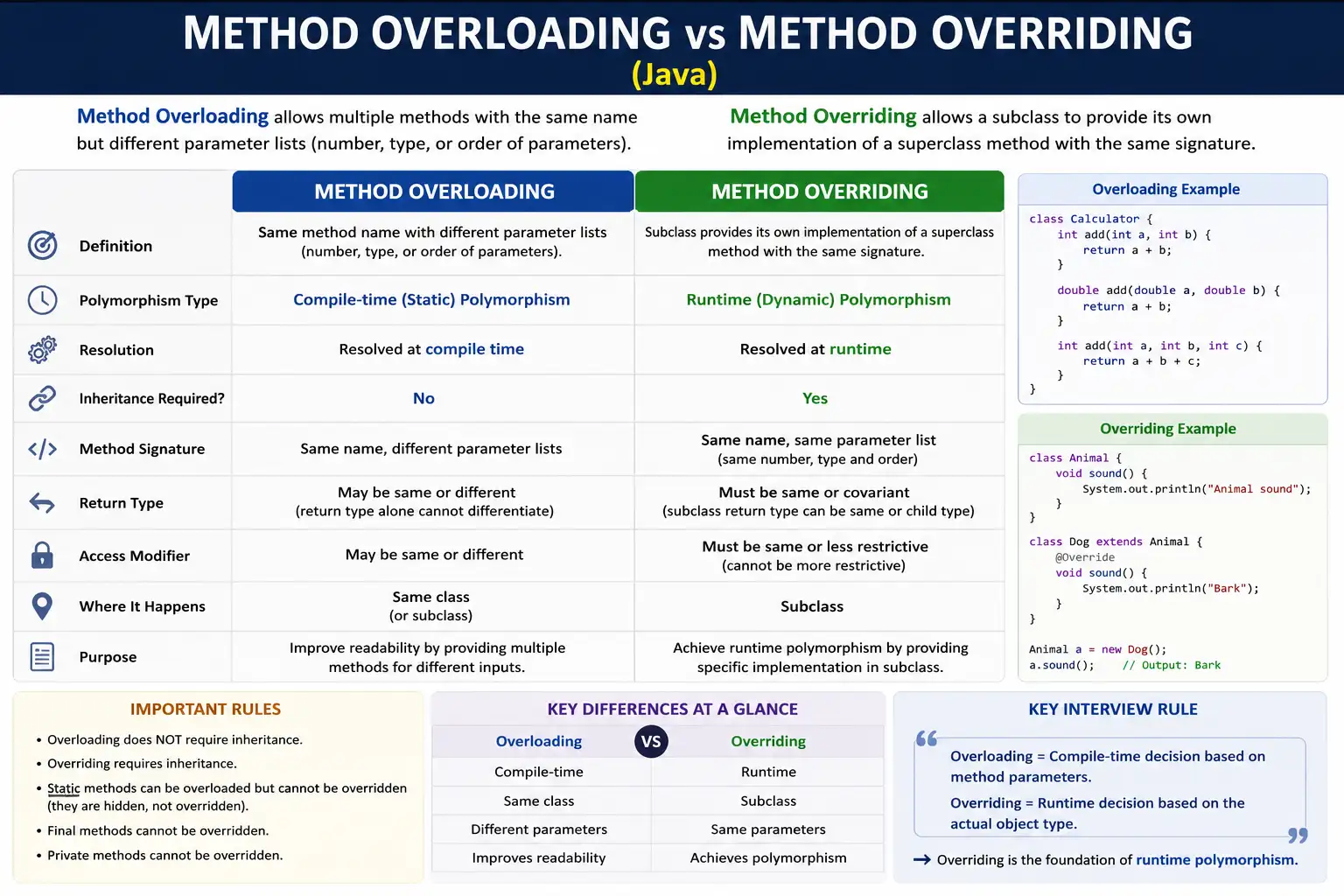
High-Level Difference (One Line)
- Overloading → Same method name, different parameters (compile time)
- Overriding → Same method signature, different implementation (runtime)
This one-line difference is the best starting point. Overloading is about method selection based on the method call expression. The compiler looks at the method name and the arguments you pass, then chooses the most suitable matching method before the program runs. Overriding is about behavior replacement in an inheritance hierarchy. The compiler allows the call based on the reference type, but the actual implementation is selected at runtime based on the object type.
In practical terms, overloading improves API readability. A class can offer one method name for related operations that accept different inputs. Overriding enables runtime polymorphism. A parent reference can point to different child objects, and each child can respond in its own way to the same method call. This is a foundation of object-oriented design.
Method Overloading
What Is Method Overloading?
Method overloading allows multiple methods with the same name in the same class (or subclass) with different parameter lists.
- ✔ Happens at compile time
- ✔ Also called static polymorphism
Overloading is common in everyday Java APIs. For example, a method named print may accept an
integer, a string, a character array, or an object. The purpose is to keep the method name consistent when the
operation concept is the same but the input form changes. This makes code easier to read because the caller
thinks in terms of the action, while the compiler handles the exact method selection.
Overloading is resolved at compile time because the compiler can inspect the argument types in the method call.
If you call add(10, 20), the compiler knows both arguments are integers. If you call
add(10.5, 20.5), it knows the arguments are doubles. The compiler then selects the matching method
before runtime. This is why overloading is called compile-time polymorphism or static polymorphism.
Overloading does not require inheritance. It can happen entirely within one class. It can also happen in a subclass if the subclass defines another method with the same name but a different parameter list. The key is not parent-child behavior; the key is different parameters. If the parameter list does not change, you do not have valid overloading.
Rules of Method Overloading
- Method name must be same
-
Parameter list must be different
- Number of parameters OR
- Type of parameters OR
- Order of parameters
- Return type alone cannot differ
- Access modifier does not matter
- Can be in same class or subclass
The most important rule is that the parameter list must be different. Difference can mean a different number of
parameters, different parameter types, or a different order of parameter types. For example,
login(String username, String password) and login(String token) are overloaded
because the number of parameters differs. show(int value) and show(String value) are
overloaded because the types differ. display(String name, int age) and display(int age,
String name) are overloaded because the order differs.
Return type alone cannot create overloading. If two methods have the same name and same parameter list but
different return types, the compiler rejects the code. The reason is simple: Java method selection for
overloading is based on the method name and arguments, not the variable that receives the return value. If you
call calculate(10), the compiler cannot safely choose between two methods only because one returns
int and another returns double. The call itself would be ambiguous.
Access modifiers do not decide overloading either. You may have overloaded methods with different access modifiers, but the overload is valid because the parameters differ, not because access differs. Similarly, checked exceptions do not create a separate overloaded method. The method signature for overloading focuses on the method name and parameter list.
Overloading Example
class Calculator {
    int add(int a, int b) {
        return a + b;
    }
    double add(double a, double b) {
        return a + b;
    }
    int add(int a, int b, int c) {
        return a + b + c;
    }
}
- ✔ Valid overloading
- ✔ Method selection decided at compile time
In the Calculator example, all three methods are named add, but each method accepts a different
parameter list. The first accepts two integers, the second accepts two doubles, and the third accepts three
integers. When the caller writes add(5, 6), the compiler selects the two-integer version. When the
caller writes add(5.5, 6.5), the compiler selects the double version. The method name stays
meaningful while the parameter list gives the compiler enough information to choose.
This pattern is useful in business code. A payment service may have overloaded methods for payment by card, payment by wallet, and payment by bank account. A reporting utility may generate a report by date range, by user ID, or by status. As long as the operation concept is the same and the parameter lists are clear, overloading can make an API cleaner.
Overloading and Type Promotion (Interview Trap)
void show(int a) {
    System.out.println("int");
}
void show(long a) {
    System.out.println("long");
}
show(10); // int
✔ Compiler chooses best match
Type promotion is one of the most common overloading traps. Java tries to choose the most specific matching
method. In the example above, 10 is an integer literal, so show(int) is the best
match. If show(int) did not exist, Java could promote the int value to long and call
show(long). The compiler follows a defined overload resolution process rather than randomly
choosing a method.
This matters when multiple overloaded methods appear valid. Java may prefer exact match, then widening, then boxing, and then varargs depending on the available methods. Ambiguity can occur when the compiler cannot decide between two equally suitable methods. Interviewers use these examples to check whether you understand that overloading is a compile-time decision based on declared argument types.
Method Overriding
What Is Method Overriding?
Method overriding allows a subclass to provide a specific implementation of a method already defined in its parent class.
- ✔ Happens at runtime
- ✔ Also called dynamic polymorphism
Overriding is possible only when there is inheritance. A child class inherits a method from a parent class and provides a new implementation with the same method signature. The parent defines the general contract, while the child provides behavior specific to its type. This is why overriding is closely tied to the IS-A relationship. A Dog is an Animal, so a Dog can override behavior defined by Animal.
Overriding is resolved at runtime. The reference type may be the parent class, but the actual object may be a child class. When the method is called, Java dispatches the call to the implementation belonging to the real object. This is runtime polymorphism, also called dynamic method dispatch. It allows flexible and extensible designs because code can depend on parent types while child objects provide specialized behavior.
Rules of Method Overriding
- Method name must be same
- Parameter list must be same
- Return type must be same or covariant
- Access modifier cannot be more restrictive
- Method must not be static, final, or private
- Requires inheritance
- Uses IS-A relationship
The signature rule is strict. For overriding, the method name and parameter list must match the parent method. If the child changes the parameter list, it is not overriding; it is overloading. This is a common source of bugs. A developer may think a child class is replacing parent behavior, but because a parameter type changed, Java treats it as a new overloaded method instead.
The return type must be the same or covariant. A covariant return type means the child method may return a more
specific type than the parent method. For example, if the parent method returns Animal, the child
method may return Dog, assuming Dog is a subtype of Animal. This is allowed because callers
expecting the parent return type can safely receive the child return type.
The access modifier cannot be more restrictive in the child class. If the parent method is public, the child override must also be public. If the parent method is protected, the child may keep it protected or make it public, but it cannot reduce visibility to private. The reason is substitutability. If a child object is used through a parent reference, it must still support the accessible methods promised by the parent type.
Static, final, and private methods are special cases. A final method cannot be overridden because the parent explicitly prevents replacement. A private method is not inherited in a way that allows overriding, so a method with the same name in the child is a separate method. A static method belongs to the class, not the object, so redefining it in a child class is method hiding, not overriding.
Overriding Example
class Animal {
    void sound() {
        System.out.println("Animal sound");
    }
}
class Dog extends Animal {
    @Override
    void sound() {
        System.out.println("Dog barks");
    }
}
- ✔ Method resolved at runtime
- ✔ Based on object type
In the Animal and Dog example, sound() is defined in the parent class and redefined in the child
class with the same method signature. The child implementation is more specific. The parent says that every
animal can make a sound, while the child says that a dog barks. This is a simple example, but the same concept
appears in frameworks, service layers, UI components, data access classes, and test automation abstractions.
The @Override annotation is strongly recommended. It tells the compiler that your intention is to
override a parent method. If you accidentally change the parameter list or method name, the compiler reports an
error. Without @Override, Java may silently treat the method as a new method, and the bug may show
up only at runtime when the parent behavior executes instead of the child behavior.
Runtime Polymorphism Example
Animal a = new Dog();
a.sound(); // Dog barks
- ✔ Reference type → Animal
- ✔ Object type → Dog
- ✔ Runtime decision
This example is the heart of runtime polymorphism. The reference variable a is of type
Animal, so the compiler checks whether Animal has a sound() method. It does, so the
call is allowed. At runtime, however, the actual object is a Dog. Therefore, the JVM executes
Dog's overridden implementation and prints Dog barks.
This distinction between reference type and object type is one of the most important interview points. The reference type controls what methods can be called at compile time. The object type controls which overridden implementation executes at runtime. If a method exists only in Dog and not in Animal, you cannot call it using an Animal reference without casting, even though the actual object is a Dog.
Overriding with Covariant Return Type
class A {
    A get() {
        return this;
    }
}
class B extends A {
    @Override
    B get() {
        return this;
    }
}
- ✔ Allowed
- ✔ Java 5+
Covariant return types make overriding more flexible while preserving type safety. In the example, class A has a method that returns A. Class B extends A and overrides the method to return B. This is valid because B is a more specific type of A. Code that expects A can still receive B safely. This feature is useful in fluent APIs, factory methods, clone-like methods, and inheritance-based builders.
The key rule is that the return type may become more specific, but it cannot become unrelated. If the parent
returns Number, the child may return Integer. But the child cannot return
String because String is not a subtype of Number. This is another area where interviewers test
whether you understand inheritance relationships rather than memorizing isolated rules.
Static Methods: Overloading vs Overriding (Very Important)
Static Methods
- ✔ Can be overloaded
- ❌ Cannot be overridden (method hiding)
class Parent {
    static void show() {
        System.out.println("Parent");
    }
}
class Child extends Parent {
    static void show() {
        System.out.println("Child");
    }
}

Parent p = new Child();
p.show(); // Parent
✔ Compile-time binding
Static methods are bound to the class, not to the object. Because overriding depends on runtime object type, static methods do not participate in overriding. If a child class defines a static method with the same signature as a static method in the parent class, Java calls it method hiding. The method selected depends on the reference type or class name used in the call, not the actual object.
In the example, Parent p = new Child(); may look like it should call Child's method, but
show() is static. The reference type is Parent, so p.show() resolves to Parent's
static method. In professional code, it is better to call static methods using the class name, such as
Parent.show(), because it makes the binding clear and avoids confusion.
Static methods can still be overloaded because overloading is based on method name and parameter list at
compile time. You can have static void show(int x) and static void show(String x).
The compiler selects the correct static overload based on the arguments. The important point is that static
methods can be overloaded but not overridden.
Overloading vs Overriding — Interview Comparison Table
| Aspect | Overloading | Overriding |
|---|---|---|
| Polymorphism | Compile-time | Runtime |
| Method name | Same | Same |
| Parameters | Must differ | Must be same |
| Return type | Can differ (not alone) | Same / covariant |
| Inheritance | ❌ Not required | ✔ Required |
| Access modifier | Any | Cannot reduce visibility |
| Static methods | ✔ Allowed | ❌ Not overridden |
| Binding time | Compile time | Runtime |
The comparison table is useful for quick revision, but the deeper distinction is the binding decision. Overloading answers the question, "Which method signature best matches this call?" Overriding answers the question, "Which implementation should run for this actual object?" The first question is answered by the compiler. The second question is answered by the JVM at runtime.
Inheritance is another major separator. Overloading does not require a parent-child relationship. A single class can overload its own methods. Overriding requires inheritance because a child class must override a method it receives from a parent class. If there is no parent method contract, there is nothing to override.
Parameters are also opposite. In overloading, parameters must differ. In overriding, parameters must remain the same. Return type rules are different too. In overloading, return type can differ, but return type alone cannot create overloads. In overriding, return type must be the same or covariant. These four rules usually solve most interview examples.
Constructor Overloading and Constructor Overriding
Constructors can be overloaded, but they cannot be overridden. Constructor overloading is common because a class may allow objects to be created with different sets of input data. For example, an Employee class may have one constructor that accepts only an ID, another that accepts ID and name, and another that accepts ID, name, and department. The constructor name is the same because it matches the class name, but the parameter lists differ.
Constructor overriding is not possible because constructors are not inherited like normal methods. A child class
constructor may call a parent constructor using super(), but it does not override the parent
constructor. This is a frequent interview trap. If asked directly, the answer is: constructors can be
overloaded, but constructors cannot be overridden.
Private, Final, and Abstract Method Cases
Private methods cannot be overridden because they are not visible to the child class as inherited methods. If a child class declares a method with the same name and parameters as a private method in the parent, it is a new method in the child, not an override. The parent's private method remains private to the parent.
Final methods cannot be overridden because the final keyword explicitly prevents child classes
from changing the implementation. This is used when the parent class wants to guarantee behavior. A final
method may still be overloaded in the same class or subclass if the parameter list changes, but the exact final
method signature cannot be overridden.
Abstract methods are designed to be overridden. An abstract method declares what a child class must provide but does not provide the complete implementation itself. When a concrete subclass extends an abstract class, it must implement the inherited abstract methods unless the subclass is also abstract. This is overriding in a very direct form: the child supplies the behavior required by the parent contract.
Real-World Use of Overloading
Overloading is useful when one operation has multiple input forms. In a testing utility, a method named
assertText might accept only expected and actual values in one overload, and expected value,
actual value, and custom message in another overload. In a logging utility, a method named log
might accept a simple message, a message with exception details, or a message with severity. The caller gets a
clean API while the class supports multiple use cases.
Good overloading should improve readability. If overloaded methods perform unrelated actions, the design becomes confusing. The shared method name should represent the same conceptual operation. Different parameters should represent different ways to supply data for that operation. This makes overloading a tool for API clarity, not just a trick for using the same method name many times.
Real-World Use of Overriding
Overriding is useful when different child classes must follow the same parent contract but behave differently.
A payment system may have a parent class or interface for payment processing, while card payment, wallet
payment, and bank transfer classes each provide their own implementation. The application can call
processPayment() through the parent type, and the correct child implementation runs at runtime.
In automation frameworks, overriding appears when base page classes define common actions and child page classes provide page-specific behavior. In UI applications, components override rendering behavior. In backend systems, service implementations override common service contracts. Overriding supports extensibility because new child classes can be introduced without changing every caller that depends on the parent type.
Overloading vs Overriding in Polymorphism
Both overloading and overriding are connected to polymorphism, but they represent different forms. Overloading is compile-time polymorphism because the compiler selects from multiple method forms. Overriding is runtime polymorphism because the JVM selects the implementation based on the actual object. This difference is why overloading is also called static polymorphism and overriding is called dynamic polymorphism.
A practical way to remember this is to focus on what changes. In overloading, the input changes. The method name is the same, but the parameters are different. In overriding, the object changes. The method signature is the same, but the implementation depends on the child object. This simple mental model helps you solve code prediction questions quickly.
Common Interview Traps
- Changing return type only → ❌ not overloading
- Expecting static method overriding → ❌
- Confusing reference type vs object type
- Forgetting access-modifier rule
- Overriding private methods (not possible)
Changing only the return type is one of the most common traps. It is not valid overloading because the
parameter list remains the same. Another trap is accidentally overloading when you intended to override. If a
child method changes a parameter from int to long, it no longer overrides the parent
method. The parent method still exists, and runtime polymorphism may not behave as expected.
Static method behavior is another high-frequency trap. Candidates often expect Parent p = new
Child(); p.show(); to call the child static method. It does not, because static methods are resolved by
reference type or class name at compile time. This is method hiding, not overriding.
Access modifiers also create tricky examples. A child class cannot override a public method with a protected or private method because that would reduce visibility. The child can maintain or increase visibility, but it cannot make the method less accessible than the parent contract. This rule protects polymorphism and substitutability.
Finally, remember that private methods are not overridden. A child method with the same name as a parent private method is a separate method. Similarly, final methods cannot be overridden at all. These cases are often used in multiple-choice questions because they look similar to normal overriding but follow different rules.
How to Identify the Correct Concept in Code
When you see a Java code question, first check the parameter list. If methods have the same name but different parameters, you are looking at overloading. Then ask what arguments are passed in the method call. The compiler will choose the best matching overload based on the declared argument types and conversion rules.
If methods have the same name and same parameters in a parent-child relationship, you are likely looking at overriding. Then check whether the method is static, final, or private. If it is static, the case is method hiding. If it is final, overriding is not allowed. If it is private, the child method is separate. If it is a normal instance method, runtime object type decides the implementation.
Next, check the reference declaration and object creation. In Animal a = new Dog();, Animal is the
reference type and Dog is the object type. The reference type controls what the compiler allows you to call.
The object type controls which overridden instance method runs. This approach helps you solve almost every
overloading and overriding output question systematically.
Best Practices
Use overloading when the methods represent the same operation with different inputs. Keep overloaded methods easy to understand and avoid too many similar overloads that create ambiguity. If overloads differ only in ways that are hard for callers to notice, such as multiple numeric types or many nullable object parameters, the API can become confusing. Clear names and clear parameter lists are more important than forcing everything into one method name.
Use overriding when child classes genuinely need specialized behavior for a parent contract. Always use the
@Override annotation. It protects you from accidental signature mistakes and makes your intention
clear to readers. Avoid reducing visibility, avoid unnecessary inheritance, and prefer interfaces or abstract
classes when you are defining common behavior for multiple implementations.
For static utility behavior, do not rely on inheritance-based hiding. Static methods are clearer when called with the class name. If behavior needs to vary by object type, use instance methods and overriding instead of static methods. This keeps polymorphic behavior predictable.
Interview-Ready Answers
Short Answer
Overloading is defining multiple methods with the same name but different parameters, while overriding is redefining a parent class method in a child class.
Detailed Answer
In Java, method overloading occurs when multiple methods share the same name but differ in parameters and is resolved at compile time. Method overriding occurs when a subclass provides its own implementation of a method defined in its superclass and is resolved at runtime based on the object type.
You can strengthen the detailed answer by adding that overloading does not require inheritance, while overriding requires inheritance. In overloading, parameters must differ. In overriding, parameters must be the same. Return type alone cannot overload a method, while overridden methods must keep the same or covariant return type. Static methods can be overloaded but cannot be overridden; they are hidden.
A polished interview answer might be: Method overloading provides multiple versions of a method with different parameters and is resolved by the compiler. Method overriding allows a subclass to replace a superclass instance method with the same signature and is resolved by the JVM at runtime based on the actual object. This distinction is the foundation of compile-time and runtime polymorphism in Java.
Key Takeaway
Overloading = compile-time decision
Overriding = runtime decision
Understanding this distinction is critical for polymorphism, inheritance, and interview success.
The easiest way to remember the topic is this: overloading changes the parameters, overriding changes the implementation. Overloading is selected from the method call at compile time. Overriding is selected from the actual object at runtime. Once you connect those two ideas to method signatures, inheritance, static methods, access rules, and return types, you can answer both definition questions and code-output questions with confidence.