OOP Real-Time Examples
Below are clear, real-world examples for each OOP principle, mapped directly to Java concepts. These are frequently asked in interviews and easy to explain on the spot.
Object-oriented programming becomes much easier when it is connected to real-life systems instead of treated as a set of abstract definitions. In Java interviews, candidates are often asked to explain encapsulation, inheritance, polymorphism, abstraction, and interfaces with real-time examples. The interviewer is not only checking whether you remember the words. They are checking whether you can recognize these principles in actual software design and explain why they matter.
OOP is a way of modeling a system using objects that represent meaningful entities. A banking application may have objects such as account, customer, transaction, branch, and loan. An e-commerce application may have user, product, cart, order, payment, and notification objects. A test automation framework may have browser, page, element, test case, report, and driver objects. Each object holds data and behavior related to its purpose. This makes code easier to organize, reuse, extend, and maintain.
The strongest interview answers are simple, practical, and connected. You should be able to say what the principle means, give a real-world example, map that example to Java code, and explain the benefit. For example, encapsulation is not only "wrapping data and methods." In a bank account, the balance should not be directly changed from outside. Deposits and withdrawals must go through controlled methods that enforce rules. That is encapsulation in a form anyone can understand.
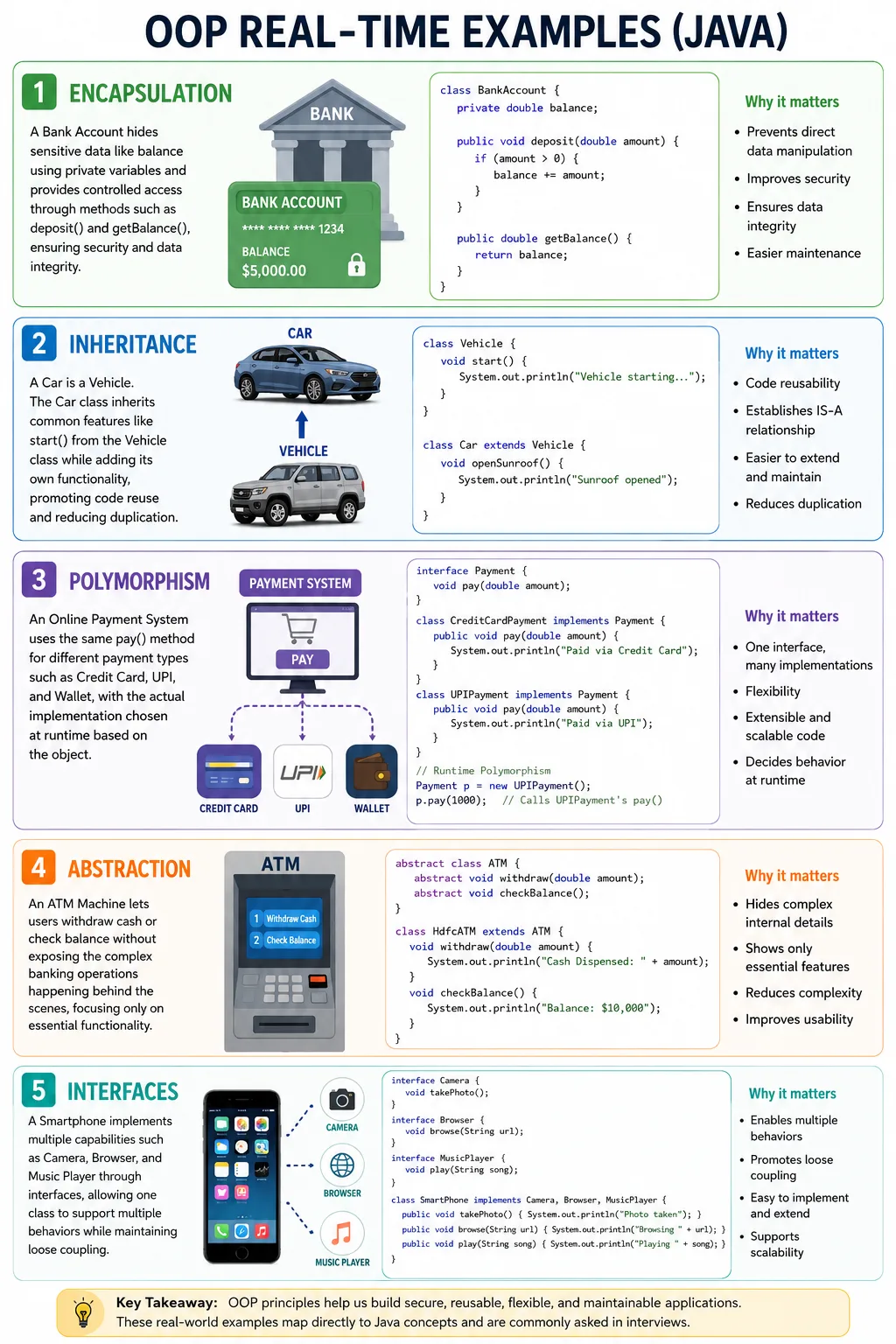
1️⃣ Encapsulation — Data Hiding & Controlled Access
Real-World Example: Bank Account
A bank account hides its balance and allows access only through methods.
Encapsulation means keeping data and the operations that work on that data together, while restricting direct access to internal state. In the bank account example, the balance is sensitive. If every part of the program could directly change the balance, invalid updates would be easy. Someone might set a negative balance, skip transaction rules, or update the amount without recording a transaction. A real banking system cannot allow that kind of uncontrolled access.
The better design is to keep the balance private and expose controlled methods such as
deposit(), withdraw(), and getBalance(). These methods become the gate
through which the object is used. The class can validate deposit amount, check withdrawal limits, apply fees,
update audit records, or reject invalid operations. The caller does not need direct access to the field.
Java Mapping
class BankAccount {
    private double balance;   // hidden data
    public double getBalance() {
        return balance;
    }
    public void deposit(double amount) {
        if (amount > 0) {
            balance += amount;
        }
    }
}
Why Encapsulation?
- Prevents direct data manipulation
- Improves security
- Easier maintenance
Interview line: Encapsulation bundles data and methods together and restricts direct access.
In Java, encapsulation is usually implemented with private fields and public or protected methods. Private
fields hide the internal representation. Public methods expose safe behavior. This gives the class control over
how its state changes. If the internal storage later changes from a simple double to a more
precise money type, callers do not need to know as long as the public methods remain stable.
Encapsulation also improves maintainability. When all balance changes pass through one method, validation logic lives in one place. If the business rule changes, the method can be updated without searching the entire application for direct field modifications. This is why encapsulation is often described as data hiding, but the real benefit is controlled change.
A common interview trap is saying encapsulation is only about getters and setters. Getters and setters can be
part of encapsulation, but blindly generating setters for every field can weaken the design. Good
encapsulation exposes meaningful operations, not just raw access to every variable. A bank account should not
necessarily expose setBalance(); it should expose business actions such as deposit and withdrawal.
2️⃣ Inheritance — IS-A Relationship
Real-World Example: Vehicle → Car / Bike
A car is a vehicle.
Inheritance represents an IS-A relationship. A car is a vehicle. A bike is a vehicle. A savings account is an account. An admin user is a user. The parent class contains common behavior and properties, while the child class specializes or extends that behavior. This allows shared logic to be reused instead of duplicated across multiple related classes.
In the vehicle example, all vehicles may have common behavior such as start, stop, accelerate, and brake. A car may add behavior such as opening a trunk or playing music. A bike may add behavior such as kick start or balancing mode. The child class does not need to rewrite every common behavior from the parent. It inherits the shared foundation and adds what makes it specific.
Java Mapping
class Vehicle {
    void start() {
        System.out.println("Vehicle starting");
    }
}
class Car extends Vehicle {
    void playMusic() {
        System.out.println("Music playing");
    }
}
Benefits
- Code reuse
- Hierarchical modeling
- Reduced duplication
Interview line: Inheritance allows a child class to acquire properties and behavior of a parent class.
Inheritance is powerful, but it should be used only when the relationship is truly IS-A. A car is a vehicle, so inheritance can make sense. But a car has an engine; an engine is not a car. That relationship should be modeled using composition, where one object contains another. Many design mistakes happen when developers use inheritance for HAS-A relationships.
In real projects, inheritance is useful for common base types, framework contracts, abstract classes, and
specialized domain entities. For example, AdminUser may extend User if an admin is
genuinely a kind of user with additional behavior. A base test class may hold common setup and teardown logic
for multiple test classes. However, excessive inheritance can make code rigid, so modern design often balances
inheritance with interfaces and composition.
The interview-safe explanation is: inheritance enables reuse and hierarchy, but it should represent a true IS-A relationship. If the relationship is HAS-A, composition is usually better. This extra detail makes your answer sound practical rather than purely theoretical.
3️⃣ Polymorphism — One Interface, Multiple Behaviors
Real-World Example: Payment System
Different payment methods, same action.
Polymorphism means one action can behave differently depending on the object performing it. In a payment
system, the action is pay(). A credit card payment, UPI payment, wallet payment, and net banking
payment all represent payment, but each one follows a different internal process. The caller does not need to
know every implementation detail. It can call a common method and allow the actual object to decide the
behavior.
This is one of the most useful OOP ideas in real applications. Without polymorphism, code often becomes a long chain of if-else or switch statements checking payment type. With polymorphism, each payment class handles its own behavior. Adding a new payment method becomes easier because you create a new class that follows the common contract instead of modifying many existing condition blocks.
Java Mapping (Runtime Polymorphism)
class Payment {
    void pay() {
        System.out.println("Payment processed");
    }
}
class CreditCard extends Payment {
    void pay() {
        System.out.println("Paid using Credit Card");
    }
}
class UPI extends Payment {
    void pay() {
        System.out.println("Paid using UPI");
    }
}

Payment p = new UPI();
p.pay();   // Paid using UPI
Why Polymorphism?
- Loose coupling
- Extensibility
- Runtime flexibility
Interview line: Polymorphism allows the same method call to behave differently based on the object type.
The line Payment p = new UPI(); is an example of runtime polymorphism. The reference type is
Payment, but the actual object is UPI. When p.pay() is called, Java
executes the UPI implementation at runtime. This is dynamic method dispatch. The decision is based on object
type, not only reference type.
Polymorphism supports loose coupling because the caller depends on a parent type or interface rather than a
specific child class. This makes code easier to extend. If a new WalletPayment class is added, the
calling code can work with it as long as it follows the same payment contract. This is why polymorphism is
strongly connected to extensibility and clean architecture.
In interviews, also mention compile-time polymorphism when appropriate. Method overloading is compile-time polymorphism because the compiler chooses the method based on parameters. Method overriding is runtime polymorphism because the JVM chooses the implementation based on the object type. The payment example mainly demonstrates runtime polymorphism.
4️⃣ Abstraction — Hiding Implementation Details
Real-World Example: ATM Machine
User knows what it does, not how it works internally.
Abstraction means showing essential behavior while hiding internal implementation details. An ATM is a perfect real-world example. A user can withdraw money, check balance, and change a PIN without knowing how the ATM communicates with the bank server, validates the card, checks limits, locks cash trays, logs transactions, or handles network failures. The user sees a simple interface; the system hides the complexity.
In software, abstraction helps developers work at the right level of detail. A payment service may expose
processPayment() without exposing the exact gateway API calls, retry logic, security token
handling, and reconciliation steps. A browser automation library may expose click() without
exposing low-level driver communication. Abstraction reduces mental load by separating what something does from
how it does it.
Java Mapping (Abstract Class)
abstract class ATM {
    abstract void withdraw(double amount);
    void checkBalance() {
        System.out.println("Balance checked");
    }
}

class SBIATM extends ATM {
    void withdraw(double amount) {
        System.out.println("Withdrawn from SBI ATM");
    }
}
Why Abstraction?
- Focus on behavior, not implementation
- Reduces complexity
- Improves design clarity
Interview line: Abstraction exposes only essential features and hides implementation details.
Java supports abstraction through abstract classes and interfaces. An abstract class can contain abstract
methods and concrete methods. In the ATM example, withdraw() is abstract because different bank
ATMs may implement withdrawal differently, while checkBalance() has a common implementation. This
combination is useful when subclasses share some behavior but must provide specific implementation for certain
operations.
Abstraction is different from encapsulation, although they often work together. Encapsulation hides data and controls access to state. Abstraction hides implementation complexity and exposes essential behavior. A bank account uses encapsulation to protect balance. An ATM service uses abstraction to expose operations like withdraw and check balance without showing the full internal workflow.
A frequent interview question is whether abstraction can be achieved without an abstract class. The answer is yes. Interfaces are also used for abstraction. In fact, interfaces are often preferred when the goal is to define a pure contract without sharing implementation state.
5️⃣ Interface — Multiple Inheritance of Behavior
Real-World Example: Smart Phone
A smartphone can call, browse, and take photos.
An interface defines a contract: what a class can do. A smartphone can act as a camera, a browser, a phone, a music player, and a GPS device. These capabilities are different behaviors. Java does not allow a class to extend multiple classes, but it does allow a class to implement multiple interfaces. This is how Java supports multiple inheritance of behavior contracts without the complexity of multiple class inheritance.
In real systems, interfaces are used everywhere. A PaymentGateway interface may define
pay() and refund(). Different gateway implementations can connect to different
providers. A NotificationService interface may be implemented by email, SMS, and push
notification classes. The application depends on the interface, while the actual implementation can change.
Java Mapping
interface Camera {
    void takePhoto();
}
interface Browser {
    void browse();
}
class Smartphone implements Camera, Browser {
    public void takePhoto() {
        System.out.println("Photo taken");
    }
    public void browse() {
        System.out.println("Browsing internet");
    }
}
Why Interface?
- Supports multiple inheritance
- Promotes loose coupling
- Ideal for contracts/APIs
Interview line: Interfaces define what a class can do, not how it does it.
Interfaces promote loose coupling because code can depend on behavior rather than concrete classes. If a method
accepts a Browser interface, it can work with any object that implements browsing behavior. The
caller does not need to know whether the object is a smartphone, tablet, or desktop browser. This makes code
easier to test and easier to extend.
Interfaces are also important for dependency injection and unit testing. A class can depend on a
PaymentGateway interface, while production code provides a real gateway implementation and test
code provides a mock or fake implementation. This design keeps business logic independent from external systems
and makes testing simpler.
Modern Java interfaces can also contain default and static methods, but the main interview point remains the same: interfaces define contracts. They are ideal when multiple unrelated classes should promise the same capability.
6️⃣ OOP in a Real Project (End-to-End Example)
Example: E-Commerce Application
| OOP Concept | Usage |
|---|---|
| Encapsulation | User, Order, Product classes |
| Inheritance | AdminUser extends User |
| Polymorphism | Payment methods (Card, UPI, Wallet) |
| Abstraction | Abstract PaymentService |
| Interface | PaymentGateway, NotificationService |
An e-commerce application is a strong end-to-end example because it naturally contains many OOP concepts. The
User, Order, and Product classes represent real business entities.
Encapsulation protects their internal state. For example, an order total should not be directly modified from
anywhere in the system. It should be calculated from order items, discounts, tax, and shipping rules through
controlled methods.
Inheritance may appear when an AdminUser is modeled as a specialized user with additional
privileges. Polymorphism appears in payment methods. The checkout flow can call a common payment operation,
while card, UPI, wallet, or net banking implementations handle their own processing. Abstraction appears when
a payment service hides gateway details behind a simple method. Interfaces appear in services such as
PaymentGateway and NotificationService.
This kind of explanation is useful in interviews because it shows that OOP principles do not exist separately. In a real system, they work together. Encapsulation protects data, abstraction simplifies usage, interfaces define contracts, polymorphism enables flexible behavior, and inheritance models hierarchy where appropriate.
OOP in a Test Automation Framework
Test automation is another practical area where OOP examples are easy to explain. In a Selenium-style framework, a page class represents a web page, element classes represent UI elements, utility classes provide reusable actions, and test classes coordinate scenarios. Encapsulation hides locator details inside page classes so tests do not directly manipulate every selector. This makes tests easier to maintain when the UI changes.
Inheritance may be used when all page classes extend a common BasePage that provides browser
actions such as click, type, wait, and getText. Polymorphism may appear when different browser drivers follow
the same WebDriver contract. Abstraction appears when a test calls login() without caring about
each internal click and input action. Interfaces may define reporting, screenshot, or notification behavior
that can have multiple implementations.
This example is especially useful for testers moving into Java automation. It shows that OOP is not only for backend developers. Good automation frameworks also rely on OOP to reduce duplication, organize code, and make changes safer.
7️⃣ OOP vs Real Life (Quick Mapping)
| Real World | OOP |
|---|---|
| Car | Class |
| Specific Car | Object |
| Driving | Method |
| Speed | Variable |
| Driver | Object interaction |
This mapping helps beginners connect programming terms to everyday thinking. A class is a blueprint, such as the idea of a car. An object is a specific car created from that blueprint, such as a red Honda Civic with a particular registration number. A method is an action the object can perform, such as start, drive, brake, or honk. A variable is data that describes the object, such as speed, color, fuel level, or model.
Object interaction is where software starts to feel like a real system. A driver object may interact with a car object by calling drive. A customer object may place an order. An order object may contain product objects. A payment object may process a transaction. These relationships help developers design code that mirrors the business domain.
Choosing Between Abstract Class and Interface
A common interview follow-up is when to use an abstract class and when to use an interface. Use an abstract class when related classes share common state or common implementation and still need some methods to be customized by subclasses. Use an interface when you want to define a capability or contract that many unrelated classes can implement.
For example, ATM as an abstract class can make sense if all ATMs share common balance-checking
logic but each bank implements withdrawal differently. Camera as an interface makes sense because
many unrelated devices can take photos: smartphones, webcams, tablets, and digital cameras. They do not need a
common parent class just to share that capability.
In modern Java design, interfaces are often used for service contracts because they support loose coupling and easier testing. Abstract classes are still useful when there is meaningful shared code or shared state. The strongest answer is not "always use interface" or "always use abstract class." The strongest answer explains the design reason.
Composition vs Inheritance
Another important real-time OOP discussion is composition versus inheritance. Inheritance models IS-A relationships. Composition models HAS-A relationships. A car is a vehicle, so inheritance may apply. A car has an engine, so composition is better. A user has an address, an order has order items, and a test report has test results. These are composition examples.
Many real systems prefer composition because it is more flexible. Instead of creating a deep inheritance tree,
objects can collaborate by containing and using other objects. For example, an OrderService can
have a PaymentGateway and a NotificationService. Those dependencies can be replaced
without changing the inheritance hierarchy.
In interviews, mentioning composition shows practical maturity. You can say that inheritance is useful for true IS-A relationships, but composition is often better for assembling behavior. This prevents overusing inheritance just because it is one of the OOP principles.
Common Interview Trap Questions
- ❓ Can we achieve abstraction without abstract class? ✔ Yes, using interfaces
- ❓ Which OOP principle improves security? ✔ Encapsulation
- ❓ Which supports runtime flexibility? ✔ Polymorphism
One common trap is confusing abstraction and encapsulation. Encapsulation hides data and controls access. Abstraction hides implementation details and exposes essential behavior. A bank account protecting balance is encapsulation. An ATM exposing withdraw without showing internal banking steps is abstraction. They often work together, but they are not the same.
Another trap is assuming inheritance is always good for reuse. Inheritance can reduce duplication, but it can also create tight coupling if used incorrectly. If the child is not truly a parent type, inheritance becomes misleading. Use composition for HAS-A relationships.
A third trap is explaining polymorphism only as method overloading. Overloading is compile-time polymorphism, but many OOP interview questions expect runtime polymorphism through method overriding. The payment example is a better real-time explanation because it shows one parent reference calling different child behavior at runtime.
How to Explain OOP in Interviews
A strong interview answer should be structured. Start by saying that OOP models software as objects that combine data and behavior. Then explain the four major principles one by one. For each principle, give a real example, a Java mapping, and a benefit. This pattern keeps your answer clear and prevents you from jumping randomly between definitions.
For encapsulation, use bank account. For inheritance, use vehicle and car. For polymorphism, use payment methods. For abstraction, use ATM. For interface, use smartphone capabilities or service contracts. These examples are simple enough to explain quickly and strong enough to connect to real software systems.
Avoid overcomplicating the answer with too many technical terms at the beginning. Start with the real-world idea, then connect it to Java. Interviewers usually prefer clear thinking over memorized jargon. Once the foundation is clear, you can add terms like IS-A relationship, HAS-A relationship, runtime polymorphism, abstract class, interface, loose coupling, and maintainability.
Best Practices for Applying OOP
Good OOP design starts with meaningful classes. A class should represent a clear responsibility, not a random collection of unrelated methods. Keep data private where possible and expose behavior through methods that enforce rules. Avoid giving every field a public setter if the field should change only through business actions.
Use inheritance carefully. Deep inheritance trees can become hard to understand and maintain. Prefer interfaces for contracts and composition for assembling behavior. Use polymorphism to replace long conditional chains when different object types perform the same operation differently. Use abstraction to hide complex internal workflows behind simple, meaningful methods.
In real projects, OOP should reduce complexity, not increase it. If a design has too many classes, too much inheritance, or unclear responsibilities, it may be over-engineered. The goal is to make the system easier to change and understand.
Layered Architecture Example
In many Java applications, OOP principles appear through layered architecture. A controller receives a request, a service applies business rules, a repository communicates with the database, and model classes represent domain data. Each layer has a responsibility. This structure is not only a framework pattern; it is also an OOP design decision that separates concerns and keeps responsibilities clear.
Encapsulation appears in model classes such as User, Product, and
Order. The service layer uses abstraction by exposing methods such as
placeOrder() or cancelOrder() without showing every validation and persistence step
to the controller. Interfaces appear when the service depends on OrderRepository rather than a
specific database implementation. Polymorphism appears when different repository implementations can be used
for production, testing, or different storage systems.
This example is useful because it shows how OOP supports clean project structure. The controller does not need to know SQL details. The repository does not need to know UI details. The service coordinates business rules. Each object collaborates with other objects through clear contracts. This makes the system easier to test, debug, and change.
Shopping Cart Example
A shopping cart is another strong real-time OOP example. The cart object contains cart items. Each cart item
refers to a product and quantity. The cart may provide methods such as addItem(),
removeItem(), calculateTotal(), and applyCoupon(). Instead of exposing
the internal list directly, the cart controls how items are added and removed. That is encapsulation.
Polymorphism can appear in discount calculation. A percentage discount, flat discount, seasonal discount, and
loyalty discount may all implement a common DiscountPolicy interface. The cart or order service
can apply a discount policy without hard-coding every discount type. If a new discount rule is introduced, a
new implementation can be added without rewriting the cart's core logic.
Abstraction appears when the checkout flow calls calculateTotal() without knowing every internal
step. The cart may calculate item subtotal, tax, shipping, discount, and final amount internally. The caller
only needs the final result. This is how OOP hides complexity while still providing meaningful behavior.
Notification System Example
A notification system is a clean interface and polymorphism example. An application may need to send messages
through email, SMS, push notification, or WhatsApp. The action is the same: send notification. The internal
implementation is different for each channel. An interface such as NotificationService can define
a send() method, and each channel can implement it differently.
The business code can depend on the interface instead of concrete classes. This supports loose coupling. If the application later changes from one email provider to another, the business logic does not need to change. Only the implementation behind the interface changes. This is a real-world reason interfaces are heavily used in Java enterprise applications.
This example also helps explain dependency injection. Instead of creating a specific notification class inside
the business service, the service receives a NotificationService. During production, it receives a
real implementation. During testing, it can receive a fake implementation. This makes the code testable and
flexible.
Common Beginner Mistakes
One beginner mistake is creating classes that only contain public fields and no meaningful behavior. This is not
strong OOP design because the data is exposed without control. A better class protects its data and provides
methods that represent business actions. For example, an Order should not expose its status for random updates;
it should provide methods such as confirm(), ship(), and cancel() that
enforce valid transitions.
Another mistake is using inheritance only to reuse code, even when the relationship is not IS-A. This can
create confusing hierarchies. For example, making ReportPrinter extend Report may be
wrong if a printer is not a report. A printer uses a report, so composition is clearer. Good OOP design chooses
relationships carefully.
A third mistake is creating interfaces for everything without a reason. Interfaces are useful for contracts, multiple implementations, and loose coupling. But if there will only ever be one simple implementation and no need for substitution, an interface may add unnecessary complexity. OOP is about useful design, not adding every possible abstraction.
How OOP Helps Maintenance
The biggest real-world benefit of OOP is maintainability. Requirements change constantly. New payment methods are added, validation rules change, notification channels expand, discounts become more complex, and user roles evolve. If code is organized around clear objects and contracts, changes can be localized. If code is written as one large procedural block, every change becomes risky.
Encapsulation localizes data rules. Inheritance and interfaces organize common contracts. Polymorphism reduces condition-heavy code. Abstraction hides details that callers do not need. Together, these principles help teams change one part of a system without breaking every other part. That is why OOP remains important in Java projects even when frameworks handle much of the plumbing.
Ultra-Short Interview Summary
OOP models real-world entities using classes and objects. Encapsulation secures data, inheritance enables reuse, polymorphism provides flexibility, and abstraction hides complexity.
Key Takeaway
OOP is not theory — it’s how real systems are designed. If you can explain OOP with real-time examples, you will stand out in interviews.
The simplest way to remember OOP is this: encapsulation protects data, inheritance models hierarchy, polymorphism enables flexible behavior, abstraction hides complexity, and interfaces define capabilities. When these ideas are applied together with good judgment, Java code becomes easier to reuse, test, extend, and maintain.