Multiple Inheritance Using Interface
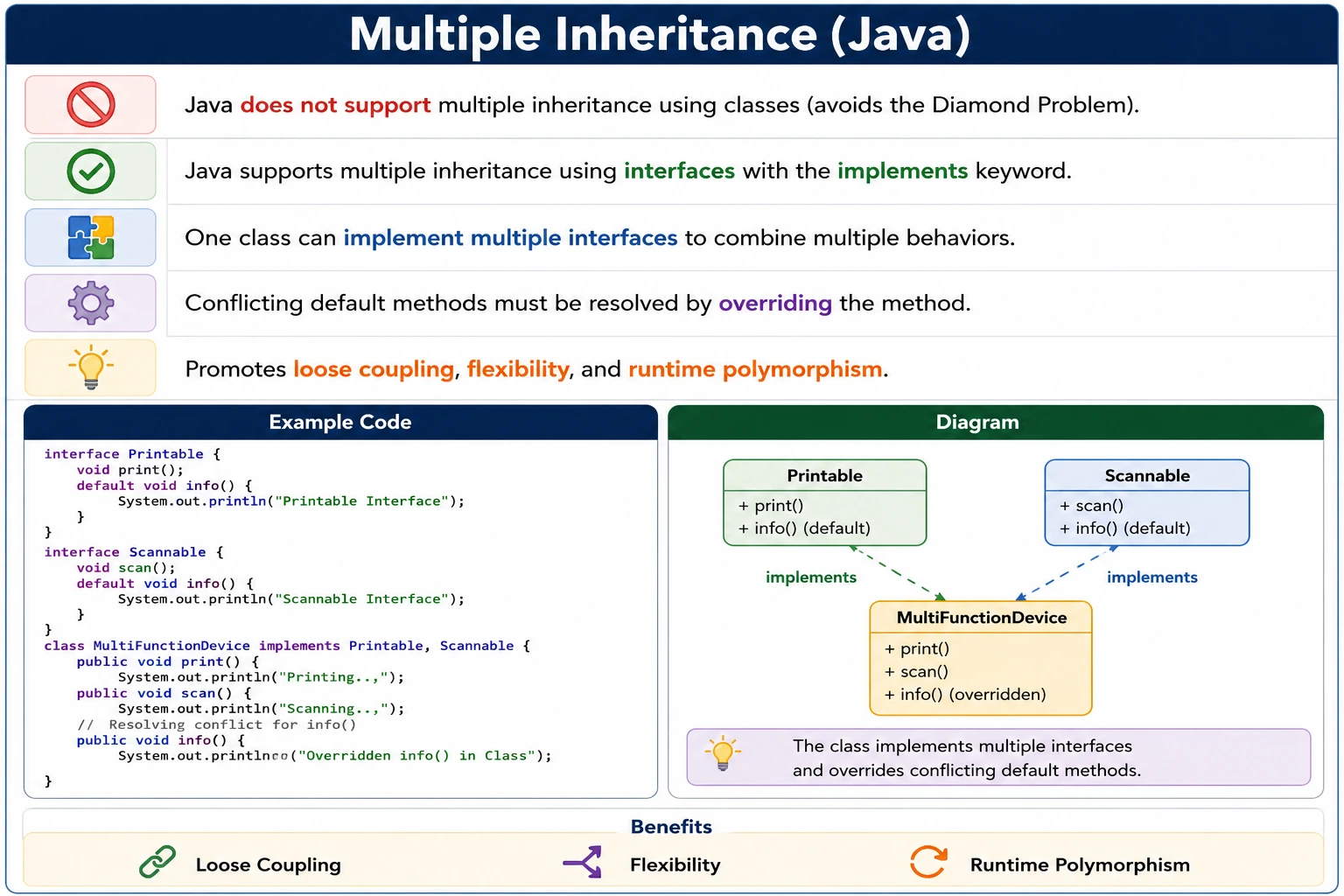
Java does not support multiple inheritance using classes, but it fully supports multiple inheritance using interfaces. This design allows a class to receive multiple behavior contracts without inheriting conflicting implementation from multiple parent classes. In practical terms, a Java class can extend only one class, but it can implement many interfaces. This is how Java gives developers the flexibility of multiple capabilities while avoiding the ambiguity that often comes with class-based multiple inheritance.
Multiple inheritance using interfaces is one of the most important Java interview topics because it connects
inheritance, abstraction, polymorphism, interface contracts, default methods, and the diamond problem. A
strong explanation should not stop at the syntax class C implements A, B. It should explain why
Java blocks multiple class inheritance, why interfaces are safer, what happens when two interfaces declare
the same method, and how Java 8 default methods changed the conflict-resolution rules.
The main idea is capability modeling. A real object can have many capabilities. A smartphone can be a camera, a GPS device, a music player, and a communication device. In Java, it does not need to inherit implementation from multiple parent classes to express those capabilities. It can implement multiple interfaces, and each interface describes one capability the class promises to provide.
What Is Multiple Inheritance?
Multiple inheritance means a type receives features from more than one parent type. In languages that allow multiple class inheritance, a class may directly inherit fields and methods from more than one superclass. Java deliberately does not allow that for classes. A Java class can extend only one class directly, which keeps the object hierarchy simpler and avoids method and state conflicts from multiple concrete parents.
Child  ->  Parent1
       ->  Parent2
Java does allow a class to implement multiple interfaces. This means the class can agree to multiple contracts. The interfaces define what behavior is required, and the class provides the actual implementation. This gives Java much of the design flexibility people want from multiple inheritance without allowing a class to inherit conflicting state or method bodies from several parent classes.
Why Java Disallows Multiple Inheritance with Classes
Java disallows multiple inheritance with classes mainly to avoid ambiguity. The most common explanation is the diamond problem. Imagine one parent class defines a method, two child classes override it, and a fourth class tries to inherit from both child classes. If that fourth class calls the method, it is not obvious which inherited implementation should run.
class A {
    void show() { }
}
class B extends A {
    void show() { }
}
class C extends A {
    void show() { }
}
// class D extends B, C { } // Ambiguous
The question is simple: which show() method should D inherit, the one from
B or the one from C? Different languages solve this problem in different ways, but
Java avoids the problem by not allowing a class to extend more than one class. This makes class inheritance
predictable. There is always one direct superclass.
State is another concern. Classes can contain instance variables and constructors. If Java allowed a class to inherit state from multiple parent classes, object initialization and field meaning could become confusing. By keeping class inheritance single and using interfaces for multiple contracts, Java keeps implementation inheritance controlled.
How Interfaces Solve the Problem
Interfaces solve the problem by separating contract from implementation. Traditional interface methods are abstract by default. They declare what a class must do, but they do not provide inherited implementation that competes with another parent implementation. When a class implements multiple interfaces, it provides the concrete methods itself. The implementing class becomes the single place where behavior is resolved.
Interfaces also do not carry instance state. Variables declared in an interface are public, static, and final constants. This means a class does not inherit multiple sets of mutable object state from interfaces. The class owns its instance state and implements the behavior promised by the interfaces.
This is why interface-based multiple inheritance is safer than class-based multiple inheritance. A class can combine several capabilities, but the class remains responsible for the actual behavior. If two interfaces declare the same abstract method signature, one implementation in the class can satisfy both contracts.
Basic Syntax: Multiple Inheritance Using Interfaces
The syntax uses implements, followed by a comma-separated list of interfaces. The class must
implement all required abstract methods from all listed interfaces. The interfaces do not become concrete
parent classes; they become contracts that the class agrees to fulfill.
interface A {
    void show();
}
interface B {
    void display();
}
class C implements A, B {
    public void show() {
        System.out.println("Show from A");
    }
    public void display() {
        System.out.println("Display from B");
    }
}
In this example, class C implements both A and B. It provides
show() for interface A and display() for interface B.
The class has one concrete implementation for each required behavior, so there is no ambiguity.
Key Rules (Interview Favorites)
A Java class can implement multiple interfaces. This is the main rule that enables multiple inheritance of
type. The class name is followed by implements, and each interface name is separated by a comma.
class Test implements A, B, C { }
A concrete class must implement all abstract methods from every interface it implements. If it does not, it
must be declared abstract. Classes use implements for interfaces, while interfaces use
extends to inherit from other interfaces. An interface can extend multiple interfaces, which
allows contracts to be composed from smaller contracts.
interface C extends A, B { }
Multiple Inheritance with Method Name Conflict (Java 7 and Below)
Before default methods were introduced, interface method conflicts were usually simple. If two interfaces declared the same abstract method signature, the implementing class only needed to provide one method. That one implementation satisfied both interface contracts because there was no inherited method body to choose from.
interface A {
    void show();
}
interface B {
    void show();
}
class C implements A, B {
    public void show() {
        System.out.println("Single implementation resolves conflict");
    }
}
There is no ambiguity here because both interfaces only require a method named show(). They do
not provide competing implementations. The class C provides one public show()
method, and that method fulfills both contracts.
Java 8+ Default Method Conflict (Important)
Java 8 introduced default methods, which allow interfaces to include method implementations. Default methods are useful for evolving interfaces without breaking existing implementations, but they reintroduce a possible ambiguity. If a class implements two interfaces and both interfaces provide the same default method signature, Java cannot automatically decide which default implementation should win.
interface A {
    default void show() {
        System.out.println("A");
    }
}
interface B {
    default void show() {
        System.out.println("B");
    }
}
class C implements A, B {
    // Compile-time error
}
This produces a compile-time error because the class inherits two competing default implementations. Java requires the class to resolve the conflict explicitly. This keeps behavior clear and prevents accidental method selection.
Solution: Override the Method
The solution is to override the conflicting method in the implementing class. Inside the overridden method,
the class can write its own logic or explicitly call one of the interface default methods using the
InterfaceName.super.methodName() syntax.
class C implements A, B {
    @Override
    public void show() {
        A.super.show(); // or B.super.show()
    }
}
This makes the behavior fully controlled. The class can choose A.super.show(),
B.super.show(), call both in a specific order, or provide a completely new implementation. The
important point is that the conflict is resolved in the class that combines the interfaces.
Interface vs Class in Multiple Inheritance
Interfaces and classes behave differently in multiple inheritance because they represent different things. A class carries implementation, state, constructors, and behavior. An interface primarily carries a contract. Even with default methods, interfaces remain safer for multiple inheritance because the implementing class must resolve conflicting defaults explicitly.
| Aspect | Interface | Class |
|---|---|---|
| Multiple inheritance | Yes | No |
| State (variables) | No instance state | Yes |
| Ambiguity | Controlled by implementation | Possible |
| Implementation | Provided by class | Inherited |
| Safety | High | Risky |
This distinction is central to Java design. Java chooses single inheritance for implementation and multiple inheritance for contracts. That combination gives developers flexibility while keeping object construction and inherited behavior easier to reason about.
Real-World Example (Interview-Friendly)
A smartphone is a useful real-world example. It can act as a camera and as a GPS device. These are separate capabilities, and both can be modeled as interfaces. The smartphone class implements both interfaces because it can perform both behaviors.
interface Camera {
    void takePhoto();
}
interface GPS {
    void navigate();
}
class SmartPhone implements Camera, GPS {
    public void takePhoto() {
        System.out.println("Taking photo");
    }
    public void navigate() {
        System.out.println("Navigating");
    }
}
This design is clean because the phone is not forced to inherit from multiple concrete parent classes. It
simply promises to provide camera behavior and GPS behavior. If another class, such as a drone or smart car,
also supports navigation, it can implement GPS too. Interfaces model capabilities that can
appear across different kinds of objects.
Why Multiple Inheritance via Interface Is Powerful
Multiple inheritance through interfaces supports loose coupling because code can depend on contracts instead of concrete classes. It enables plug-and-play behavior because different implementations can be substituted as long as they follow the same interface. It avoids ambiguity because implementation remains under the control of the implementing class. These qualities make interfaces the backbone of many Java frameworks and APIs.
The Java Collections Framework uses interfaces such as List, Set, and
Map. JDBC uses interfaces such as Connection and Statement. Modern
application frameworks use service, repository, listener, handler, and callback interfaces heavily. In each
case, the interface defines a contract and concrete classes provide the implementation.
Design Benefits in Real Projects
In real projects, interface-based multiple inheritance helps classes express several independent roles. A
class may be Serializable, Comparable, and AutoCloseable. Each
interface describes one capability. The class can combine those capabilities without inheriting unrelated
state or implementation from multiple parent classes.
This is especially valuable in layered applications. A class can implement a business interface and a framework interface at the same time. A component can be treated as one type by the business layer and as another type by infrastructure code. The object remains one object, but it can be viewed through different interface contracts depending on the context.
Interface-based design also improves testing. If a class depends on an interface, tests can provide a fake implementation. This is useful for external systems such as payment gateways, email services, APIs, file storage, and database access. The code under test depends on the contract, not on the slow or unpredictable real implementation.
Common Design Mistakes
A common mistake is creating too many broad interfaces. An interface should represent a clear capability. If an interface contains many unrelated methods, implementing classes may be forced to provide methods they do not really support. Smaller, focused interfaces usually lead to cleaner design.
Another mistake is using interfaces only to mimic class inheritance. Interfaces should model capabilities and contracts, not shared state. If classes need common fields, constructors, and substantial shared implementation, an abstract class may be a better choice. If classes need several independent capabilities, interfaces are usually the right tool.
Developers should also be careful with default methods. Default methods are useful, but conflicting defaults must be resolved explicitly. If many interfaces contain complex default behavior, the design can become hard to understand. Keep interface default methods small and purposeful.
Interface Segregation and Multiple Inheritance
Multiple inheritance using interfaces works best when interfaces are small and focused. This idea is often called interface segregation. Instead of creating one large interface with many unrelated methods, it is usually better to create several smaller interfaces that represent separate capabilities. A class can then implement only the capabilities it truly supports.
For example, a large Machine interface with print(), scan(), and
fax() may not fit a simple printer that can only print. A cleaner design would use separate
Printable, Scannable, and Faxable interfaces. A multifunction printer
can implement all three interfaces, while a simple printer implements only Printable. This is
multiple inheritance through interfaces used with discipline.
This approach keeps contracts honest. Classes are not forced to implement methods that do not make sense for
them. Callers can also depend on the smallest interface they need. If a method only needs printing behavior,
it can accept Printable instead of a broad device type. That makes code easier to reuse and
easier to test.
Default Method Conflict Strategy
Default methods are useful, but they require careful conflict handling. When two interfaces provide default methods with the same signature, the implementing class should not treat the override as a formality. It should make a deliberate design decision. Sometimes the class should call one interface's default method. Sometimes it should call both. Sometimes it should ignore both defaults and provide a new implementation.
The best choice depends on the meaning of the interfaces. If one default method represents logging and another represents tracking, calling both may make sense. If two defaults represent alternative ways to start a component, choosing one may be correct. If neither default fully matches the combined class, writing a new implementation is safer. Java forces the override because the language cannot know the business meaning of the conflict.
This rule is a strength, not a weakness. It prevents accidental behavior. The class that combines multiple interfaces is the right place to decide how those contracts should work together.
Multiple Interface References
A single object that implements multiple interfaces can be viewed through different reference types. This is
useful because each caller can receive only the capability it needs. If a FileHandler implements
Readable and Writable, one method can accept it as Readable and call
only read(), while another method can accept it as Writable and call only
write(). The object is the same, but each reference exposes a different contract.
This is a practical form of abstraction. It prevents callers from depending on more behavior than necessary.
It also improves security and clarity at the code level because a method that only needs reading capability
cannot accidentally call writing behavior through a Readable reference.
How to Explain the Diamond Problem Clearly
The diamond problem is easiest to explain with a simple question: if a class inherited the same method from two different parents, which method body should run? With class inheritance, both parents may provide state and implementation, so the answer can be ambiguous. Java avoids this by allowing only one superclass.
With interfaces, the normal case is safer because interfaces declare behavior and the implementing class provides the method body. If both interfaces declare the same abstract method, the class provides one method, and there is no conflict. With Java 8 default methods, a conflict can occur again, but Java requires the implementing class to override the method and choose the behavior explicitly. This is the clean interview explanation.
Practical Maintenance Advantage
The maintenance advantage of interface-based multiple inheritance becomes clear when requirements change. If a class implements focused interfaces, new behavior can often be added through a new interface instead of changing an existing class hierarchy. Existing callers continue using the contracts they already understand, while new callers can depend on the new capability. This reduces the risk of accidental side effects.
It also helps teams reason about responsibility. When a class implements Readable, the team
knows it supports reading. When it implements Writable, the team knows it supports writing. The
interfaces communicate capability directly in the type system. This is clearer than placing unrelated methods
into a large parent class just because several classes happen to need them.
Multiple Inheritance Using Interfaces: 20 Quick Examples
1. Basic Multiple Inheritance Using Interfaces
interface A {
    void a();
}

interface B {
    void b();
}

class C implements A, B {
    public void a() {
        System.out.println("Method A");
    }

    public void b() {
        System.out.println("Method B");
    }

    public static void main(String[] args) {
        C c = new C();
        c.a();
        c.b();
    }
}
Output
Method A
Method B
2. Multiple Interfaces with Common Method Name
interface A {
    void show();
}

interface B {
    void show();
}

class C implements A, B {
    public void show() {
        System.out.println("Single implementation");
    }

    public static void main(String[] args) {
        new C().show();
    }
}
Explanation: One implementation satisfies both interfaces.
Output: Single implementation
3. Diamond Problem Solved with Interfaces (Abstract Methods)
interface A {
    void show();
}

interface B extends A {}

interface C extends A {}

class D implements B, C {
    public void show() {
        System.out.println("Resolved");
    }

    public static void main(String[] args) {
        new D().show();
    }
}
Explanation: No ambiguity because method is abstract.
Output: Resolved
4. Diamond Problem with Default Methods (Conflict)
interface A {
    default void show() {
        System.out.println("A");
    }
}

interface B {
    default void show() {
        System.out.println("B");
    }
}

class C implements A, B {
    public void show() {
        System.out.println("C");
    }

    public static void main(String[] args) {
        new C().show();
    }
}
Explanation: Class must override conflicting default method.
Output: C
5. Calling Specific Interface Default Method
interface A {
    default void show() {
        System.out.println("A");
    }
}

interface B {
    default void show() {
        System.out.println("B");
    }
}

class C implements A, B {
    public void show() {
        A.super.show();
    }

    public static void main(String[] args) {
        new C().show();
    }
}
Explanation: Explicitly chooses interface implementation.
Output: A
6. Multiple Interfaces + Class Inheritance
interface Fly {
    void fly();
}

interface Swim {
    void swim();
}

class Animal {
    void eat() {
        System.out.println("Eating");
    }
}

class Duck extends Animal implements Fly, Swim {
    public void fly() {
        System.out.println("Flying");
    }

    public void swim() {
        System.out.println("Swimming");
    }

    public static void main(String[] args) {
        Duck d = new Duck();
        d.eat();
        d.fly();
        d.swim();
    }
}
Output
Eating
Flying
Swimming
7. Interface Extending Multiple Interfaces
interface A {
    void a();
}

interface B {
    void b();
}

interface C extends A, B {
    void c();
}

class D implements C {
    public void a() { System.out.println("A"); }
    public void b() { System.out.println("B"); }
    public void c() { System.out.println("C"); }

    public static void main(String[] args) {
        C obj = new D();
        obj.a();
        obj.b();
        obj.c();
    }
}
Output
A
B
C
8. Multiple Inheritance via Interface Reference
interface A {
    void a();
}

interface B {
    void b();
}

class C implements A, B {
    public void a() { System.out.println("A"); }
    public void b() { System.out.println("B"); }

    public static void main(String[] args) {
        A a = new C();
        B b = new C();
        a.a();
        b.b();
    }
}
Explanation: Same object, different views.
Output
A
B
9. Interface Constants in Multiple Inheritance
interface A {
    int X = 10;
}

interface B {
    int Y = 20;
}

class C implements A, B {
    public static void main(String[] args) {
        System.out.println(X + Y);
    }
}
Explanation: Interface variables are public static final.
Output: 30
10. Multiple Interfaces with No Conflict
interface Print {
    void print();
}

interface Scan {
    void scan();
}

class PrinterScanner implements Print, Scan {
    public void print() {
        System.out.println("Printing");
    }

    public void scan() {
        System.out.println("Scanning");
    }

    public static void main(String[] args) {
        PrinterScanner ps = new PrinterScanner();
        ps.print();
        ps.scan();
    }
}
Output
Printing
Scanning
11. Interface Default + Abstract Combination
interface A {
    default void show() {
        System.out.println("Default A");
    }
}

interface B {
    void show();
}

class C implements A, B {
    public void show() {
        System.out.println("Implemented");
    }

    public static void main(String[] args) {
        new C().show();
    }
}
Explanation: Abstract method forces implementation.
Output: Implemented
12. Functional Interfaces in Multiple Inheritance (Not Allowed)
@FunctionalInterface
interface A {
    void show();
}

// @FunctionalInterface
// interface B {
//     void test();
// }

interface C extends A {
    void test(); // breaks functional rule
}
Explanation: Functional interface must have exactly one abstract method.
13. Multiple Inheritance for Capability Modeling
interface Readable {
    void read();
}

interface Writable {
    void write();
}

class FileHandler implements Readable, Writable {
    public void read() {
        System.out.println("Reading file");
    }

    public void write() {
        System.out.println("Writing file");
    }

    public static void main(String[] args) {
        FileHandler f = new FileHandler();
        f.read();
        f.write();
    }
}
Output
Reading file
Writing file
14. Interface + Default + Override
interface A {
    default void show() {
        System.out.println("A default");
    }
}

interface B {
    default void show() {
        System.out.println("B default");
    }
}

class C implements A, B {
    public void show() {
        B.super.show();
    }

    public static void main(String[] args) {
        new C().show();
    }
}
Output
B default
15. Real-World Example (Selenium-Style)
interface Clickable {
    void click();
}

interface Typeable {
    void type(String text);
}

class WebElement implements Clickable, Typeable {
    public void click() {
        System.out.println("Clicked");
    }

    public void type(String text) {
        System.out.println("Typed: " + text);
    }

    public static void main(String[] args) {
        WebElement e = new WebElement();
        e.click();
        e.type("Hello");
    }
}
Output
Clicked
Typed: Hello
16. Multiple Inheritance Prevents Code Duplication
interface Loggable {
    default void log() {
        System.out.println("Logging");
    }
}

interface Trackable {
    default void track() {
        System.out.println("Tracking");
    }
}

class Service implements Loggable, Trackable {
    public static void main(String[] args) {
        Service s = new Service();
        s.log();
        s.track();
    }
}
Output
Logging
Tracking
17. Interface Reference Hiding Implementation Details
interface A {
    void show();
}

interface B {
    void test();
}

class C implements A, B {
    public void show() { System.out.println("Show"); }
    public void test() { System.out.println("Test"); }

    public static void main(String[] args) {
        A a = new C();
        a.show();
        // a.test(); // not accessible
    }
}
Explanation: Reference type controls accessible methods.
18. Multiple Inheritance vs Class Inheritance (Contrast)
class A {}
class B {}

// class C extends A, B {} // Not allowed

interface X {}
interface Y {}

class Z implements X, Y {} // Allowed
Explanation: Java allows multiple inheritance only via interfaces.
19. Interview Trap – Same Default Method Signature
interface A {
    default void run() {}
}

interface B {
    default void run() {}
}

class C implements A, B {
    // must override run()
    public void run() {}
}
Explanation: Mandatory override due to ambiguity.
20. Interview Summary – Multiple Inheritance Using Interface
interface A {
    void a();
}

interface B {
    void b();
}

class C implements A, B {
    public void a() { System.out.println("A"); }
    public void b() { System.out.println("B"); }

    public static void main(String[] args) {
        A a = new C();
        B b = new C();
        a.a();
        b.b();
    }
}
Key Points
- Achieved using implements
- Supports multiple inheritance safely
- Resolves diamond problem
- Promotes loose coupling & polymorphism
Common Beginner Mistakes
A common beginner mistake is trying to extend multiple classes in Java. Java does not allow
class C extends A, B. A class can extend only one class, but it can implement many interfaces.
Remembering the difference between implementation inheritance and contract inheritance prevents many syntax
and design errors.
Another frequent mistake is forgetting to implement every abstract method from every interface. If a class implements several interfaces, it accepts all of their contracts. A concrete class must provide all required methods, even when the methods come from different interfaces. If it does not, the class must be declared abstract.
Developers also confuse extends and implements. A class extends another class. A
class implements an interface. An interface extends another interface. This wording matters because it
reflects the type relationship. Classes inherit implementation from classes, while classes fulfill contracts
from interfaces.
Ignoring default method conflicts is another important mistake. If two interfaces provide the same default method, the implementing class must override it. Java will not guess which default method should be used. This explicit rule keeps behavior predictable.
Interview-Ready Design Explanation
In interviews, the best way to explain this topic is to begin with Java's restriction: Java does not support multiple inheritance through classes because it can create ambiguity, especially with the diamond problem. Then explain Java's solution: a class can implement multiple interfaces because interfaces define contracts and the implementing class provides the behavior.
A strong answer should mention that if multiple interfaces declare the same abstract method, one implementation in the class is enough. There is no conflict because no inherited implementation is competing. If multiple interfaces provide the same default method, the class must override the method to resolve the conflict explicitly. This distinction shows deeper understanding of Java 8+ interface behavior.
It is also useful to explain multiple inheritance through a real-world example. A smartphone can implement
Camera, GPS, and MusicPlayer interfaces because it provides all those
capabilities. This is clearer than trying to force the phone to inherit from several concrete parent classes.
Interfaces model what the object can do.
When to Use Multiple Interfaces
Use multiple interfaces when a class has several independent capabilities. A file component may be readable, writable, closable, and loggable. A user interface element may be clickable, typeable, visible, and enabled. Each interface describes one focused contract. The implementing class combines those contracts because it genuinely supports all of those behaviors.
Multiple interfaces are also useful when different callers need to view the same object through different
roles. One module may only need the Readable behavior, while another module may need the
Writable behavior. The same object can be passed through different interface references,
exposing only the behavior each caller needs. This supports encapsulation at the design level because callers
do not receive unnecessary access.
Avoid implementing many interfaces just to collect unrelated methods. If a class claims too many responsibilities, it becomes harder to understand and maintain. Interfaces should represent real and focused capabilities, not a checklist of random methods.
Why This Matters in Java Frameworks
Java frameworks use interface-based multiple inheritance heavily because frameworks need flexible extension points. A framework can define several small interfaces, and application classes can implement the combinations they need. This avoids rigid class hierarchies and allows objects to participate in multiple framework roles.
Collections are a familiar example. A class can implement interfaces that describe collection behavior, iteration behavior, serialization behavior, or comparison behavior. JDBC is another example, where many database vendors provide concrete classes behind standard interfaces. Application code can depend on the interfaces while different implementations work behind the scenes.
This is why multiple inheritance using interfaces is more than an interview syntax topic. It is a central part of how Java achieves flexible architecture while keeping class inheritance simple and safe.
Interview-Ready Answers
Short Answer
Java supports multiple inheritance using interfaces, not classes. A class can implement multiple interfaces and provide the required method implementations.
Detailed Answer
Java avoids multiple inheritance with classes to prevent ambiguity (diamond problem). However, it supports multiple inheritance using interfaces, where a class can implement multiple interfaces and provide its own implementation, ensuring clarity and flexibility.
If two interfaces declare the same abstract method, one implementation in the class can satisfy both contracts. If two interfaces provide the same default method, the implementing class must override the method and resolve the conflict explicitly. This gives Java safe multiple inheritance of type without uncontrolled multiple inheritance of implementation.
Key Takeaway
Java achieves multiple inheritance safely through interfaces. This design delivers flexibility without class-based ambiguity, making interfaces a cornerstone of robust Java architecture. Interfaces allow a class to combine multiple capabilities while keeping implementation clear, explicit, and under the control of the implementing class.