main() Method Explained in Java
The main() method is the entry point of a standalone Java application. When a Java program is launched from the command line, an IDE, or a build tool, the Java Virtual Machine looks for a specific method signature and begins execution from that method. Without a properly defined main() method, a normal standalone Java program cannot start, even if the class compiles successfully. This is why the main method is one of the first Java concepts every beginner must understand clearly.
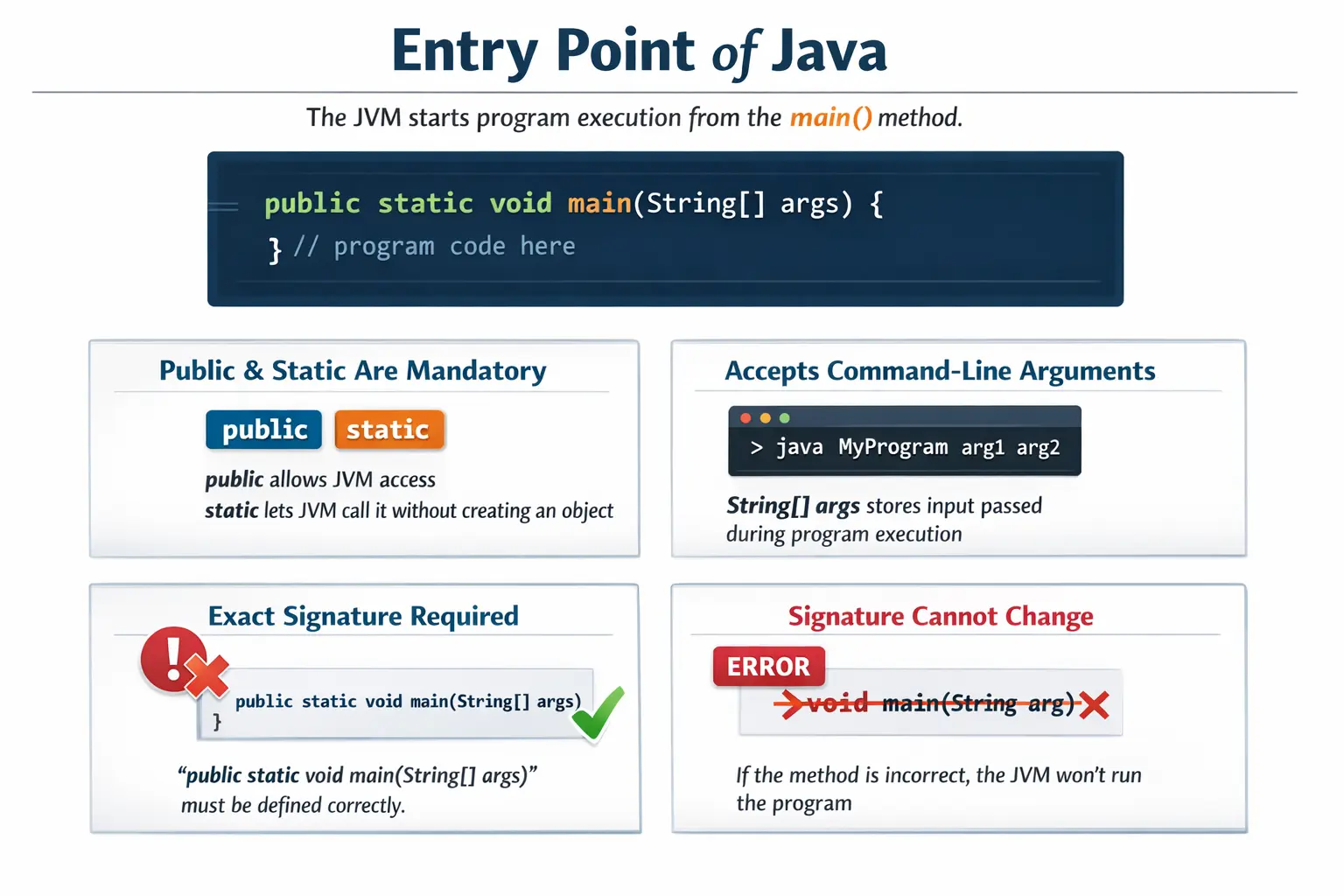
The main method is important not only because it starts execution, but also because it reveals several core Java ideas at once: access modifiers, static members, return types, method names, arrays, command-line arguments, and JVM execution flow. Many beginners memorize the syntax without understanding why each keyword is required. That creates confusion later when they make small changes to the signature and the program no longer runs.
In interviews, the main() method is a common topic because it tests whether you understand Java execution fundamentals. A strong answer should explain what the method does, why it is public, why it is static, why it returns void, why the name must be exactly main, and what String[] args means. Once this concept is clear, topics such as classes, objects, methods, static members, command-line execution, and JVM behavior become easier to understand.
Standard Syntax of the main() Method
The standard and most commonly used syntax of the Java main method is shown below. This is the signature that the JVM recognizes as the starting point of a standalone Java application.
public static void main(String[] args)
This method must be placed inside a class. Java does not allow normal executable statements to exist independently outside a class. When the JVM starts the program, it loads the specified class and searches for this method signature. If it finds the correct signature, it invokes the method and begins executing the statements inside it from top to bottom.
A minimal Java program using the main method looks like this.
public class HelloWorld {
    public static void main(String[] args) {
        System.out.println("Hello Java");
    }
}
In this example, HelloWorld is the class name, and main() is the entry point. When the program runs, the JVM executes the print statement inside the main method. After the last statement completes, the program terminates unless other non-daemon threads are still running.
Why public Is Used
The keyword public is an access modifier. It makes the main method accessible from anywhere. The JVM is not part of your class, so it must be able to access the method from outside the class. Declaring the method as public allows the JVM to invoke it when program execution begins.
If the main method is not public, it will not be considered a valid entry point for standard execution. The class may still compile because Java allows methods with different access modifiers, but the JVM may fail to launch the program as expected. This is why the standard main method signature begins with public.
From an interview perspective, the important explanation is simple: public allows the JVM to access the main method from outside the class. Without that access, the JVM cannot use the method as the program’s starting point.
Why static Is Used
The keyword static means the method belongs to the class rather than to an object of the class. This is essential because program execution begins before any object is created. The JVM must be able to call the main method directly using the class, without first creating an instance.
If the main method were non-static, the JVM would need an object to call it. But at the starting point of execution, there is no object unless the program creates one. Java avoids this problem by requiring the entry method to be static. The JVM can load the class and invoke the static main method immediately.
public class TestApp {
    public static void main(String[] args) {
        System.out.println("JVM calls this method without creating an object");
    }
}
This also introduces an important Java concept: static methods cannot directly access non-static variables or methods without an object reference. Inside main, if you want to call an instance method, you must create an object first. This is a common beginner confusion and a common interview follow-up question.
Why void Is Used
The keyword void means the method does not return any value. The JVM calls the main method to execute program instructions, but it does not expect the method to return a result. Once the method finishes, control returns to the runtime environment and the program ends normally unless other work continues.
Some other programming languages allow the main function to return an integer status code. Java does not use the return value of main in that way. If a Java program needs to indicate abnormal termination, it can use mechanisms such as exceptions or System.exit() with a status code. But the main method itself must use void in the standard signature.
If you change the return type to int or any other type, the method may become an ordinary method named main, but it will not match the expected entry point signature. The JVM strictly searches for the correct form.
Why the Method Name Must Be main
The name main is special because the JVM recognizes it as the starting method for standalone execution. Java is case-sensitive, so main, Main, and MAIN are different names. Only lowercase main matches the expected entry point.
If you write Main instead of main, the program may still compile because Java allows methods with different names. However, when you try to run the class, the JVM will not find the correct entry method. This distinction is important because compilation and execution are different phases. A class can compile successfully but still fail to run as a standalone application if the main method is missing or incorrectly declared.
Interviewers often ask this to check whether you understand that the JVM does not guess the starting method. It follows a standard convention and searches for the exact recognized signature.
What String[] args Means
The parameter String[] args represents command-line arguments. It is an array of strings that stores values passed to the program when it is launched. This allows the same program to receive different input without changing the source code.
Suppose a program is executed like this from the command line.
java Test hello world
In this case, the values after the class name are passed into the args array.
args[0] = "hello"
args[1] = "world"
The name args is only a variable name. It can be changed to another valid identifier, such as values or input, and the method will still work as long as the parameter type is a string array. However, args is the conventional name used in most Java examples and documentation.
public static void main(String[] values)
Command-line arguments are useful for simple configuration, file names, flags, or input values. In large applications, more advanced configuration methods are used, but understanding String[] args is still essential for Java basics.
Full Example Program
The following program demonstrates a simple main method that prints a startup message and displays the number of command-line arguments received.
public class TestApp {
    public static void main(String[] args) {
        System.out.println("Application started");
        System.out.println("Arguments count: " + args.length);
    }
}
When this program is executed, the JVM loads the TestApp class, searches for the standard main method, invokes it, and executes the statements inside. If command-line arguments are provided, args.length shows how many values were passed. If no arguments are provided, the array still exists, but its length is zero.
This example also shows that the main method can contain normal Java statements, method calls, object creation, condition checks, loops, and any valid Java logic. In real applications, the main method often starts the program and delegates work to other classes rather than containing all logic itself.
Can We Change the main() Method Signature?
The logical signature required by the JVM must remain the same, but Java allows a few variations that are still treated as equivalent. For example, the order of public and static can be changed because both are modifiers. The string array syntax can also be written in different valid forms.
static public void main(String[] args)
public static void main(String args[])
public static void main(String... args)
These versions are valid because they still represent a public static method named main with a void return type and a string array or varargs parameter. The varargs form String... args is treated as a string array for this purpose.
Some variations are not valid entry points. The following examples may compile as methods in some cases, but they do not match the JVM’s expected entry point.
private static void main(String[] args)
public void main(String[] args)
public static int main(String[] args)
The first is not public, the second is not static, and the third does not return void. Because they do not match the required signature, the JVM will not use them as the starting point of a standalone Java program.
Overloading the main() Method
The main method can be overloaded like any other method in Java. Method overloading means creating multiple methods with the same name but different parameter lists. However, the JVM always starts execution with the standard main method that accepts a string array.
public class Demo {
    public static void main(String[] args) {
        main(10);
    }

    public static void main(int x) {
        System.out.println("Overloaded main method: " + x);
    }
}
In this example, the JVM first calls main(String[] args). Inside that method, the program manually calls the overloaded main(int x) method. The overloaded version is not called automatically by the JVM. This distinction is important for interviews because it proves that overloading is allowed, but the entry point remains fixed.
Overloading main is not common in real-world code because it can confuse readers. It is mostly discussed as an interview concept. In professional code, it is usually better for the main method to call clearly named helper methods or application startup classes.
Execution Flow Involving main()
The execution flow of a standalone Java program is predictable. First, the Java command or runtime environment starts the JVM. The JVM loads the specified class into memory. It then searches for the valid main method signature. Once the method is found, the JVM invokes it. The statements inside the method execute sequentially unless control flow statements, method calls, exceptions, or threads change the flow.
When the main method finishes, the program usually terminates. If the program starts other non-daemon threads, the JVM may continue running until those threads complete. If an uncaught exception occurs inside main, the program terminates abnormally and displays the exception stack trace.
This execution flow explains why the main method is called the entry point, not necessarily the entire application. In larger programs, main is often only the bootstrap method. It starts the application, creates required objects, loads configuration, or delegates execution to other components.
Why the Exact Signature Matters
The exact main method signature matters because the JVM follows a strict contract. It does not analyze all methods and guess which one should start the application. It looks for a recognized method form. This provides consistency across Java programs and avoids ambiguity.
This strictness also supports predictable tooling. IDEs, command-line execution, build tools, and runtime environments can all rely on the same entry point convention. Developers anywhere can identify the starting point of a simple Java application by looking for public static void main(String[] args).
Any incorrect change to access modifier, static keyword, return type, method name, or parameter type can prevent the JVM from starting the program. This is why beginners should first memorize the standard syntax and then understand the purpose of each part.
Common Beginner Mistakes
One common mistake is forgetting the static keyword. Without static, the method belongs to an object, and the JVM cannot call it directly as the entry point. Another mistake is misspelling main or changing its capitalization. Because Java is case-sensitive, Main is not the same as main.
Beginners also sometimes change String[] args to a different type, such as String args or int[] args. These do not match the expected entry point. Changing the return type from void to int is another common mistake, often influenced by other programming languages.
Another common confusion is thinking that the main method creates the class object automatically. It does not. The main method is static, so it runs without object creation. If the program needs to use instance variables or instance methods, it must create an object explicitly inside main or elsewhere.
Interview-Ready Explanation
A short interview answer can be: "The main method is the entry point of a standalone Java application. The JVM begins execution from public static void main(String[] args)." This answer is concise and suitable when the interviewer asks for a quick definition.
A detailed answer can be: "The main method is declared as public so the JVM can access it, static so the JVM can call it without creating an object, void because it does not return a value, main because that is the method name recognized by the JVM, and String[] args to receive command-line arguments. The JVM strictly searches for this signature when starting a standalone Java program."
If the interviewer asks whether main can be overloaded, answer that it can be overloaded like any other method, but the JVM calls only the standard main(String[] args) version automatically. Other overloaded versions must be called manually from code.
Key Takeaway
The main() method is mandatory for standalone Java applications because it gives the JVM a clear starting point for execution. Its standard signature is not random; every keyword has a specific reason. public provides access, static avoids object creation, void indicates no return value, main is the recognized method name, and String[] args stores command-line arguments.
Mastering the main method builds a strong foundation for understanding Java execution. Before moving into object-oriented programming, collections, exception handling, multithreading, Selenium, or frameworks, every learner should be comfortable explaining how the JVM starts a Java program and why the main method signature matters.