Lambda Expressions
Lambda expressions introduce a concise, functional style of programming in Java. They enable you to represent behavior as data, drastically reducing boilerplate code and improving readability—especially with collections, streams, and concurrency.
Before Java 8, Java developers usually passed behavior by writing anonymous inner classes. That approach worked, but it often buried the actual logic inside several lines of ceremony. If a developer wanted to sort a list, start a thread, listen for an event, or define a simple filtering condition, the code had to create an object, override a method, and place the real business logic inside that method. Lambda expressions were introduced to make those small units of behavior direct and readable. Instead of focusing on the surrounding object structure, the code can focus on the action that should happen.
The important idea is that a lambda is not just a shorter syntax trick. It changes how Java code is organized in many everyday situations. A lambda lets you pass a decision, calculation, transformation, or action into another method. That is why lambdas fit naturally with collection processing, stream pipelines, asynchronous tasks, and callback-style APIs. They allow the library code to manage the flow while your code supplies the behavior that varies from one use case to another.
Lambda expressions also made functional-style programming practical in Java while preserving Java's strong type system. Java did not become a purely functional language, and lambdas do not replace classes, objects, or methods. Instead, they give developers a clean way to express small pieces of behavior when a full class would be unnecessary. This balance is what makes lambdas useful in real projects: they reduce boilerplate without changing the core object-oriented nature of Java.
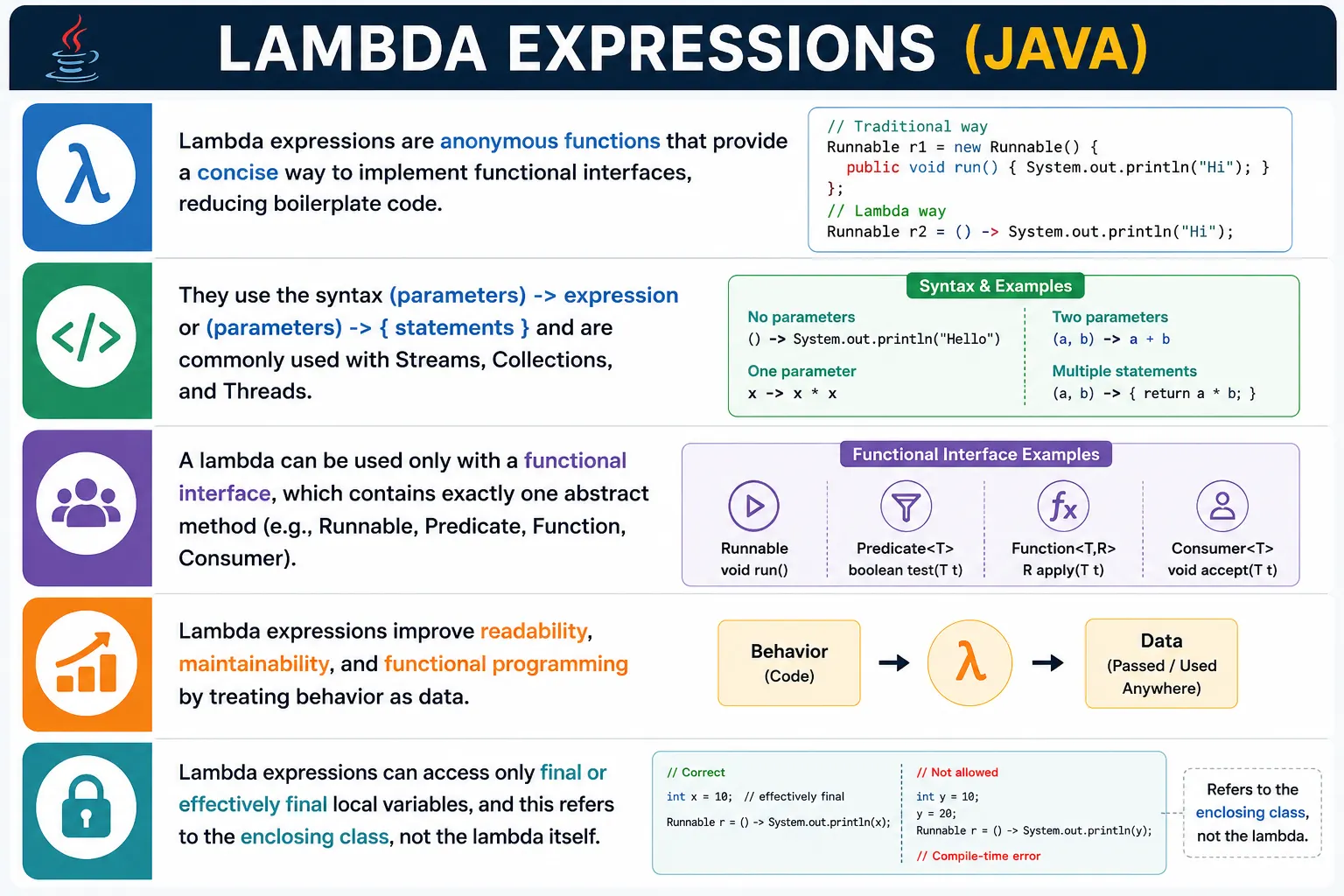
This is a very high-frequency interview topic (Java 8+).
Interviewers ask about lambda expressions because they connect several modern Java concepts together. To
answer well, you should understand the syntax, but you should also understand functional interfaces, type
inference, variable capture, the meaning of this, and why lambdas are used heavily with the
Streams API. A strong answer explains that lambdas are concise implementations of functional interfaces,
then supports that answer with examples such as Runnable, Predicate,
Function, Consumer, sorting with Comparator, and filtering data
with streams.
What Is a Lambda Expression?
A lambda expression is an anonymous function—a block of code that:
- Has no name
- Can be passed as an argument
- Can be executed later
It is primarily used to implement functional interfaces.
In Java, a lambda expression always needs a target type. That target type is normally a functional
interface, which means an interface with exactly one abstract method. The lambda provides the implementation
for that single method. For example, Runnable has one abstract method named
run(), so a lambda can provide the code that should run. Comparator has one main
comparison method, so a lambda can provide the comparison logic used for sorting. The lambda itself does
not float independently like a separate top-level function; it is interpreted through the functional
interface expected by the surrounding code.
This target-type behavior is one of the most important details for beginners. The same-looking lambda can
mean different things depending on the interface it is assigned to. A lambda such as
x -> x * 2 could represent a mathematical operation, a transformation, or any other single
method contract that accepts one value and returns one value. Java decides whether the lambda is valid by
checking the method signature of the functional interface. The number of parameters, parameter types, and
return type must match the abstract method.
The phrase "anonymous function" is useful, but it should not make you think lambdas behave exactly like
JavaScript or Python functions. Java lambdas are strongly typed. They are compiled against a known interface
and participate in compile-time type checking. That is why mistakes such as returning a value from a
void functional interface or passing two parameters to a one-parameter interface are caught
by the compiler.
Basic Syntax
(parameters) -> expression
or

(parameters) -> {
    statements;
}
A lambda expression has three visible parts: the parameter list, the arrow token, and the body. The
parameter list describes what values the lambda receives. The arrow separates the inputs from the behavior.
The body describes what the lambda does. When the body is a single expression, Java can return the result
automatically if the functional interface expects a return value. When the body contains multiple
statements, braces are required, and a return statement is required if a value must be
returned.
Java can often infer the parameter types from the target interface. If a Comparator<String>
is expected, Java already knows the lambda receives two String values. Because of that, you can
write (a, b) -> a.compareTo(b) instead of writing the types explicitly. This type inference
keeps lambdas compact, but the type information is still present in the program. The compiler uses the
target interface to verify the lambda.
For a single parameter, parentheses can often be omitted, which is why examples such as
n -> n % 2 == 0 are common. For zero parameters, parentheses are required, as in
() -> System.out.println("Hello"). For two or more parameters, parentheses are also required.
If you explicitly mention parameter types, all parameters must include their types. Java does not allow
mixing typed and untyped parameters in the same lambda because that would make the method signature less
clear.
Examples
() -> System.out.println("Hello");

(a, b) -> a + b

(int a, int b) -> {
    return a * b;
}
Functional Interface (Foundation of Lambdas)
A functional interface has exactly one abstract method.
@FunctionalInterface
interface Calculator {
    int add(int a, int b);
}
Functional interfaces are the foundation that makes lambda expressions work in Java. A functional interface defines a single abstract method, often called a SAM. The lambda expression supplies the implementation for that method. If an interface has two unrelated abstract methods, Java would not know which method the lambda is supposed to implement, so the interface cannot be used as a lambda target. This is why lambdas are tightly connected to the idea of one clear method contract.
The @FunctionalInterface annotation is not required, but it is a useful safety check. When you
place this annotation on an interface, the compiler verifies that the interface really has only one
abstract method. If another developer accidentally adds a second abstract method later, compilation fails
immediately. This protects lambda usage across the codebase and documents the intention of the interface.
A functional interface can still have default methods and static methods. Default methods have an implementation inside the interface, and static methods belong to the interface itself. They do not count as additional abstract methods. This allows functional interfaces to provide helper behavior while preserving the single abstract method needed by lambdas.
- ✔ Can have default and static methods
- ✔ @FunctionalInterface is optional but recommended
Lambda with Functional Interface
Without Lambda (Old Style)
Calculator c = new Calculator() {
    public int add(int a, int b) {
        return a + b;
    }
};
With Lambda (Java 8+)
Calculator c = (a, b) -> a + b;
The difference between the old style and the lambda style is not only the number of lines. In the old style, the reader must mentally skip over the object creation syntax and method declaration before reaching the real operation. In the lambda version, the operation is visible immediately: take two inputs and add them. This is especially helpful when the behavior is passed into another method, because the surrounding code remains focused on the task rather than the mechanics of creating an anonymous class.
Anonymous classes are still useful when you need extra state, multiple methods, or a more complex object. Lambdas are best when the goal is to provide a small implementation of one method. A good developer chooses between them based on clarity. If the behavior is short and directly tied to a functional interface, a lambda is usually cleaner. If the behavior grows large or needs its own named structure, a class or helper method is usually easier to maintain.
- ✔ Cleaner
- ✔ Readable
- ✔ Less boilerplate
Common Built-in Functional Interfaces
| Interface | Method | Purpose |
|---|---|---|
| Runnable | run() | No input, no output |
| Consumer<T> | accept(T) | Input, no output |
| Supplier<T> | get() | No input, output |
| Function<T, R> | apply(T) | Input → output |
| Predicate<T> | test(T) | Boolean condition |
Java provides several built-in functional interfaces in java.util.function so developers do
not need to create a custom interface for every small operation. Predicate<T> is used when
a condition must be tested and the result is true or false. It is common in
filtering logic. Function<T, R> is used when one value is converted into another value.
It is common in mapping logic. Consumer<T> accepts a value and performs an action without
returning a result. Supplier<T> provides a value without receiving input.
Choosing the right functional interface makes lambda-based code easier to read. If a method parameter is a
Predicate<User>, the reader immediately understands that the lambda is a condition about a
user. If the parameter is a Function<Order, Invoice>, the reader understands that the
lambda transforms an order into an invoice. These interface names express intent, and the lambda supplies
the small behavior needed for that intent.
Examples
Runnable r = () -> System.out.println("Running");

Predicate isEven = n -> n % 2 == 0;

Function length = s -> s.length();
Lambda with Collections (Very Common)
Iterating a List
Listlist = Arrays.asList("Java", "Python", "C++"); list.forEach(s -> System.out.println(s));
Sorting with Lambda
Collections.sort(list, (a, b) -> a.compareTo(b));
Collections are one of the easiest places to see the value of lambdas. Iterating a list with
forEach lets you pass the action that should be performed for each element. Sorting a list lets
you pass comparison behavior directly where it is needed. Filtering, mapping, grouping, and reducing become
clearer when the variable part of the logic is expressed as a small lambda instead of a separate class.
In real applications, lambda expressions are often used to express business rules over collections. A shopping application may filter active products, a banking application may select high-value transactions, and a testing utility may transform raw test records into report rows. The collection API provides the traversal mechanism, while the lambda provides the rule. This separation keeps the code compact and reduces repeated loop logic.
Lambdas also work naturally with the Streams API. A stream pipeline reads almost like a sequence of data processing steps: filter the items, map them to another shape, sort them, and collect the result. Each step receives behavior through a lambda or method reference. This style is powerful, but it should still be used with discipline. A stream pipeline with clear, short lambdas is readable. A stream pipeline with large nested lambdas and side effects can become harder to understand than a regular loop.
Lambda with Threads
Thread t = new Thread(() -> {
    System.out.println("Thread running");
});
t.start();
- ✔ Uses Runnable internally
- ✔ Preferred modern approach
Thread creation is another common lambda use case because Runnable is a functional interface.
A thread needs a task to execute, and a lambda can describe that task directly. This avoids the old pattern
of writing an anonymous Runnable class just to place a few lines inside the
run() method. The same idea applies to ExecutorService, where tasks can be
submitted as lambdas.
A lambda makes the task definition shorter, but it does not automatically solve concurrency problems. If the lambda reads or writes shared mutable data, the usual thread-safety rules still apply. Synchronization, immutable data, concurrent collections, atomic classes, and clear ownership of shared state remain important. In interviews, it is useful to say that lambdas simplify task creation, but safe concurrent behavior still depends on proper design.
Parameter Rules
(a, b) -> a + b          // type inferred
(int a, int b) -> a + b // explicit type
❌ Mixing typed and untyped parameters is not allowed
Parameter rules are mostly about keeping the lambda consistent with the functional interface method. If the abstract method accepts two integers, the lambda must accept two compatible parameters. If the abstract method returns a boolean, the lambda body must produce a boolean result. Type inference can reduce visual noise, but it does not remove these requirements. The compiler still validates the lambda against the target method signature.
In day-to-day code, inferred types are usually preferred for simple lambdas because the target type is visible from the left side of the assignment or from the method parameter. Explicit parameter types are useful when they make a complex expression easier to understand or when the compiler needs extra help. The goal is readability, not simply writing the fewest possible characters.
Lambda Body Rules
- Single statement → braces optional
- Multiple statements → braces + return required
a -> a * a

a -> {
    int result = a * a;
    return result;
}
The lambda body can be an expression body or a block body. An expression body is compact and is best for
simple calculations, comparisons, or transformations. A block body is better when the logic needs more than
one statement, such as validation, logging, temporary variables, or exception handling. When a block body
returns a value, the return keyword is required because Java treats the body like a normal
method block.
A practical rule is to keep lambdas short enough that their purpose is obvious at the call site. If a lambda grows into a long block, move the logic into a named method and call that method from the lambda or use a method reference. Named methods are easier to test, reuse, and debug. Lambdas are excellent for concise behavior, but they should not become hidden mini-programs inside a stream pipeline or callback.
Variable Capture (Effectively Final)
Lambdas can access local variables only if they are final or effectively final.
int x = 10;
Runnable r = () -> {
    System.out.println(x);
};
❌ Modifying x later → compilation error
A local variable is effectively final when it is assigned once and not changed afterward. Java allows a lambda to read such a variable because its value is stable from the lambda's point of view. If the local variable could be changed later, the behavior would be confusing because the lambda may run after the enclosing method has moved on. The effectively final rule keeps local variable capture predictable.
This rule applies to local variables, not to fields. A lambda can access instance variables and static variables because those variables belong to an object or class rather than the current stack frame. However, mutating fields inside lambdas should be done carefully, especially in stream and concurrency code. A lambda with side effects can make the flow harder to reason about and can create race conditions when used with parallel processing.
In interviews, variable capture is often tested with small code snippets. If a variable is declared before a lambda, used inside the lambda, and then modified afterward, the code will not compile. The correct explanation is that the variable is not effectively final. This is not a runtime error; it is a compile-time rule.
this Keyword in Lambda (Interview Trap)
- this refers to enclosing class, not lambda
- Unlike anonymous inner classes
this.toString(); // enclosing object
The behavior of this is a common interview trap because lambdas and anonymous inner classes
look similar but do not behave the same way. An anonymous inner class creates a separate inner object, so
this inside that anonymous class refers to the anonymous object. A lambda does not create a new
named inner class scope in the same way. Inside a lambda, this refers to the enclosing object.
This difference matters when the enclosing class has fields or methods with the same names as local values, or when you call an instance method from inside the lambda. Understanding this rule helps avoid subtle confusion during debugging. It also reinforces the idea that a lambda is mainly a compact implementation of behavior for a functional interface, not a replacement for every feature of an anonymous class.
Lambda vs Anonymous Inner Class
| Aspect | Lambda | Anonymous Class |
|---|---|---|
| Code size | Minimal | Verbose |
| this reference | Enclosing class | Inner class |
| Readability | High | Low |
| Performance | Better | Slight overhead |
Lambdas and anonymous inner classes can both implement functional interfaces, but they are not identical tools. A lambda is ideal when you only need to provide one behavior and the implementation is short. An anonymous class is still useful when you need more structure, separate state, overridden methods from an abstract class, or a distinct object identity. Lambdas improve common cases, but they do not make anonymous classes obsolete.
Performance is usually not the main reason to choose a lambda. The stronger reason is clarity. Modern Java compilers and runtimes handle lambdas efficiently, but readable code is the real advantage. A simple lambda makes intent visible. A poorly written lambda with nested conditions and hidden side effects can be worse than an anonymous class. Good lambda usage is about expressing small behavior cleanly.
Where Lambdas Are Used Heavily
- Streams API
- Collections sorting/filtering
- Event handling
- Concurrency (Runnable, Callable)
- Functional-style programming
Streams are the most recognized modern Java use case for lambdas. Methods such as filter,
map, sorted, forEach, and reduce expect functional
behavior. A lambda tells the stream which items to keep, how to transform an item, how to compare items, or
what action to perform. This is why lambda expressions and streams are usually taught together.
Lambdas are also common in test automation and support utilities. A Selenium or Java testing project may use lambdas for wait conditions, retry rules, data transformations, report formatting, or filtering test results. Build tools and frameworks may accept callbacks for custom behavior. Even when a tester is not writing large application code, understanding lambdas helps when reading modern Java examples and framework APIs.
Event handling is another natural area. User interface frameworks and asynchronous APIs often need to know what should happen when an event occurs. A lambda can express the handler directly. The same pattern applies to scheduled jobs, background tasks, and small commands. The method or framework controls when the behavior is executed, while the lambda defines what the behavior is.
Limitations of Lambda Expressions
- Can be used only with functional interfaces
- Cannot have state (no instance variables)
- Cannot throw checked exceptions directly (without handling)
- Overuse can reduce readability if complex
Lambdas are powerful, but they have clear boundaries. A lambda can only target a functional interface, so it cannot directly implement an interface with multiple abstract methods. It also cannot define instance fields the way an anonymous class can. If the behavior needs durable state, lifecycle methods, or several operations that belong together, a normal class is usually a better design.
Checked exceptions require special attention. If a lambda is assigned to Runnable, the
run() method does not declare checked exceptions, so the lambda cannot throw a checked
exception unless it handles it inside the body. This surprises many beginners when they try to call methods
such as Thread.sleep or file I/O inside a lambda. The exception rules come from the target
functional interface method.
Another limitation is readability. Lambdas encourage compact code, but compact code is not always clear code. Deeply nested lambdas, long stream chains, and side effects inside functional operations can make code difficult to debug. A responsible Java developer uses lambdas where they clarify intent and switches to named methods or ordinary control flow when that produces clearer code.
Common Beginner Mistakes
- Trying to use lambda with non-functional interfaces
- Writing complex logic inside lambda
- Confusing this behavior
- Ignoring readability
- Forgetting variable must be effectively final
The first common mistake is trying to use a lambda without a proper target type. Java needs to know the functional interface before it can understand the lambda. Another mistake is assuming a lambda can be used anywhere a method can be used. Lambdas are expressions assigned to or passed as functional interface implementations; they are not standalone method declarations.
Beginners also tend to write too much logic inside a lambda because the syntax feels convenient. A lambda should normally express one clear operation. If it validates data, updates state, logs messages, catches exceptions, and returns a value all in one block, the code will be harder to maintain. In that situation, extract a method with a meaningful name and use the lambda only as a bridge.
Another frequent issue is side effects in stream operations. A lambda passed to map should
transform data; a lambda passed to filter should test a condition. When these lambdas also
modify external lists, counters, or object fields, the pipeline becomes less predictable. This is especially
risky with parallel streams. Keeping lambdas pure where possible improves reliability.
Interview-Ready Answers
Short Answer
Lambda expressions provide a concise way to implement functional interfaces in Java.
Detailed Answer
In Java, lambda expressions are anonymous functions used to implement functional interfaces. Introduced in Java 8, they reduce boilerplate code, improve readability, and enable functional programming features such as streams and parallel processing.
A stronger interview answer can add that a lambda has a target type, and that target type must be a
functional interface with one abstract method. You can mention that lambdas are commonly used with
Runnable, Comparator, Predicate, Function,
Consumer, and Supplier. You can also explain that lambdas support type inference,
can capture effectively final local variables, and treat this as the enclosing object rather
than as a new anonymous class instance.
If the interviewer asks for a real-world use case, sorting and filtering are the simplest examples. You can
say that a lambda can define how a list should be sorted or which records should be selected from a stream.
For concurrency, you can explain that a lambda can provide the task for a Runnable or
ExecutorService. These examples show that you understand both the syntax and the practical
purpose.
Key Takeaway
Lambda expressions = behavior as data. They make Java cleaner, more expressive, and functional, especially when combined with functional interfaces and streams.
The best way to think about lambdas is that they let you separate the stable workflow from the behavior that changes. A collection method knows how to iterate. A stream method knows how to build a pipeline. A thread knows how to execute a task. Your lambda supplies the condition, transformation, comparison, or action. This is why lambda expressions are one of the most important features introduced in Java 8 and why they remain central to modern Java programming.
To use lambdas well, learn the relationship between lambdas and functional interfaces, keep lambda bodies short, avoid unnecessary side effects, handle checked exceptions correctly, and understand variable capture. Once these rules are clear, lambdas become a practical everyday tool rather than just an interview topic.
How to Read Lambda Code in Real Projects
When you see a lambda in a real Java project, the first step is to identify the target functional
interface. Look at the variable type, method parameter type, or API documentation. If the target type is
Predicate<Transaction>, the lambda is a condition that receives a transaction and returns
a boolean. If the target type is Function<Employee, String>, the lambda receives an
employee and returns a string. If the target type is Runnable, the lambda receives no input
and returns no output; it simply performs a task. This habit makes lambda code much easier to understand.
The second step is to read the lambda body as the changing rule inside a larger workflow. In a stream
pipeline, filter asks which elements should remain, map asks how each element
should be transformed, and forEach asks what action should be performed for each element. In
sorting, the lambda describes ordering. In concurrency, the lambda describes a task. Once you identify the
role of the surrounding method, the lambda usually becomes straightforward.
The third step is to check for side effects and exception handling. A lambda that only returns a value based on its input is usually easy to test and reason about. A lambda that changes external state, writes to a shared list, updates a counter, logs several messages, or catches multiple exceptions requires more careful review. This does not mean side effects are always wrong, but they should be intentional and visible. In team code, clear lambda usage helps future developers understand whether the code is transforming data, checking a rule, triggering an action, or scheduling work.
Lambda Expression Examples
1. Lambda with No Parameters
Runnable r = () -> System.out.println("Hello Lambda");
new Thread(r).start();
2. Lambda with One Parameter
interface Printer {
    void print(String msg);
}

class Demo {
    public static void main(String[] args) {
        Printer p = msg -> System.out.println(msg);
        p.print("Java Lambda");
    }
}
3. Lambda with Multiple Parameters
interface Adder {
    int add(int a, int b);
}

class Demo {
    public static void main(String[] args) {
        Adder a = (x, y) -> x + y;
        System.out.println(a.add(10, 20));
    }
}
4. Lambda with Explicit Return
Adder a = (x, y) -> {
    return x + y;
};
5. Lambda Without Return Keyword (Expression Body)
Adder a = (x, y) -> x + y;6. Lambda with Runnable (Thread Creation)
new Thread(() -> {
    System.out.println("Thread using Lambda");
}).start();
7. Lambda with Comparator
import java.util.*;

class Demo {
    public static void main(String[] args) {
        List<Integer> list = Arrays.asList(3, 1, 2);
        Collections.sort(list, (a, b) -> a - b);
        System.out.println(list);
    }
}
8. Lambda with Comparator (Descending Order)
Collections.sort(list, (a, b) -> b - a);9. Lambda with forEach()
import java.util.*;

class Demo {
    public static void main(String[] args) {
        List<String> list = Arrays.asList("Java", "Selenium");
        list.forEach(s -> System.out.println(s));
    }
}
10. Lambda with Method Reference
list.forEach(System.out::println);11. Lambda with Predicate
import java.util.function.Predicate;

class Demo {
    public static void main(String[] args) {
        Predicate<Integer> isEven = x -> x % 2 == 0;
        System.out.println(isEven.test(10));
    }
}
12. Lambda with Function
import java.util.function.Function;

class Demo {
    public static void main(String[] args) {
        Function<String, Integer> length = s -> s.length();
        System.out.println(length.apply("Lambda"));
    }
}
13. Lambda with Consumer
import java.util.function.Consumer;

class Demo {
    public static void main(String[] args) {
        Consumer<String> c = s -> System.out.println(s.toUpperCase());
        c.accept("java");
    }
}
14. Lambda with Supplier
import java.util.function.Supplier;

class Demo {
    public static void main(String[] args) {
        Supplier<Double> random = () -> Math.random();
        System.out.println(random.get());
    }
}
15. Lambda with Stream.filter()
import java.util.*;

class Demo {
    public static void main(String[] args) {
        List<Integer> list = Arrays.asList(1, 2, 3, 4);
        list.stream()
            .filter(x -> x % 2 == 0)
            .forEach(System.out::println);
    }
}
16. Lambda with map()
list.stream()
    .map(x -> x * 2)
    .forEach(System.out::println);
17. Lambda Capturing Local Variable (Effectively Final)
class Demo {
    public static void main(String[] args) {
        int x = 10;
        Runnable r = () -> System.out.println(x);
        r.run();
    }
}
Rule: Variable must be effectively final.
18. ❌ Modifying Local Variable Inside Lambda (Trap)
int x = 10;
Runnable r = () -> {
    // x++; // ❌ compilation error
};
19. Lambda vs Anonymous Class
// Anonymous class
Runnable r1 = new Runnable() {
    public void run() {
        System.out.println("Old way");
    }
};

// Lambda
Runnable r2 = () -> System.out.println("Lambda way");
20. Lambda with Custom Functional Interface
@FunctionalInterface
interface Calculator {
    int operate(int a, int b);
}

class Demo {
    public static void main(String[] args) {
        Calculator c = (a, b) -> a * b;
        System.out.println(c.operate(3, 4));
    }
}
21. Lambda with Exception Handling
Runnable r = () -> {
    try {
        Thread.sleep(100);
    } catch (Exception e) {
        System.out.println("Handled");
    }
};
22. Lambda in ExecutorService
import java.util.concurrent.*;

class Demo {
    public static void main(String[] args) {
        ExecutorService ex = Executors.newSingleThreadExecutor();
        ex.execute(() -> System.out.println("Task running"));
        ex.shutdown();
    }
}
23. Lambda Returning Object
Supplier<String> s = () -> "Lambda Result";
System.out.println(s.get());
24. ❌ Lambda Cannot Replace Non-Functional Interface
// Interface with multiple abstract methods ❌
// Lambda not allowed
25. Interview Summary – Lambda Expressions
(parameters) -> expression
(parameters) -> { statements }
Key Points
- Requires functional interface
- Reduces boilerplate
- Supports collections, streams, threads
- Variables must be effectively final
- Improves readability & maintainability