History of Java: From Embedded Devices to Global Standard
Introduction
Java is a programming language that grew from a small device-focused project into one of the most widely used enterprise and application development platforms in the world. Its history explains many of its defining traits, including platform independence, security, and strong object-oriented design. Java was not created for a single trend; it was designed to solve practical problems in portability and reliability, which is why it remains relevant decades later.
Why Java’s History Matters
The history of Java matters because the language was shaped by real engineering problems, not by academic theory alone. Java was created at a time when software needed to run across different devices, processors, and operating systems. Developers were facing the difficulty of writing programs that worked in one environment but needed major changes in another. Java’s design answered that challenge by separating the program from the underlying hardware through bytecode and the Java Virtual Machine.
Understanding this history helps explain why Java emphasizes portability, security, object-oriented design, strong typing, and runtime management. These features did not appear randomly. They came from the need to build dependable software for networked and varied environments. Java’s early goals still influence how it is used today in enterprise platforms, backend services, automation frameworks, Android applications, and cloud systems.
The Software World Before Java
Before Java became popular, languages such as C and C++ dominated many areas of software development. These languages were powerful and efficient, but they also required developers to manage many low-level details. Programs often had to be compiled separately for each operating system or processor architecture. Memory management was manual, and mistakes could lead to crashes, leaks, and security problems. For expert developers, this control was valuable, but it also made large-scale software harder to maintain.
The growing diversity of devices made the problem more visible. Software was no longer limited to one type of computer. Consumer electronics, networked devices, workstations, servers, and early internet systems all needed reliable software. A language that could provide portability without sacrificing structure became increasingly attractive. Java emerged from this need for practical portability and safer execution.
The Green Project at Sun Microsystems
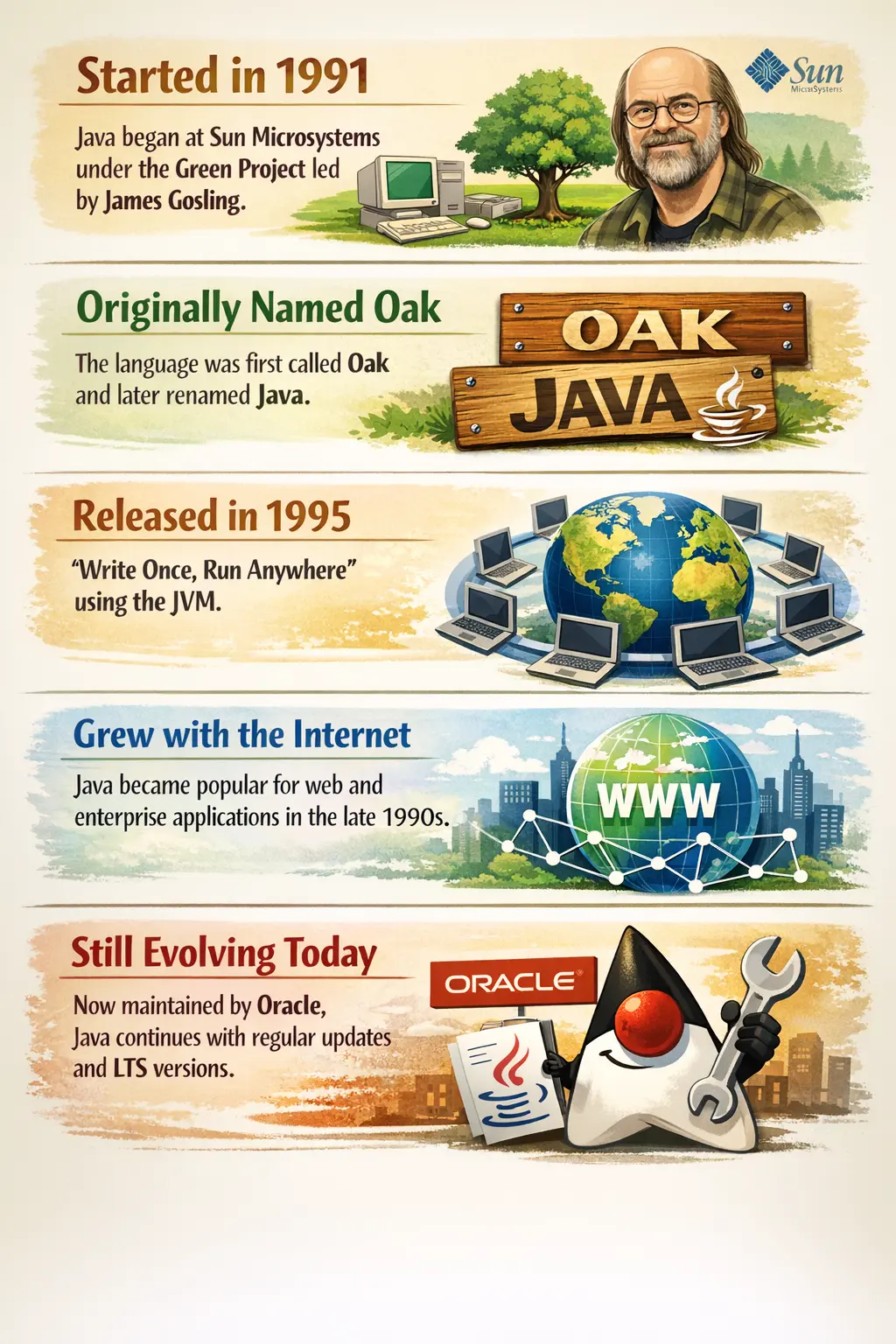
Java began inside Sun Microsystems in 1991 as part of the Green Project. The team included James Gosling, Mike Sheridan, and Patrick Naughton. Their original goal was not to create a language for enterprise web applications. They were exploring software for consumer electronic devices, including set-top boxes, televisions, and other embedded systems. These devices could have different processors, limited resources, and changing hardware designs.
This embedded-device focus strongly influenced Java’s early design. The team needed software that could be moved across hardware with minimal changes. They needed safety because consumer devices could not be expected to crash frequently. They needed a clean programming model that developers could use to build reliable systems. Even though Java later became famous for web and enterprise development, its earliest roots were in the challenge of making software portable, secure, and dependable across devices.
James Gosling and the Birth of Oak
James Gosling is widely recognized as the father of Java. During the Green Project, he designed a language called Oak. The name reportedly came from an oak tree outside his office. Oak was intended to be a simple, robust, object-oriented language suitable for embedded systems. It was influenced by C and C++, but it tried to remove some of the dangerous and complex parts of those languages, such as direct pointer manipulation.
Oak emphasized safety and portability from the beginning. It was designed to run on a virtual machine model so that programs could be executed across different hardware. That idea later became one of Java’s defining features. Although Oak itself did not become a commercial success in its original form, its design principles became the foundation for Java. The shift from Oak to Java was not just a name change; it was a change in direction toward a much larger opportunity.
Why Oak Became Java
The name Oak could not be used commercially because it was already trademarked. The team needed a new name, and Java was chosen. The name was inspired by coffee, which explains the coffee cup logo associated with Java. The rebranding happened during a period when the internet was growing rapidly, and the team saw that the same portability problems they had considered for embedded devices also existed on the web.
The internet created a new kind of platform diversity. Users accessed content from different operating systems and browsers. Developers wanted programs that could travel across networks and run safely on different machines. Java’s architecture matched this need well. The language moved from an embedded-device experiment to a web-ready technology at exactly the right time. This timing helped Java become visible to a much broader developer audience.
The Official Launch in 1995
Java was officially released by Sun Microsystems in 1995. The launch introduced the slogan Write Once, Run Anywhere, which captured the language’s most important promise. Developers could write Java source code, compile it into bytecode, and run that bytecode on any system with a compatible JVM. This was a major shift from the traditional compile-for-each-platform model.
The 1995 release arrived during the web boom, when organizations were excited about internet technologies. Java stood out because it offered portability, security checks, object-oriented structure, and network-oriented capabilities. Developers and businesses saw it as a language built for a connected future. The JVM was central to this promise because it allowed Java programs to run independently of the underlying operating system.
The JVM and Platform Independence
The Java Virtual Machine is one of the most important ideas in Java history. Instead of compiling Java code directly into machine-specific instructions, the Java compiler produces bytecode. The JVM reads and executes that bytecode. Each operating system has its own JVM implementation, but the bytecode remains the same. This makes Java programs portable across platforms.
Platform independence solved a real business problem. Organizations could develop applications once and deploy them across different systems. This was especially valuable for enterprises with mixed environments. A Java application could run on developer machines, testing servers, production servers, and different operating systems with fewer code changes. This portability became one of the reasons Java was trusted for long-term enterprise software.
Java Applets and Early Web Popularity
In the late 1990s, Java gained public attention through applets. Applets were small Java programs that could run inside web browsers and provide dynamic content. At the time, static web pages were common, and applets demonstrated that web pages could become more interactive. They helped introduce many developers and users to Java.
Applets are now obsolete because browser technology, JavaScript, HTML5, and security practices evolved. However, applets played an important role in Java’s early visibility. They showed the potential of running portable code across the web. More importantly, Java’s future did not depend only on applets. As applets declined, Java became stronger in server-side and enterprise development, where it had a more durable role.
Java Moves into Enterprise Development
Java’s enterprise adoption was one of the most important chapters in its history. Businesses needed software that could handle large user bases, complex workflows, database operations, security requirements, and long-term maintenance. Java’s object-oriented model, strong typing, portability, memory management, and mature libraries made it suitable for this environment.
Technologies such as Java EE, application servers, JDBC, servlets, JSP, and later frameworks like Spring helped Java become a standard for enterprise systems. Banks, insurance companies, telecom providers, government agencies, healthcare platforms, and large retail systems adopted Java for critical applications. This enterprise foundation kept Java relevant long after its early browser applet period ended.
Java 1.0 and the Early Foundation
Java 1.0 established the basic language, core libraries, applet support, networking capabilities, and the JVM execution model. It gave developers the first official version of the language and platform. Although early Java was smaller than modern Java, the core ideas were already present: object-oriented programming, platform independence, garbage collection, exception handling, and security checks.
Early Java releases focused on proving that the model worked. The language needed to show that portable bytecode could run across systems and that developers could build useful programs with it. This foundation was important because later versions expanded the libraries and language features while preserving the original philosophy.
Java 1.2 and the Collections Framework
Java 1.2, released as part of the Java 2 platform, introduced the Collections Framework. This was a major improvement because it provided standardized data structures and algorithms such as lists, sets, maps, iterators, and collection utilities. Before this, developers had fewer consistent tools for handling groups of objects. Collections made Java programming more powerful and organized.
The Collections Framework remains one of the most important parts of Java. It is used in almost every real Java project, including backend systems, automation frameworks, data processing, and application development. The introduction of collections showed Java’s movement from a young language into a richer development platform suitable for serious applications.
Java 5 and Modern Language Features
Java 5 was a major milestone in the language’s evolution. It introduced generics, annotations, enhanced for-loops, autoboxing, enums, varargs, and other improvements. Generics improved type safety in collections and reduced the need for casting. Annotations became important for frameworks, testing tools, dependency injection, and configuration. Enhanced for-loops made iteration simpler and more readable.
Java 5 helped modernize the language without breaking its core identity. Many features that developers use every day came from this release. Testing frameworks, enterprise frameworks, and automation tools rely heavily on annotations. Collections became safer and cleaner through generics. This version showed that Java could evolve while still protecting backward compatibility.
Java 8 and Functional-Style Programming
Java 8 was another historic release. It introduced lambda expressions, functional interfaces, the Stream API, default methods in interfaces, and a new date and time API. Lambda expressions allowed developers to write more concise behavior-oriented code. The Stream API made data processing more expressive by supporting operations such as filter, map, sorted, and collect.
Java 8 changed how many developers wrote Java. It did not turn Java into a purely functional language, but it added functional-style capabilities to an object-oriented language. This made Java more expressive for collections, data transformations, event handling, and modern framework usage. Java 8 became one of the most widely adopted versions because it provided major benefits while remaining familiar.
Long-Term Support Versions
Enterprises value stability, so long-term support versions became important in Java’s history. Versions such as Java 8, Java 11, Java 17, and Java 21 have been widely discussed because organizations can standardize on them for extended periods. Long-term support releases provide predictable updates and maintenance, which is important for production systems that cannot constantly upgrade without planning.
This LTS model helps Java remain practical for large organizations. Businesses can choose a stable version, plan migrations carefully, and avoid unnecessary disruption. At the same time, Java continues to release new features regularly. The balance between innovation and stability is one of Java’s strongest historical advantages.
Oracle’s Acquisition of Sun Microsystems
In 2010, Oracle acquired Sun Microsystems and became the steward of Java. This was a significant transition because Sun had created and guided Java from the beginning. Oracle brought strong commercial backing, enterprise focus, and a more structured release model. The acquisition also raised questions in the community about licensing, governance, and the future of the language.
Over time, Java continued to evolve under Oracle’s stewardship. The language received regular updates, new release cycles, long-term support versions, performance improvements, and language enhancements. Java also remained supported by a broad ecosystem beyond Oracle, including OpenJDK contributors, framework communities, IDE vendors, cloud providers, and enterprise users. The language’s survival after this transition showed the strength of the Java ecosystem.
OpenJDK and the Java Community
OpenJDK is the open-source reference implementation of the Java platform. Its role is important because Java is not only controlled by one company in practical use. The broader community, including organizations and individual contributors, participates in Java’s evolution. OpenJDK helped strengthen transparency and collaboration around the platform.
The Java Community Process and wider ecosystem also influenced Java’s growth. Framework builders, tool creators, library maintainers, educators, testers, and enterprise developers all shaped how Java was used. This community strength is one reason Java has remained relevant. A language becomes durable when it has not only technical features but also a large, active, practical ecosystem.
Backward Compatibility as a Historical Strength
One of Java’s most important historical strengths is backward compatibility. Many older Java applications can continue running on newer platforms with minimal changes. This matters greatly in enterprise environments where systems may live for decades. Businesses do not want every language update to force a complete rewrite. Java’s careful approach to compatibility protected long-term investments.
Backward compatibility can sometimes make language evolution slower or more cautious, but it is one reason organizations trust Java. Stability matters when software supports banking, insurance, healthcare, government services, retail operations, and large automation systems. Java’s history shows a consistent attempt to balance improvement with preservation.
Java in Test Automation History
Java also became important in test automation. Selenium WebDriver, TestNG, JUnit, Cucumber, Maven, Gradle, Rest Assured, and many reporting tools are commonly used with Java. As web applications grew, automation teams needed stable programming languages for building maintainable test frameworks. Java’s object-oriented structure and tooling made it a natural choice.
Many automation engineers learn Java because enterprise testing projects often use it. Page Object Model, base test classes, utility classes, data-driven testing, framework configuration, reporting, logging, and CI/CD execution can all be built effectively in Java. This testing history adds another reason Java remains relevant for both developers and QA professionals.
Java and the Rise of Spring
The Spring Framework played a major role in Java’s modern enterprise popularity. Spring simplified enterprise development by offering dependency injection, application configuration, web development support, database integration, security modules, and later Spring Boot for rapid application creation. Spring helped Java move away from heavy enterprise patterns toward more flexible and developer-friendly approaches.
Spring Boot in particular made Java attractive for microservices and cloud-ready backend systems. It reduced configuration complexity and helped teams create production-ready services quickly. Java’s history cannot be separated from the frameworks that kept it useful. Spring is one of the clearest examples of the ecosystem renewing Java’s relevance.
Misconceptions About Java’s History
One misconception is that Java was created only for web development. In reality, Java began with embedded consumer devices and later found a major opportunity in the web. Another misconception is that Java and JavaScript are closely related. They are different languages with different histories, designs, and use cases. The similarity in names has caused confusion for decades, but technically they are separate technologies.
Another misconception is that Java stopped evolving after Java 8. Java 8 was important, but it was not the end of Java’s progress. Newer releases introduced language improvements, performance enhancements, library updates, records, pattern matching features, improved garbage collectors, and other platform improvements. Java’s history is not frozen; it continues to develop while maintaining strong compatibility.
Why Java Survived for Decades
Java survived for decades because it solved real problems and kept adapting. Platform independence made deployment easier. Object-oriented design supported large systems. Garbage collection reduced memory risks. Security features made networked applications safer. Backward compatibility protected existing investments. Frameworks and tools kept the ecosystem productive. These strengths made Java useful beyond short-term technology trends.
Many languages become popular for a period and then fade when the ecosystem changes. Java remained because it became deeply embedded in business systems and because it continued evolving. Its history is a combination of strong original design, enterprise adoption, community support, and practical modernization. That combination is difficult to replace quickly.
Interview-Ready Understanding of Java History
In interviews, Java’s history can be explained clearly: Java was started in 1991 at Sun Microsystems under the Green Project by James Gosling and his team. It was first called Oak and was originally intended for embedded consumer devices. Later it was renamed Java and released officially in 1995 with the Write Once, Run Anywhere philosophy. The JVM made platform independence possible by running compiled bytecode across different systems.
A stronger interview answer also mentions that Java became popular during the web boom, later became a major enterprise language, evolved through important versions such as Java 5 and Java 8, and is now maintained under Oracle’s stewardship with OpenJDK and long-term support releases. This answer shows not only memorized dates but also an understanding of why Java became successful.
The Origin of Java (1991)
Java began in 1991 at Sun Microsystems as part of an initiative known as the Green Project. The project was led by James Gosling, with key contributions from Mike Sheridan and Patrick Naughton. The original goal was to develop software for embedded consumer devices such as set-top boxes and televisions.
These devices required software that was portable, secure, and reliable across different hardware. Those needs heavily influenced Java’s design. The language was first called Oak, named after an oak tree outside Gosling’s office. Even at this early stage, the focus on portability and safety was clear.
From Oak to Java (1994–1995)
As the project evolved, the team discovered that the name Oak was already trademarked. The language was renamed Java. Around the same time, the focus shifted from embedded devices to the rapidly growing internet and web applications.
The name “Java” was inspired by coffee, symbolizing energy and freshness. More importantly, the technology behind the language was redesigned to support networked and web-based environments, positioning Java for the internet era.
Official Release and the JVM (1995)
Java was officially released in 1995 with the slogan “Write Once, Run Anywhere.” This idea was made possible by the Java Virtual Machine, which allowed compiled Java programs to run on any system that had a compatible JVM.
At a time when C and C++ programs often had to be recompiled for each platform, Java’s approach was revolutionary. The same program could run on Windows, Solaris, or Linux without modification. This portability quickly attracted attention from developers and organizations.
Java and the Web Boom
In the late 1990s, Java gained visibility through applets that ran inside web browsers and enabled dynamic content. While applets are now obsolete, they played a major role in Java’s early popularity.
More importantly, enterprises began adopting Java for large-scale systems. Its stability, security model, and portability made it attractive for business applications. This period established Java as a serious enterprise technology rather than just a web experiment.
Evolution Through Versions
Java evolved steadily over the years. Early versions established the core language and libraries. Java 1.2 introduced the Collections Framework, which significantly improved data handling.
Java 5 was a major milestone, adding generics, annotations, and enhanced for-loops. Java 8 later introduced lambda expressions and the Stream API, modernizing the language for functional-style programming.
Subsequent long-term support releases such as Java 11 and Java 17 provided stability for enterprises. A key aspect of Java’s evolution is backward compatibility, allowing older applications to continue running on newer versions.
Oracle’s Stewardship
In 2010, Oracle Corporation acquired Sun Microsystems and became the steward of Java. Oracle introduced a predictable release cycle and formalized long-term support versions.
This transition gave Java strong commercial backing and a structured update model. Enterprises gained confidence that Java would remain stable and supported for the long term.
Why Java Succeeded
Java succeeded because it solved real problems. Platform independence through the JVM allowed broad deployment. A strong security model made it suitable for networked environments. Object-oriented design supported maintainable systems. Backward compatibility protected long-term investments.
Community and enterprise support also played a major role. Many legacy Java systems built decades ago still run today with minimal changes, which is rare in the software world.
Common Misconceptions
Some beginners believe Java was created only for web development, but its roots are in embedded systems. Others think Java is outdated, yet it continues to receive updates and power large systems. Java is also often confused with JavaScript, even though the two are unrelated languages. Another misconception is that Java stopped evolving after Java 8, which is not true given the regular release cadence.
Interview Perspective
In interviews, Java’s history is often summarized by noting that it was created in 1991 by James Gosling at Sun Microsystems and released in 1995 as a platform-independent language. A stronger explanation mentions the Green Project, the JVM, and the Write Once, Run Anywhere philosophy, along with Oracle’s current stewardship and ongoing evolution.
Key Takeaway
Java’s history explains its portability, stability, and long-term relevance. It was designed to handle real-world constraints and has continuously evolved without abandoning compatibility. That combination of innovation and stability is why Java remains a cornerstone technology in enterprise and automation ecosystems today.