finally Block
The finally block in Java is used to execute important cleanup code after a
try block, regardless of whether an exception occurs or not. It is one of the core parts of Java
exception handling because it gives developers a predictable place to release resources, reset state, and
perform actions that must happen before control leaves a protected block of code. Without reliable cleanup,
programs can leak files, database connections, network sockets, locks, and other resources. Over time, those
leaks can make an application slow, unstable, or completely unusable.
The main purpose of finally is not to handle the exception itself. That is the role of
catch. The role of finally is to run code that should execute after the
try and optional catch flow finishes. This distinction is important. A
catch block asks, "How should this exception be handled?" A finally block asks,
"What cleanup must happen no matter how this block finishes?" When used correctly, finally
makes programs safer and more predictable.
This topic appears frequently in Java interviews because it has several tricky edge cases. Interviewers often
ask whether finally executes when an exception is caught, when an exception is not caught, when a
method returns, when a loop breaks, or when System.exit() is called. A strong answer requires
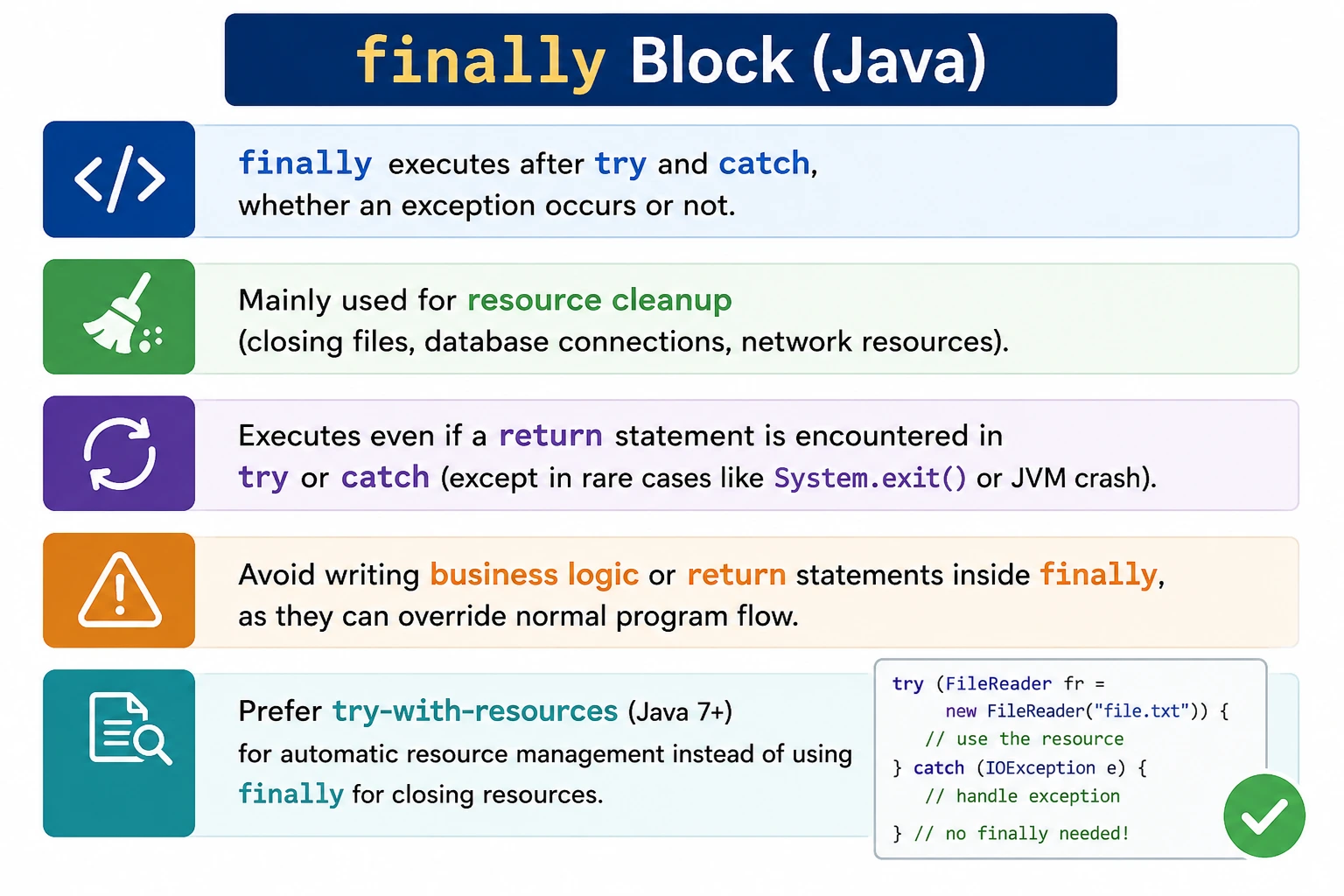
more than saying "finally always executes." The accurate answer is that finally executes in
almost all normal control-flow situations, but it may not execute if the JVM terminates abruptly.
In real applications, finally is most useful around cleanup-sensitive operations. Examples
include closing file readers, releasing database connections, unlocking resources, clearing temporary state,
and ensuring a transaction-related action does not leave the system halfway completed. Modern Java provides
try-with-resources for many resource-cleanup situations, but understanding
finally remains essential because it explains the underlying cleanup concept and still appears
in many codebases.
What Is the finally Block?
A finally block is an optional block that can be attached to a try statement. It
runs after the try block completes and after any matching catch block completes. It
runs whether the try block completes successfully, throws an exception that is caught, throws an
exception that is not caught, returns from a method, breaks out of a loop, or continues to the next loop
iteration. In these normal control-flow cases, Java still executes the finally block before the
control transfer completes.
This makes finally a reliable cleanup location. If a file is opened in the try
block, cleanup code can close it in finally. If a lock is acquired, finally can
release it. If a temporary flag is set before a risky operation, finally can restore it. The
common theme is responsibility: when code acquires something or changes a critical state, it should also
guarantee that the resource or state is cleaned up.
However, finally should not be treated as a place for ordinary business logic. Business logic
belongs in normal code paths. Exception handling belongs in catch. Cleanup belongs in
finally. Keeping those responsibilities separate makes Java programs easier to read and safer to
maintain.
Basic Syntax
The basic syntax places finally after a try block and optional
catch blocks. A try block must be followed by at least one catch block,
one finally block, or both. This means try-finally is valid even without
catch.
try {
    // risky code
} catch (Exception e) {
    // handling code
} finally {
    // cleanup code
}
When both catch and finally are present, the catch block handles the exception and
the finally block performs cleanup. If no exception occurs, the catch block is skipped but the finally block
still runs. If an exception occurs and no catch block matches, the finally block still runs before the
exception propagates to the caller.
Why finally Is Important
The importance of finally becomes clear when working with resources. Many resources are not
managed automatically in the same way as normal Java objects. A file stream may keep an operating-system file
handle open. A database connection may occupy a limited connection-pool slot. A socket may hold a network
resource. A lock may block other threads. If these resources are not released, the application may continue
running for a while but gradually become unstable.
Java has garbage collection, but garbage collection is not a replacement for deterministic cleanup. Garbage
collection handles memory for unreachable objects. It does not guarantee that external resources are released
immediately at the exact time a program needs them released. This is why cleanup logic historically belonged
in finally. The developer could make sure the cleanup ran immediately after the protected
operation completed.
finally also helps restore system state. Suppose a method sets a temporary configuration flag,
changes the cursor in a desktop application, starts a timer, or acquires a lock. If an exception occurs in
the middle of the operation, the state still needs to be restored. A finally block gives the
method a consistent location to restore that state even if the normal flow is interrupted.
Basic Example
In this example, no exception occurs because 10 / 2 is valid. The catch block is
skipped, but the finally block still executes. This shows that finally is tied to
completion of the try statement, not only to exception handling.
try {
    int a = 10 / 2;
} catch (ArithmeticException e) {
    System.out.println("Error");
} finally {
    System.out.println("Finally block executed");
}
Output:
Finally block executed
The output proves that finally runs even when the program follows the successful path. In real
code, that final line might close a resource rather than print a message.
Execution Scenarios (Very Important)
1. No Exception Occurs
When no exception occurs, Java executes the try block normally, skips any catch blocks, executes
the finally block, and then continues after the try-catch-finally statement.
try {
    int x = 10 / 2;
} catch (Exception e) {
} finally {
    System.out.println("Finally");
}
The finally block executes because the protected operation has completed, even though there was
no failure to handle.
2. Exception Occurs and Is Caught
When an exception occurs and a matching catch block exists, Java first transfers control to the matching
catch block. After that catch block finishes, Java executes finally. This order is
important: handling happens first, cleanup happens afterward.
try {
    int x = 10 / 0;
} catch (ArithmeticException e) {
} finally {
    System.out.println("Finally");
}
The exception is caught, but cleanup still runs. This is the most common use case shown in beginner examples.
3. Exception Occurs and Is Not Caught
If an exception occurs and no matching catch block exists, the exception is not handled in the current
method. Even then, Java executes the finally block before allowing the exception to propagate to
the caller. After finally completes, the exception continues moving up the call stack.
try {
    int x = 10 / 0;
} finally {
    System.out.println("Finally");
}
The finally block runs, and then the program may terminate if no higher-level method catches the
exception. This behavior is very important because it means cleanup can still happen even when the current
method cannot recover.
Can finally Exist Without catch?
Yes, finally can exist without a catch block. This is useful when the current
method does not want to handle the exception but still needs to perform cleanup before the exception
propagates. In this form, the method is saying: "I am not handling the failure here, but I must clean up
before the failure leaves this method."
try {
    int x = 10 / 2;
} finally {
    System.out.println("Cleanup");
}
A catch block is optional when finally is present. A finally block is
also optional when catch is present. What Java does not allow is a standalone
try block without either catch or finally.
When finally Does NOT Execute (Rare but Important)
1. System.exit() is Called
The phrase "finally always executes" is a useful simplification, but it is not perfectly accurate. If
System.exit() is called before control reaches the finally block, the JVM begins
shutdown and the finally block does not execute in the normal way.
try {
    System.exit(0);
} finally {
    System.out.println("Finally");
}
This is a common interview edge case. The finally block does not run because the JVM is instructed to exit.
2. JVM Crash / Power Failure
The finally block also cannot run if the JVM crashes, the process is killed forcefully, the
machine loses power, or the operating system terminates the application abruptly. Java can guarantee
finally only within the normal execution control of the JVM. It cannot execute code after the
runtime itself is no longer running.
return Statement and finally
Another important behavior is the interaction between return and finally. If a
method returns from the try block, Java still executes finally before the value is
returned to the caller. This can surprise beginners because the return statement looks like the end of the
method, but Java gives finally a chance to run first.
int test() {
    try {
        return 10;
    } finally {
        System.out.println("Finally");
    }
}
Output:
Finally
The method returns 10, but only after printing Finally. This confirms that
finally runs before the return completes.
return in finally (Very Dangerous)
A return statement inside finally is legal, but it is strongly discouraged. It can
override a value returned from the try block or catch block. Even worse, it can
suppress an exception that was about to be thrown. This makes code difficult to reason about and can hide
serious defects.
int test() {
    try {
        return 10;
    } finally {
        return 20;
    }
}
Output:
20
The method returns 20, not 10, because the return inside finally
overrides the earlier return. This is why production code should avoid returning from finally.
A cleanup block should clean up, not decide the business result of the method.
finally vs try-with-resources
Before Java 7, finally was the standard way to close resources manually. The developer declared
the resource outside the try block, used it inside the block, and closed it inside
finally. This works, but it creates verbose code and can become error-prone when multiple
resources must be closed.
Traditional Cleanup
FileReader fr = null;
try {
    fr = new FileReader("file.txt");
} finally {
    if (fr != null) fr.close();
}
Modern Approach (Java 7+)
Java 7 introduced try-with-resources, which automatically closes resources that implement
AutoCloseable. This is usually cleaner and safer for file streams, readers, writers, database
statements, result sets, and similar resources.
try (FileReader fr = new FileReader("file.txt")) {
    // use file
}
Even though try-with-resources is preferred for resource closing, finally still
matters. It is useful for non-resource cleanup, state restoration, legacy code, and interview understanding.
Knowing both approaches helps developers choose the right tool.
finally with Exception Propagation
When an exception is not caught in the current method, it propagates to the caller. A finally
block executes before that propagation continues. This allows a method to clean up even when it is not
responsible for handling the error. For example, a low-level method may not know how to recover from a
database failure, but it can still release a local resource before the exception moves upward.
This pattern is common in layered applications. A repository method may clean up local resources and allow an
exception to reach a service layer. A service layer may add business context and rethrow. A controller may
convert the exception into an HTTP response. The finally block helps each layer leave its own
state clean before control moves elsewhere.
finally with break and continue
finally also executes when control leaves a try block because of
break or continue. If a loop contains a try-finally block and the
try block executes break, Java runs finally before leaving the loop. If
the try block executes continue, Java runs finally before moving to the
next iteration.
This behavior reinforces the same rule: finally runs before the control transfer completes.
Whether the transfer is caused by return, exception propagation, break, or continue, Java normally gives
finally a chance to execute.
Exceptions Inside finally
A finally block can also throw an exception. This should be handled carefully because an
exception thrown from finally may hide an exception thrown from the try block. For
example, if the try block throws one exception and the finally block throws another
exception during cleanup, the cleanup exception can become the visible exception. The original failure may be
lost or harder to diagnose.
This is one reason try-with-resources is safer for resource cleanup. It has defined behavior for
suppressed exceptions, preserving more diagnostic information. When writing manual finally
cleanup, developers should avoid throwing new exceptions casually and should handle cleanup failures in a way
that preserves the original cause whenever possible.
What Should Go Inside finally?
The best content for a finally block is cleanup code that must run regardless of success or
failure. This includes releasing resources, resetting temporary flags, restoring thread-local values,
unlocking locks, stopping timers, or clearing temporary state. The code should be short, predictable, and
focused on cleanup.
Business decisions should not be placed in finally. Returning values, changing main workflow
results, performing complex validation, or making new business decisions inside finally creates
confusing code. The reader expects finally to clean up, so using it for unrelated logic violates
that expectation.
finally and Resource Ownership
A useful rule for deciding whether cleanup belongs in finally is resource ownership. The code
that acquires a resource should usually be responsible for releasing it. If a method opens a file, obtains a
connection, starts a timer, or acquires a lock, that same method should make sure the resource is released
even when something goes wrong. The finally block provides a clear structure for that
responsibility.
Problems often appear when ownership is unclear. One method may open a resource and pass it to another method, leaving both methods uncertain about who should close it. This can cause double-closing, forgotten cleanup, or cleanup at the wrong time. A disciplined design makes ownership explicit. If the caller owns the resource, the caller cleans it up. If the method creates the resource for its own internal use, the method should clean it up before returning or before allowing an exception to propagate.
finally in Transaction-Like Workflows
Although database transaction management is often handled by frameworks, the concept behind
finally still matters. A transaction-like workflow usually has setup, risky work, success
handling, failure handling, and cleanup. The cleanup step should not depend on whether the work succeeded.
For example, temporary transaction state, locks, or context objects may need to be cleared whether the
transaction commits or rolls back.
In framework-based applications, developers may not write manual finally blocks for every
transaction, but the framework itself often follows the same principle internally. It ensures that resources
are released and context is cleared after the operation completes. Understanding finally helps
developers reason about these framework behaviors and avoid leaving application state dirty after failures.
finally and Suppressed Exceptions
Manual cleanup inside finally can create a subtle problem when both the try block
and the cleanup code fail. Suppose the original operation throws one exception, and then the cleanup code in
finally throws another exception. The cleanup exception may replace or obscure the original
exception, making it harder to identify the true cause of the failure. This is one reason manual cleanup must
be written carefully.
try-with-resources handles this situation more cleanly by supporting suppressed exceptions. If
the main operation fails and closing the resource also fails, Java can preserve the primary exception and
attach the cleanup failure as a suppressed exception. This gives developers better diagnostic information.
Even if you mostly use try-with-resources, knowing the limitation of manual
finally cleanup helps you understand why the modern approach is preferred.
finally in Multithreaded Code
In multithreaded programs, finally is especially important when locks or thread-local state are
involved. If a thread acquires a lock and an exception occurs before the lock is released, other threads may
remain blocked. Placing the unlock operation in finally ensures that the lock is released even
when the protected operation fails.
The same principle applies to thread-local values. If a method sets contextual information for the current
thread, it should clear or restore that information in finally. Otherwise, later work on the
same thread may accidentally see stale context. This is particularly relevant in server applications that
reuse threads from a thread pool.
finally vs catch Responsibilities
A clear distinction between catch and finally leads to cleaner code. The
catch block is responsible for handling a specific failure. It may log the exception, recover
from it, wrap it, rethrow it, or convert it into a response. The finally block is responsible for
cleanup that must happen regardless of success or failure.
Mixing these responsibilities creates confusion. If finally logs business errors, changes return
values, or decides whether an operation succeeded, the code becomes difficult to reason about. If
catch contains cleanup that must also happen in successful cases, cleanup may be missed. The
safest design is to let each block do its own job.
Real-World Example Thinking
Consider a method that reads configuration from a file. The normal logic opens the file, reads values, and
builds a configuration object. If the file is missing, a catch block may log a configuration error or load
defaults. Regardless of success or failure, the file reader should be closed. That closing action belongs in
finally or, in modern Java, in try-with-resources.
Consider another method that temporarily changes an application flag before running a risky operation. If the
operation succeeds, the flag must be restored. If the operation fails, the flag must still be restored. This
is not resource closing, but it is state cleanup. A finally block is appropriate because the
restoration must happen regardless of the outcome.
How to Explain finally in Simple Words
A simple way to explain finally is to say that it is the cleanup section of exception handling.
The try block attempts the risky work. The catch block handles a failure if one is
caught. The finally block performs cleanup before control leaves the structure. This cleanup
happens after success, after handled failure, and before uncaught failure continues upward.
For interviews, it is helpful to include the phrase "almost always." Saying "finally always executes" is
usually accepted at a beginner level, but a stronger answer says that it executes in normal JVM-controlled
flows and does not execute when the JVM terminates abruptly, such as through System.exit(), a
crash, a forced process kill, or power failure.
Common Beginner Mistakes
One common beginner mistake is writing business logic inside finally. This makes the program
harder to understand because the block is expected to contain cleanup. Another mistake is using
return inside finally, which can override earlier return values or suppress
exceptions. This behavior is legal but dangerous.
Beginners also sometimes assume that finally always executes without exception. It is better to
say it executes in almost all normal JVM-controlled flows, but it may not execute when System.exit()
is called, the JVM crashes, the process is killed, or power is lost. Another common mistake is failing to
handle cleanup errors carefully. Cleanup should not create new hidden problems.
Best Practices
Use finally for cleanup and state restoration, not for main business logic. Keep it short and
easy to understand. Avoid return statements inside finally. Avoid throwing new
exceptions from finally unless there is a clear reason and the original cause is preserved.
For resources that implement AutoCloseable, prefer try-with-resources in modern
Java. It is cleaner, safer, and handles suppressed exceptions better than manual closing code. Use
finally when cleanup is not simply closing an auto-closeable resource, or when maintaining legacy
code that already uses the traditional pattern.
Interview Perspective
In interviews, a strong explanation should say that finally is used for cleanup and executes
after try and catch in almost all normal flows. It should mention that
finally runs whether an exception occurs, whether it is caught, and even before a method return
completes. It should also mention the important exceptions: System.exit(), JVM crash, process
termination, or power failure.
A practical answer should also warn against returning from finally. This shows real experience
because the syntax is allowed but the behavior is dangerous. If you can explain that a return inside
finally can override a return from try or catch, you demonstrate a
deeper understanding of Java control flow.
Interview-Ready Answers
Short Answer
The finally block is used to execute cleanup code whether an exception occurs or not.
Detailed Answer
In Java, the finally block is executed after try and catch blocks
regardless of whether an exception is thrown or handled. It is typically used for cleanup such as closing
files, releasing connections, unlocking resources, or restoring state. It also executes before a return,
break, continue, or uncaught exception propagation completes. The main cases where finally does
not execute are JVM termination, System.exit(), process kill, crash, or power failure.
Key Takeaway
finally provides predictable cleanup in Java exception handling. Use it for resource release and
state restoration, not for business logic. Avoid return inside finally because it
can override return values and hide exceptions. In modern Java, prefer try-with-resources for
auto-closeable resources, but understand finally because it remains central to Java control flow.
finally Block Examples (Interview Favorites)
1. Basic finally Execution
class Demo {
    public static void main(String[] args) {
        try {
            int a = 10 / 0;
        } catch (ArithmeticException e) {
            System.out.println("Catch");
        } finally {
            System.out.println("Finally");
        }
    }
}
Output
Catch
Finally
2. finally Without Exception
class Demo {
    public static void main(String[] args) {
        try {
            System.out.println("Try block");
        } finally {
            System.out.println("Finally block");
        }
    }
}
Output
Try block
Finally block
3. finally Without catch
class Demo {
    public static void main(String[] args) {
        try {
            System.out.println("Only try");
        } finally {
            System.out.println("Only finally");
        }
    }
}
Output
Only try
Only finally
4. finally with Multiple catch
class Demo {
    public static void main(String[] args) {
        try {
            String s = null;
            s.length();
        } catch (ArithmeticException e) {
            System.out.println("Arithmetic");
        } catch (NullPointerException e) {
            System.out.println("Null");
        } finally {
            System.out.println("Finally executed");
        }
    }
}
Output
Null
Finally executed
5. finally Executes Even After return
class Demo {
    static int test() {
        try {
            return 10;
        } finally {
            System.out.println("Finally");
        }
    }

    public static void main(String[] args) {
        System.out.println(test());
    }
}
Output
Finally
10
6. finally Overrides return (Interview Favorite)
class Demo {
    static int test() {
        try {
            return 10;
        } finally {
            return 20;
        }
    }

    public static void main(String[] args) {
        System.out.println(test());
    }
}
Output
20
7. finally with Exception + return
class Demo {
    static int test() {
        try {
            int a = 10 / 0;
            return 1;
        } catch (ArithmeticException e) {
            return 2;
        } finally {
            return 3;
        }
    }

    public static void main(String[] args) {
        System.out.println(test());
    }
}
Output
3
8. finally Executes When Exception Not Caught
class Demo {
    public static void main(String[] args) {
        try {
            int a = 10 / 0;
        } finally {
            System.out.println("Finally executed");
        }
    }
}
Output
Finally executed
Exception in thread "main" java.lang.ArithmeticException
9. finally with Nested try-catch
class Demo {
    public static void main(String[] args) {
        try {
            try {
                int a = 10 / 0;
            } catch (ArithmeticException e) {
                System.out.println("Inner catch");
            }
        } finally {
            System.out.println("Outer finally");
        }
    }
}
Output
Inner catch
Outer finally
10. finally and Resource Cleanup (Old Style)
import java.io.FileInputStream;

class Demo {
    public static void main(String[] args) {
        FileInputStream fis = null;
        try {
            fis = new FileInputStream("test.txt");
        } catch (Exception e) {
            System.out.println("Exception");
        } finally {
            try {
                if (fis != null) fis.close();
                System.out.println("Resource closed");
            } catch (Exception e) {}
        }
    }
}
Output
Exception
Resource closed
11. finally vs try-with-resources
import java.io.*;

class Demo {
    public static void main(String[] args) {
        try (FileInputStream fis = new FileInputStream("test.txt")) {
            System.out.println("Using resource");
        } catch (Exception e) {
            System.out.println("Exception");
        }
    }
}
Explanation
Resource auto-closed (no finally needed)
12. finally Not Executed with System.exit()
class Demo {
    public static void main(String[] args) {
        try {
            System.exit(0);
        } finally {
            System.out.println("Finally");
        }
    }
}
Explanation
JVM terminates immediately
finally not executed
13. finally Not Executed on JVM Crash
class Demo {
    public static void main(String[] args) {
        try {
            Runtime.getRuntime().halt(0);
        } finally {
            System.out.println("Finally");
        }
    }
}
Explanation
JVM halt means no cleanup
14. finally with throw
class Demo {
    static void test() {
        try {
            throw new RuntimeException();
        } finally {
            System.out.println("Finally");
        }
    }

    public static void main(String[] args) {
        test();
    }
}
Output
Finally
Exception in thread "main" java.lang.RuntimeException
15. finally with throw Overrides Exception
class Demo {
    static void test() {
        try {
            throw new ArithmeticException();
        } finally {
            throw new NullPointerException();
        }
    }

    public static void main(String[] args) {
        test();
    }
}
Explanation
finally exception overrides try exception
16. finally with Loop
class Demo {
    public static void main(String[] args) {
        for (int i = 1; i <= 3; i++) {
            try {
                System.out.println(i);
            } finally {
                System.out.println("Finally");
            }
        }
    }
}
Output
1
Finally
2
Finally
3
Finally
17. finally in Method Call Stack
class Demo {
    static void m1() {
        try {
            m2();
        } finally {
            System.out.println("Finally in m1");
        }
    }

    static void m2() {
        int a = 10 / 0;
    }

    public static void main(String[] args) {
        try {
            m1();
        } catch (Exception e) {
            System.out.println("Exception caught");
        }
    }
}
Output
Finally in m1
Exception caught
18. finally with break
class Demo {
    public static void main(String[] args) {
        while (true) {
            try {
                break;
            } finally {
                System.out.println("Finally");
            }
        }
    }
}
Output
Finally
19. finally with continue
class Demo {
    public static void main(String[] args) {
        for (int i = 1; i <= 2; i++) {
            try {
                continue;
            } finally {
                System.out.println("Finally " + i);
            }
        }
    }
}
Output
Finally 1
Finally 2
20. Interview Summary: finally Block
class Demo {
    public static void main(String[] args) {
        try {
            int a = 10 / 0;
        } catch (Exception e) {
            System.out.println("Catch");
        } finally {
            System.out.println("Cleanup");
        }
    }
}
Key Points
- Executes almost always
- Used for cleanup
- Overrides return and exceptions if present
- Not executed only on JVM termination
Output
Catch
Cleanup