final Keyword in Java
In Java, the final keyword is used to place a restriction on a variable, method, or class. It communicates that something is not meant to be changed in a specific way. A final variable cannot be reassigned after initialization, a final method cannot be overridden by a subclass, and a final class cannot be extended. This makes final one of the most important keywords for writing safe, predictable, and intention-revealing Java code.
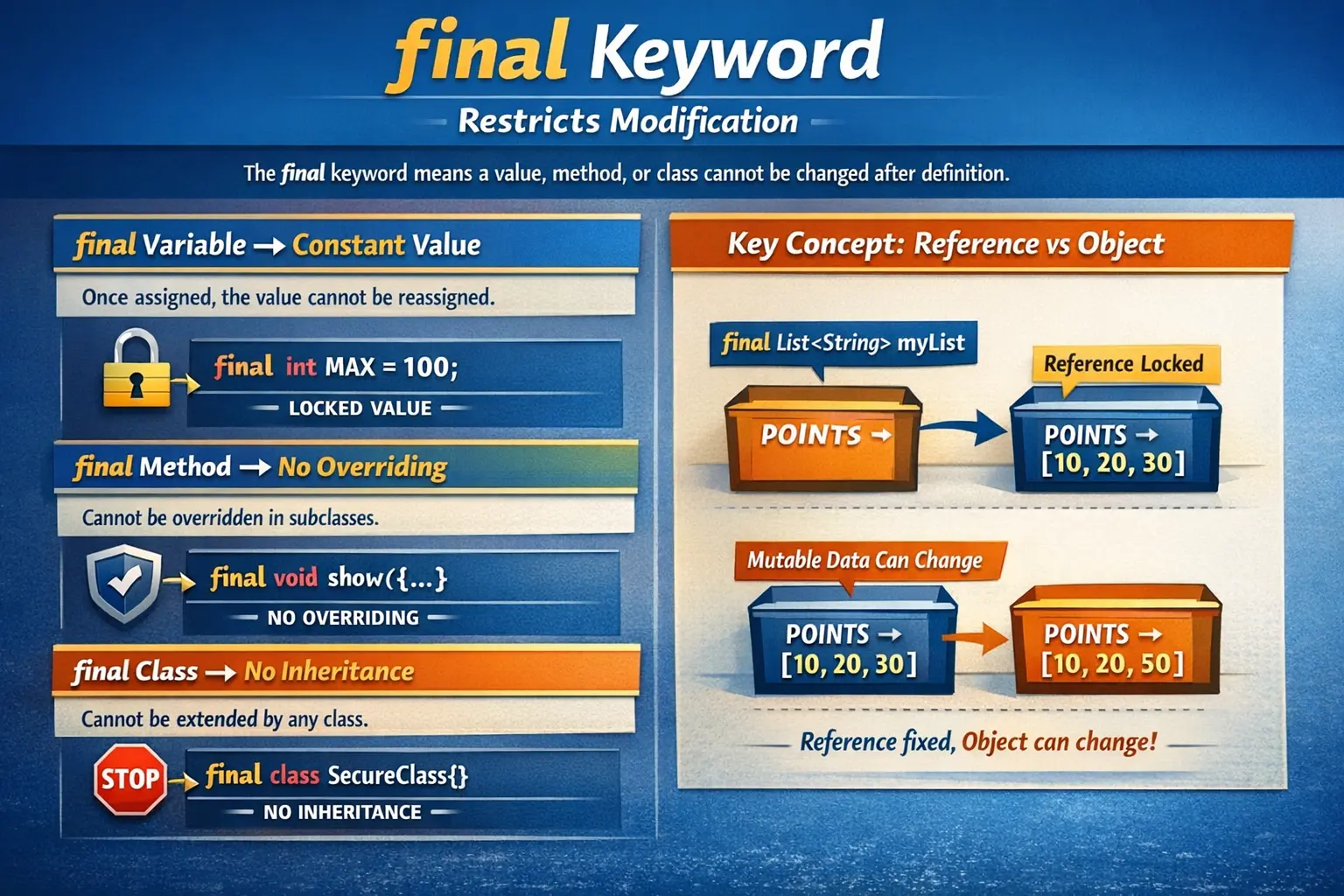
At first, final may look simple because developers often explain it as “cannot be changed.” That explanation is useful for beginners, but it is incomplete. The meaning of final depends on where it is used. With a variable, it prevents reassignment. With a method, it prevents overriding. With a class, it prevents inheritance. These are related ideas, but they are not identical. Understanding the difference is essential for using final correctly.
The final keyword is also important from a design perspective. It helps protect constants, preserve critical logic, prevent unsafe inheritance, support immutable-style programming, and make developer intention clear. In large Java applications, controlling what can and cannot change is just as important as writing functionality. The final keyword gives developers a language-level way to express that control.
What Does final Mean in Java?
The final keyword is a non-access modifier. A non-access modifier changes the behavior of a class, method, or variable without controlling visibility like public, private, or protected. The purpose of final is to restrict modification.
When applied to a variable, final means the variable can be assigned only once. When applied to a method, it means subclasses cannot override that method. When applied to a class, it means no other class can extend it. These rules are checked by the compiler, so violations are caught at compile time rather than becoming runtime surprises.
final int maxLimit = 100;

final class Utility {
}

class Parent {
    final void display() {
        System.out.println("Final method");
    }
}
Each use of final expresses a different restriction. The variable maxLimit cannot be reassigned. The class Utility cannot be inherited. The method display() cannot be overridden in a child class.
Why the final Keyword Matters
Modern software development involves change, but not every part of a program should be open to change. Some values must remain constant, some methods must preserve their behavior, and some classes are not designed for inheritance. The final keyword allows developers to enforce these boundaries clearly.
One major benefit is safety. If a value should never change after initialization, marking it final prevents accidental reassignment. This is useful for constants, identifiers, configuration values, constructor-initialized fields, and values that must remain stable after object creation.
Another benefit is design clarity. When another developer sees final, they understand that reassignment, overriding, or inheritance is intentionally blocked. This reduces ambiguity. The code communicates not only what it does, but also what it does not allow.
The final keyword can also support performance optimizations in some situations. The compiler and JVM may be able to make assumptions about final values or final methods. However, performance should not be the main reason for using final. Its biggest value is correctness, clarity, and design safety.
final Variables
A final variable is a variable that can be assigned only once. After the value is assigned, the variable cannot be reassigned. This applies to local variables, instance variables, static variables, and method parameters. The exact initialization rules depend on where the variable is declared.
final int MAX_LIMIT = 100;
// MAX_LIMIT = 200; // compilation error
In this example, MAX_LIMIT is assigned the value 100. Any attempt to assign a new value causes a compilation error. This makes final variables useful when a value must remain stable.
It is important to understand that final applies to the variable, not always to the object’s internal state. For primitive variables, this distinction is simple because the value itself cannot be changed. For reference variables, the reference cannot be changed, but the object may still be mutable.
final Local Variables
A final local variable is declared inside a method, constructor, or block. It must be assigned before use and can be assigned only once. After assignment, the method cannot reassign it.
void test() {
    final int x = 10;
    // x = 20; // compilation error
    System.out.println(x);
}
Final local variables are useful when a method uses a value that should not change during execution. They can prevent accidental reassignment in complex methods and make the method logic easier to follow.
Local variables used inside lambda expressions and anonymous inner classes must be final or effectively final. A variable is effectively final when it is not declared with the final keyword but is assigned only once and not modified afterward. This rule exists because Java needs stable captured values for such constructs.
final Instance Variables
A final instance variable belongs to an object and can be assigned only once for that object. It may be initialized at the time of declaration, inside an instance initializer block, or inside every constructor. Once assigned, it cannot be reassigned for that object.
class Employee {
    final int id;

    Employee(int id) {
        this.id = id;
    }
}
This pattern is common in real-world Java. Each Employee object can have a different id, but once an object is created, its ID cannot be changed. This is useful for fields that define identity or stable object state.
A final instance variable must be definitely assigned. If a class has multiple constructors, every constructor must initialize the final field unless it is already initialized at declaration. Otherwise, the compiler reports an error.
class Student {
    final int rollNumber = 101;
}
In this example, the final field is initialized at declaration. Every object will have the same value unless the field is designed differently. If each object needs a different value, constructor initialization is usually better.
final Static Variables
A final static variable belongs to the class and can be assigned only once. When static and final are used together, the variable usually represents a constant. Such constants are typically written in uppercase letters with underscores between words.
class Constants {
    static final double PI = 3.14159;
    static final int MAX_LOGIN_ATTEMPTS = 3;
}
The static keyword means one copy belongs to the class. The final keyword means the value cannot be reassigned. Together, they create a shared fixed value. This is widely used for configuration values, limits, labels, error codes, and fixed business rules.
A static final variable can also be initialized in a static block. This is useful when the value requires some logic during class loading.
class Config {
    static final String ENV;

    static {
        ENV = "QA";
    }
}
The value is assigned once in the static block. After that, it cannot be reassigned. This pattern is less common than direct initialization, but it is valid when initialization is more complex.
final Reference Variables
One of the most important concepts is the behavior of final reference variables. If a reference variable is final, the reference cannot point to a different object after assignment. However, if the object itself is mutable, its internal state can still change.
final StringBuilder builder = new StringBuilder("Java");
builder.append(" Programming"); // allowed

// builder = new StringBuilder("Python"); // compilation error
The variable builder cannot be reassigned to a new StringBuilder object. But the existing StringBuilder object can still be modified because StringBuilder is mutable. This is the key difference between a final reference and an immutable object.
This distinction is frequently asked in interviews. A final reference prevents reassignment. It does not automatically make the referenced object immutable. To achieve immutability, the object’s class must be designed so its state cannot change after construction.
final Methods
A final method cannot be overridden by a subclass. This is useful when a parent class defines logic that must remain unchanged. Subclasses can inherit and use the method, but they cannot provide a new implementation for it.
class Parent {
    final void display() {
        System.out.println("Parent display");
    }
}

class Child extends Parent {
    // void display() {} // compilation error
}
The compiler prevents the child class from overriding display(). This protects the method’s behavior. If the method contains critical logic, final prevents subclasses from accidentally or intentionally changing it.
Final methods are useful in framework base classes, security validation, core business rules, template methods, and utility-like parent logic. They allow inheritance while preserving specific behavior that must not be altered.
Why Use final Methods?
Inheritance is powerful, but it also creates risk. A subclass can override a method and change behavior in a way the parent class designer did not expect. Sometimes this flexibility is desired. Other times it can break correctness, security, or consistency.
For example, suppose a base class has a method that performs authentication checks before allowing an operation. If a subclass could override that method and bypass the check, the system could become unsafe. Declaring the method final prevents that.
class SecureService {
    final void validateAccess() {
        System.out.println("Access validation logic");
    }
}
By marking validateAccess() final, the developer communicates that subclasses should not change that behavior. This is a design decision, not just a syntax rule.
final Classes
A final class cannot be extended. If a class is declared final, no subclass can inherit from it. This is useful when the class is complete, security-sensitive, immutable, utility-focused, or not designed for inheritance.
final class Utility {
    void help() {
        System.out.println("Helping");
    }
}

// class MyUtility extends Utility {} // compilation error
The class Utility cannot be extended. This prevents other classes from modifying its behavior through inheritance. If a class has no reason to be inherited or inheritance could make it unsafe, final can be a good design choice.
One of the most famous final classes in Java is String. The String class is final, which means it cannot be subclassed. This helps preserve its immutability, security, and predictable behavior.
Why String Is final
The String class is used everywhere in Java: class loading, file paths, network connections, database URLs, security tokens, usernames, passwords, configuration keys, and string literals. If String could be subclassed, a subclass might change behavior in unsafe ways.
By making String final, Java ensures that string behavior remains consistent. Combined with immutability, this supports string pooling, safe sharing, reliable hashing, and secure use in sensitive operations.
This does not mean every class should be final. It means classes should be final when extension is not intended or would create design risk. If a class is designed for inheritance, it should be documented and structured carefully. If it is not designed for inheritance, marking it final can be clearer.
final and Immutability
A common misconception is that final automatically means immutable. This is not always true. Final prevents reassignment of a variable, overriding of a method, or extension of a class. Immutability means an object’s state cannot change after creation. These are related but different ideas.
final StringBuilder sb = new StringBuilder("Java");
sb.append(" Rocks"); // allowed
The reference sb is final, so it cannot point to another object. But the StringBuilder object itself can still change. Therefore, the reference is final, but the object is not immutable.
To create an immutable class, developers usually make fields private and final, avoid setters, initialize values through constructors, and protect mutable internal objects from direct exposure. The final keyword helps with immutable design, but it is not sufficient by itself.
final Method Parameters
The final keyword can also be applied to method parameters. A final parameter cannot be reassigned inside the method. This can prevent accidental modification of input references or values.
void calculate(final int amount) {
    // amount = 20; // compilation error
    System.out.println(amount);
}
Final parameters are not required in most Java code, but some teams use them for clarity or to prevent accidental reassignment in complex methods. As with final local variables, if the parameter is a reference to a mutable object, final prevents reassignment of the parameter, not mutation of the object.
final with Blank Final Variables
A blank final variable is a final variable that is declared but not initialized immediately. It must be initialized exactly once before the constructor or initialization process completes.
class Product {
    final int productId;

    Product(int productId) {
        this.productId = productId;
    }
}
This pattern is useful when the value is not known until object creation. Each object can receive a different final value, but once assigned, the value cannot change. This is common for IDs, names, configuration injected through constructors, and values that define object identity.
final vs finally vs finalize
Java has three similar-looking terms: final, finally, and finalize(). They are completely different and should not be confused.
final is a keyword used with variables, methods, and classes to restrict modification. finally is a block used in exception handling to execute cleanup code whether an exception occurs or not. finalize() was a method related to garbage collection, but it is deprecated and should not be used in modern Java programming.
try {
    System.out.println("Work");
} finally {
    System.out.println("Cleanup");
}
The finally block has nothing to do with final variables or final classes. It belongs to exception handling. Remembering this distinction is important for interviews.
Common Mistakes with final
One common mistake is assuming that final makes every object immutable. It does not. A final reference cannot be reassigned, but the object can still be modified if the object’s class is mutable.
Another mistake is forgetting to initialize final variables. A final variable must be assigned exactly once. If a final instance variable is not assigned at declaration or in every constructor path, the program fails to compile.
A third mistake is trying to override a final method. Subclasses can inherit final methods, but they cannot override them. The compiler prevents this.
A fourth mistake is trying to extend a final class. Once a class is declared final, inheritance is not allowed. Developers must use composition or another design instead.
A fifth mistake is overusing final everywhere without design reason. While final improves safety, excessive use can make code rigid. Use it intentionally where restriction communicates value.
Best Practices
Use static final for constants. Fixed values such as maximum limits, default timeout values, application names, error codes, and configuration keys are good candidates for constants. Follow uppercase naming conventions for constants.
Use final instance variables for values that should be assigned during object creation and never changed afterward. IDs, immutable configuration values, and constructor-injected dependencies are common examples.
Use final methods when overriding would break correctness, security, or expected behavior. Do not make every method final by default unless the class design requires it.
Use final classes when inheritance is not intended or could be unsafe. Utility classes, immutable classes, and security-sensitive classes may be good candidates.
Remember that final is a design signal. It tells future developers that a value, method, or class is intentionally restricted. Use it where that message improves clarity.
Interview Perspective
In interviews, the final keyword can be explained as a non-access modifier used to restrict modification. It can be applied to variables, methods, and classes.
A final variable cannot be reassigned after initialization. A final method cannot be overridden by a subclass. A final class cannot be extended. These are the three core points every answer should include.
A stronger answer should also explain that final references do not make mutable objects immutable. For example, a final StringBuilder reference cannot point to another object, but the same StringBuilder object can still be modified.
Interviewers may also ask about final, finally, and finalize(). The correct answer is that final restricts modification, finally is used for cleanup in exception handling, and finalize() is a deprecated garbage-collection-related method.
Key Takeaway
The final keyword is a powerful Java feature used to restrict change. It helps prevent accidental reassignment, protect method behavior, and block inheritance when extension is not intended. Used correctly, it improves code safety, readability, and design clarity.
Final variables are assigned once. Final methods cannot be overridden. Final classes cannot be extended. Final references cannot be reassigned, but the referenced object may still be mutable unless the class itself is designed to be immutable.
The golden rule is simple: use final when a value, behavior, or class design should remain stable. It is not just a syntax feature; it is a way to express intention and protect important parts of a Java program.