Default vs Parameterized Constructor
Constructors are used to initialize objects. In Java, the two most common types discussed in interviews are Default Constructors and Parameterized Constructors. Understanding their differences is essential for object creation, initialization control, and clean OOP design.
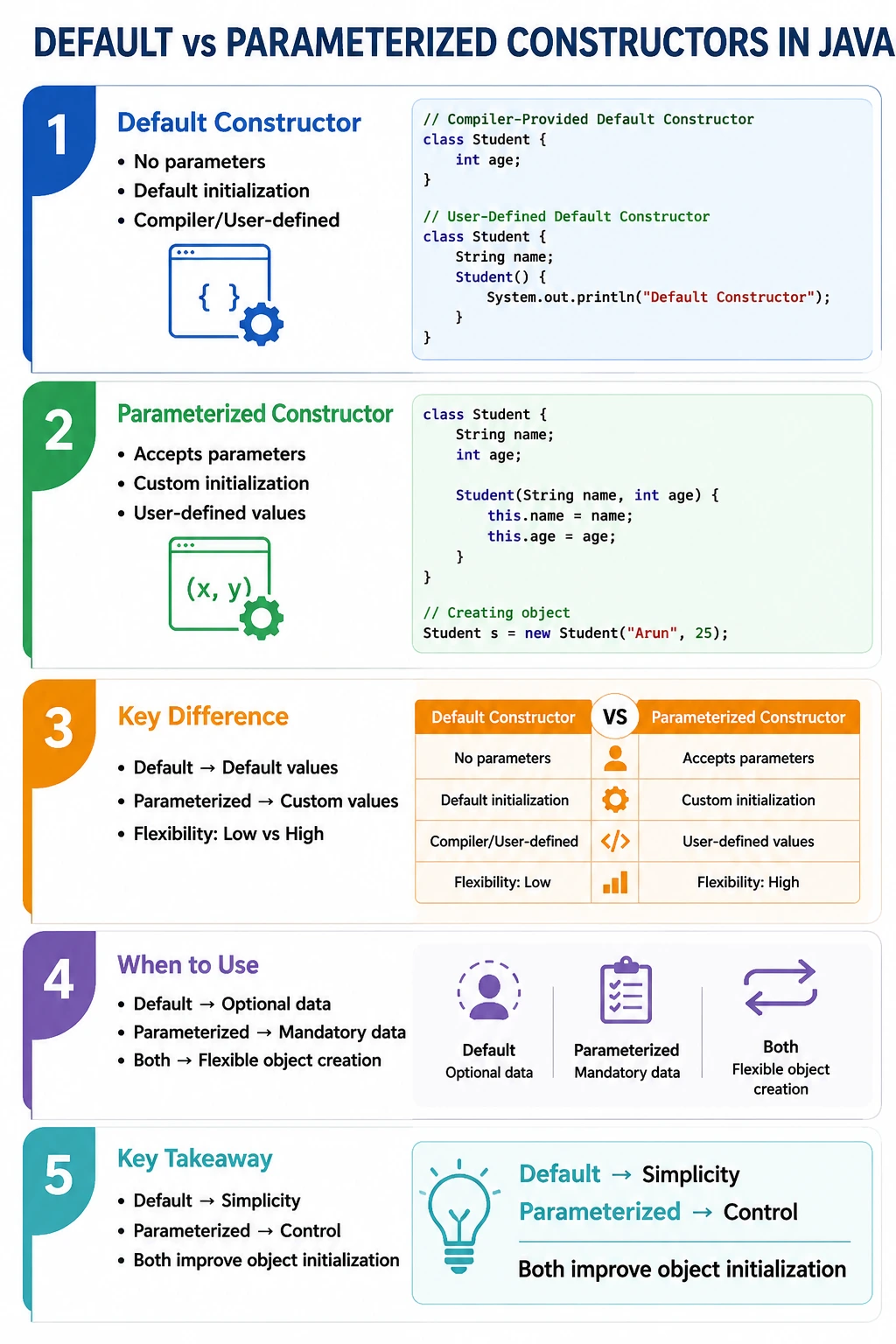
What Is a Default Constructor?
A default constructor is a constructor that takes no parameters and allows an object to be created without supplying values from the caller. In Java interviews, the term default constructor is used in two closely related ways. Strictly speaking, a default constructor is the no-argument constructor generated by the compiler when no constructor is written in the class. In everyday discussion, many developers also use the phrase to refer to an explicitly written no-argument constructor. Both forms create an object without arguments, but they are not exactly the same from a compiler perspective.
The compiler-provided default constructor is automatic. If a class contains no constructor at all, Java silently provides a no-argument constructor. That constructor performs default initialization. Numeric instance variables receive 0, boolean variables receive false, char variables receive the null character, and reference variables receive null unless field initializers assign other values.
class Student {
    int age;
}

// Compiler effectively provides:
Student() { }
This generated constructor is simple, but it is important because it allows code such as new Student() to compile. The object is created successfully, and age starts with the default int value of 0. The constructor does not contain custom logic because the programmer did not provide any.
A user-defined no-argument constructor is different because the programmer writes it explicitly. It still accepts no arguments, but it can contain custom initialization logic.
class Student {
    Student() {
        System.out.println("No-arg constructor");
    }
}
In practice, many people call this a default constructor because it creates an object with no arguments. For precise interview answers, explain both meanings. Say that the compiler-provided default constructor exists only when no constructor is written, while a no-argument constructor can also be written manually by the programmer.
What Is a Parameterized Constructor?
A parameterized constructor accepts arguments and initializes the object with custom values at creation time. It gives the caller a way to supply meaningful data while the object is being created. This is useful when an object should not start with blank or language-default values.
class Student {
    String name;
    int age;

    Student(String name, int age) {
        this.name = name;
        this.age = age;
    }
}

Student s = new Student("John", 20);
Here, the Student object starts with a name and age supplied by the caller. The constructor parameters receive the values, and this.name and this.age assign those values to the object's instance variables. The this keyword is used because the parameter names match the field names. This is a common Java style because it keeps names meaningful while making assignments explicit.
Parameterized constructors are especially important when an object has mandatory data. If every Student must have a name, the class can require the name in the constructor. This prevents incomplete objects and makes the class safer to use. Instead of creating an empty object and hoping the caller remembers to set fields later, the constructor ensures required state is available immediately.
Why the Difference Matters
The difference between default and parameterized constructors is not only about syntax. It is about control over object initialization. A default constructor gives simplicity: create the object now and rely on default values or later assignment. A parameterized constructor gives control: create the object with specific values immediately. Both are useful, but they serve different design needs.
If a class represents a simple container where all fields are optional, a no-argument constructor may be enough. If a class represents a meaningful business entity, a parameterized constructor is often better because it can enforce required information. For example, an Account object without an account number may be invalid. An Order object without an order id or customer may not make sense. In such cases, allowing empty object creation can lead to errors later.
Constructor choice also affects readability. When a developer sees new Student("John", 20), the object state is visible at creation time. When a developer sees new Student(), they must look for later setter calls or default initialization to understand the object's state. Neither style is automatically wrong, but each communicates a different level of initialization.
Default Constructor Behavior
A compiler-provided default constructor appears only when the class has no constructor at all. This is one of the most important rules in Java constructor learning. The moment you define any constructor, even a parameterized one, Java stops generating the default constructor automatically. If you still want no-argument object creation, you must write the no-argument constructor yourself.
This behavior prevents ambiguity. If a programmer writes a constructor, Java assumes the programmer wants control over object creation. It does not add another constructor behind the scenes because doing so could allow objects to be created in a way the programmer did not intend.
Default constructors are useful when default state is acceptable. A class may start with default values and allow values to be assigned later. Frameworks may also require no-argument constructors for reflection, serialization, deserialization, or object mapping. In such situations, a no-argument constructor may be necessary even if the class also has parameterized constructors.
Parameterized Constructor Behavior
A parameterized constructor requires the caller to provide values that match the constructor signature. If the constructor expects a String and an int, the caller must pass compatible arguments in the correct order. This makes object creation more controlled but also more demanding. The caller cannot create the object without knowing the required data.
Parameterized constructors can assign fields, validate input, and create a meaningful starting state. For example, a constructor can reject negative age or null name. This helps prevent invalid objects from entering the system. It is usually better to fail during construction than to allow an incomplete object to move through the program and fail later in a confusing place.
However, parameterized constructors should not contain heavy business workflows. They should initialize the object, not perform long-running operations, database calls, network requests, or complex processing. If object creation becomes too heavy, the class becomes hard to test and hard to use predictably.
Key Differences: Default vs Parameterized Constructor
| Feature | Default Constructor | Parameterized Constructor |
|---|---|---|
| Parameters | No | Yes |
| Who creates it | Compiler / Programmer | Programmer |
| Purpose | Default initialization | Custom initialization |
| Flexibility | Low | High |
| Values assigned | Default values | User-defined values |
| Interview relevance | High | Very high |
Behavior When Both Are Present
A class can contain both a no-argument constructor and one or more parameterized constructors. This is called constructor overloading. Constructor overloading gives callers multiple valid ways to create objects. One caller may create an object with default state, while another caller may create an object with custom state immediately.
class Test {

    Test() {
        System.out.println("Default");
    }

    Test(int x) {
        System.out.println("Parameterized");
    }
}
- Both constructors coexist
- This is constructor overloading
When new Test() is used, the no-argument constructor runs. When new Test(10) is used, the parameterized constructor runs. The compiler selects the constructor based on the arguments passed during object creation. This is similar to method overloading, but it happens during construction.
Having both constructors can be useful when default state is valid but custom state is also supported. For example, a Report object may be created with default status or with a specific title. An Employee object may be created empty for a framework and also created with id and name in normal business code. The key is that every constructor should create an object that is safe to use.
Important Interview Rule
If you define any constructor, the compiler will not generate a default constructor automatically. This rule is one of the most frequently tested constructor concepts. Many beginners assume that new Test() will always work, but it works only when a no-argument constructor exists, either compiler-generated or explicitly written.
class Test {
    Test(int x) { }
}

new Test(); // Compile-time error

Test() { }
In this example, the class has a parameterized constructor. Because a constructor is already defined, Java does not add a no-argument constructor. Therefore, new Test() fails unless the programmer writes Test() explicitly. The solution is not to remove the parameterized constructor, but to add a no-argument constructor if no-argument creation is required.
This rule becomes important in inheritance as well. If a parent class has only a parameterized constructor, the child class constructor must explicitly call it using super(arguments). Otherwise, Java tries to insert super(), and compilation fails because the parent has no no-argument constructor.
Constructor Call Flow Comparison
The call flow for default and parameterized constructors differs mainly in how data enters the object. A default or no-argument constructor receives no external values. It initializes fields using language defaults, field initializers, or logic written inside the constructor. A parameterized constructor receives values from the caller and uses them to initialize fields.
Default Constructor
Student s = new Student();
- No arguments passed
- Object initialized with default values
This approach is simple. It allows quick object creation and may be enough when fields are optional. However, the object may need additional setter calls before it becomes meaningful. If the caller forgets those setter calls, the object may remain incomplete.
Parameterized Constructor
Student s = new Student("Alice", 25);
- Values passed at runtime
- Object initialized meaningfully
This approach makes object state clearer at creation time. The constructor arguments communicate what values are required or expected. The object begins with meaningful state, and the class has an opportunity to validate the supplied values before construction completes.
Default Values vs User-Defined Values
Default constructors often lead to default values. Java's default values are predictable, but they are not always meaningful for the business domain. An int field becomes 0, but 0 may not be a valid age, salary, quantity, or account balance in every context. A String field becomes null, but null may not be acceptable for a name or email address.
Parameterized constructors allow the caller to provide user-defined values. This makes the object's meaning clearer. Instead of an object starting with null and 0, it can start with "Alice" and 25. These values represent actual state rather than placeholder defaults.
A good class design decides whether language defaults are acceptable. If they are, a no-argument constructor may be fine. If they are not, a parameterized constructor should be used to require meaningful data.
Constructor Overloading and Flexibility
When both default and parameterized constructors are present, the class offers flexible object creation. This flexibility is useful, but it should not be careless. Each constructor should represent a valid and understandable creation path. If a class has too many constructors with similar parameter lists, callers may become confused about which one to use.
Constructor overloading is strongest when each constructor has a clear purpose. A no-argument constructor may create default state. A constructor with one parameter may initialize the most important field. A constructor with all required parameters may create a fully initialized object. The constructors can use this() chaining to avoid duplicated logic.
When there are many optional fields, a builder pattern can be better than a long list of overloaded constructors. For beginner Java and interview preparation, constructor overloading is essential to understand. For larger production design, it should be balanced with readability.
When to Use Each
Use a default or no-argument constructor when values are optional, when the object can safely start with defaults, or when a framework requires no-argument construction. Some frameworks create objects using reflection and then set fields later. Serialization, deserialization, object mapping, and certain older frameworks may expect a no-argument constructor.
Use a no-argument constructor when default object state is valid. For example, a Settings object may start with default preferences. A Report object may start with status "Draft". A Cart object may start empty because an empty cart is valid. In these cases, no-argument creation makes sense.
Use a parameterized constructor when the object must start in a valid state, when mandatory fields exist, or when business rules require initialization. A User may require username and email. An Account may require account number. A Product may require product id and name. Requiring these values in the constructor prevents incomplete objects from being created accidentally.
Parameterized constructors are also useful for immutable objects. If fields are final, they must be assigned during construction. This makes the constructor the central place for object state. Immutable classes usually rely heavily on parameterized constructors because values cannot be changed later through setters.
Framework Requirements and No-Argument Constructors
In real projects, no-argument constructors are sometimes required for framework reasons rather than pure domain design. Some tools instantiate classes reflectively, meaning they create objects without directly calling a visible parameterized constructor from your code. After object creation, they may set fields using reflection, setters, or mapping logic.
This is common in data binding, object mapping, serialization, and certain testing libraries. In such cases, a class may include a no-argument constructor even if normal business code prefers parameterized construction. This does not mean the no-argument constructor is always the best domain design; it may be present to support framework integration.
When a no-argument constructor exists only for framework use, teams often keep it protected or package-private if possible, depending on framework requirements. They may also document the intended creation path so application code still uses parameterized constructors or factories for valid objects.
Validation Differences
Default constructors usually perform little or no validation because no external values are supplied. They may assign standard default values, but they cannot validate caller input that does not exist. Parameterized constructors, on the other hand, can validate arguments immediately. This is a major advantage when object correctness matters.
For example, a parameterized constructor can check that age is not negative, name is not blank, and email has a valid format. If validation fails, the constructor can throw an exception and prevent creation of an invalid object. This fail-fast behavior keeps bad data from spreading through the application.
Validation should be focused. Constructors should validate the data needed to create a valid object, but they should not perform long business workflows. The goal is object safety, not heavy processing.
Common Beginner Mistakes
The most common beginner mistake is assuming the default constructor always exists. It does not. The compiler provides it only when no constructor is written. If a parameterized constructor is defined, new ClassName() will fail unless a no-argument constructor is explicitly added.
Another mistake is confusing compiler-provided default constructors with programmer-written no-argument constructors. Both accept no arguments, but only one is generated automatically. In interviews, using precise language avoids confusion.
Beginners also confuse default values with meaningful values. Java may initialize an int to 0, but that does not mean 0 is valid in the business context. A parameterized constructor may be needed to create meaningful state.
Another frequent mistake is not using this correctly when constructor parameter names match field names. In the assignment this.name = name, the left side is the instance variable and the right side is the parameter. Without this, the assignment may not update the object field.
Interview-Ready Answers
Short Answer
A default constructor has no parameters and initializes objects with default values, while a parameterized constructor initializes objects with user-defined values.
Detailed Answer
In Java, a default constructor either comes from the compiler or is explicitly written without parameters. A parameterized constructor accepts arguments and allows custom initialization. If a class defines a parameterized constructor, the compiler does not generate a default constructor automatically.
A strong interview answer should also mention the key compiler rule. If no constructor is written, the compiler creates a default no-argument constructor. If any constructor is written, the compiler does not create one automatically. This rule explains many compile-time errors in constructor questions.
When comparing the two, emphasize purpose. Default constructors provide simple object creation and default initialization. Parameterized constructors provide controlled object creation and custom initialization. A well-designed class may use one or both depending on whether default state is valid and whether mandatory data exists.
Design Perspective
From a design perspective, the constructor choice should protect object correctness. If an object can exist meaningfully with defaults, a no-argument constructor is acceptable. If an object needs required data, a parameterized constructor is safer. If both creation styles are valid, constructor overloading can support both.
Good class design avoids forcing callers to create incomplete objects. It also avoids making constructors so complex that object creation becomes difficult. The best constructor design is clear, intentional, and aligned with the domain.
Real-World Example: Student Object
Imagine a Student class used in a school application. If the system allows a student record to be created first and filled later, a no-argument constructor may be acceptable. The object can start with default values, and the application can set name, age, course, and roll number later. This style is simple, but it depends on the caller remembering to complete the object before using it.
If the system requires every student to have a name and roll number from the beginning, a parameterized constructor is better. The class can require those values at creation time and reject invalid input. This prevents a Student object from existing in an incomplete state. In business applications, this difference matters because incomplete objects often cause later validation errors, null checks, or incorrect reports.
The same thinking applies to many domains. An Order may require a customer. A Payment may require an amount. A LoginPage object in automation may require a driver. A no-argument constructor is useful only when the object can truly start without those values or when a framework needs that creation style.
Impact on Maintainability
Constructor choice affects maintainability because it controls how clearly objects are created. A parameterized constructor makes required data visible at the call site. When you read new Employee(101, "Anita"), you can immediately see that the employee starts with an id and name. With a no-argument constructor followed by several setter calls, the initialization flow may be spread across multiple lines or even multiple methods.
However, parameterized constructors can also become hard to maintain if they accept too many arguments. A constructor with seven parameters, especially several parameters of the same type, becomes difficult to read and easy to call incorrectly. In such cases, the problem is not that parameterized constructors are bad; the problem is that the object has too many creation options packed into one signature.
For maintainable code, use parameterized constructors for required values, keep constructor argument lists reasonable, and consider helper objects or builder patterns for many optional values. Use no-argument constructors when default state is meaningful or required by framework behavior. The goal is always clarity at object creation time.
Testing Constructor Behavior
Constructors should be tested when they contain meaningful initialization or validation. A default constructor can be tested by creating the object and checking whether fields start with expected defaults. A parameterized constructor can be tested by passing values and confirming that the object's state matches those values.
Validation behavior should also be tested. If a constructor rejects null names or negative values, tests should confirm that invalid input fails clearly. This is especially important for domain objects because constructor validation protects the system from bad data at the earliest point.
In test automation projects, constructor behavior is also important for page objects and utilities. A page object constructor may require a driver. If the driver is null, the constructor can reject it immediately. This makes test failures clearer because the object cannot be created incorrectly.
How to Explain the Difference Clearly
The clearest explanation starts with parameters. A default constructor has no parameters and creates an object with default or internally assigned values. A parameterized constructor has parameters and creates an object using values supplied by the caller. Then explain the compiler rule: the compiler provides a default constructor only if the class has no constructor at all.
After that, explain design intent. Default constructors are useful for optional state, simple objects, or framework requirements. Parameterized constructors are useful for mandatory state, custom initialization, and object validity. This answer shows both syntax knowledge and practical judgment.
Finally, give a short example. A Student created with new Student() starts with defaults. A Student created with new Student("John", 20) starts with supplied values. If only the parameterized constructor exists, new Student() will not compile unless a no-argument constructor is also defined.
Key Takeaway
Default constructors provide simplicity. Parameterized constructors provide control. Default constructors allow no-argument creation and default initialization. Parameterized constructors allow custom values and stronger object validity at creation time. A well-designed class chooses the constructor style that matches its responsibility, framework needs, and business rules.
Default vs Parameterized Constructor Examples
1. Default Constructor (Compiler-Provided)
class Demo {
    int x;
}

class Test {
    public static void main(String[] args) {
        Demo d = new Demo();
        System.out.println(d.x);
    }
}
Explanation
- No constructor written by programmer
- Compiler creates default constructor
- Output: 0
2. Parameterized Constructor
class Demo {
    int x;

    Demo(int x) {
        this.x = x;
    }

    public static void main(String[] args) {
        Demo d = new Demo(10);
        System.out.println(d.x);
    }
}
Explanation
- Value passed during object creation
- Output: 10
3. Default Constructor Is NOT Generated If Parameterized Exists
class Demo {
    int x;

    Demo(int x) {
        this.x = x;
    }

    public static void main(String[] args) {
        // Demo d = new Demo();  // Compile-time error
    }
}
Explanation
- Once you define a constructor, compiler does not add default one
4. Explicit Default + Parameterized Constructors
class Demo {
    int x;

    Demo() {
        x = 0;
    }

    Demo(int x) {
        this.x = x;
    }

    public static void main(String[] args) {
        Demo d1 = new Demo();
        Demo d2 = new Demo(20);

        System.out.println(d1.x);
        System.out.println(d2.x);
    }
}
Explanation
- Both constructors coexist
- Output:
- 0
- 20
5. Using this() to Call Parameterized from Default
class Demo {
    int x;

    Demo() {
        this(10);
    }

    Demo(int x) {
        this.x = x;
    }

    public static void main(String[] args) {
        Demo d = new Demo();
        System.out.println(d.x);
    }
}
Explanation
- Constructor chaining
- Output: 10
6. Calling Default from Parameterized Constructor
class Demo {
    int x;

    Demo() {
        x = 5;
    }

    Demo(int x) {
        this();
        this.x = x;
    }

    public static void main(String[] args) {
        Demo d = new Demo(20);
        System.out.println(d.x);
    }
}
Explanation
- this() must be first statement
- Output: 20
7. Parameterized Constructor Without this
class Demo {
    int x;

    Demo(int a) {
        x = a;
    }

    public static void main(String[] args) {
        Demo d = new Demo(15);
        System.out.println(d.x);
    }
}
Explanation
- Works when parameter name differs
- Output: 15
8. Variable Shadowing Without this (Bug)
class Demo {
    int x;

    Demo(int x) {
        x = x;   // wrong
    }

    public static void main(String[] args) {
        Demo d = new Demo(30);
        System.out.println(d.x);
    }
}
Explanation
- Parameter shadows instance variable
- Output: 0
9. Fixing Shadowing Using this
class Demo {
    int x;

    Demo(int x) {
        this.x = x;
    }

    public static void main(String[] args) {
        Demo d = new Demo(30);
        System.out.println(d.x);
    }
}
Explanation
- Correct assignment
- Output: 30
10. Default Constructor in Inheritance
class A {
    A() {
        System.out.println("A");
    }
}

class B extends A {
    B() {
        System.out.println("B");
    }

    public static void main(String[] args) {
        new B();
    }
}
Explanation
- Parent default constructor called first
- Output:
- A
- B
11. Parameterized Constructor in Parent Class
class A {
    A(int x) {
        System.out.println(x);
    }
}

class B extends A {
    B() {
        super(10);
    }

    public static void main(String[] args) {
        new B();
    }
}
Explanation
- Must explicitly call super(x)
- Output: 10
12. Missing super() Call (Compile Error)
class A {
    A(int x) {}
}

class B extends A {
    // B() {}  // Compile-time error
}
Explanation
- No default constructor in parent
- Compiler cannot insert super()
13. Constructor Overloading with Default Values
class User {
    String role;

    User() {
        role = "Guest";
    }

    User(String role) {
        this.role = role;
    }

    public static void main(String[] args) {
        System.out.println(new User().role);
        System.out.println(new User("Admin").role);
    }
}
Explanation
- Different object states
- Output:
- Guest
- Admin
14. Default vs Parameterized in Object Array
class Demo {
    int x;

    Demo() {
        x = 1;
    }

    Demo(int x) {
        this.x = x;
    }

    public static void main(String[] args) {
        Demo[] arr = {
            new Demo(),
            new Demo(5)
        };

        System.out.println(arr[0].x);
        System.out.println(arr[1].x);
    }
}
Explanation
- Each object uses its own constructor
- Output:
- 1
- 5
15. Private Default + Public Parameterized Constructor
class Config {
    int value;

    private Config() {}

    Config(int value) {
        this.value = value;
    }

    public static void main(String[] args) {
        Config c = new Config(10);
        System.out.println(c.value);
    }
}
Explanation
- Restricts object creation style
- Output: 10
16. Constructor Execution Count
class Demo {
    Demo() {
        System.out.println("Constructor");
    }

    public static void main(String[] args) {
        new Demo();
        new Demo();
    }
}
Explanation
- Constructor runs once per object
- Output:
- Constructor
- Constructor
17. Default Constructor with Instance Block
class Demo {
    {
        System.out.println("Instance Block");
    }

    Demo() {
        System.out.println("Default Constructor");
    }

    public static void main(String[] args) {
        new Demo();
    }
}
Explanation
- Instance block executes before constructor
- Output:
- Instance Block
- Default Constructor
18. Parameterized Constructor with Instance Block
class Demo {
    {
        System.out.println("Instance Block");
    }

    Demo(int x) {
        System.out.println("Parameterized Constructor");
    }

    public static void main(String[] args) {
        new Demo(10);
    }
}
Explanation
- Same execution order
- Output:
- Instance Block
- Parameterized Constructor
19. Default vs Parameterized in Real-World Example
class Browser {
    String name;

    Browser() {
        name = "Chrome";
    }

    Browser(String name) {
        this.name = name;
    }

    public static void main(String[] args) {
        System.out.println(new Browser().name);
        System.out.println(new Browser("Firefox").name);
    }
}
Explanation
- Default values vs user-defined values
- Output:
- Chrome
- Firefox
20. Interview Summary – Default vs Parameterized Constructor
class Demo {
    int x;

    Demo() {
        x = 0;
    }

    Demo(int x) {
        this.x = x;
    }

    public static void main(String[] args) {
        System.out.println(new Demo().x);
        System.out.println(new Demo(10).x);
    }
}
Explanation
- Default initializes with defaults
- Parameterized initializes with passed values
- Output:
- 0
- 10