Default Methods
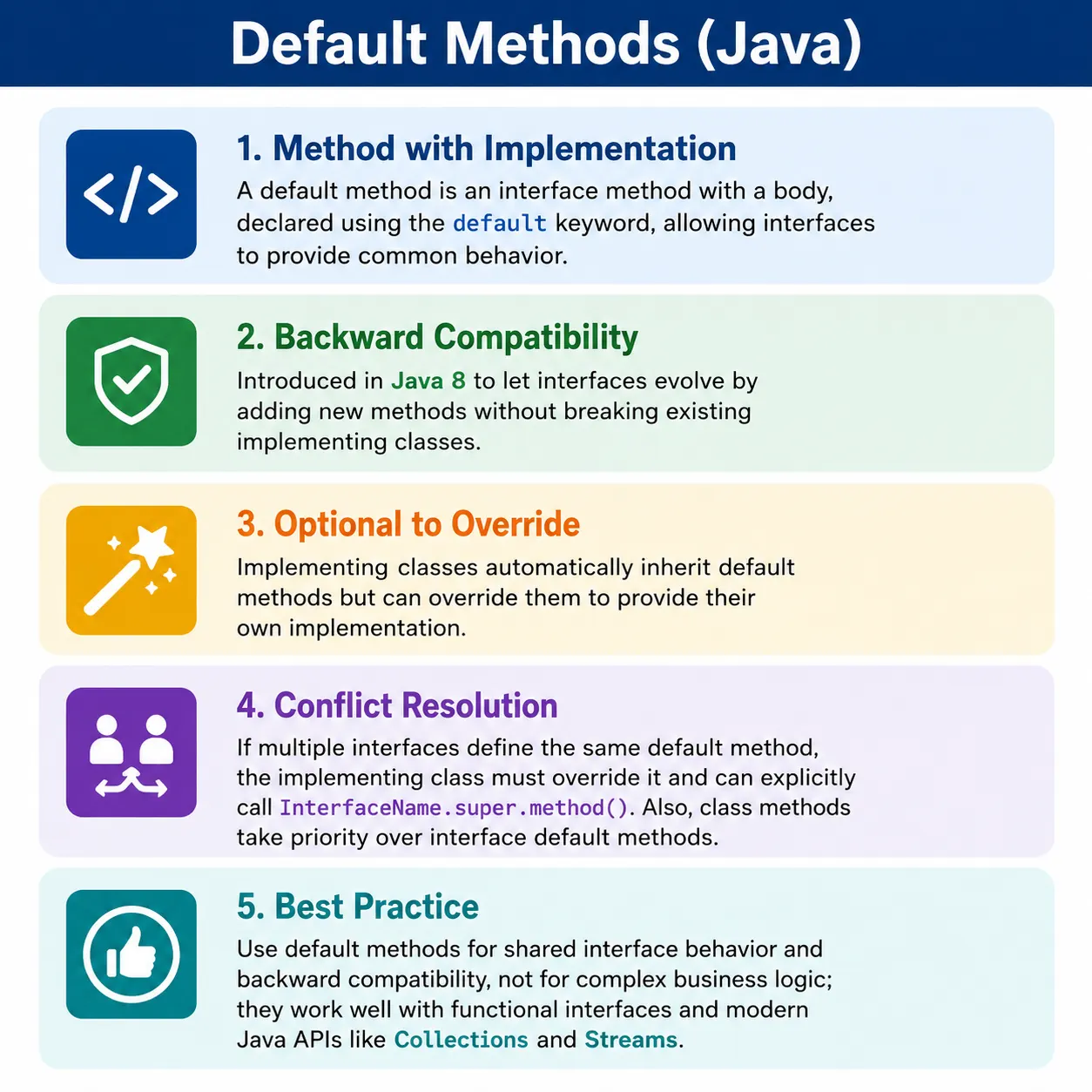
Default methods were introduced in Java 8 to allow interfaces to have method implementations. They enable interface evolution without breaking existing implementations and are a key enabler for functional programming features (lambdas, streams). This is a frequent interview topic, especially around diamond problem resolution.
Before Java 8, interfaces were mostly pure contracts. They could declare abstract methods, and every
implementing class had to provide the behavior. This model was clean, but it created a serious evolution
problem. If the Java platform designers added a new abstract method to an existing interface such as
Iterable, Collection, List, or Iterator, every class in
the world that implemented that interface would immediately fail to compile until it added the new method.
Default methods solved that problem by allowing an interface to provide a method body. Existing implementing classes automatically inherit the method, so the interface can grow without forcing every implementation to change. This is why default methods are often described as a backward-compatibility feature. They made it possible for Java 8 to add useful methods to long-standing interfaces while preserving older code.
Default methods also support the broader Java 8 shift toward functional programming. Methods such as
forEach(), removeIf(), and sort() became available on existing
collection-related interfaces. These methods work well with lambdas and method references, but they could
not have been added as abstract methods without breaking compatibility. Default methods gave Java a way to
modernize interfaces safely.
What Is a Default Method?
A default method is a method in an interface that has a method body and is declared using the default keyword.
interface Vehicle {
    default void start() {
        System.out.println("Vehicle started");
    }
}
- ✔ Method has implementation
- ✔ Classes implementing the interface inherit it automatically
A default method looks similar to an ordinary instance method, but it is declared inside an interface and
begins with the default keyword. It has a body, so implementing classes are not required to
override it. If a class implements the interface and does not provide its own method, the default method is
available through objects of that class.
This does not mean interfaces became the same as classes. Interfaces still cannot hold normal instance state like classes do. A default method can use constants, call other interface methods, call private helper methods in newer Java versions, and use its parameters, but it is still part of an interface contract. It provides common behavior, not a full object state model.
The main purpose of a default method is to provide a reasonable inherited behavior that classes can accept or override. If an implementing class needs different behavior, it can override the default method just like it would override an inherited class method. The class implementation then takes precedence.
Why Default Methods Were Introduced
Before Java 8:
- Interfaces could have only abstract methods
- Adding a new method broke all implementing classes
With Java 8:
- Default methods allow backward compatibility
- Existing classes need no change
Interface evolution was the central reason default methods were introduced. Large platforms and libraries cannot easily change public interfaces once many applications depend on them. Adding a new abstract method to a widely used interface is a breaking change. Adding a default method is usually not breaking because existing implementations inherit the provided behavior.
This allowed Java 8 to enrich existing APIs. For example, collection interfaces could gain methods that accept functional interfaces without requiring every collection implementation to be rewritten at once. Default methods acted as a bridge between older object-oriented interfaces and newer lambda-friendly APIs.
However, this compatibility benefit should not be misunderstood as permission to put all logic in interfaces. Default methods are best for small common behavior, API evolution, and convenience methods. If the behavior depends on object state, lifecycle, constructors, or complex shared implementation, an abstract class or composition-based design is often a better choice.
Syntax Rules
interface InterfaceName {
    default returnType methodName() {
        // implementation
    }
}
- ✔ Must have a body
- ✔ Cannot be abstract
- ✔ Implicitly public
A default method must have a method body because its purpose is to provide an implementation. It cannot be
declared abstract at the same time because those two ideas conflict. Interface methods are
public by nature, so default methods are also public. You do not use protected or package-level
default visibility for Java 8 default methods.
The default keyword used here is different from default access in Java. In access control,
"default" usually means package-private access when no modifier is written. In interface methods,
default is an explicit keyword that means the method has an implementation inherited by
implementing classes. This distinction matters because beginners often confuse the two meanings.
Using Default Methods
Interface
interface Printer {
    default void print() {
        System.out.println("Printing...");
    }
}
Implementing Class
class LaserPrinter implements Printer {
    // no need to override print()
}
✔ print() available automatically
When a class implements an interface with a default method, it automatically receives that behavior unless it overrides the method. This is similar to inheriting a method from a superclass, but the method comes from an interface. The class can use the default behavior as-is when it is suitable, which keeps simple implementations small.
This is useful when many implementations can share the same behavior but still need the flexibility to customize it. For example, an interface may define a default logging helper, a validation convenience method, or a method that combines other abstract methods. Implementations that need special behavior can override the default without affecting other classes.
Overriding Default Methods
Implementing classes can override default methods.
class InkjetPrinter implements Printer {
    @Override
    public void print() {
        System.out.println("Inkjet printing...");
    }
}
✔ Class version takes precedence
Overriding a default method is straightforward. The implementing class declares a method with the same signature and provides its own body. Once it does this, the class method wins over the interface default method. This priority rule keeps class behavior explicit and avoids forcing classes to accept interface behavior that does not fit.
An overriding method can also call the interface default implementation using
InterfaceName.super.methodName(). This is useful when the class wants to extend the default
behavior rather than replace it completely. The syntax makes the chosen interface explicit, which becomes
important when multiple interfaces define methods with the same signature.
Default Methods vs Abstract Methods
| Aspect | Default Method | Abstract Method |
|---|---|---|
| Has body | ✔ Yes | ❌ No |
| Mandatory override | ❌ No | ✔ Yes |
| Introduced | Java 8 | Java 1.0 |
| Backward compatible | ✔ Yes | ❌ No |
An abstract method defines a requirement. Any concrete class implementing the interface must provide the method. A default method defines optional inherited behavior. A class may use it without overriding, or it may replace it with class-specific behavior. This difference is central to understanding why default methods support backward compatibility.
If you add an abstract method to an existing interface, all implementers must change. If you add a default method, implementers can continue working. That is the practical difference library designers care about. Abstract methods express essential behavior every implementation must define. Default methods express common or convenience behavior that can be inherited safely.
Default Methods vs Static Methods in Interface
| Aspect | Default Method | Static Method |
|---|---|---|
| Called via | Object | Interface name |
| Inherited | ✔ Yes | ❌ No |
| Overridable | ✔ Yes | ❌ No |
interface Utils {
    default void show() {}
    static void help() {}
}
Default methods and static interface methods both have bodies, but they are used differently. A default method belongs to implementing objects. You call it through an instance of a class that implements the interface. A static method belongs to the interface itself and is called using the interface name. Static interface methods are not inherited as instance methods and cannot be overridden.
Use static methods in interfaces for helper operations related to the interface type. Use default methods when implementing classes should inherit behavior. This distinction helps keep interface design clean. A utility-like operation should not become a default method just because interfaces can now contain method bodies.
Diamond Problem & Default Methods (Very Important)
Scenario: Two Interfaces, Same Default Method
interface A {
    default void show() {
        System.out.println("A");
    }
}

interface B {
    default void show() {
        System.out.println("B");
    }
}

class Test implements A, B {
    // ❌ Compilation error unless overridden
}
The diamond problem appears when a class receives the same method signature from more than one inheritance path. With default methods, this commonly happens when a class implements two interfaces that both provide a default method with the same signature. Java cannot choose one automatically because either choice might be wrong. Instead, the compiler requires the class to override the method and resolve the conflict.
This rule protects code from silent ambiguity. If Java picked interface A today and later a
developer expected interface B, the behavior would be confusing. By forcing an explicit
override, Java makes the class author decide which behavior should apply.
Resolving the Conflict
class Test implements A, B {
    @Override
    public void show() {
        A.super.show(); // or B.super.show()
    }
}
- ✔ Class must override
- ✔ Explicitly choose which interface method to call
The conflict is resolved by writing an overriding method in the class. Inside that method, the class can
call A.super.show(), B.super.show(), both methods, or neither method. The class
can also provide completely new behavior. The important point is that the resolution is visible in the class
code.
This syntax is one of the most common interview points. InterfaceName.super.methodName() is the
way to call a specific interface's default method from an overriding class method. It is not the same as
calling a superclass method with super.methodName(); the interface name must be specified.
Interface vs Class Priority Rule (Interview Rule)
- Class methods win over interface default methods
- More specific interface wins
- If ambiguity → class must override
class Parent {
    public void show() {}
}

interface Child {
    default void show() {}
}
✔ Parent.show() is used
Java follows clear priority rules to resolve inherited methods. A concrete class method wins over an interface default method. This preserves normal class inheritance behavior and prevents interfaces from unexpectedly overriding class logic. If a superclass already provides a method, an interface default method with the same signature does not replace it.
When interfaces inherit from other interfaces, the more specific interface can win. But when Java cannot determine a single most specific default method, the implementing class must override. These rules are designed to avoid accidental behavior and force clarity where ambiguity exists.
Default Methods & Functional Interfaces
- ✔ Functional interfaces can have default methods
- ✔ Only one abstract method allowed
@FunctionalInterface
interface Task {
    void execute();

    default void log() {
        System.out.println("Logging...");
    }
}
✔ Still a functional interface
Functional interfaces can have default methods because default methods are not abstract. A functional
interface is defined by having exactly one abstract method. It may still include default methods, static
methods, and methods inherited from Object. This allowed Java 8 APIs to combine lambda support
with reusable interface behavior.
For example, a functional interface can require one operation such as execute() but provide a
default helper such as log() or describe(). A lambda implements the abstract
method, and the resulting object can still call the default methods. This is a powerful but subtle part of
modern Java design.
Real-World Usage Examples
- Collection → forEach()
- List → sort()
- Iterator → forEachRemaining()
These were added without breaking old code.
The Java Collections Framework is the most visible real-world example of default methods. Adding methods
such as forEach() made collections more lambda-friendly. Adding sort() to
List gave lists a convenient sorting operation. Adding forEachRemaining() to
Iterator improved iteration support. These changes could reach existing implementations
because default methods provided backward-compatible behavior.
Default methods are also useful in custom APIs where an interface has a stable core contract but later needs convenience behavior. For example, an interface may define a required operation and later add a default method that combines existing operations. If the default implementation is reasonable for most implementers, it can evolve the API without forcing all implementers to change at once.
Common Beginner Mistakes
- Forgetting default keyword
- Assuming default methods are mandatory
- Confusing static and default methods
- Not resolving diamond conflict
- Overusing default methods
Beginners often assume default methods must be overridden because they are declared in an interface. That is not true. The entire purpose of a default method is that an implementation is already available. Override it only when the class needs different behavior.
Another mistake is confusing default methods with static interface methods. A default method is inherited by implementing classes and called through objects. A static method is called on the interface name and is not overridden. Mixing these ideas leads to incorrect method calls and interview mistakes.
Overuse is the design mistake. Interfaces should not become dumping grounds for business logic. Default methods are helpful for common behavior and compatibility, but too much implementation inside interfaces can make inheritance relationships harder to reason about.
Best Practices
- Use default methods sparingly
- Avoid adding business logic to interfaces
- Prefer abstract classes for stateful behavior
- Use default methods for common behavior
- Always resolve ambiguity explicitly
A good default method should be small, general, and connected to the interface contract. It should not depend on hidden state that the interface cannot own. If the behavior requires fields, constructors, protected helper methods, or lifecycle state, an abstract class or composition is likely a better design.
Default methods are most appropriate when they are built from existing abstract methods or when they provide a sensible convenience behavior. For example, a default method can call a required method with common arguments or provide a simple adapter around the core operation. This keeps the interface focused and makes the default behavior easy to understand.
When multiple interfaces create ambiguity, resolve it explicitly. Do not try to hide or avoid the conflict. The overriding class is the right place to make the choice visible because that class is combining the interface contracts.
Interview-Ready Answers
Short Answer
Default methods allow interfaces to have method implementations.
Detailed Answer
In Java 8, default methods were introduced to allow interfaces to provide method implementations using the default keyword. They enable backward compatibility when interfaces evolve and support functional programming features, while still allowing implementing classes to override the default behavior.
A stronger interview answer should mention that default methods were added mainly for interface evolution. They allowed Java to add methods to existing interfaces without breaking existing implementations. You should also explain the conflict rules: class methods win over interface defaults, more specific interfaces win when applicable, and ambiguous defaults from multiple interfaces must be resolved by overriding.
Key Takeaway
Default methods make interfaces evolvable. They balance flexibility and compatibility, but should be used carefully to avoid design complexity.
The practical takeaway is that default methods are a compatibility and convenience tool, not a replacement for classes. They let interfaces grow and provide common behavior while preserving the ability for classes to override. Used carefully, they make APIs easier to evolve. Used carelessly, they can blur the line between interface contracts and implementation logic.
Design Thinking Behind Default Methods
Default methods changed the way Java developers think about interface design. Before Java 8, adding a method to an interface was a major decision because every implementer had to change. After Java 8, library authors gained a safer path for adding convenience methods. However, this does not mean every future method should be added as a default method. The default implementation must make sense for most existing implementations.
A default method is strongest when it can be written in terms of other methods already declared by the interface. For example, if an interface has a core operation, a default method can provide a common wrapper around that operation. This keeps the default behavior consistent with the interface contract. If the method requires assumptions that not all implementations can satisfy, making it default may create misleading behavior.
In application code, default methods are useful for stable extension points. A framework interface might define one required method and provide optional hooks with default no-op behavior. Implementers can override only the hooks they need. This can reduce boilerplate, but it must be documented clearly so developers know which methods are required and which methods are optional.
When to Use Abstract Classes Instead
Abstract classes remain important even though interfaces can now have default methods. An abstract class can hold instance fields, constructors, protected methods, and shared state. A default method cannot give an interface normal per-object fields. If common behavior depends on state that must be initialized and maintained, an abstract class is usually a better choice.
Abstract classes are also useful when there is a strong base implementation and subclasses are variations of that implementation. Interfaces are better when you want to define a role or capability that many unrelated classes can implement. Default methods add convenience to interfaces, but they do not change this design distinction.
A simple rule is this: use an interface with default methods for capability contracts and small common behavior; use an abstract class for shared state and partial implementation. This answer is useful in interviews because it shows that you understand default methods as part of Java design, not just syntax.
Default Method Conflict Rules in Detail
Default method conflicts are one of the most important parts of this topic because Java allows a class to implement multiple interfaces. If those interfaces provide different default implementations for the same method signature, the class receives two possible inherited methods. Java refuses to guess. The class must override the method and provide one clear implementation.
The rule "class wins" is equally important. If a superclass provides a concrete method and an interface provides a default method with the same signature, the superclass method is used. This keeps normal class inheritance stable. Interfaces should not unexpectedly change behavior that a class hierarchy already defines. This rule is often summarized as "classes win over interfaces."
The "more specific interface wins" rule applies when one interface extends another. If a child interface overrides a default method from a parent interface with its own default method, a class implementing the child interface inherits the more specific version. Ambiguity exists only when Java cannot determine a single most specific method. In that case, the implementing class must override.
Private Interface Methods and Default Methods
Java 9 added private methods in interfaces, which made default methods easier to organize. In Java 8, if multiple default methods needed shared helper logic, developers had limited options. They could duplicate code or expose helper methods as default or static methods even when those helpers were not meant to be part of the public interface API. Java 9 private interface methods solved that problem.
A private interface method can be called by default methods inside the same interface. This allows the interface to keep common implementation details hidden while exposing only the useful default methods. Private static interface methods can also support static methods. This feature helps interfaces remain clean when default methods need shared internal logic.
Even with private helpers, default methods should stay focused. If an interface needs many private helper methods and complex implementation logic, that may be a sign that the design belongs in a class or service instead. Private interface methods are useful for reducing duplication, not for turning interfaces into full implementation containers.
Default Methods and API Versioning
API versioning is one of the strongest real-world reasons for default methods. Suppose a library publishes an interface in version 1.0 and many applications implement it. Later, the library needs to add a new convenience method. If that method is abstract, every existing implementation must be updated. If the method has a default implementation based on existing behavior, the library can add it with much less disruption.
This does not mean default methods make every API change safe. A new default method can still create source conflicts if an implementing class already has a method with an incompatible signature or if multiple interfaces introduce ambiguity. It can also change behavior if callers begin using the new default method without considering whether the inherited implementation fits every implementation. API authors still need to design carefully.
The best default methods for API evolution are those that can be implemented in terms of existing abstract methods and have behavior that is logically correct for all existing implementers. If the new method needs information that some implementations do not have, forcing a default may be misleading. In that case, a new interface or adapter may be safer.
Default Methods in Functional-Style APIs
Java 8 introduced lambdas, functional interfaces, streams, and default methods together for a reason. These features support each other. Functional interfaces can remain valid even when they contain default methods, because default methods are not abstract. This lets an interface define one lambda-compatible operation and still provide convenience methods around it.
Many functional-style APIs use default methods to compose behavior. A default method might provide chaining, logging, fallback behavior, or a common adapter around the single abstract method. The lambda supplies the core operation, and the default method provides reusable behavior. This keeps functional interfaces compact while allowing them to be more expressive.
However, default methods should not hide complex business workflows inside functional interfaces. If a default method becomes large, difficult to test, or dependent on outside systems, it is probably no longer just interface convenience. It may deserve a separate class or service.
How to Review Default Method Usage
When reviewing code that adds a default method to an interface, first ask why the method belongs in the interface. If the reason is backward compatibility, convenience based on existing methods, or a common capability shared by most implementers, the design may be reasonable. If the reason is simply to avoid creating a utility class or abstract class, the design may need more thought.
Next, check whether the default behavior is correct for all current implementers. A default method that is correct for one implementation but wrong for another creates subtle bugs. Existing classes may inherit the behavior silently. If many implementers must override the method immediately, the default may not be a good default.
Finally, check conflict risk. If the interface is likely to be combined with other interfaces that use similar method names, a default method may create ambiguity. Clear names and narrow interface contracts reduce this risk. When conflicts do occur, resolving them explicitly in the implementing class is the right approach.
Real-World Examples Beyond Collections
Outside the Java Collections Framework, default methods can be useful in application extension points. A plugin interface may require one core method but provide optional lifecycle hooks with default no-op implementations. Implementers can override only the hooks they need. This avoids forcing every plugin class to implement empty methods.
A testing framework interface might require an execute() method and provide default methods
such as before(), after(), or description(). Simple implementations
can ignore those hooks, while advanced implementations can override them. This style should be documented
clearly so developers know which behavior is required and which behavior is optional.
In domain code, default methods can express small capability behavior. For example, an interface that
exposes a status method might provide a default isActive() convenience method. This is
reasonable if the convenience method is directly derived from the interface contract. It is less reasonable
if the method requires hidden business dependencies or mutable state.
Interview Explanation Strategy
When explaining default methods in an interview, start with the definition: a default method is a concrete
method in an interface declared with the default keyword. Then explain the reason: Java 8 added
them so interfaces could evolve without breaking existing implementations. This immediately shows both
syntax and purpose.
After that, mention overriding and priority rules. Implementing classes inherit default methods but can
override them. Class methods win over interface defaults. If two unrelated interfaces provide the same
default method, the class must override and resolve the conflict. You can mention
InterfaceName.super.method() to call a specific interface default method.
Finally, connect default methods to functional interfaces and collections. Functional interfaces can have default methods because only abstract methods count toward the single abstract method rule. Java used default methods to add lambda-friendly behavior to existing interfaces. This gives a complete, practical answer rather than a memorized one-line definition.
Default Methods Examples (Quick Reference)
1. Basic Default Method in Interface
interface Vehicle {
    default void start() {
        System.out.println("Vehicle starting");
    }
}

class Car implements Vehicle {
}

class Demo {
    public static void main(String[] args) {
        new Car().start();
    }
}
Output
Vehicle starting
2. Class Inheriting Default Method Automatically
interface Printer {
    default void print() {
        System.out.println("Printing...");
    }
}

class HPPrinter implements Printer {
}
Explanation
- Implementing class need not override
- Default method is inherited
3. Overriding Default Method in Class
interface Printer {
    default void print() {
        System.out.println("Default print");
    }
}

class LaserPrinter implements Printer {
    @Override
    public void print() {
        System.out.println("Laser print");
    }
}
4. Calling Interface Default Method from Override
interface Printer {
    default void print() {
        System.out.println("Default print");
    }
}

class InkPrinter implements Printer {
    public void print() {
        Printer.super.print();
        System.out.println("Ink print");
    }
}
Output
Default print
Ink print
5. Multiple Interfaces with Same Default Method (Conflict)
interface A {
    default void show() {
        System.out.println("A");
    }
}

interface B {
    default void show() {
        System.out.println("B");
    }
}

class Demo implements A, B {
    public void show() {
        System.out.println("Resolved");
    }
}
Rule
Must override to resolve ambiguity.
6. Resolving Conflict Using InterfaceName.super
class Demo implements A, B {
    public void show() {
        A.super.show();
        B.super.show();
    }
}
7. Default Method vs Abstract Method
interface A {
    default void run() {
        System.out.println("Default run");
    }
}

interface B {
    void run();
}

class Demo implements A, B {
    public void run() {
        System.out.println("Implemented run");
    }
}
Rule
- Abstract method wins
- Must implement
8. Default Method vs Class Method (Class Wins)
interface A {
    default void test() {
        System.out.println("Interface");
    }
}

class Base {
    public void test() {
        System.out.println("Class");
    }
}

class Demo extends Base implements A {
}
Output
Class
9. Default Method Cannot Override Object Methods
interface A {
    // default String toString() { } ❌ not allowed
}
Reason
Object methods cannot be default methods.
10. Default Method with Parameters
interface Calculator {
    default int add(int a, int b) {
        return a + b;
    }
}

class Demo {
    public static void main(String[] args) {
        Calculator c = new Calculator() {};
        System.out.println(c.add(5, 7));
    }
}
11. Default Method Using Private Helper Method (Java 9+)
interface Logger {
    default void log() {
        helper();
    }

    private void helper() {
        System.out.println("Logging...");
    }
}
12. Default Method + Lambda (Not Used Together)
@FunctionalInterface
interface Task {
    void run();

    default void info() {
        System.out.println("Task info");
    }
}
Note
Still functional (only one abstract method).
13. Default Method in Functional Interface
@FunctionalInterface
interface Printer {
    void print();

    default void status() {
        System.out.println("Ready");
    }
}
14. Using Default Method via Interface Reference
Printer p = () -> System.out.println("Printing");
p.status();
p.print();
15. Multiple Default Methods (No Conflict)
interface A {
    default void a() {}
}

interface B {
    default void b() {}
}

class Demo implements A, B {
}
16. Default Method Evolution Use Case (Java 8 Reason)
interface ListV1 {
    void add();
}

// Later version
interface ListV2 {
    default void size() {
        System.out.println("Size");
    }
}
Explanation
Prevents breaking existing implementations.
17. Default Method Cannot Access Instance Fields
interface A {
    default void test() {
        // System.out.println(x); ❌ no instance fields
    }
}
18. Default Method Access Modifiers
interface A {
    default void a() {}     // public by default
    // protected/private ❌ not allowed (Java 8)
}
19. Real Interview Trap
interface A {
    default void run() {}
}

class Demo implements A {
    // No override needed
}
Interview Question
Is override mandatory? → ❌ No
20. Default Method vs Static Method
interface A {
    default void d() {
        System.out.println("Default");
    }

    static void s() {
        System.out.println("Static");
    }
}

A a = new A() {};
a.d();
// a.s(); ❌ not allowed
A.s();   // ✅
21. Default Method with Interface Inheritance
interface A {
    default void show() {
        System.out.println("A");
    }
}

interface B extends A {
}

class Demo implements B {
}
22. Overriding Default Method as Abstract
interface A {
    default void show() {}
}

interface B extends A {
    void show(); // makes it abstract again
}
23. Default Method Cannot Be final
interface A {
    // default final void test() {} ❌
}
24. Default Method Real-World Usage
// Java Collections (forEach, removeIf)
// Comparator.thenComparing()
// Iterable.forEach()
25. Interview Summary – Default Methods
default method = concrete method in interface
Key Points
- Introduced in Java 8
- Enables interface evolution
- Class method > interface default
- Conflict must be resolved explicitly
- Supports code reuse without breaking changes