Constructors
A constructor in Java is a special member of a class that is used to initialize objects. It is automatically invoked when an object is created and ensures the object starts in a valid, usable state. This is a high-frequency interview topic and foundational for object lifecycle understanding.
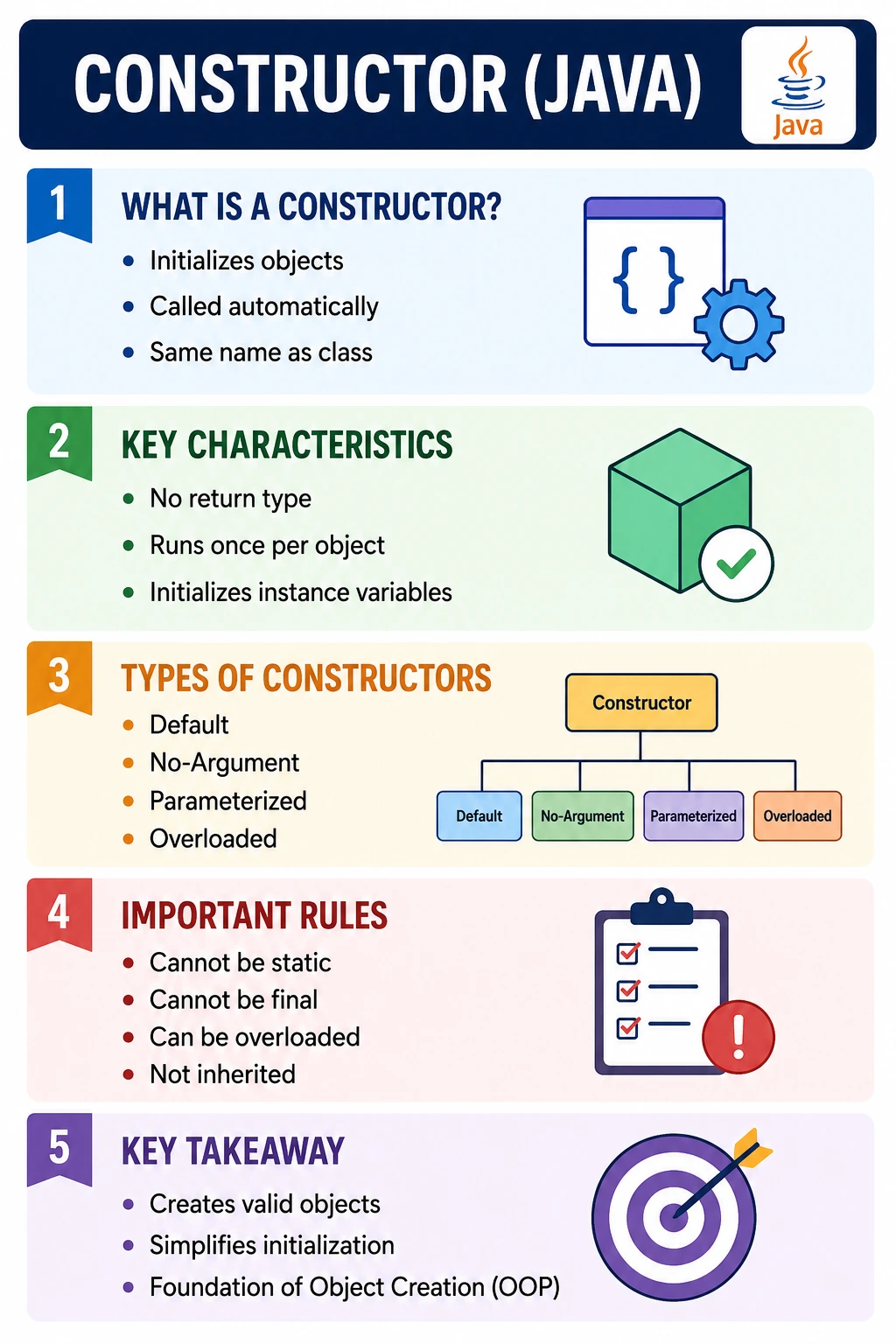
What Is a Constructor?
A constructor is a special block of code inside a class that runs when an object is created. Its primary responsibility is object initialization. A constructor has the same name as the class and does not have a return type, not even void. This rule separates constructors from ordinary methods. A method represents behavior that can be called again and again after an object exists. A constructor represents the starting point of an object.
Consider a simple Student class:
class Student {
    Student() {
        System.out.println("Constructor called");
    }
}
When a Student object is created, the constructor executes automatically. The caller does not call it like a normal method. The new keyword starts object creation, and the constructor is part of that creation process. This automatic execution makes constructors the natural place to assign starting values, enforce required data, and prepare an object for safe use.
Constructors are often described as special methods, but that phrase must be understood carefully. They look similar to methods because they contain code and can accept parameters, but they are not inherited, do not declare a return type, and are invoked only during object creation. Their purpose is not general business logic; their purpose is initialization.
Why Constructors Are Needed
Constructors are needed because objects should begin life in a valid state. If a class represents a Student, the object may need a name, age, roll number, or course. If a class represents a BankAccount, the object may need an account number, owner, and opening balance. If these values are not initialized properly, the object may exist but be incomplete, unsafe, or unusable.
A constructor gives the class control over object creation. Instead of allowing outside code to create an empty object and then set fields in any order, the class can require important values at the moment the object is created. This reduces errors from uninitialized state and makes the code easier to reason about. When the constructor finishes successfully, the object should be ready for meaningful use.
Constructors also support clean object-oriented design. A class should protect its own rules. If every object of a class must have certain values, the constructor is the right place to enforce that requirement. For example, an Employee object should not exist without an employee id if that id is mandatory in the domain. A parameterized constructor can require it.
Basic Constructor Syntax
The basic constructor syntax uses the class name as the constructor name. There is no return type. The constructor body contains initialization logic.
class ClassName {
    ClassName() {
        // initialization logic
    }
}
If a constructor accidentally declares a return type, it becomes a method, not a constructor. This is a common beginner mistake. For example, void Student() is not a constructor because it has the void return type. It is just a method named Student. The real constructor must match the class name and must not declare any return type.
Constructors can use access modifiers such as public, private, protected, or default package access. Public constructors allow object creation from anywhere that can access the class. Private constructors prevent direct object creation from outside the class and are often used in utility classes, singleton patterns, or controlled factory designs.
Constructor Execution During Object Creation
When an object is created using new, Java performs several steps. First, memory is allocated in the heap for the object. Then instance variables receive default values. After that, field initializers and initialization blocks run in the correct order. Finally, the constructor body executes. Once the constructor completes, the reference to the object is returned to the caller.
This order matters because instance variables always have some value before the constructor body begins. Numeric fields start as 0, boolean fields start as false, and reference fields start as null unless explicitly initialized. The constructor can replace those defaults with meaningful values.
Understanding this flow helps explain why constructors are not just ordinary methods. A method runs after an object already exists. A constructor participates in the creation process itself. It is the bridge between allocated memory and a usable object.
Types of Constructors in Java
Constructors are commonly discussed in three forms: default constructors, no-argument constructors, and parameterized constructors. These names are sometimes used loosely, so it is important to understand the difference.
Default Constructor
A default constructor is provided by the compiler only when the programmer does not write any constructor in the class. It has no parameters and performs default initialization. This means instance variables receive their default values or field initializer values.
class Test {
    // compiler creates a default constructor
}
Conceptually, the compiler adds something equivalent to:
Test() { }
The important rule is that the compiler provides a default constructor only if no constructor is written at all. If you write even one parameterized constructor, Java does not automatically add a no-argument constructor. This is one of the most common interview traps.
No-Argument Constructor
A no-argument constructor is a constructor with no parameters. It may be compiler-provided or explicitly written by the programmer. When you write it yourself, it can contain custom initialization logic.
class Test {
    Test() {
        System.out.println("No-arg constructor");
    }
}
This constructor is useful when an object can be created without external input or when the class wants to apply standard default values. For example, a Report object may start with status "Draft" even if the caller provides no status.
Parameterized Constructor
A parameterized constructor accepts input values and uses them to initialize the object. This is useful when an object needs custom state at creation time.
class Student {
    String name;
    int age;

    Student(String n, int a) {
        name = n;
        age = a;
    }
}
Object creation with this constructor looks like this:
Student s1 = new Student("John", 20);
The values "John" and 20 are passed to the constructor, and the constructor assigns them to the object's instance variables. This creates a Student object that starts with meaningful state rather than blank defaults.
Constructor Overloading
Constructor overloading means defining multiple constructors in the same class with different parameter lists. It allows objects to be created in different valid ways. One constructor may create an object with default values, another may accept one required value, and another may accept several values.
class Employee {
    Employee() {
        System.out.println("Default");
    }

    Employee(int id) {
        System.out.println("ID: " + id);
    }

    Employee(int id, String name) {
        System.out.println(id + " " + name);
    }
}
Overloading improves flexibility, but it should be used with purpose. Each constructor should represent a meaningful way to create the object. Too many constructors with similar parameter types can make object creation confusing. If a class needs many optional values, a builder pattern or setter-based configuration may be more readable.
The compiler selects the constructor based on the arguments supplied during object creation. This is similar to method overloading. The number, type, and order of parameters determine which constructor is invoked.
The this Keyword in Constructors
The this keyword refers to the current object. In constructors, it is commonly used to distinguish instance variables from parameters when both have the same name.
class Student {
    int age;

    Student(int age) {
        this.age = age;
    }
}
Here, this.age refers to the instance variable, while age refers to the constructor parameter. Without this, the assignment age = age would assign the parameter to itself and leave the instance variable unchanged. Using this makes the code precise and readable.
Many Java developers prefer constructor parameters to have the same names as fields because it improves clarity. The this keyword then clearly identifies the object field. This pattern is common in production Java code.
Constructor Chaining with this()
Constructor chaining means one constructor calls another constructor in the same class. This is done using this(). Constructor chaining helps avoid duplicated initialization logic when multiple constructors share common setup.
class Test {
    Test() {
        this(10);
        System.out.println("No-arg");
    }

    Test(int a) {
        System.out.println("Param: " + a);
    }
}
The call to this(10) invokes another constructor in the same class. Java requires this() to be the first statement in the constructor. This rule exists because constructor chaining must happen before the rest of the constructor body runs. Only one direct this() call is allowed in a constructor.
Constructor chaining is useful when one constructor provides default values and another performs the main initialization. Instead of duplicating code, the simpler constructor can call the more complete constructor with default arguments.
Calling Parent Constructors with super()
When inheritance is involved, a child class constructor must ensure that the parent part of the object is initialized first. This is done using super(). If the programmer does not write super() explicitly, Java inserts a call to the no-argument parent constructor automatically, as long as that constructor exists.
class A {
    A() {
        System.out.println("Parent");
    }
}

class B extends A {
    B() {
        super();
        System.out.println("Child");
    }
}
The parent constructor runs before the child constructor body. This order is logical because a child object contains the inherited part of the parent. That parent state must be initialized before child-specific initialization continues.
If the parent class has only a parameterized constructor and no no-argument constructor, the child constructor must explicitly call the parent constructor using super(arguments). Otherwise, the code will not compile. This is another important constructor rule often tested in interviews.
Constructor vs Method
Constructors and methods may look similar, but they serve different purposes. A constructor initializes a new object. A method performs behavior after an object exists. A constructor has the same name as the class and no return type. A method can have any valid name and must declare a return type, even if that return type is void.
Constructors are called automatically during object creation. Methods are called explicitly by code. Constructors are not inherited, while methods can be inherited depending on access modifiers and class relationships. Constructors execute once per object creation, while methods can be called many times on the same object.
Constructor vs Method (Key Differences)
| Feature | Constructor | Method |
|---|---|---|
| Name | Same as class | Any name |
| Return Type | None | Required |
| Invocation | Automatic | Manual |
| Purpose | Object initialization | Business logic |
| Inheritance | No | Yes |
Important Constructor Rules
Constructors follow several rules that every Java learner should know. A constructor cannot be static because it belongs to object creation, while static belongs to the class. A constructor cannot be final because constructors are not inherited and cannot be overridden. A constructor can be overloaded, which means a class can provide multiple ways to create objects. A constructor is not inherited by child classes, although child constructors can call parent constructors using super().
Constructors execute once per object creation. If you create three objects, the constructor runs three times. If you call methods on the same object later, the constructor does not run again. This is why constructors are suitable for initialization but not for repeated operations. Repeated business behavior belongs in methods.
Another important rule is that this() and super() cannot both be used as separate first statements in the same constructor. A constructor can either call another constructor in the same class using this(), or call a parent constructor using super(). If this() is used, the called constructor eventually handles the parent constructor call. Java enforces this order so object construction remains predictable.
Constructors and Object Validity
A strong constructor should help create valid objects. This does not mean every constructor must contain complex validation, but it should protect required state. If a User object must have a username, the constructor should not silently allow a missing username unless the domain genuinely permits it. If an Account object cannot have a negative opening balance, the constructor can reject negative values.
Validation in constructors should be focused and fast. Constructors should not perform heavy database calls, long network operations, or complex workflows. Their job is to initialize object state, not to perform an entire business process. Heavy logic inside constructors makes object creation slow, hard to test, and difficult to reason about.
A balanced constructor checks required values, assigns fields, and leaves complex behavior to methods or services. This creates objects that are safe to use without making construction unpredictable.
Private Constructors
A constructor can be private. A private constructor prevents other classes from directly creating objects using new. This is useful in specific designs. Utility classes often use private constructors because they contain only static methods and should not be instantiated. Singleton patterns use private constructors to control how many objects can exist. Factory-based designs may hide constructors and provide named static methods for object creation.
For example, a MathUtils class may have only static helper methods. Creating a MathUtils object would not add value. A private constructor communicates that the class is not meant to be instantiated. It also prevents accidental object creation.
Private constructors should be used deliberately. Most normal domain classes need public or package-access constructors so objects can be created where needed. A private constructor is not a default choice; it is a design tool for controlling object creation.
Constructors and Immutable Objects
Constructors are especially important for immutable objects. An immutable object is an object whose state cannot change after creation. To support immutability, fields are often declared private and final, and all required values are assigned in the constructor. After construction, the object exposes read-only behavior and does not provide setters that change state.
For example, a Money object may store amount and currency. Once created, those values should not change. If a new amount is needed, the program creates a new Money object. The constructor becomes the single place where required values are supplied and validated.
This style is common in reliable Java design because immutable objects are easier to reason about, safer to share, and less prone to accidental mutation. Constructors make this possible by ensuring all required state is available at creation time.
Constructors in Inheritance
Constructor behavior becomes more important when classes use inheritance. A child object contains the parent portion and the child portion. Java initializes the parent portion first. This is why a parent constructor runs before the child constructor. The child constructor can explicitly call a parent constructor using super(arguments), or Java may insert super() automatically when possible.
Constructors are not inherited because they are tied to class names and object creation rules. A child class must define its own constructors if it needs custom creation behavior. Even if a parent class has useful constructors, the child class does not automatically receive them as callable child constructors.
If the parent class does not have a no-argument constructor, the child constructor must explicitly call one of the available parent constructors. This rule ensures that parent state is initialized correctly before child-specific initialization begins.
Constructors in Real Projects
In real applications, constructors appear in model classes, service classes, page objects, data transfer objects, configuration objects, and test utilities. A model class constructor may require business data. A service class constructor may receive dependencies. A page object constructor may receive a driver or page context. A test data object constructor may receive values used for test execution.
In automation frameworks, constructors are commonly used in Page Object Model. A LoginPage constructor may accept a WebDriver reference and store it for page actions. This allows the page object to be ready immediately after creation. The constructor initializes the object with the dependency it needs to operate.
In backend code, constructors are often used for dependency injection. A class receives its required collaborators through the constructor, making dependencies explicit. This improves testability because tests can pass controlled mock or fake dependencies. Constructor-based dependency design is widely used because it creates objects with complete required state.
Best Practices for Constructors
Keep constructors focused on initialization. Assign required fields, validate essential input, and prepare the object for use. Avoid putting lengthy business workflows inside constructors. If object creation triggers too much behavior, the code becomes hard to test and unexpected side effects become more likely.
Prefer parameterized constructors when required data must be present. This prevents incomplete objects. Use no-argument constructors when default state is valid or when frameworks require them. Some frameworks create objects reflectively and may need a no-argument constructor, but domain design should still make object validity clear.
Use this when parameter names match field names. This is a standard Java style and makes assignments clear. Use constructor chaining to reduce duplicate initialization logic, but do not create confusing chains that are hard to follow. If constructor combinations become too many, consider a builder pattern.
Choosing the Right Constructor Design
Choosing constructor design is a practical decision. If an object has only one valid way to be created, one parameterized constructor may be enough. If an object can be created with default values or with custom values, a no-argument constructor and a parameterized constructor may both make sense. If the number of optional values grows, too many constructors can become difficult to read.
For example, a User class with name and email as mandatory values should probably require those values in the constructor. Optional values such as phone number, address, or profile image can be set later or handled through a builder. This prevents a long list of overloaded constructors where it is hard to remember which argument position means what.
Constructor design should serve readability. A line such as new User("John", "john@example.com") is clear. A line with six string arguments is not clear because the reader cannot easily identify each value. In such cases, named setters, builder patterns, or value objects may produce better code.
Constructors and Default Values
Java gives fields default values before the constructor body runs. Numeric fields become 0, boolean fields become false, char fields become the null character, and reference fields become null. These defaults are language-level defaults, not necessarily business-level defaults. A constructor can replace them with meaningful values.
For example, an Order object may have a status field. Java's default for a String reference is null, but the business default may be "CREATED". A no-argument constructor can assign that default status. This makes the object safer because it starts in a meaningful business state rather than a raw language default.
Default values should be chosen deliberately. Relying on Java's defaults is acceptable only when those values make sense for the domain. Otherwise, constructors should assign explicit values so object behavior is predictable.
Constructor Errors and Exceptions
A constructor can throw an exception if object creation cannot be completed safely. This is useful when invalid input would create an unusable object. For example, a constructor may reject a null username, a negative balance, or an invalid configuration path. Failing fast during construction is often better than allowing an invalid object to move through the system and fail later in a less obvious place.
Constructor exceptions should be used thoughtfully. They should indicate that the object cannot be validly created. They should not be used for routine flow control or avoidable heavy operations. If construction depends on external systems, consider whether that work belongs in a factory or service method instead of directly inside the constructor.
Interview Explanation Strategy
In interviews, constructor questions are usually simple at first and then become deeper. Start with the definition: a constructor is a special class member used to initialize objects, has the same name as the class, has no return type, and runs automatically during object creation. Then explain default, no-argument, and parameterized constructors.
A strong answer should mention that the compiler provides a default constructor only when no constructor is defined. It should also explain constructor overloading, this(), super(), and the difference between constructor and method. If asked about inheritance, say that constructors are not inherited, but child constructors call parent constructors.
For practical strength, add that constructors should create valid objects and should not contain heavy business logic. This shows that you understand constructors not only as syntax but also as a design tool.
Common Beginner Mistakes
Many beginners think constructors have a return type. They do not. If a return type is written, the code defines a method, not a constructor. Another common mistake is assuming the default constructor always exists. The compiler provides it only when no constructor is written. Once you define any constructor, the implicit default constructor disappears.
Variable shadowing is another frequent issue. If a constructor parameter has the same name as an instance variable, use this to assign the parameter to the field. Without this, the assignment may update only the local parameter and leave the object field unchanged.
Beginners also sometimes call constructors like ordinary methods. A constructor runs during object creation using new or through this() and super() inside constructor chaining. It is not called with normal method syntax after an object already exists.
Finally, constructors should not be overloaded without purpose. Multiple constructors are useful when they represent meaningful creation options. Too many similar constructors can make code hard to read, especially when several parameters share the same type.
Constructor Examples (Quick Reference)
1. Default Constructor (Implicit)
class Demo {
    int x;
}

class Test {
    public static void main(String[] args) {
        Demo d = new Demo();
        System.out.println(d.x);
    }
}
Explanation: Compiler provides a default constructor and initializes int to 0.
Output: 0
2. User-Defined No-Argument Constructor
class Demo {
    Demo() {
        System.out.println("Constructor called");
    }

    public static void main(String[] args) {
        new Demo();
    }
}
Explanation: Constructor executes during object creation.
Output: Constructor called
3. Parameterized Constructor
class Demo {
    int x;

    Demo(int a) {
        x = a;
    }

    public static void main(String[] args) {
        Demo d = new Demo(10);
        System.out.println(d.x);
    }
}
Explanation: Initializes object state with provided values.
Output: 10
4. Multiple Constructors (Overloading)
class Demo {
    Demo() {
        System.out.println("No-arg");
    }

    Demo(int x) {
        System.out.println("Parameterized");
    }

    public static void main(String[] args) {
        new Demo();
        new Demo(5);
    }
}
Explanation: Constructor overloading is allowed in Java.
Output:
No-arg
Parameterized
5. Constructor vs Method
class Demo {
    Demo() {
        System.out.println("Constructor");
    }

    void Demo() {
        System.out.println("Method");
    }

    public static void main(String[] args) {
        Demo d = new Demo();
        d.Demo();
    }
}
Explanation: Constructor has no return type; method has a return type.
Output:
Constructor
Method
6. Using this in Constructor
class Demo {
    int x;

    Demo(int x) {
        this.x = x;
    }

    public static void main(String[] args) {
        Demo d = new Demo(20);
        System.out.println(d.x);
    }
}
Explanation: Resolves variable shadowing between parameter and field.
Output: 20
7. Constructor Chaining using this()
class Demo {
    Demo() {
        this(10);
        System.out.println("No-arg");
    }

    Demo(int x) {
        System.out.println("Value: " + x);
    }

    public static void main(String[] args) {
        new Demo();
    }
}
Explanation: this() calls another constructor in the same class and must be first.
Output:
Value: 10
No-arg
8. Constructor Chaining using super()
class A {
    A() {
        System.out.println("Parent");
    }
}

class B extends A {
    B() {
        super();
        System.out.println("Child");
    }

    public static void main(String[] args) {
        new B();
    }
}
Explanation: super() calls parent constructor explicitly.
Output:
Parent
Child
9. Implicit super() Call
class A {
    A() {
        System.out.println("Parent");
    }
}

class B extends A {
    B() {
        System.out.println("Child");
    }

    public static void main(String[] args) {
        new B();
    }
}
Explanation: Compiler inserts super() automatically.
Output:
Parent
Child
10. Parameterized super() Call
class A {
    A(int x) {
        System.out.println(x);
    }
}

class B extends A {
    B() {
        super(10);
    }

    public static void main(String[] args) {
        new B();
    }
}
Explanation: Explicit call required for parent constructor with arguments.
Output: 10
11. Constructor Execution Order (Inheritance)
class A {
    A() {
        System.out.println("A");
    }
}

class B extends A {
    B() {
        System.out.println("B");
    }
}

class C extends B {
    C() {
        System.out.println("C");
    }

    public static void main(String[] args) {
        new C();
    }
}
Explanation: Constructors execute top-down across the inheritance chain.
Output:
A
B
C
12. Constructor Cannot Be static
class Demo {
    // static Demo() {}  // Compile-time error
}
Explanation: Constructors belong to objects, not the class.
13. Constructor Cannot Have Return Type
class Demo {
    // int Demo() {}  // Compile-time error
}
Explanation: Any return type makes it a method.
14. Private Constructor
class Demo {
    private Demo() {
        System.out.println("Private");
    }

    public static void main(String[] args) {
        new Demo();
    }
}
Explanation: Restricts object creation to the same class (used in Singleton).
Output: Private
15. Constructor in Singleton Pattern (Basic)
class Singleton {
    private static Singleton instance;

    private Singleton() {}

    static Singleton getInstance() {
        if (instance == null) {
            instance = new Singleton();
        }
        return instance;
    }

    public static void main(String[] args) {
        Singleton s1 = getInstance();
        Singleton s2 = getInstance();
        System.out.println(s1 == s2);
    }
}
Explanation: Ensures a single instance of the class.
Output: true
16. Constructor with Object Parameter
class User {
    String name;

    User(User u) {
        this.name = u.name;
    }
}

class Demo {
    public static void main(String[] args) {
        User u1 = new User();
        u1.name = "Admin";

        User u2 = new User(u1);
        System.out.println(u2.name);
    }
}
Explanation: Copy constructor style using another object.
Output: Admin
17. Constructor Called Only Once Per Object
class Demo {
    Demo() {
        System.out.println("Called");
    }

    public static void main(String[] args) {
        Demo d1 = new Demo();
        Demo d2 = new Demo();
    }
}
Explanation: Constructor runs once per object creation.
Output:
Called
Called
18. Constructor and Instance Block
class Demo {
    {
        System.out.println("Instance Block");
    }

    Demo() {
        System.out.println("Constructor");
    }

    public static void main(String[] args) {
        new Demo();
    }
}
Explanation: Instance block runs before the constructor.
Output:
Instance Block
Constructor
19. Constructor and Static Block
class Demo {
    static {
        System.out.println("Static Block");
    }

    Demo() {
        System.out.println("Constructor");
    }

    public static void main(String[] args) {
        new Demo();
    }
}
Explanation: Static block runs once when class loads.
Output:
Static Block
Constructor
20. Interview Summary – Constructors
class Demo {
    int x;

    Demo(int x) {
        this.x = x;
    }

    public static void main(String[] args) {
        Demo d = new Demo(10);
        System.out.println(d.x);
    }
}
Explanation: Constructors initialize objects, share class name, and have no return type.
Output: 10
Interview-Ready Answers
Short Answer
A constructor is a special class member used to initialize objects when they are created.
Detailed Answer
In Java, a constructor has the same name as the class and no return type. It is automatically invoked during object creation to initialize instance variables. Java supports default, no-argument, parameterized, and overloaded constructors.
Key Takeaway
Constructors define how an object is born. Proper constructor design ensures safe, consistent, and maintainable object initialization, forming the backbone of clean Java applications.