Abstraction
Abstraction is an object-oriented programming principle that focuses on exposing only the essential features of an object while hiding the internal implementation details. It allows developers to describe what an object can do without forcing every user of that object to understand how the work is done internally. In Java, abstraction is one of the main ideas that helps large applications stay understandable, flexible, and maintainable as the codebase grows.
The basic idea is simple: a class, abstract class, or interface should present a clean contract to the outside world. That contract tells other parts of the program what operations are available. The internal logic, calculations, data handling, and implementation steps remain hidden inside the concrete class that performs the work. This separation allows callers to depend on behavior instead of implementation details.
Abstraction is closely connected to good design because real software systems become difficult to maintain
when every class knows too much about every other class. If one part of the system depends on another part's
internal logic, small changes can create wide impact. Abstraction reduces that dependency. A caller can use a
method such as pay(), send(), draw(), or start() without
knowing the exact internal sequence behind it.
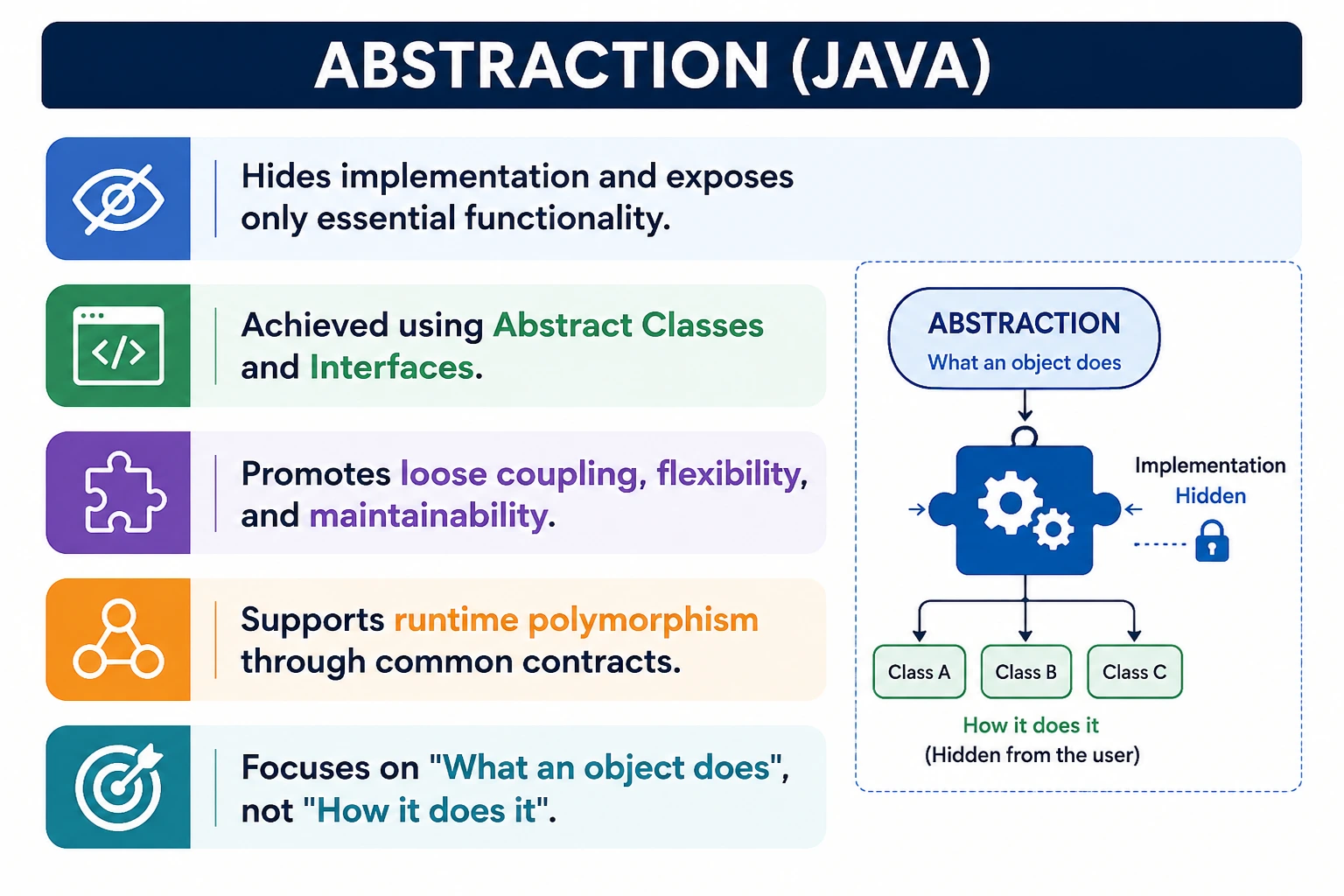
Abstraction is a high-frequency Java interview topic, especially when interviewers compare abstract classes and interfaces. A strong explanation should cover what abstraction means, why it is useful, how Java implements it, how it differs from encapsulation, and when to choose an abstract class instead of an interface. It should also connect abstraction to polymorphism because abstract types are often used as reference types while concrete implementations provide the actual behavior at runtime.
What Is Abstraction?
Abstraction means showing what an object does while hiding how it does it. The outside user sees the useful
behavior, but the internal details remain private to the implementation. For example, a payment service may
expose a pay() method. The caller does not need to know whether the implementation validates a
card, checks a wallet balance, contacts a bank server, writes audit logs, or updates transaction status. The
caller only needs to know that calling pay() attempts to complete a payment.
In Java, abstraction is achieved mainly through abstract classes and interfaces. An abstract class can define common state and partial behavior while leaving some methods incomplete for child classes to implement. An interface defines a contract that implementation classes must follow. Both approaches allow code to depend on a general type while the concrete class supplies the details.
A simple definition is: abstraction hides complexity and exposes functionality. This definition is useful, but it is important to understand what "complexity" means in real code. Complexity may be business rules, validation logic, network communication, database updates, calculations, or algorithmic details. Abstraction keeps that complexity behind a clear method or contract so callers can work at a higher level.
Why Abstraction Is Important
Abstraction reduces complexity by allowing developers to focus on the relevant level of detail. A developer using a class should not always need to understand every internal calculation or every supporting method. By exposing a small, meaningful set of operations, abstraction keeps classes easier to use. This matters in large systems where hundreds of classes interact with each other.
It also improves maintainability. If implementation details are hidden behind a stable contract, those
details can change without forcing changes in every caller. For example, a notification feature may start by
sending emails through one provider and later move to another provider. If callers depend only on a
NotificationService abstraction, the internal provider change can be handled inside the
implementation with limited impact.
Abstraction enhances flexibility because it allows multiple implementations of the same contract. A
Payment abstraction can be implemented by credit card, UPI, wallet, and net banking payment
classes. A Browser abstraction can be implemented by Chrome, Firefox, or Edge classes in a test
automation framework. The same calling code can work with different implementations as long as they follow
the agreed contract.
Abstraction also supports loose coupling and polymorphism. Loose coupling means one class depends on a general contract instead of a specific implementation. Polymorphism allows that general reference to point to different concrete objects at runtime. Together, abstraction and polymorphism make Java systems easier to extend without rewriting existing logic repeatedly.
Real-World Analogy
A common real-world analogy is driving a car. As a driver, you interact with the steering wheel, accelerator, brake pedal, gear selector, and dashboard indicators. These are the essential controls exposed to you. You do not need to understand the full internal working of the engine, fuel injection system, braking mechanism, electrical wiring, or transmission system in order to drive. The car hides the internal complexity and gives you a usable interface.
This is abstraction. The car exposes what you need to operate it and hides how the internal machinery works. In software, a class or interface should do the same thing. It should expose clear operations and hide unnecessary internal details. This makes the system easier to use and reduces the chance that callers will depend on implementation details that may change later.
Another practical analogy is an ATM. A user chooses options such as withdraw cash, check balance, or change PIN. The user does not see the internal communication with banking servers, validation rules, transaction logging, cash dispenser control, or security checks. The ATM provides an abstract interface for banking operations. The internal system remains hidden, but the useful functionality is available.
How Abstraction Is Achieved in Java
Java provides two main mechanisms for abstraction: abstract classes and interfaces. Both allow developers to define behavior at a general level and leave specific details to concrete classes. The choice between them depends on the design need. If classes share common state and partial implementation, an abstract class may be suitable. If unrelated classes share a capability or contract, an interface is usually better.
Before Java 8, interfaces were often described as a way to achieve full abstraction because interface methods were abstract by default. Modern Java interfaces can also contain default and static methods, but the main purpose of an interface remains contract definition. Abstract classes remain useful when a base class needs fields, constructors, common methods, and abstract methods together.
Abstract Class
An abstract class is a class declared using the abstract keyword. It cannot be instantiated
directly because it is incomplete by design. It may contain abstract methods, which have no body, and
concrete methods, which have full implementation. It may also contain instance variables, constructors,
static members, final methods, and normal methods. This makes abstract classes useful when related classes
share common structure but still require subclass-specific behavior.
An abstract method acts like a promise. The parent abstract class says that every concrete child class must provide this behavior, but it does not define how the behavior should work. A concrete method in the same abstract class can provide common behavior that all child classes reuse. This combination is sometimes called partial abstraction because some details are hidden and some common implementation is provided.
Abstract Class Example
abstract class Vehicle {
    abstract void start(); // abstract method
    void fuel() {           // concrete method
        System.out.println("Fueling vehicle");
    }
}

class Car extends Vehicle {
    @Override
    void start() {
        System.out.println("Car starts with key");
    }
}
In this example, Vehicle defines an abstract method named start(). Every concrete
subclass must implement start() because different vehicles may start differently. At the same
time, Vehicle provides a concrete fuel() method because fueling behavior is treated
as common. The child class Car supplies the missing implementation for start().
Key Rules of Abstract Classes
Abstract classes cannot be instantiated directly, but their constructors can still execute when a concrete subclass object is created. This surprises many beginners. The constructor exists to initialize the parent part of the child object. Abstract classes may contain both abstract and non-abstract methods, may hold instance variables, and may define constructors. However, because Java supports single inheritance for classes, an abstract class can extend only one class, and a child class can extend only one abstract or concrete class directly.
Interface
An interface defines a contract that classes must implement. It focuses on capability rather than shared state. If a class implements an interface, it promises that it can perform the operations declared by that interface. Interfaces are especially useful when different classes are not part of the same inheritance hierarchy but still share a common behavior.
interface Payment {
    void pay();
}

class CreditCardPayment implements Payment {
    @Override
    public void pay() {
        System.out.println("Credit card payment");
    }
}
In this example, Payment defines a contract with the pay() method. The
CreditCardPayment class implements that contract and provides the actual payment logic. Code can
work with a Payment reference without depending directly on CreditCardPayment. This
is abstraction through an interface.
Key Rules of Interfaces
Interface methods are public and abstract by default unless they are declared as default, static, or private helper methods in modern Java versions. Interfaces do not have constructors because they are not used to create objects directly and do not manage instance state in the same way classes do. Variables declared in an interface are public, static, and final by default, which means they behave as constants. A class can implement multiple interfaces, making interfaces Java's main mechanism for multiple type inheritance.
Abstract Class vs Interface (Interview Favorite)
The difference between an abstract class and an interface is one of the most common Java interview topics. Both support abstraction, but they represent different design intentions. An abstract class is useful when related classes share common state or partial implementation. An interface is useful when different classes share a capability or contract, even if they are otherwise unrelated.
| Feature | Abstract Class | Interface |
|---|---|---|
| Methods | Abstract + concrete | Abstract (default allowed Java 8+) |
| Variables | Instance variables | Constants only |
| Constructors | Yes | No |
| Multiple inheritance | No | Yes |
| Access modifiers | Any | Public only |
| Use case | IS-A relationship | CAN-DO capability |
A practical rule is this: use an abstract class when there is a strong IS-A relationship and shared
implementation. Use an interface when you want to define a capability that many classes can provide. For
example, Car may extend Vehicle because a car is a vehicle. But
Car, Robot, and MobilePhone may all implement a
Rechargeable interface because they share a capability, not a parent identity.
Abstraction vs Encapsulation (Common Confusion)
Abstraction and encapsulation are related but different. Abstraction focuses on hiding complexity and showing essential behavior. Encapsulation focuses on protecting data by binding fields and methods together and controlling access through access modifiers. Abstraction is mostly a design-level concept. Encapsulation is mostly an implementation-level technique.
| Aspect | Abstraction | Encapsulation |
|---|---|---|
| Focus | What | How |
| Purpose | Hide complexity | Protect data |
| Achieved by | Abstract class / interface | Access modifiers |
| Level | Design | Implementation |
For example, an interface named Payment is abstraction because it hides the details of how a
payment is processed and exposes only the pay() operation. A class with private fields and
public getter or setter methods is encapsulation because it protects internal data from direct access. In a
good Java design, abstraction and encapsulation often work together. Abstraction decides what should be
visible, and encapsulation protects how data is managed internally.
Abstraction with Polymorphism
Abstraction becomes especially powerful when combined with polymorphism. A variable can be declared using an abstract class or interface type, while the actual object can be a concrete implementation. The caller works with the abstract contract, and the runtime object provides the actual behavior.
Payment p = new CreditCardPayment();
p.pay();
Here, Payment is the abstraction and CreditCardPayment is the implementation. The
caller does not need to know the details of credit card processing. If tomorrow the program uses
UpiPayment or WalletPayment, the same Payment reference can still be
used. This is how abstraction supports flexible and loosely coupled design.
When to Use Abstraction
Abstraction should be used when behavior varies but the contract remains stable. This is common in framework design, APIs, libraries, large enterprise applications, automation frameworks, and service-oriented systems. If several implementations perform the same kind of operation in different ways, abstraction can define the common operation while concrete classes provide the details.
It is also useful when a caller should not depend on a specific implementation. For example, a business service should not always need to know whether data comes from a database, file, API, or cache. It can depend on a repository abstraction. The implementation can change without forcing the business service to change. This makes code easier to test and easier to evolve.
Common Beginner Mistakes
A common beginner mistake is confusing abstraction with encapsulation. Abstraction is about hiding implementation complexity and exposing essential behavior. Encapsulation is about protecting data and controlling access. They often appear together, but they are not the same concept.
Another mistake is overusing abstract classes. Not every shared method requires an abstract class. Sometimes a simple concrete class, utility class, or interface is a better fit. Abstract classes should be used when related classes share partial implementation or state. If the goal is only to define a capability across unrelated classes, an interface is usually cleaner.
Beginners also try to instantiate abstract classes directly or forget to implement abstract methods in concrete child classes. Java prevents both mistakes at compile time. An abstract class represents an incomplete concept, so it cannot be directly instantiated. A concrete child class must complete the missing behavior by implementing all inherited abstract methods.
Interview-Ready Answers
Short Answer
Abstraction is the concept of hiding implementation details and exposing only essential features or behavior. In Java, it is achieved mainly through abstract classes and interfaces.
Detailed Answer
In Java, abstraction allows developers to define a contract without exposing all implementation details. Abstract classes provide partial abstraction by allowing both abstract and concrete methods, fields, and constructors. Interfaces define behavior contracts that classes implement. Abstraction helps reduce complexity, supports loose coupling, enables polymorphism, and makes applications easier to maintain and extend.
Key Takeaway
Abstraction defines the contract, while implementation provides the details. It allows Java code to focus on what an object does instead of how it does it internally. When used well, abstraction reduces complexity, improves maintainability, supports polymorphism, and makes systems easier to extend without tightly coupling callers to concrete implementation classes.
Design Value of Abstraction
The real value of abstraction appears as systems grow. In a small program, calling a concrete class directly may feel simple. In a larger application, direct dependency on concrete classes can make change difficult. If every class depends on a specific implementation, replacing that implementation may require many edits. Abstraction creates a stable boundary. The caller depends on the boundary, and the implementation can evolve behind it.
This design is common in layered applications. A controller may depend on a service abstraction. A service may depend on a repository abstraction. The repository implementation may use a database today and an API tomorrow. If the abstraction remains stable, higher layers do not need to know the internal storage details. This keeps responsibilities separate and makes each layer easier to test.
Abstraction is also useful for teams. When multiple developers work on a system, clear contracts reduce misunderstandings. One developer can build against an interface while another developer works on the implementation. As long as both follow the same contract, the pieces can work together. This is one reason abstraction is important not only for code design but also for collaboration.
Abstraction in Frameworks and APIs
Java frameworks rely heavily on abstraction. A framework often defines interfaces or abstract classes, and application developers provide concrete implementations. The framework does not need to know every application class in advance. It only needs to know the contract. At runtime, the application supplies the actual implementation.
APIs also use abstraction. A public API should expose useful operations without exposing internal storage,
algorithms, or infrastructure. For example, a payment API may expose authorize(),
capture(), and refund(). The consumer of the API does not need to know how fraud
checks, gateway routing, audit logging, and settlement processing happen internally. The API provides the
abstraction, and the implementation handles the details.
This separation protects both sides. The API consumer gets a simple and stable way to use functionality. The API provider can improve internal implementation without breaking consumers, as long as the external contract remains compatible.
Choosing the Right Abstraction
Good abstraction requires judgment. If an abstraction is too specific, it does not provide much flexibility. If it is too broad, it becomes vague and difficult to implement consistently. The best abstraction captures a real shared behavior in the domain. The method names should be meaningful, and the contract should be clear enough that every implementation can follow it without confusion.
For example, PaymentProcessor is a meaningful abstraction if every implementation processes a
payment. But an interface named DoWork with a method named execute() may be too
vague unless the domain clearly defines what work means. Vague abstractions make code harder to understand
because developers must inspect every implementation to learn what the contract really means.
A practical rule is to introduce abstraction when there is a stable concept with multiple possible implementations or when hiding implementation details meaningfully reduces coupling. Avoid abstraction only for the sake of making code look advanced. Simple code is better than unnecessary abstraction when there is no real variation or complexity to hide.
Abstraction in Real Project Architecture
In real project architecture, abstraction often appears at boundaries between major responsibilities. A user interface should not need to know how data is stored. A business service should not need to know the exact SQL query used by a repository. A payment workflow should not need to know every low-level detail of the payment gateway. By placing abstractions at these boundaries, teams reduce the impact of change and keep responsibilities clear.
For example, a service may depend on an interface called UserRepository. One implementation may
store users in a relational database. Another implementation may read users from an external API. A test
implementation may return in-memory sample data. The service can use the same abstraction in all cases. This
makes the service easier to test because tests can provide a lightweight implementation without connecting to
a real database.
Abstraction also improves replacement and migration work. If a system moves from one email provider to
another, a well-designed EmailService abstraction can protect most of the application from that
change. Only the concrete implementation needs to change. Without abstraction, provider-specific logic may
spread across controllers, services, jobs, and utility classes, making migration risky and expensive.
However, abstraction should still remain understandable. A project can suffer from too many layers if every small class gets an interface without a real reason. Good abstraction hides meaningful complexity. Poor abstraction hides simple code behind unnecessary indirection. The goal is not to create more files; the goal is to create stable contracts where they reduce coupling and improve clarity.
Abstraction and Testing
Abstraction is especially valuable for testing. When code depends on interfaces or abstract contracts, testers and developers can replace expensive or unpredictable dependencies with controlled implementations. A class that sends notifications can be tested with a fake notification sender. A class that reads payment status can be tested with a stub payment gateway. This makes tests faster, more reliable, and easier to isolate.
From a manual testing perspective, abstraction also explains why the same business behavior may be tested through different implementations. A payment feature may expose the same user-facing operation for card, UPI, wallet, and net banking. The abstract behavior is "make a payment," while the implementation differs by payment method. Understanding this helps testers design scenarios that validate both the common contract and the implementation-specific rules.
Abstraction Examples in Java
1. Basic Abstraction Using Abstract Class
abstract class Animal {
    abstract void sound();
}

class Dog extends Animal {
    void sound() {
        System.out.println("Dog barks");
    }

    public static void main(String[] args) {
        Animal a = new Dog();
        a.sound();
    }
}
Explanation
- Abstract method forces implementation
Output: Dog barks
2. Abstract Class with Concrete Method
abstract class Vehicle {
    void start() {
        System.out.println("Vehicle started");
    }

    abstract void run();
}

class Car extends Vehicle {
    void run() {
        System.out.println("Car running");
    }

    public static void main(String[] args) {
        Vehicle v = new Car();
        v.start();
        v.run();
    }
}
Explanation
- Partial abstraction
Output:
Vehicle started
Car running
3. Cannot Instantiate Abstract Class
abstract class A {}

class Test {
    public static void main(String[] args) {
        // A a = new A();  // Compile-time error
    }
}
Explanation
- Abstract classes cannot be instantiated
4. Abstract Class with Constructor
abstract class A {
    A() {
        System.out.println("Abstract constructor");
    }
}

class B extends A {
    B() {
        System.out.println("Child constructor");
    }

    public static void main(String[] args) {
        new B();
    }
}
Explanation
- Abstract class constructors execute
Output:
Abstract constructor
Child constructor
5. Abstract Class with Fields
abstract class Bank {
    double rate;
    abstract double getRate();
}

class SBI extends Bank {
    double getRate() {
        return 6.5;
    }

    public static void main(String[] args) {
        Bank b = new SBI();
        System.out.println(b.getRate());
    }
}
Explanation
- Variables + abstract methods
Output: 6.5
6. Interface for Full Abstraction
interface Payment {
    void pay();
}

class UPI implements Payment {
    public void pay() {
        System.out.println("Paid using UPI");
    }

    public static void main(String[] args) {
        Payment p = new UPI();
        p.pay();
    }
}
Explanation
- Interface provides 100% abstraction
Output: Paid using UPI
7. Interface with Multiple Implementations
interface Shape {
    void draw();
}

class Circle implements Shape {
    public void draw() {
        System.out.println("Circle");
    }
}

class Square implements Shape {
    public void draw() {
        System.out.println("Square");
    }
}

class Test {
    public static void main(String[] args) {
        Shape s1 = new Circle();
        Shape s2 = new Square();
        s1.draw();
        s2.draw();
    }
}
Explanation
- Same interface, different behavior
Output:
Circle
Square
8. Interface Reference Achieving Polymorphism
interface Logger {
    void log();
}

class FileLogger implements Logger {
    public void log() {
        System.out.println("File logging");
    }

    public static void main(String[] args) {
        Logger l = new FileLogger();
        l.log();
    }
}
Explanation
- Abstraction + polymorphism
Output: File logging
9. Abstract Class vs Interface (Method Access)
abstract class A {
    abstract void show();
}

class B extends A {
    void show() {
        System.out.println("Implemented");
    }

    public static void main(String[] args) {
        A a = new B();
        a.show();
    }
}
Explanation
- Abstract class can have state and behavior
Output: Implemented
10. Interface with Default Method (Java 8+)
interface Test {
    default void show() {
        System.out.println("Default method");
    }
}

class Demo implements Test {
    public static void main(String[] args) {
        new Demo().show();
    }
}
Explanation
- Interface can have default methods
Output: Default method
11. Overriding Default Method
interface Test {
    default void show() {
        System.out.println("Default");
    }
}

class Demo implements Test {
    public void show() {
        System.out.println("Overridden");
    }

    public static void main(String[] args) {
        new Demo().show();
    }
}
Explanation
- Default methods can be overridden
Output: Overridden
12. Interface with Static Method
interface Util {
    static void help() {
        System.out.println("Helping");
    }
}

class Test {
    public static void main(String[] args) {
        Util.help();
    }
}
Explanation
- Static methods belong to interface
Output: Helping
13. Abstract Class with Final Method
abstract class A {
    final void show() {
        System.out.println("Final method");
    }
}

class B extends A {
    public static void main(String[] args) {
        new B().show();
    }
}
Explanation
- Final method cannot be overridden
Output: Final method
14. Abstract Class with Multiple Child Classes
abstract class Shape {
    abstract void area();
}

class Rectangle extends Shape {
    void area() {
        System.out.println("Rectangle area");
    }
}

class Circle extends Shape {
    void area() {
        System.out.println("Circle area");
    }
}

class Test {
    public static void main(String[] args) {
        Shape s = new Rectangle();
        s.area();
    }
}
Explanation
- Common abstraction, multiple implementations
Output: Rectangle area
15. Abstract Method Cannot Be Private
abstract class A {
    // private abstract void show();  // Compile-time error
}
Explanation
- Abstract methods must be overridden, so they cannot be private
16. Abstract Class Implementing Interface
interface A {
    void show();
}

abstract class B implements A {
    abstract void test();
}
Explanation
- Abstract class can partially implement interface
17. Real-World Example (Browser Abstraction)
abstract class Browser {
    abstract void open();
}

class Chrome extends Browser {
    void open() {
        System.out.println("Chrome opened");
    }

    public static void main(String[] args) {
        Browser b = new Chrome();
        b.open();
    }
}
Explanation
- Implementation hidden from user
Output: Chrome opened
18. Abstraction Prevents Tight Coupling
interface DB {
    void connect();
}

class MySQL implements DB {
    public void connect() {
        System.out.println("MySQL connected");
    }
}

class App {
    static void start(DB db) {
        db.connect();
    }

    public static void main(String[] args) {
        start(new MySQL());
    }
}
Explanation
- App independent of DB implementation
Output: MySQL connected
19. Abstract Class vs Concrete Class
abstract class A {
    abstract void show();
}

class B {
    void show() {}
}
Explanation
- Abstract enforces rule
- Concrete does not
20. Interview Summary – Abstraction
abstract class Animal {
    abstract void sound();
}

class Dog extends Animal {
    void sound() {
        System.out.println("Bark");
    }

    public static void main(String[] args) {
        Animal a = new Dog();
        a.sound();
    }
}
Explanation
- Hides implementation
- Exposes behavior
- Achieved using abstract classes & interfaces
Output: Bark