Abstract Classes
An abstract class in Java is a partially implemented class that defines common structure and behavior while
leaving selected details for subclasses to complete. It is declared with the abstract keyword
and is used when a group of related classes share a common identity but still need their own specific
implementations for certain operations. Abstract classes are one of Java's main tools for abstraction because
they let a parent class describe what must happen while allowing child classes to decide how it should
happen.
The word "abstract" means incomplete or conceptual. An abstract class may contain fully implemented methods, fields, constructors, and static members, but it can also contain abstract methods that do not have method bodies. Because the class may be incomplete, Java does not allow direct object creation from an abstract class. Instead, a concrete subclass extends the abstract class and provides implementations for the missing abstract methods.
Abstract classes are a high-frequency Java interview topic because they connect several core OOP concepts: abstraction, inheritance, method overriding, constructors, polymorphism, access modifiers, and interface comparison. A strong understanding of abstract classes helps explain why Java supports partial abstraction, how base classes enforce consistent behavior, and when an interface would be a better design choice.
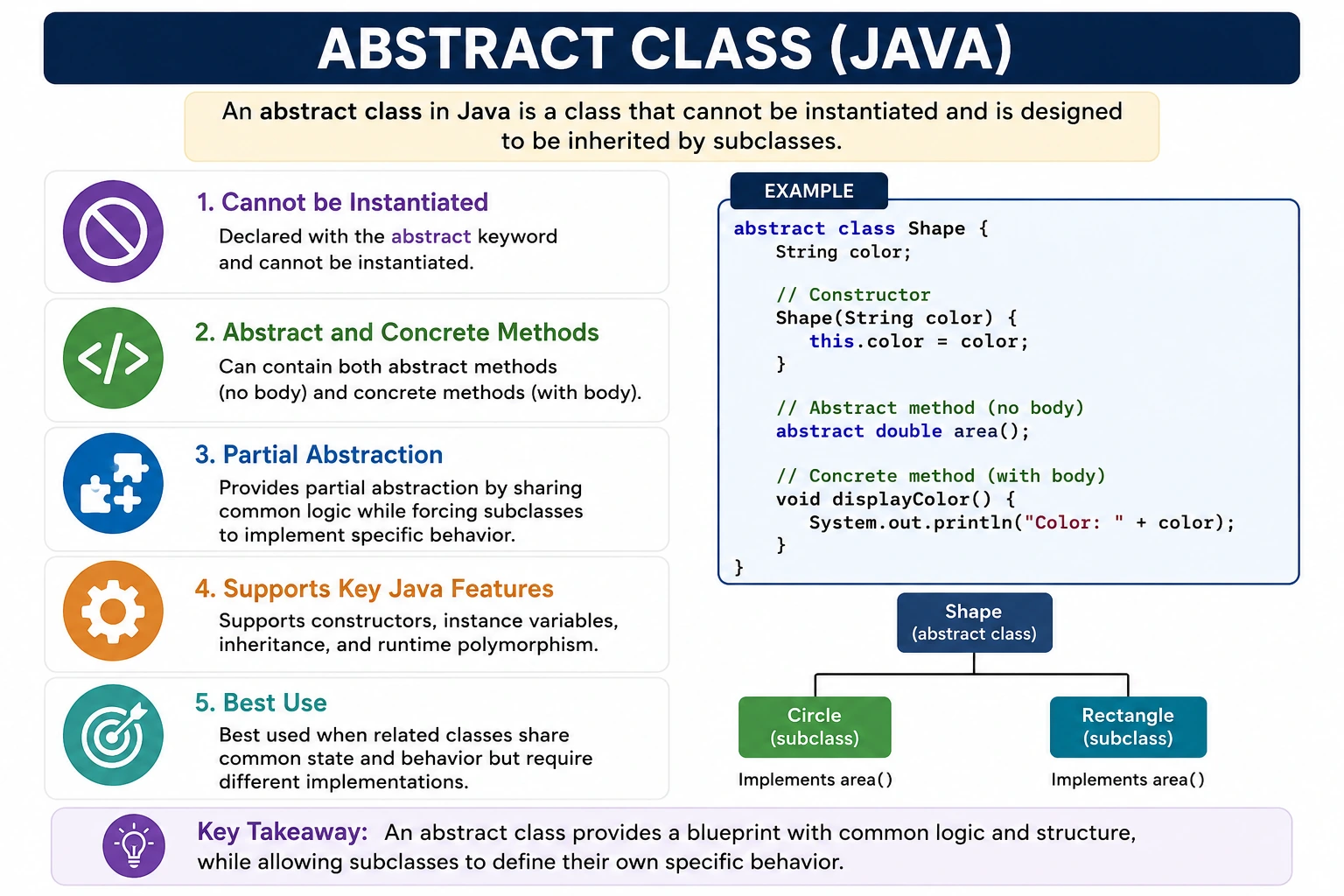
What Is an Abstract Class?
An abstract class is a class that acts as a base design for other classes. It may define common data and common behavior, but it can also define method signatures that subclasses must implement. This makes it different from a normal concrete class. A concrete class is complete and can be instantiated. An abstract class may be incomplete and is intended to be extended.
The main purpose of an abstract class is to represent a shared parent concept. For example, Vehicle
can be an abstract class because a vehicle is a broad category. You normally create objects such as
Car, Bike, or Bus, not a generic vehicle with no specific type. The
abstract class can define common behavior such as fuel() or stop(), while
subclasses implement specific behavior such as start().
Abstract classes support inheritance-based abstraction. They allow the parent class to define a contract for child classes and optionally provide reusable implementation. This is especially useful when related classes have common state or repeated behavior that should not be duplicated across every subclass.
abstract class Vehicle {
    abstract void start();
}
Why Abstract Classes Are Needed
Abstract classes are needed when a parent concept has common behavior but should not be used directly as a complete object. They help avoid code duplication by keeping shared logic in one place. If every subclass needs the same calculation, validation, or helper method, that behavior can live in the abstract superclass. Each subclass then inherits the common behavior instead of copying it.
They also enforce method implementation in subclasses. An abstract method tells every concrete child class,
"You must provide this behavior." This creates design consistency. For example, if every bank account must
calculate interest differently, an abstract BankAccount class can declare
calculateInterest() as abstract. Each concrete account type must implement it, but callers can
still work with the common account abstraction.
Abstract classes provide partial abstraction. They do not hide everything and they do not define only empty contracts. Instead, they can combine reusable implementation with incomplete behavior. This is useful when subclasses are strongly related and should share state, constructors, or common algorithms while customizing selected steps.
Abstract Method
An abstract method is a method declaration without a method body. It ends with a semicolon because the abstract class declares the method but does not implement it. A concrete subclass must override the abstract method and provide the actual method body. If a subclass does not implement all inherited abstract methods, that subclass must also be declared abstract.
abstract void start();
Abstract methods are useful when the parent class knows that every child must perform an operation but does not know the exact implementation. A vehicle must start, but a car, bike, and electric scooter may start in different ways. A shape must calculate area, but a circle and rectangle use different formulas. The abstract method captures the required behavior while leaving the details to subclasses.
Abstract Class Example (Basic)
The following example shows the typical structure of an abstract class. The Vehicle class has an
abstract method named start() and a concrete method named fuel(). The
Car class extends Vehicle and implements the missing start() method.
The object is created using the concrete class, but the reference can be of the abstract parent type.
abstract class Vehicle {

    abstract void start();   // abstract method

    void fuel() {            // concrete method
        System.out.println("Fueling vehicle");
    }
}

class Car extends Vehicle {

    @Override
    void start() {
        System.out.println("Car starts with key");
    }
}

Vehicle v = new Car();
v.start();
v.fuel();
This example demonstrates abstraction and polymorphism together. The variable type is Vehicle,
which represents the abstract parent contract. The actual object is Car, which supplies the
implementation. The caller can use common methods through the abstract type while runtime behavior comes from
the concrete subclass where needed.
Key Rules of Abstract Classes (Very Important)
The first important rule is that an abstract class cannot be instantiated directly. Java prevents object creation because the class may contain incomplete abstract methods. An object must be created from a concrete subclass that has completed the required behavior.
// Vehicle v = new Vehicle(); // Compile-time error
An abstract class can have both abstract and non-abstract methods. This is one of its biggest advantages. Abstract methods enforce subclass implementation, while concrete methods provide shared behavior. An abstract class can also have constructors. The constructor is not used to create the abstract class directly; it is used to initialize the abstract parent portion when a concrete subclass object is created.
abstract class A {
    A() {
        System.out.println("Constructor");
    }
}
Abstract classes can have instance variables because they can represent shared state. A parent abstract class
such as Account may hold a balance field, while child classes define different deposit or
interest rules. Like all Java classes, an abstract class can extend only one class. A concrete subclass must
implement all inherited abstract methods unless it is also declared abstract.
Abstract Class with Constructor
Constructors in abstract classes are often misunderstood. Even though you cannot instantiate an abstract class directly, its constructor can run when a concrete child object is created. This happens because every child object includes the parent portion of the object, and that parent portion must be initialized first.
abstract class Shape {
    Shape() {
        System.out.println("Shape created");
    }
    abstract double area();
}

class Circle extends Shape {
    double radius;

    Circle(double r) {
        radius = r;
    }

    double area() {
        return 3.14 * radius * radius;
    }
}
Constructor execution runs from parent to child. In the example, creating a Circle object first
initializes the Shape part and then initializes the Circle part. This allows the
abstract parent class to prepare common state before subclass-specific initialization occurs.
Abstract Class with Partial Implementation
Partial implementation is where abstract classes are especially useful. A parent class can define a common algorithm while leaving one or more variable steps to subclasses. This prevents duplication while still allowing specialization. The abstract class owns the stable part of the behavior, and the subclass owns the changing part.
abstract class Bank {

    abstract double getRateOfInterest();

    double calculateInterest(double amount) {
        return amount * getRateOfInterest() / 100;
    }
}
In this bank example, calculateInterest() is common logic. It uses getRateOfInterest(),
but the actual rate may differ from bank to bank. Each bank subclass implements the abstract method, while
the shared calculation stays in one place. This is a practical example of code reuse through partial
abstraction.
Abstract Class vs Concrete Class
A concrete class is complete and can be instantiated directly. An abstract class is a base design that may be incomplete and is intended to be extended. Concrete classes represent actual objects in the system. Abstract classes represent shared concepts that concrete classes build upon.
| Feature | Abstract Class | Concrete Class |
|---|---|---|
| Instantiation | No | Yes |
| Abstract methods | Allowed | Not allowed |
| Implementation | Partial | Full |
| Use case | Base design | Actual object |
If a class is ready to create meaningful objects, it should usually be concrete. If a class exists mainly to define shared structure and force subclasses to complete certain behavior, it should be abstract.
Abstract Class vs Interface (Quick Preview)
Abstract classes and interfaces both support abstraction, but they are used for different design needs. An abstract class is best when related classes share state or partial implementation. An interface is best when multiple classes share a capability or contract but do not necessarily belong to the same class hierarchy.
| Feature | Abstract Class | Interface |
|---|---|---|
| Methods | Abstract + concrete | Abstract (default allowed) |
| Variables | Instance variables | Constants only |
| Constructors | Yes | No |
| Multiple inheritance | No | Yes |
| Use case | IS-A relationship | Capability/contract |
A simple rule is to use an abstract class for an IS-A relationship with shared implementation and to use an
interface for a CAN-DO capability. For example, Car can extend an abstract
Vehicle class because a car is a vehicle. But Car, Phone, and
Laptop may all implement a Rechargeable interface because they share a capability,
not a parent identity.
When to Use Abstract Classes
Use an abstract class when multiple related classes share common state and behavior. If subclasses need the same fields, constructors, helper methods, or partial algorithms, an abstract class can provide a stable base. This keeps shared logic centralized and makes subclass code smaller and more focused.
Abstract classes are also useful when you want to enforce a template. The parent class can define the general process, while subclasses fill in selected steps. This is common in reporting, payment processing, workflow execution, and framework lifecycle methods. The abstract class defines the skeleton, and concrete subclasses complete the variable details.
When NOT to Use Abstract Classes
Do not use an abstract class when only a method contract is needed and there is no shared state or common implementation. In that case, an interface is usually clearer. Interfaces also support multiple inheritance of type, so they are better when a class needs to expose several independent capabilities.
Abstract classes should also not be used merely to make code look advanced. If there is only one concrete class and no clear shared base behavior, an abstract class may add unnecessary complexity. Good abstraction hides meaningful variation. Poor abstraction adds extra layers without improving clarity.
Common Beginner Mistakes
A common beginner mistake is trying to create an object of an abstract class. Java does not allow this because the abstract class may be incomplete. Another mistake is forgetting to implement all abstract methods in a concrete subclass. If even one abstract method remains unimplemented, the subclass must also be declared abstract.
Beginners also confuse abstract classes with interfaces. Both can define abstraction, but an abstract class is stronger when shared state and common implementation are needed. An interface is stronger when defining a capability across unrelated classes. Overusing abstract classes can create rigid inheritance hierarchies, especially because Java allows a class to extend only one class.
Another practical mistake is putting too much implementation into an abstract class. If a base class knows too much about every subclass, changes become risky. A good abstract class provides common behavior and a clear contract, but it should not become a large container for unrelated logic.
Design Value of Abstract Classes
The design value of an abstract class is that it creates a common parent model for related classes. It allows developers to place shared behavior in one place while still forcing subclasses to provide important details. This creates consistency across the hierarchy. Every subclass follows the same base structure, but each subclass can implement its own specific behavior where needed.
Abstract classes are particularly useful when the domain has a natural hierarchy. In a banking system,
Account may be abstract while SavingsAccount, CurrentAccount, and
LoanAccount are concrete. In a graphics application, Shape may be abstract while
Circle, Rectangle, and Triangle are concrete. In these examples, the
abstract class represents a real shared concept.
Abstract classes also support polymorphism. A variable can be declared using the abstract class type while the actual object is a concrete subclass. This allows callers to work with a general contract while runtime behavior comes from the subclass implementation. This is one of the reasons abstract classes are often used in framework and application design.
Abstract Classes in Real Projects
In real projects, abstract classes are often used to define base workflows. A report generation system may
have an abstract Report class with common methods for header, footer, file naming, and logging.
Each concrete report class implements the report body differently. A test automation framework may define an
abstract base test class with common setup and cleanup logic while child test classes provide specific test
behavior.
This approach keeps repeated logic out of every subclass. If the common setup changes, it can be updated in the abstract base class. Subclasses automatically inherit the correction. At the same time, abstract methods ensure that each subclass provides the behavior that cannot be generalized.
The risk is that abstract base classes can become too large over time. If every new subclass needs a special exception or override, the design may be too broad. A healthy abstract class should contain behavior that is genuinely common and stable. Implementation details that apply only to one subclass should remain in that subclass.
Abstract Classes and Polymorphism
Abstract classes are often used with polymorphism. Even though an abstract class cannot be instantiated directly, it can be used as a reference type. A variable of an abstract class type can point to any concrete subclass object. This allows the caller to work with a general parent type while the actual implementation is selected from the concrete child class at runtime.
For example, a variable of type Shape can point to a Circle object, a
Rectangle object, or a Triangle object. The caller can invoke area()
through the Shape reference, and Java executes the implementation provided by the actual object.
This is runtime polymorphism, and abstract classes provide a strong way to define the shared contract that
makes it possible.
This design becomes useful when code must process many related objects uniformly. A reporting module can
hold a list of Report references and call generate() on each one. Some reports may
be sales reports, some may be inventory reports, and some may be audit reports. The loop does not need to
know the exact class of every report. Each concrete subclass provides the correct behavior.
Abstract Classes and the Template Method Pattern
One of the best-known uses of abstract classes is the template method pattern. In this pattern, the abstract class defines the overall steps of an algorithm, and subclasses implement one or more specific steps. The parent class controls the flow, while child classes customize the details. This is a clean way to reuse the stable structure of a process while allowing variation where it is needed.
Consider report generation. Every report may require a header, body, and footer. The header and footer may
be common, but the body differs for sales, inventory, and finance reports. An abstract Report
class can define a final generate() method that calls header(), body(),
and footer(). The body() method can be abstract, forcing each child report to
provide its own content. This keeps the process consistent while allowing controlled customization.
The template method pattern also prevents duplication. Without an abstract base class, every report class might repeat the same header and footer logic. If that common logic changes, every report class must be updated. With an abstract class, common logic lives in one place, and child classes focus on the parts that truly differ.
Access Modifiers in Abstract Classes
Abstract classes can use normal Java access modifiers. Abstract methods may be public, protected, or package-private, depending on where they need to be implemented and called. They cannot be private because a private method is not visible to subclasses, and an abstract method must be implemented by a subclass. This is why a private abstract method is contradictory and causes a compile-time error.
Protected members are common in abstract classes because they allow subclasses to reuse parent behavior or state without exposing those details publicly. However, protected fields should be used carefully. Directly exposing fields to subclasses can make the hierarchy fragile. Protected methods often provide better control because the abstract class can decide how shared state should be accessed or modified.
Public abstract methods define behavior that callers can rely on through the abstract reference. Protected abstract methods are usually internal hooks used by the parent class as part of a template method. Choosing the right access level helps communicate whether a method is part of the public contract or part of internal subclass customization.
Abstract Classes and Constructors in Detail
Abstract class constructors are important because they initialize shared parent state. A parent abstract
class may require values that every subclass must provide. For example, an abstract User class
may require a role, username, or ID. Each subclass can pass those values to the parent constructor using
super(arguments). This keeps common initialization centralized.
The constructor chain always begins with the highest parent class and then moves downward to the concrete child class. If an abstract class extends another class, that parent constructor runs first. Then the abstract class constructor runs. Finally, the concrete child constructor runs. This order ensures that the inherited state is ready before child-specific initialization happens.
A common interview question asks why abstract classes have constructors if they cannot be instantiated. The answer is that abstract classes are not instantiated directly, but their constructor is executed as part of creating a concrete subclass object. The abstract class still contributes fields and initialization logic to the final object.
Interview Explanation Strategy
In interviews, explain abstract classes in a structured way. Start with the definition: an abstract class is
a class declared with the abstract keyword that may contain abstract and concrete methods and
cannot be instantiated directly. Then explain why it is used: it provides partial abstraction, shares common
behavior, and forces subclasses to implement required methods.
Also mention the rules. Abstract classes can have constructors, fields, concrete methods, static methods, and final methods. They can contain abstract methods, but abstract methods cannot be private, static, or final because they must be overridden by subclasses. A concrete subclass must implement all inherited abstract methods, or the subclass must also be declared abstract.
Finally, compare abstract classes with interfaces. Use an abstract class when there is a strong IS-A relationship with shared state or common implementation. Use an interface when the goal is to define a capability or contract across potentially unrelated classes. This comparison shows practical design understanding rather than memorized syntax.
Common Rules Behind the Syntax
Many abstract class rules make sense when viewed from Java's type system. An abstract method cannot be static because static methods belong to the class and are resolved without an object, while abstract methods depend on subclass implementation through objects. An abstract method cannot be final because final prevents overriding, and an abstract method must be overridden before a concrete object can be created. An abstract method cannot be private because subclasses would not be able to see it or implement it.
An abstract class itself cannot be final for a similar reason. A final class cannot be extended, but an abstract class is designed to be extended. Declaring a class as both abstract and final would mean the class is incomplete but also cannot be completed by any subclass. Java rejects that contradiction at compile time.
These rules are not arbitrary. They protect the design contract. If a class declares abstract behavior, Java requires some subclass to provide that behavior before objects can be created. If a modifier would make that implementation impossible, the compiler reports an error early instead of allowing a broken hierarchy.
Abstract Classes and Maintainability
Abstract classes can improve maintainability when they are used to centralize stable common behavior. A base class can hold shared validation, logging, formatting, setup, or lifecycle logic. Subclasses then implement only the behavior that differs. This keeps duplicated logic out of child classes and makes future changes easier because common behavior is corrected in one place.
The same feature can reduce maintainability if the abstract class becomes too broad. If unrelated subclasses inherit methods they do not need, the base class starts to feel like a storage area for random code. A good abstract class should have a clear responsibility and a meaningful name. Its abstract methods should express behavior that every concrete subclass truly needs to provide.
Additional Abstract Class Examples (20 Scenarios)
1. Abstract Class with Multiple Abstract Methods
abstract class Device {
    abstract void powerOn();
    abstract void powerOff();
}

class Phone extends Device {
    void powerOn() { System.out.println("Phone ON"); }
    void powerOff() { System.out.println("Phone OFF"); }

    public static void main(String[] args) {
        Device d = new Phone();
        d.powerOn();
        d.powerOff();
    }
}
Output
Phone ON
Phone OFF
2. Abstract Class with State (Fields)
abstract class Account {
    double balance;
    abstract void deposit(double amt);
}

class Savings extends Account {
    void deposit(double amt) {
        balance += amt;
    }

    public static void main(String[] args) {
        Account a = new Savings();
        a.deposit(500);
        System.out.println(a.balance);
    }
}
Output
500.0
3. Abstract Class with Protected Members
abstract class Base {
    protected int x = 10;
    abstract void show();
}

class Child extends Base {
    void show() { System.out.println(x); }

    public static void main(String[] args) {
        new Child().show();
    }
}
Output
10
4. Abstract Method Implementation Across Levels
abstract class A {
    abstract void m();
}

abstract class B extends A {
    // still abstract
}

class C extends B {
    void m() { System.out.println("Implemented"); }

    public static void main(String[] args) {
        new C().m();
    }
}
Output
Implemented
5. Abstract Class with Template Method Pattern
abstract class Report {
    final void generate() {
        header();
        body();
        footer();
    }
    void header() { System.out.println("Header"); }
    abstract void body();
    void footer() { System.out.println("Footer"); }
}

class SalesReport extends Report {
    void body() { System.out.println("Sales Data"); }

    public static void main(String[] args) {
        new SalesReport().generate();
    }
}
Output
Header
Sales Data
Footer
6. Abstract Class Constructor with Parameters
abstract class User {
    String role;
    User(String role) {
        this.role = role;
    }
}

class Admin extends User {
    Admin() {
        super("ADMIN");
    }

    public static void main(String[] args) {
        System.out.println(new Admin().role);
    }
}
Output
ADMIN
7. Abstract Class Returning Abstract Type
abstract class Shape {
    abstract String name();
}

class Circle extends Shape {
    String name() { return "Circle"; }
}

class Test {
    static Shape create() {
        return new Circle();
    }

    public static void main(String[] args) {
        System.out.println(create().name());
    }
}
Output
Circle
8. Abstract Class with Static Method
abstract class Util {
    static void help() {
        System.out.println("Helping");
    }
}

class Test {
    public static void main(String[] args) {
        Util.help();
    }
}
Output
Helping
9. Abstract Class with Instance Block
abstract class A {
    {
        System.out.println("Instance Block");
    }
}

class B extends A {
    B() { System.out.println("Constructor"); }

    public static void main(String[] args) {
        new B();
    }
}
Output
Instance Block
Constructor
10. Overriding Abstract Method with Broader Access
abstract class A {
    protected abstract void show();
}

class B extends A {
    public void show() { System.out.println("Shown"); }

    public static void main(String[] args) {
        new B().show();
    }
}
Output
Shown
11. Abstract Class vs Interface (State Difference)
abstract class Counter {
    int count;
    abstract void inc();
}

class Impl extends Counter {
    void inc() { count++; }

    public static void main(String[] args) {
        Counter c = new Impl();
        c.inc();
        System.out.println(c.count);
    }
}
Output
1
12. Abstract Method Cannot Be Static
abstract class A {
    // abstract static void m(); // Compile-time error
}
Explanation
Abstract methods need instance context.
13. Abstract Class with Final Field
abstract class Config {
    final String ENV = "PROD";
}

class App extends Config {
    public static void main(String[] args) {
        System.out.println(new App().ENV);
    }
}
Output
PROD
14. Partial Implementation of Interface via Abstract Class
interface Ops {
    void a();
    void b();
}

abstract class BaseOps implements Ops {
    public void a() { System.out.println("A"); }
}

class FullOps extends BaseOps {
    public void b() { System.out.println("B"); }

    public static void main(String[] args) {
        Ops o = new FullOps();
        o.a();
        o.b();
    }
}
Output
A
B
15. Abstract Class with Covariant Return
abstract class Factory {
    abstract Number create();
}

class IntFactory extends Factory {
    Integer create() { return 10; }

    public static void main(String[] args) {
        System.out.println(new IntFactory().create());
    }
}
Output
10
16. Abstract Class and instanceof
abstract class A {}
class B extends A {}

class Test {
    public static void main(String[] args) {
        A a = new B();
        System.out.println(a instanceof A);
        System.out.println(a instanceof B);
    }
}
Output
true
true
17. Abstract Class Cannot Be Final
// final abstract class A {} // Compile-time error
Explanation
final prevents inheritance; abstract requires it.
18. Abstract Class with Synchronized Method
abstract class Service {
    synchronized void ping() {
        System.out.println("Ping");
    }
}

class Impl extends Service {
    public static void main(String[] args) {
        new Impl().ping();
    }
}
Output
Ping
19. Real-World Abstraction (Payment Gateway)
abstract class PaymentGateway {
    abstract boolean pay(double amount);
}

class Stripe extends PaymentGateway {
    boolean pay(double amount) {
        System.out.println("Stripe: " + amount);
        return true;
    }

    public static void main(String[] args) {
        PaymentGateway pg = new Stripe();
        pg.pay(99.99);
    }
}
Output
Stripe: 99.99
20. Interview Summary – Abstract Classes
abstract class A {
    abstract void run();
}

class B extends A {
    void run() { System.out.println("Running"); }

    public static void main(String[] args) {
        A a = new B();
        a.run();
    }
}
Key Points
- Cannot instantiate
- Can have state, constructors, concrete methods
- Enables partial abstraction
Output
Running
Interview-Ready Answers
Short Answer
An abstract class is a class that cannot be instantiated and may contain abstract and concrete methods.
Detailed Answer
In Java, an abstract class is used to achieve abstraction by providing partial implementation. It can contain abstract methods that must be implemented by subclasses and concrete methods with shared logic. Abstract classes support inheritance and polymorphism.
Key Takeaway
Abstract classes define a base blueprint with shared behavior and mandatory methods. They are ideal when you need partial abstraction with code reuse.