Why Git Was Created
Introduction
Git is one of the most important tools in modern software development. Whether you are a Java developer, Selenium automation engineer, API tester, DevOps engineer, or open-source contributor, Git is likely part of your daily workflow. Today it is difficult to imagine software development without version control, branching, merging, pull requests, and distributed collaboration. However, Git was not created simply as another development tool. It was born out of necessity, driven by real-world challenges faced by one of the largest software projects in the world—the Linux Kernel.
To truly appreciate Git, it is important to understand the problems that existed before its creation. Git was designed to solve critical issues related to source code management, collaboration, performance, reliability, and scalability. Understanding why Git was created helps developers understand not only the tool itself but also the principles behind modern software development workflows.
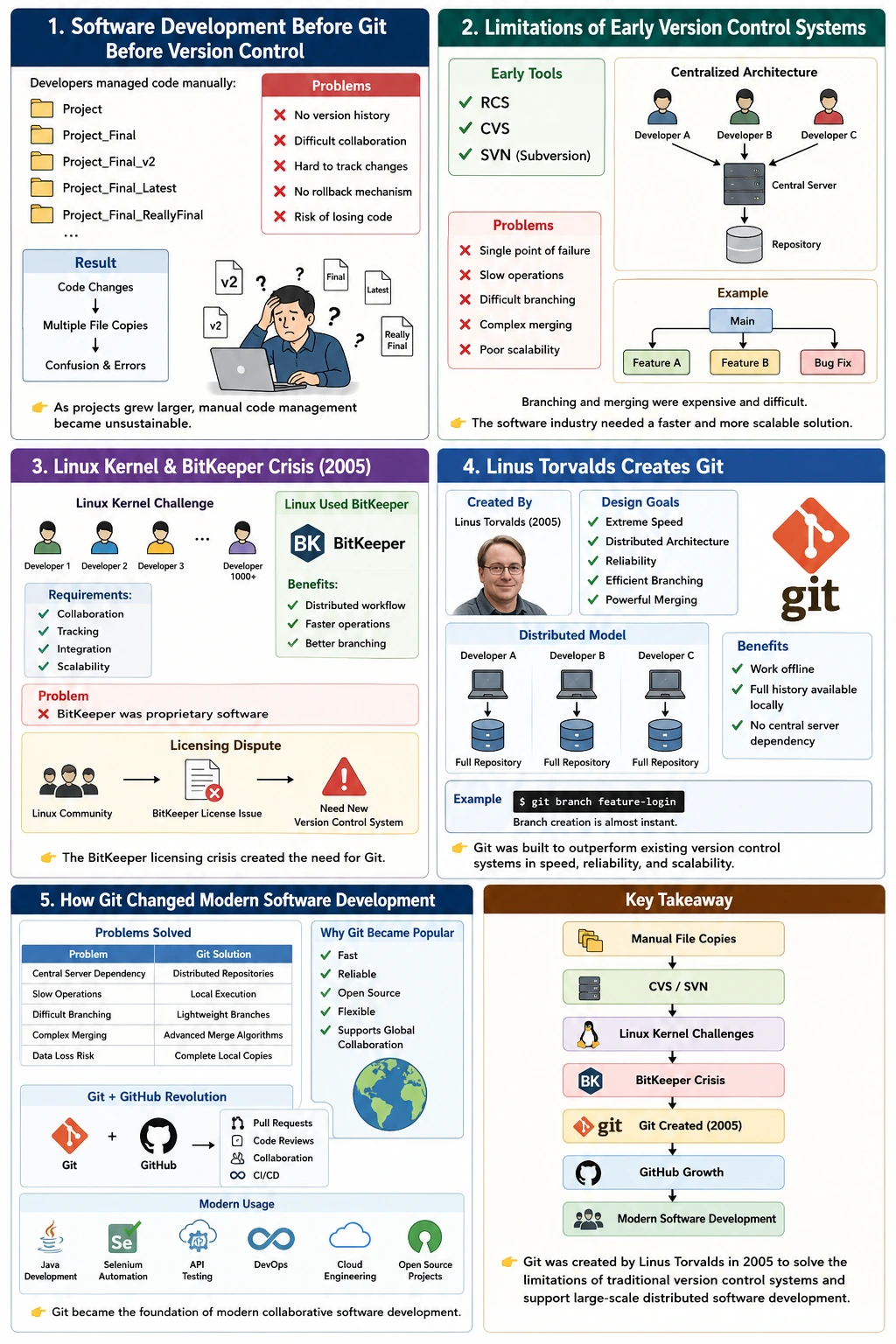
Software Development Before Version Control
In the early days of software development, programmers had no sophisticated tools to manage changes in source code. Most development was done by individuals or very small teams. When changes were made, developers often created copies of files manually.
A typical project directory might look like this:
Project
Project_Final
Project_Final_v2
Project_Final_Latest
Project_Final_ReallyFinal
At first glance this might seem manageable, but as projects grew larger, problems quickly appeared. Developers often forgot which file represented the latest version. Tracking historical changes became almost impossible. Recovering previous versions required manually searching through folders, and collaboration between multiple developers was extremely difficult.
If a mistake was introduced into the latest version, developers had no reliable way to identify when the change occurred or who made it. As software systems became larger and more complex, this manual approach became unsustainable.
The Emergence of Early Version Control Systems
To solve these challenges, version control systems began to emerge. Early tools such as Revision Control System (RCS), Concurrent Versions System (CVS), and later Subversion (SVN) introduced structured methods for managing source code.
These systems allowed developers to:
- Track changes
- Maintain version history
- Restore older versions
- Collaborate on shared projects
- Manage source code more efficiently
The basic architecture followed a centralized model.
Developer
     ↓
Central Server
     ↓
Source Code Repository
Developers checked out code from a central server, made changes locally, and then committed those changes back to the server.
This represented a major improvement over manual file copying. Teams could now work together using a shared repository and maintain a history of modifications.
However, as software projects grew larger, new limitations began to emerge.
Problems with Centralized Version Control Systems
Although CVS and SVN were revolutionary for their time, they introduced their own set of challenges.
Single Point of Failure
One of the biggest issues was the dependency on a central server.
Consider the following structure:
Developer A
Developer B
Developer C
      ↓
 Central Server
Every developer depended on that server for nearly all version control operations.
If the server became unavailable due to hardware failure, network outages, or corruption, development activities could come to a halt. In extreme situations, loss of the server could result in the loss of project history.
This created a significant risk for large organizations.
Slow Performance
Most operations required communication with the central repository.
Common activities such as:
- Viewing history
- Comparing versions
- Checking logs
- Performing commits
often involved network communication.
As teams became geographically distributed, network latency introduced delays that reduced productivity.
Developers wanted a system where common operations could execute locally and quickly.
Difficult Branching and Merging
Modern development heavily relies on branching.
A typical workflow may look like:
Main
 ├── Feature A
 ├── Feature B
 └── Bug Fix
In older systems, branching was expensive and difficult.
Creating branches often required significant storage and processing resources. Merging branches back into the main codebase could be complex and error-prone.
Because branching was difficult, many teams avoided it altogether, limiting their ability to develop features independently.
Poor Scalability
As projects grew in size, centralized systems struggled.
Large projects often involved:
- Thousands of files
- Hundreds of developers
- Millions of lines of code
- Frequent commits
Performance began to degrade as repository size increased.
The software industry needed a solution capable of supporting very large projects without sacrificing speed or reliability.
The Linux Kernel Challenge
One project in particular exposed the limitations of existing tools more than any other: the Linux Kernel.
The Linux Kernel is one of the largest collaborative software projects in history. Thousands of developers from around the world contribute changes continuously.
A simplified view looks like:
Developer 1
Developer 2
Developer 3
...
Developer 1000+
Each contribution must be:
- Tracked
- Reviewed
- Integrated
- Tested
- Maintained
Managing this scale of collaboration required an extremely powerful version control system.
Linux's Use of BitKeeper
Before Git existed, Linux development relied on a commercial version control system called BitKeeper.
BitKeeper provided several features that Linux developers needed:
- Distributed workflows
- Faster operations
- Better scalability
- Improved branching
For several years, BitKeeper served as the primary tool used for Linux Kernel development.
However, there was a problem.
BitKeeper was proprietary software.
The Linux community used it under a special licensing arrangement.
The BitKeeper Licensing Crisis
In 2005, disagreements arose between the Linux community and the company that owned BitKeeper.
As a result, Linux developers lost access to the free version of BitKeeper.
This created an immediate crisis.
The Linux project depended on advanced version control capabilities, and existing alternatives such as CVS and SVN could not adequately support Linux's development model.
The Linux community needed a replacement—and needed one quickly.
Linus Torvalds Decides to Build Git
Faced with this challenge, Linux creator Linus Torvalds decided to create a new version control system.
Rather than adapting an existing tool, he chose to build a completely new system from scratch.
His objective was not simply to create another version control tool.
He wanted a system that would outperform existing solutions in speed, reliability, and scalability.
The result was Git.
Git was officially created in 2005.
Design Goals Behind Git
Linus Torvalds established several key goals during Git's design.
Extreme Speed
Git needed to be significantly faster than existing systems.
Developers spend a large portion of their day interacting with version control.
Operations such as:
git log
git diff
git branch
should execute instantly.
To achieve this, Git stores most repository data locally, eliminating unnecessary server communication.
Distributed Architecture
One of Git's most revolutionary features was its distributed design.
Instead of depending on a central server, every developer receives a complete repository.
Developer A
     ↓
Full Repository

Developer B
     ↓
Full Repository

Developer C
     ↓
Full Repository
This means every developer has:
- Full commit history
- Complete branches
- Complete repository data
Even without network access, developers can continue working.
Reliability and Data Integrity
Git was designed to make data corruption extremely difficult.
Every commit is identified using cryptographic hashing.
Example:
8f14e45fceea167a5a36dedd4bea2543These hashes uniquely identify repository content.
If data changes unexpectedly, Git can detect the corruption immediately.
This approach provides strong guarantees regarding repository integrity.
Efficient Branching
Git treats branches as lightweight references rather than expensive copies.
Creating a branch is nearly instantaneous.
git branch feature-loginThis encourages developers to create branches frequently.
Feature development, experimentation, and bug fixing become much safer and more manageable.
Powerful Merging
Git was designed to support frequent merging.
Modern workflows often involve:
Main Branch
      ↓
Feature Branch
      ↓
Merge Back
Git's merging algorithms make this process significantly easier than older systems.
This capability became one of Git's greatest strengths.
How Git Solved Existing Problems
Git directly addressed the shortcomings of earlier systems.
| Problem | Git Solution |
|---|---|
| Central server dependency | Distributed repositories |
| Slow operations | Local execution |
| Difficult branching | Lightweight branches |
| Complex merging | Advanced merge algorithms |
| Data loss risk | Complete local copies |
| Scalability issues | Optimized storage model |
| Collaboration challenges | Distributed workflows |
These improvements dramatically changed how teams developed software.
Why Git Became So Popular
Git's adoption grew rapidly because it solved real-world problems effectively.
Organizations quickly recognized several benefits.
Speed
Most operations execute locally, making Git extremely fast.
Reliability
Cryptographic hashing protects repository history.
Flexibility
Git supports numerous workflows and team structures.
Collaboration
Distributed development enables teams across the world to work together efficiently.
Open Source
Unlike BitKeeper, Git is completely free and open source.
Anyone can use, modify, and contribute to its development.
GitHub and the Explosion of Git Adoption
Although Git itself was revolutionary, its popularity accelerated dramatically with the rise of GitHub.
GitHub provided:
- Remote repository hosting
- Pull requests
- Code reviews
- Collaboration tools
- Open-source community support
Other platforms followed:
- GitLab
- Bitbucket
- Azure Repos
These services transformed Git from a powerful version control system into the foundation of modern collaborative software development.
Impact on Modern Software Development
Today Git is used in virtually every area of software engineering.
Examples include:
- Java development
- Selenium automation
- API testing
- Mobile application development
- Cloud engineering
- DevOps pipelines
- Microservices architecture
- Open-source software
Modern development workflows depend heavily on Git concepts such as:
- Branching
- Merging
- Pull requests
- Code reviews
- Continuous Integration
- Continuous Delivery
Without Git, many of today's development practices would be far more difficult to implement.
Real-World Example
Consider a login feature.
Without Git:
Login_v1.java
Login_v2.java
Login_Final.java
Login_Final_New.java
Tracking changes becomes confusing and error-prone.
With Git:
Repository
     ↓
Commit 1
Commit 2
Commit 3
Commit 4
Developers can:
- View complete history
- Compare versions
- Restore previous code
- Track authorship
- Collaborate safely
The difference in productivity and maintainability is enormous.
Conclusion
Git was created in 2005 by Linus Torvalds to address the limitations of traditional version control systems and to support the massive development requirements of the Linux Kernel. Existing tools suffered from problems such as centralized architecture, slow performance, difficult branching, limited scalability, and dependency on server availability. The licensing issues surrounding BitKeeper created an urgent need for a new solution, leading to the birth of Git.
From the beginning, Git was designed around principles of speed, reliability, distributed development, scalability, and efficient branching and merging. These design decisions transformed Git into far more than a version control tool—it became the foundation of modern software collaboration. Today, millions of developers rely on Git every day to manage code, track changes, collaborate across teams, and deliver software efficiently.
Understanding why Git was created provides valuable insight into its architecture and explains why it has become the dominant version control system in the software industry.