Negative Scenarios
Negative scenarios validate how the system behaves when invalid input, restricted conditions, missing data, rule violations, unauthorized actions, or failure situations occur. While happy path scenarios confirm what happens when everything goes correctly, negative scenarios confirm what the system does when something goes wrong. They answer a practical question: what should the system do when the user, data, or environment does not follow the ideal path?
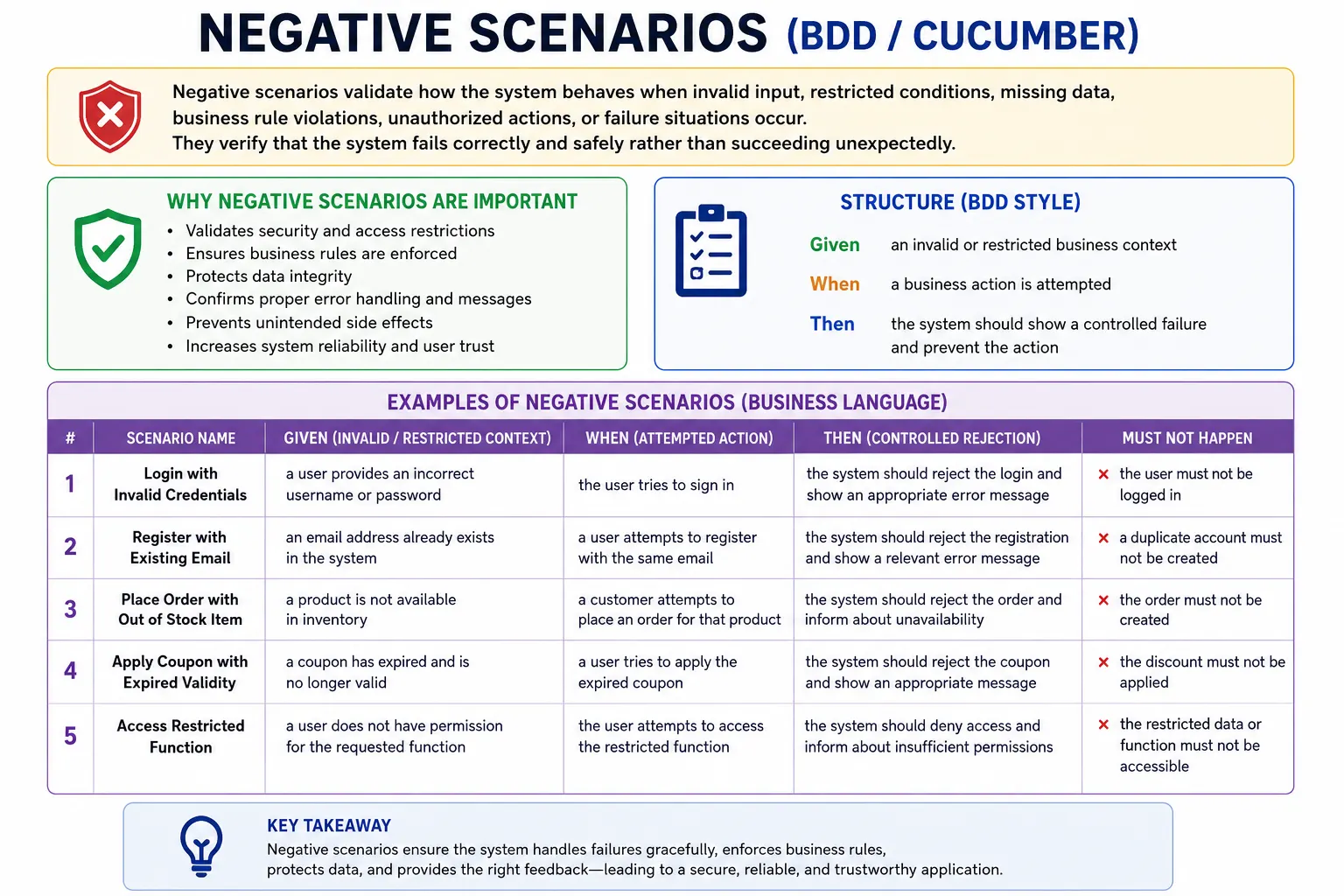
In BDD and Cucumber, negative scenarios are not written to prove that the system breaks. They are written to prove that the system fails correctly. A reliable system should reject invalid actions, protect important data, enforce business rules, show meaningful messages, and remain stable. Negative scenarios help teams describe and validate that controlled failure behavior.
What Is a Negative Scenario?
A negative scenario is a business-readable example that describes how the system should respond when a user attempts something invalid, restricted, incomplete, or not allowed by a rule. It may involve invalid credentials, missing mandatory information, insufficient balance, expired tokens, duplicate requests, unauthorized access, or violation of a business constraint. The expected result is not success. The expected result is controlled rejection or safe handling.
For example, a login happy path confirms that a user with valid credentials can log in. A login negative scenario confirms that a user with invalid credentials is denied access. The goal is not simply to see an error. The goal is to verify that access is not granted, the system remains secure, and the user receives a meaningful response.
Negative scenarios are essential because real users do not always provide perfect data. They forget passwords, leave fields empty, use expired cards, exceed limits, attempt unauthorized actions, refresh pages, submit forms twice, and operate under changing conditions. A system that works only for perfect input is not reliable. It must also handle imperfect input safely.
Why Negative Scenarios Are Critical
Negative scenarios are critical because many serious production defects occur outside the happy path. A feature may work when valid data is entered, but fail badly when a field is missing, a permission is wrong, a limit is exceeded, or a dependency is unavailable. If testing focuses only on successful flows, the team may miss defects that affect data integrity, security, user trust, and business control.
Negative scenarios validate business rules and constraints. If a user should not transfer more money than their available balance, the system must reject the transfer. If a locked account should not be used for login, access must be denied. If a coupon expires after a certain date, it must not apply a discount. These are not optional checks. They protect the business from incorrect outcomes.
They also improve robustness. A robust application does not collapse when something unexpected happens. It handles invalid conditions gracefully, provides clear feedback, prevents unintended side effects, and keeps the system in a valid state. Negative testing validates this strength. It confirms that failure behavior is intentional rather than accidental.
Negative Scenarios Complement Happy Paths
Happy paths and negative scenarios work together. A happy path defines the successful baseline behavior. Negative scenarios explore what happens when that baseline is disrupted. The happy path says, "This is what should happen when everything is valid." The negative scenario says, "This is what should happen when a rule is violated or a condition is invalid."
For example, the happy path for order placement may confirm that a user with items in the cart and valid payment details can place an order. Negative scenarios may confirm that the order is rejected when payment details are invalid, when the cart is empty, when an item is out of stock, or when the user's account is restricted. Each negative scenario protects a different rule.
This relationship is important in scenario design. Start with the happy path, then expand into negative scenarios. Without the happy path, negative scenarios may feel disconnected. Without negative scenarios, the happy path gives only partial confidence. Together, they create a more complete view of behavior.
Characteristics of Good Negative Scenarios
A good negative scenario is behavior-focused, rule-driven, explicit about expected failure, clear about what should not happen, and independent of UI or technical handling. It should describe the business condition that makes the action invalid and the business outcome that should result. It should not read like a list of clicks or low-level assertions.
The scenario should be rule-driven because negative behavior usually exists to enforce a rule. The rule may be a validation rule, permission rule, financial rule, data integrity rule, security rule, or workflow rule. The scenario should make that rule visible. A negative scenario without a clear rule often becomes a random failure test instead of meaningful acceptance criteria.
Good negative scenarios also state the expected rejection clearly. A vague outcome such as "Then an error should appear" is usually weak. A stronger outcome says "Then access should be denied" or "Then the transfer should be declined." If it is important that something must not happen, the scenario should say so directly.
Structure of a Negative Scenario
A negative scenario can follow the same Given, When, Then structure as any BDD scenario:
Scenario: <Failure or rejection behavior>
  Given <invalid or restricted context>
  When <action is attempted>
  Then <system rejects or handles correctly>
The Given step establishes the invalid or restricted context. The When step describes the attempted action. The Then step describes the expected controlled failure. This structure helps keep the scenario focused. The scenario is not about every technical step that leads to failure. It is about the business rule and the correct system response.
For example:
Scenario: Login fails with invalid credentials
  Given the user provides invalid credentials
  When the user attempts to log in
  Then access should be denied
This scenario clearly defines the cause and the expected outcome. It does not expose fields, buttons, selectors, or backend implementation. It expresses the business behavior: invalid credentials must not result in access.
What to Validate in Negative Scenarios
Negative scenarios should validate more than the presence of an error message. A message may appear, but the system may still perform an unintended action. For example, an order may show an error but still charge the customer. A transfer may be declined visually but still reduce the account balance. A login may show an error but still create a session. These are serious defects.
A strong negative scenario verifies that the operation is rejected, the correct business-level message or outcome is produced, no unintended side effects occur, and the system remains stable. If the scenario involves data or money, it is especially important to state what must not change. For example:
Then the order should be rejected
And no payment should be processed
This tells the team that rejection alone is not enough. The payment must not happen. Negative scenarios are often about protection. They protect data, money, access, workflow state, and user trust.
Negative vs Happy Path
A happy path uses valid inputs and expects success. A negative scenario uses invalid, restricted, missing, or rule-breaking conditions and expects controlled failure. Both are essential. The happy path proves that the system can do the right thing. Negative scenarios prove that the system can prevent the wrong thing.
| Aspect | Happy Path | Negative Scenario |
|---|---|---|
| Input | Valid | Invalid or restricted |
| Outcome | Success | Controlled failure |
| Goal | Validate main flow | Validate rule enforcement |
| Priority | First | Immediately after |
Negative scenarios should usually be written immediately after the happy path for a key behavior. Once the team knows what success looks like, it can define how failure should be handled. This creates a balanced feature file: one part shows the intended successful behavior, while the other part shows the safeguards.
Common Types of Negative Scenarios
Common negative scenarios include invalid credentials, missing mandatory data, unauthorized access, insufficient balance, expired or invalid tokens, duplicate requests, and business rule violations. These are common because they represent real-world conditions. Users make mistakes, attackers attempt access, systems receive duplicate submissions, and business constraints must be enforced.
Missing mandatory data is a frequent example. If the user attempts to submit a form without a required field, the system should reject the submission and explain what is missing. Unauthorized access is another important category. If a normal user attempts to access an admin function, the system should deny the action and avoid exposing restricted data.
Financial and transactional systems often require negative scenarios around limits and state. A user should not transfer more money than available. A refund should not be processed twice. An order should not be cancelled after shipment if the business rule prevents it. These scenarios protect data integrity and business correctness.
Good vs Bad Negative Scenario
A weak negative scenario is often UI-driven:
Given I leave the password field empty
When I click submit
Then error appears
This version describes interface steps and ends with a vague outcome. A stronger behavior-driven version is:
Given the user does not provide a password
When the user attempts to log in
Then access should be denied
The second version is clearer because it describes the business rule. A password is required for login, and without it, access must be denied. The automation can still leave the password field empty and click submit internally, but the Gherkin remains focused on behavior.
If the error message itself matters, the scenario can mention it in business language. For example, "Then the user should be told that password is required." This is better than saying "Then error appears" because it defines the expected message meaning, not just the presence of a visual element.
Using But in Negative Scenarios
The But keyword can be useful in negative scenarios when the team wants to state what must not change. In Gherkin, But works like And, but it improves readability by contrasting the expected failure with something that should remain unchanged. This is especially helpful in data, money, account, and workflow scenarios.
Then the transfer should be declined
But the account balance should remain unchanged
This scenario communicates two important expectations. First, the transfer is declined. Second, the account balance is protected. Without the second step, a system might show a decline message while still changing the balance. The But step makes the protection rule explicit.
But should not be overused for style. Use it when it improves meaning. In negative scenarios, it is most valuable when the scenario must say both what should happen and what should not happen.
Negative Scenarios and Business Rules
Negative scenarios are closely connected to business rules. Many business rules are restrictions: a user cannot exceed a limit, cannot access another user's data, cannot apply an expired coupon, cannot cancel a shipped order, or cannot approve their own request. These restrictions must be tested explicitly because they often protect revenue, compliance, security, and operational correctness.
A good negative scenario should make the rule understandable. For example:
Scenario: Shipped order cannot be cancelled
  Given the order has already been shipped
  When the user attempts to cancel the order
  Then the cancellation should be rejected
This scenario is not about a button. It is about the business rule that shipped orders cannot be cancelled. The Gherkin describes the restriction clearly, and the automation can verify the UI, API, or data state behind the scenes.
Negative Scenarios and Security
Negative scenarios are also important for security. Many security failures are negative-path failures. A user should not access restricted pages. A token should not work after expiry. A locked account should not log in. A user should not perform actions outside their role. A request without proper authorization should be rejected. These scenarios verify that the system protects users and data.
Security-related negative scenarios should be prioritized because their impact can be high. A missing validation message may be a usability issue, but unauthorized access can be a serious business and privacy risk. Teams should identify which negative scenarios protect sensitive data, financial transactions, account access, and administrative functions.
In BDD, security scenarios should still be written in understandable business language. For example, "Then the user should not be allowed to view another customer's account" is clearer than "Then API returns 403." The automation can verify the exact status code, but the scenario communicates the business protection.
Automation Strategy for Negative Scenarios
Not every negative scenario should be automated at the same priority. High-risk negative scenarios should be automated early, especially those involving security, money, data integrity, permissions, and critical business rules. These scenarios protect the system from serious failures and should run regularly.
Low-value negative scenarios may not need full end-to-end automation. For example, testing every possible invalid character in every text field through the UI may create a large, slow, fragile automation suite. Some of those checks may be better handled through unit tests, API tests, validation tests, or exploratory manual testing. BDD scenarios should focus on meaningful business failures.
Tags can help organize negative scenarios. Teams may use tags such as @negative, @validation, @security, or @critical depending on their framework. Tagging allows important negative tests to run in targeted suites, such as smoke, regression, security-focused, or release validation suites.
Common Mistakes in Negative Scenarios
One common mistake is combining multiple failures in one scenario. For example, a scenario may include invalid password, locked account, expired token, and missing email all together. When it fails, the team cannot easily tell which rule is broken. A good negative scenario usually validates one rule violation at a time.
Another mistake is writing technical validations instead of business outcomes. "Then the database should not insert a row" may be relevant internally, but a behavior-focused scenario might say "Then the order should not be created." This keeps the feature file readable while still allowing automation to check the database if needed.
Teams also sometimes forget the expected outcome. A negative scenario that only describes invalid input is incomplete. It must say what the system should do. Should the action be rejected? Should access be denied? Should the user be informed? Should the balance remain unchanged? Without the expected outcome, the scenario is not testable.
Best Practices for Negative Scenarios
Write one rule violation per scenario. This keeps scenarios focused and makes failures easier to diagnose. Use business terms for failures. Instead of saying "Then validation error is displayed," say "Then the user should be told that email is required" or "Then the transfer should be declined." The outcome should be clear enough for a business stakeholder to review.
Explicitly state what should not happen when side effects matter. If a payment should not be processed, say so. If account balance should remain unchanged, say so. If access should not be granted, say so. Negative scenarios are often about preventing damage, so protective outcomes should be visible in the scenario.
Keep scenarios short and focused. Review them with the business analyst or product owner to confirm rule accuracy. Developers and testers may understand the technical failure, but the business owner understands the rule's intent. Collaboration prevents scenarios from validating the wrong rejection behavior.
Negative Scenarios During Refinement
Negative scenarios should be discussed during refinement, not postponed until late testing. Once the happy path is clear, the team should ask what can go wrong and what the system should do in each case. This helps uncover missing acceptance criteria before development begins. Many defects are avoided when negative rules are clarified early.
Useful refinement questions include: What if required data is missing? What if the user lacks permission? What if the request is duplicated? What if the item is unavailable? What if the limit is exceeded? What if the token expires? What should change, and what must remain unchanged? These questions turn vague requirements into concrete scenarios.
Early negative scenario design also helps developers build better validation and error handling. If the team knows the expected failure behavior before coding, developers can implement it intentionally rather than reacting to defects later.
Negative Scenarios and Data Integrity
Data integrity is one of the most important reasons to write negative scenarios. A system should not only reject invalid actions at the screen level. It should also prevent incorrect data from being saved, processed, or shared with other systems. A form may show an error message, but if the invalid record is still created in the backend, the negative behavior has failed.
For example, if an order is rejected because payment fails, the system should not create a confirmed order. If a transfer is declined because balance is insufficient, the account balance should not change. If a user is denied access, the system should not expose restricted data. These checks are often more important than the visible message because they protect the business state.
In Gherkin, data integrity can be expressed in business language. Instead of writing "Then no row should be inserted into the transaction table," write "Then no transfer should be created." The automation can still verify database state if needed, but the scenario remains understandable to business stakeholders.
Negative Scenarios and Error Messages
Error messages matter because they guide the user when something goes wrong. A negative scenario should not always verify exact message text, but it should verify the business meaning of the message when that meaning is important. A user who forgets a required password should be told that the password is required. A user whose payment is declined should be told that payment could not be completed. A vague or misleading message can create support issues and user frustration.
At the same time, teams should avoid overfitting BDD scenarios to exact UI text unless the wording is a formal requirement. If the scenario says the exact message must be "Password is mandatory," then a harmless wording change to "Password is required" may break the test even though the behavior is acceptable. A more behavior-focused step might say, "Then the user should be told that password is required."
Error message validation should be balanced. The scenario should confirm that the user receives useful feedback, but it should not become fragile because of minor copy changes unless those changes matter to the business, legal, compliance, or user experience requirements.
Using Scenario Outline for Negative Cases
Scenario Outline can be useful for negative scenarios when the same rule is tested with multiple invalid examples. For example, a password policy may reject passwords that are too short, missing a number, missing an uppercase letter, or using unsupported characters. If the behavior is the same, a Scenario Outline can express these examples cleanly.
Scenario Outline: Password is rejected when it violates policy
  Given the user provides a password with <violation>
  When the user attempts to create the account
  Then the account should not be created
  And the user should be told that the password is invalid
The examples table should remain business-readable. If it contains only cryptic values or technical flags, stakeholders may not understand what is being validated. Use meaningful example descriptions where possible. Scenario Outline should clarify the rule, not hide it inside a large data table.
Avoid using Scenario Outline for unrelated failures. Invalid password, locked account, expired token, and missing email are different rules. Combining them into one outline may look efficient, but it weakens documentation and makes failures harder to interpret. Use outlines when examples belong to the same rule.
Real-World Negative Scenario Examples
In a banking application, an important negative scenario is insufficient balance. The user attempts to transfer more money than available. The system should decline the transfer, explain the reason, and keep the account balance unchanged. This scenario protects money movement and account correctness. It is more important than simply checking that an error appears.
In an e-commerce application, a negative scenario may involve an out-of-stock product. The user attempts to place an order for an unavailable item. The system should reject the order or prevent checkout, and no payment should be processed for that item. This protects both customer trust and operational accuracy.
In an admin portal, a negative scenario may involve unauthorized access. A normal user attempts to approve a request that requires admin permission. The system should deny the action and leave the request status unchanged. This verifies both access control and workflow integrity. These examples show why negative scenarios are business safeguards, not just error tests.
Prioritizing Negative Scenarios
Not all negative scenarios carry equal value. A missing optional field may be low risk, while unauthorized access to customer data may be critical. Teams should prioritize negative scenarios based on business impact, likelihood, security risk, data integrity risk, financial impact, and frequency of use. This helps avoid huge negative test suites that are expensive to maintain but not risk-focused.
High-priority negative scenarios usually involve money, permissions, personal data, compliance, irreversible actions, duplicate transactions, and critical workflow restrictions. These should be reviewed carefully and often automated. Lower-priority negative checks can be handled through manual exploratory testing, lower-level automated tests, or selected regression coverage depending on project needs.
Prioritization is especially important in BDD because feature files should stay readable. If every possible invalid input becomes a separate Gherkin scenario, living documentation becomes noisy. Capture the important business rules in Gherkin and leave exhaustive input combinations to more suitable test levels.
Maintaining Negative Scenarios Over Time
Negative scenarios need regular review because business rules change. A validation that was correct in one release may become outdated after a policy change, new permission model, new payment rule, or new compliance requirement. If negative scenarios are not maintained, they can start rejecting behavior that is now valid or accepting behavior that should now be blocked.
During regression planning, teams should review high-risk negative scenarios first. If the change touches authentication, authorization, payments, customer data, order status, or approval workflows, related negative scenarios should be checked and updated. This keeps the feature file aligned with current business rules and protects the value of living documentation.
Maintenance also means removing duplicate or low-value negative scenarios. A clean feature file should show important failure behavior clearly. It should not become a dumping place for every invalid input ever tested. Good negative scenario maintenance keeps coverage meaningful, readable, and risk-focused.
Interview-Ready Summary
Negative scenarios validate how the system behaves when invalid input, restricted conditions, missing data, or rule violations occur. They ensure that the system rejects invalid actions, enforces business rules, protects data, and fails gracefully. They complement happy path scenarios by validating controlled failure instead of successful behavior.
A strong negative scenario is behavior-focused and explicit about the expected rejection. It should describe one rule violation, the attempted action, and the correct system response. It should also state what should not happen when side effects matter. For example, if a transfer is declined, the account balance should remain unchanged.
A concise interview answer could be: A negative scenario is a BDD scenario that validates the system's behavior when something invalid or restricted happens. It confirms that the system handles failure gracefully, enforces rules, prevents unintended side effects, and protects users and data.
Golden Rule
The golden rule is simple: a system is not reliable until it fails correctly. Successful behavior is only half of quality. The system must also reject invalid actions safely, protect important data, and guide users when something goes wrong. Negative scenarios make that reliability visible and testable.