Edge Case Scenarios
Edge case scenarios validate how a system behaves at boundaries, limits, rare combinations, and unusual but valid conditions. They are different from ordinary happy path scenarios because they do not represent the most common flow. They are also different from negative scenarios because the input is not necessarily invalid. An edge case is usually valid, but it sits at the edge of a business rule, technical limit, time condition, or data boundary where defects are more likely to appear.
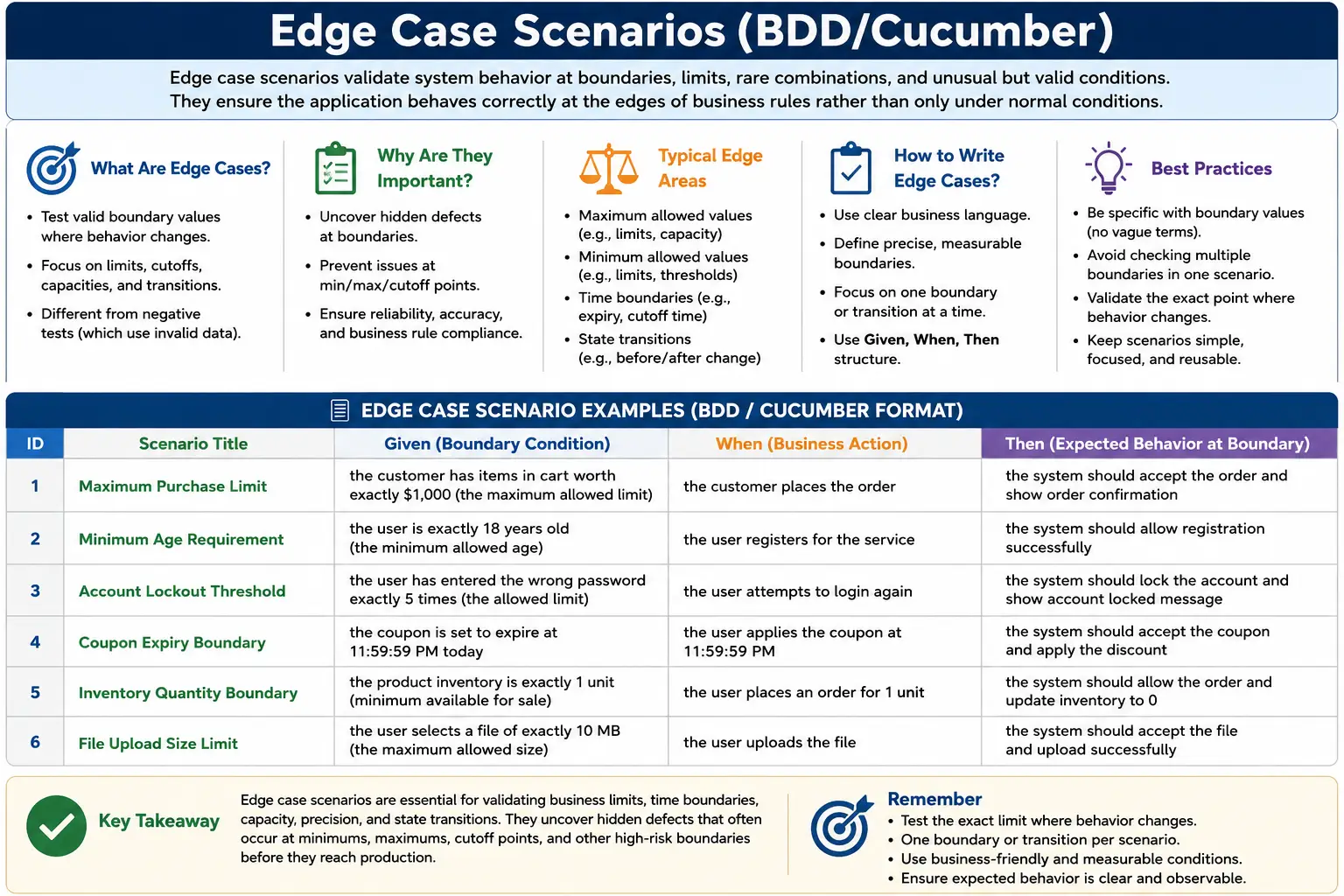
In BDD and Cucumber, edge case scenarios help teams describe these boundary behaviors in business-readable language. They answer an important question: how does the system behave at extremes or uncommon conditions? A system may work correctly for normal values, normal dates, normal user counts, and normal workflows, but fail at the exact minimum, exact maximum, cutoff time, capacity limit, or transition point. Edge scenarios make those risky points visible.
What Is an Edge Case Scenario?
An edge case scenario is a scenario that validates system behavior at the boundary of a rule or at an uncommon condition that is still possible and meaningful. It may test the maximum number of items allowed in a cart, the exact expiration time of a reset link, the minimum age required for registration, the last day of a billing cycle, or rounding at two decimal places. These are not random tests. They come from rules, limits, and conditions that the system is expected to handle correctly.
Edge cases are often misunderstood as negative scenarios. This is not always correct. If a password field allows a maximum of 20 characters, entering exactly 20 characters is an edge case and should usually be accepted. Entering 21 characters may be a negative scenario and should be rejected. The boundary is where the behavior changes. A good tester pays attention to both sides of that boundary.
In BDD, an edge case should still be behavior-focused. The scenario should describe the business boundary and expected behavior, not the technical implementation. Instead of saying that a database column accepts a certain string length, the scenario can say that a user can register with the maximum allowed username length. The automation can verify the technical detail behind the scenes.
Why Edge Case Scenarios Matter
Edge case scenarios matter because many defects appear at boundaries rather than in normal flows. Developers and testers often check common cases first, and those cases may pass easily. The problem appears when the value is exactly at the limit, just above the limit, just before expiry, just after expiry, near a rounding threshold, or during a state transition. These conditions are easy to miss but can create serious production defects.
Edge cases expose hidden assumptions. A developer may assume that a cart will not contain many items, that a user will not submit a form exactly at midnight, that decimal rounding will be straightforward, or that a token will not be used at the exact expiry boundary. Real systems do not operate only under comfortable conditions. Users and data often reach limits, and the system must behave predictably when they do.
They also improve system resilience. A resilient system handles unusual but valid situations without data corruption, incorrect rejection, unexpected failure, or confusing behavior. Edge case scenarios help confirm that the system remains stable not only during common usage but also at the edges of its business rules.
Edge Case vs Negative Scenario
The difference between an edge case and a negative scenario is important. A negative scenario usually uses invalid, restricted, or rule-breaking input and expects controlled rejection. An edge case often uses valid but extreme or uncommon input and expects correct handling. The distinction matters because treating edge cases as negatives can lead to wrong behavior.
| Aspect | Edge Case | Negative Scenario |
|---|---|---|
| Input | Valid but extreme | Invalid or restricted |
| Frequency | Rare or uncommon | Can be common |
| Goal | Boundary validation | Rule enforcement |
| Example | Maximum password length | Empty password |
For example, a password that is exactly the maximum allowed length is an edge case. It should be accepted if the rule allows it. A password that is empty is a negative case. It should be rejected because it violates the requirement. Both scenarios are useful, but they validate different things.
Common Sources of Edge Cases
Boundary values are the most common source of edge cases. These include minimum and maximum values, such as minimum password length, maximum file size, maximum cart quantity, minimum transfer amount, maximum characters in a field, or maximum number of login attempts. Defects often appear when developers use greater-than instead of greater-than-or-equal-to logic, or when validation handles one side of the boundary incorrectly.
Time-based limits are another major source. Expiry rules, cutoff times, billing cycles, trial periods, session timeouts, booking deadlines, and report generation windows all create edge conditions. A reset link may be valid for 24 hours, but what happens exactly at 24 hours? Is it still valid or expired? What happens one second before or one second after? These details must be clarified and tested.
Capacity limits, rare combinations, state transitions, precision, and rounding also create edge cases. A system may behave differently when a cart reaches maximum capacity, when a user changes status during a transaction, when a payment amount rounds near a decimal boundary, or when several valid but uncommon conditions occur together. These scenarios help reveal defects hidden behind normal usage.
Structure of an Edge Case Scenario
A good edge case scenario follows the same basic BDD structure as other scenarios:
Scenario: <Boundary or rare condition>
  Given <edge condition exists>
  When <action is performed>
  Then <system behaves correctly at the edge>
The Given step establishes the edge condition. The When step describes the action being performed. The Then step describes the correct behavior at the boundary. The scenario should be clear about the exact condition being tested. Approximate wording weakens edge case testing because boundaries must be precise.
For example:
Scenario: Password reset link expires exactly at 24 hours
  Given a password reset link was generated 24 hours ago
  When the user attempts to reset the password
  Then the link should be rejected
This scenario validates behavior at the exact boundary. It also raises an important business question: at exactly 24 hours, should the link be valid or rejected? Edge case scenarios often reveal this kind of requirement ambiguity before development or production.
Boundary Value Edge Cases
Boundary value scenarios check behavior at the minimum and maximum allowed values. If a cart allows a maximum of 50 items, the system should behave correctly when the cart contains 50 items and when the user tries to add the 51st item. The first condition may be valid. The second may be rejected. Both are connected to the same boundary.
Scenario: Maximum allowed items in cart
  Given the cart contains the maximum allowed items
  When the user adds one more item
  Then the item should not be added
This scenario validates the upper limit. A complete set of boundary checks may also include adding the item that reaches the maximum successfully. The key is to test the exact limit and the point where behavior changes. Testing only a random large number may miss the actual boundary defect.
Time Boundary Edge Cases
Time-based edge cases are common in real applications. Sessions expire, links expire, discounts end, bookings close, billing cycles reset, and reports run at scheduled times. Time boundaries are risky because they involve precision, time zones, server clocks, date formats, and business definitions. A rule that sounds simple can become complex when implemented.
For example, if a session expires after 30 minutes of inactivity, the team must clarify what happens at exactly 30 minutes. Is the session still valid until after 30 minutes, or does it expire at the exact moment? What happens at 29 minutes and 59 seconds? What happens at 30 minutes and 1 second? These are edge case questions.
Time edge cases should be written carefully in BDD. The scenario should express the business rule, while automation can control time using test utilities, mocked clocks, or controlled test data. Avoid vague phrases such as "after some time" when the boundary is important. Use exact durations and expected outcomes.
Precision and Rounding Edge Cases
Precision and rounding defects are common in financial, measurement, tax, billing, and reporting systems. A small rounding error may look harmless, but it can create incorrect totals, failed reconciliation, customer complaints, or regulatory issues. Edge case scenarios help validate how the system behaves near decimal boundaries.
For example, a payment system may need to round to two decimal places. The behavior for values such as 10.004, 10.005, and 10.006 must be clear. Does the system round half up, bankers round, truncate, or follow currency-specific rules? If the rule is not clear, edge scenarios force the team to define it.
In BDD, the scenario should describe the business expectation, such as "Then the payment total should be rounded to the nearest cent." More detailed examples can be added when the rounding rule is critical. Automation can verify exact numeric values, but the scenario should remain understandable.
State Transition Edge Cases
State transitions are another rich source of edge cases. Many systems behave differently depending on status: draft, submitted, approved, rejected, shipped, cancelled, expired, locked, active, inactive, or archived. Defects often occur just before or just after a state change. A user may attempt to cancel an order exactly when it moves from processing to shipped, or approve a request just after it was withdrawn.
These scenarios matter because state defines allowed actions. A booking may be editable before confirmation but locked afterward. A document may be deletable while in draft but not after approval. A subscription may renew at midnight and change access rules. Edge case scenarios validate that these transitions are handled correctly.
Good state transition scenarios should be explicit about the state and action. They should avoid technical implementation language and focus on the business rule. For example, "Given the order has just been shipped, When the user attempts to cancel the order, Then cancellation should not be allowed."
Edge Case vs Happy Path
Happy path scenarios validate normal successful usage. Edge case scenarios extend confidence beyond normal usage by checking extremes and boundaries. Both can be valid flows. A happy path may use a typical number of cart items, while an edge case may use the maximum allowed cart items. A happy path may reset a password immediately, while an edge case may reset it at the expiration boundary.
| Happy Path | Edge Case |
|---|---|
| Normal input | Extreme but valid input |
| Common usage | Rare usage |
| Simple flow | Boundary-focused flow |
Edge cases should not replace happy paths. The team should first understand the normal successful behavior, then identify where the behavior has important limits. This produces a balanced feature file: the happy path defines baseline success, and edge cases validate behavior near risk boundaries.
Prioritizing Edge Case Scenarios
Not all edge cases deserve the same level of attention or automation. Some boundaries have high business impact, while others are low value. Teams should prioritize edge cases when the business impact is high, financial or security risk exists, historical defects occurred, or the logic is complex. This keeps scenario design practical and risk-based.
Financial limits, access limits, time expiry rules, capacity limits, and critical workflow state changes often deserve high priority. A rounding error in a payment system may be far more important than a character limit edge case in an optional comment field. Prioritization helps teams spend effort where edge defects would hurt most.
Automation strategy should follow the same thinking. High-risk edge cases should often be automated and run in regression. Low-value or rare boundaries may be tested manually, covered at a lower test level, or documented without full automation. BDD feature files should capture important business edges, not every technical limit in the system.
Common Mistakes with Edge Cases
A common mistake is treating every edge case as a negative scenario. Some edge values should be accepted. If the maximum allowed transfer is 10,000, a transfer of exactly 10,000 may be valid. A transfer of 10,001 may be invalid. If the team does not distinguish these cases, it may implement or test the wrong behavior.
Another mistake is writing too many low-value edge scenarios. Boundary testing is powerful, but not every boundary belongs in Gherkin. If feature files become filled with dozens of technical value combinations, they stop being useful living documentation. Use Gherkin for meaningful business boundaries and use unit, API, or data-driven tests for exhaustive technical combinations.
Teams also make scenarios overly technical. A scenario about rounding should not need to explain internal floating-point implementation. A scenario about capacity should not mention database constraints unless the database constraint is the business concern. Keep the scenario focused on observable business behavior.
Best Practices for Edge Case Scenarios
Derive edge cases from business rules. Look for words such as minimum, maximum, before, after, exactly, until, at least, no more than, expires, cutoff, limit, and capacity. These words often indicate boundaries. When a requirement contains a boundary, ask what happens exactly at the boundary, just below it, and just above it.
Validate exact boundaries, not approximations. If a rule says 24 hours, test 24 hours, not "about one day." If a rule says maximum 50 items, test 50 and 51, not only a random large number. Edge case testing depends on precision. Vague test conditions weaken the value of the scenario.
Review edge cases with both business analysts and developers. Business analysts clarify rule intent. Developers clarify implementation risk and technical feasibility. Testers connect these perspectives into meaningful examples. This collaboration is especially valuable for time, rounding, and state transition boundaries, where assumptions are common.
Edge Cases During Refinement
Edge cases should be discussed during backlog refinement, not discovered only during late testing. Once the happy path and negative scenarios are understood, the team should look for boundaries. What is the minimum allowed value? What is the maximum? What happens exactly at expiry? What happens just before and just after a cutoff? What states allow or prevent the action?
These questions often uncover missing requirements. A product owner may say that a discount expires at midnight, but the team must know which timezone matters. A requirement may say that a file can be up to 10 MB, but the team must decide whether exactly 10 MB is accepted. Edge case discussion turns vague limits into testable rules.
Early edge case discovery also helps developers design better validation and testers prepare better test data. If boundaries are clarified before coding, the team can avoid defects instead of only finding them later.
Real-World Edge Case Examples
In an e-commerce application, cart capacity is a practical edge case. The happy path may validate that a user can add a few items to the cart. The edge case validates the maximum allowed quantity. If the system allows 99 items, it should behave correctly at 99 and reject or handle the 100th item according to the business rule. This protects pricing, inventory, shipping, and performance assumptions.
In a banking application, transfer limits are common edge cases. A user may be allowed to transfer up to a defined daily limit. The system should allow a transfer exactly at the limit if the rule says "up to and including," and reject a transfer just above the limit. If this boundary is implemented incorrectly, the bank may block valid customers or allow transactions that violate policy.
In a subscription system, expiry boundaries are important. A trial may end after 14 days, a coupon may expire at midnight, or a subscription may renew at the end of the billing cycle. Edge cases around these dates validate whether the system grants or removes access at the correct moment. These tests often reveal timezone and cutoff assumptions that were not obvious in the requirement.
Edge Cases and Test Data
Edge case testing depends heavily on accurate test data. To test maximum cart quantity, the cart must contain the exact number of allowed items. To test account age, the user record must have the exact required date. To test expiry, the token must be generated at the correct time. Poor test data can make an edge case unreliable or meaningless.
Test data for edge cases should be controlled and repeatable. If a scenario depends on the current date, current time, or existing database state, the automation or test setup should manage those conditions carefully. Otherwise, the scenario may pass one day and fail another day for reasons unrelated to product quality. This is especially true for expiry, billing, and scheduling scenarios.
In BDD, the scenario should describe the edge condition in business language, while setup utilities can create the required data. For example, "Given the user has reached the daily transfer limit" is cleaner than listing all previous transactions in the scenario. The feature file stays readable, and the automation prepares the exact data behind the scenes.
Automation Strategy for Edge Cases
Edge cases can be strong automation candidates when they protect critical logic. Boundaries around money, access, expiry, capacity, and legal rules should often be automated because they are risky and may regress when logic changes. Automated edge scenarios provide quick feedback when a developer accidentally changes a comparison operator, rounding method, cutoff rule, or validation condition.
However, not every edge case belongs in an end-to-end Cucumber suite. Some edge conditions are better tested at unit or API level because they require many data combinations and do not need a full UI workflow. For example, dozens of numeric rounding combinations may be better suited to lower-level automated tests, while one or two business-critical rounding examples can remain in Gherkin.
The best strategy is layered. Use BDD scenarios for meaningful business boundaries that stakeholders should understand. Use unit tests and API tests for exhaustive value combinations. Use exploratory testing for unusual combinations that may not justify permanent automation. This keeps the Cucumber suite valuable without making it heavy.
Edge Cases and Scenario Outline
Scenario Outline can help when several boundary examples belong to the same rule. For example, a minimum age rule may need examples for just below the minimum, exactly at the minimum, and above the minimum. The outline can make the rule visible while keeping the examples organized.
Scenario Outline: Account registration age boundary
  Given the user is <age> years old
  When the user attempts to register
  Then registration should be <result>
This can be useful if the examples table is small and business-readable. But teams should avoid turning Scenario Outline into a large technical spreadsheet. If the examples table has many rows that only developers understand, the feature file loses its value as living documentation.
A good rule is to use Scenario Outline when the data examples clarify the business boundary. If the examples are mainly exhaustive technical combinations, place them in lower-level automated tests.
Maintaining Edge Case Scenarios
Edge case scenarios must be maintained as business rules evolve. A maximum limit may increase, an expiry period may change, a rounding rule may be updated, or a state transition may be redesigned. If the scenario remains unchanged after the rule changes, it becomes misleading. This is a common reason living documentation loses trust.
During refinement and regression planning, teams should review edge cases whenever requirements mention limits, dates, statuses, precision, or capacity. If a story changes an existing rule, related edge scenarios should be checked. This review prevents outdated boundary assumptions from staying in the suite.
Maintenance also means removing low-value edge scenarios. As systems grow, teams may accumulate many boundary checks. Some remain critical, while others become redundant or better handled elsewhere. A clean suite keeps the most meaningful edge scenarios visible and moves exhaustive technical checks to more suitable test layers.
Boundary Analysis Mindset
Edge case design becomes easier when testers develop a boundary analysis mindset. Whenever a requirement contains a number, date, duration, count, amount, status, role, or limit, the tester should pause and ask where the behavior changes. That change point is the boundary. The most valuable scenarios are usually at the boundary, just before it, and just after it.
For example, if a user can upload files up to 5 MB, the useful questions are not only whether upload works. The team should ask whether a file smaller than 5 MB is accepted, whether exactly 5 MB is accepted, and whether a file larger than 5 MB is rejected. The exact rule matters. "Up to 5 MB" usually includes 5 MB, but the team should confirm instead of assuming.
This mindset also helps business analysts and developers. Business analysts can clarify rules more precisely, and developers can implement comparisons correctly. Testers can convert those clarified rules into clear BDD scenarios. Edge case scenario design is therefore not just a testing activity. It is a requirement clarification technique that improves the whole delivery process.
Balancing Edge Coverage
Edge coverage needs balance. Too little edge testing leaves hidden defects in production, but too much edge testing can make the suite noisy and expensive to maintain. The goal is not to test every imaginable rare condition in Gherkin. The goal is to identify the edges that matter to the business and validate them at the right test level.
A useful approach is to keep high-value business boundaries in Cucumber and move exhaustive technical combinations to unit, component, or API tests. For example, one BDD scenario may describe the maximum daily transfer limit, while lower-level tests cover many numeric combinations around that limit. This gives both business clarity and technical depth without overloading the feature file.
Interview-Ready Summary
Edge case scenarios validate behavior at boundaries, limits, and unusual but valid conditions. They are different from negative scenarios because edge inputs are often valid but extreme, while negative inputs are invalid or restricted. Edge cases are important because many defects occur at minimums, maximums, expiry times, capacity limits, state transitions, and rounding boundaries.
A strong edge case scenario is derived from a business rule, uses clear measurable conditions, validates the exact boundary, and remains behavior-focused. It should explain the edge condition, the action performed, and the expected system behavior. High-risk edge cases should be prioritized for automation, especially when money, security, data integrity, or complex logic is involved.
A concise interview answer could be: An edge case scenario tests system behavior at the boundary or extreme of a valid condition, such as maximum allowed value, exact expiry time, or rounding limit. Edge cases help find hidden defects that may not appear in happy path or ordinary negative testing.
Golden Rule
The golden rule is simple: if there is a boundary, there is a bug waiting there. Boundaries are where assumptions meet reality. A system that works for normal values but fails at the limits is not robust. Edge case scenarios make those limits visible, testable, and reviewable before they become production problems.