Behavior-Focused Scenario Design
Behavior-focused scenario design is the practice of writing BDD scenarios that describe what the system does from a business perspective, not how the system is implemented. A good scenario captures intent, action, and outcome without exposing UI steps, technical logic, automation details, database operations, or API mechanics. It reads like a business example, not like a Selenium script written in English.
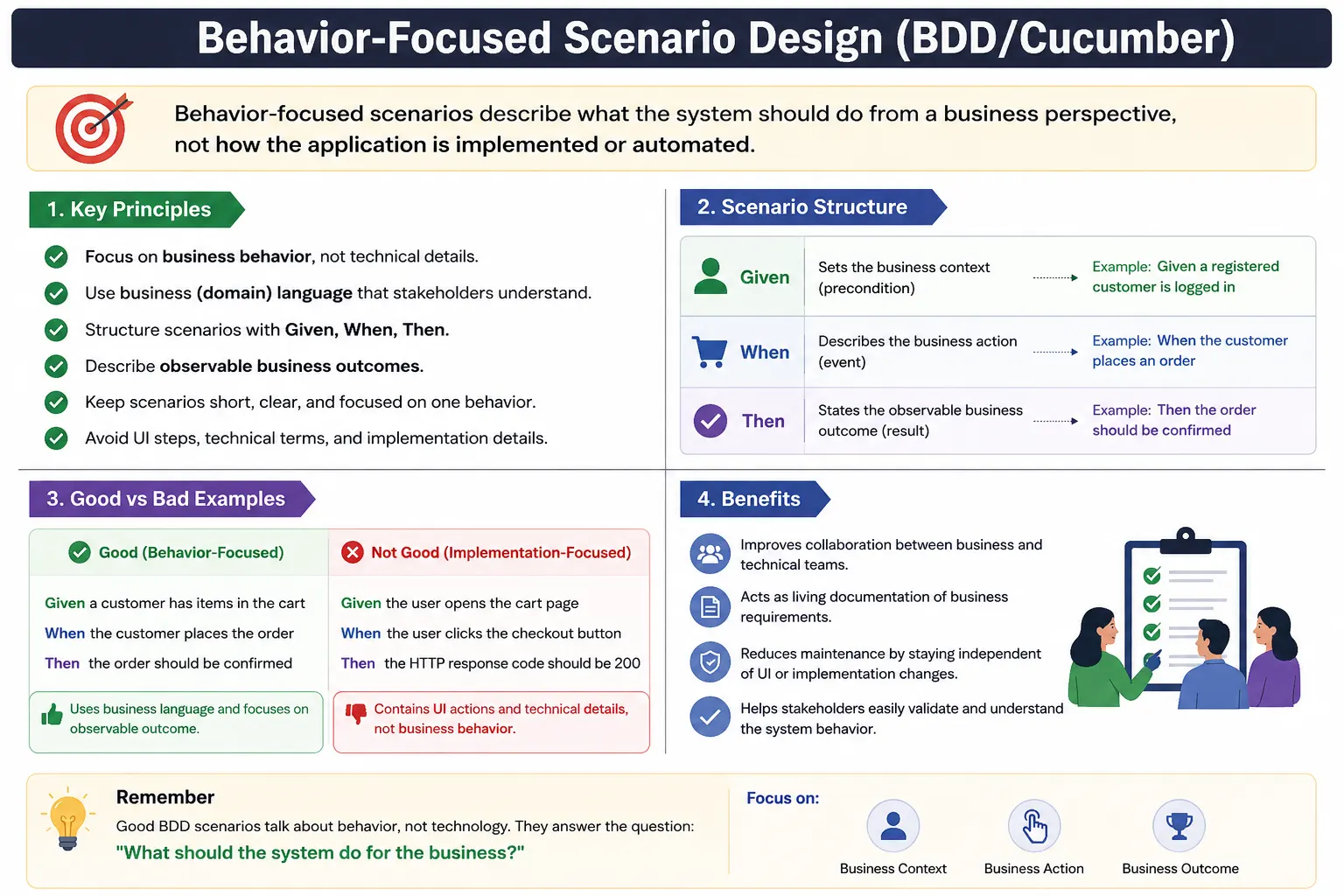
This distinction is one of the most important skills in Cucumber and BDD. Many teams adopt Gherkin because they want collaboration, shared understanding, acceptance criteria, and living documentation. But those benefits disappear when scenarios are written as procedural test scripts. Behavior-focused design keeps scenarios readable, stable, and useful for business analysts, testers, developers, product owners, and automation engineers.
What Behavior-Focused Scenario Design Means
Behavior-focused scenario design means describing the observable behavior of the system in domain language. The scenario should explain the business situation, the meaningful action, and the expected business result. It should avoid unnecessary implementation details. A stakeholder should be able to read the scenario and say whether it matches the expected product behavior without needing to understand page objects, selectors, HTTP status codes, database tables, or automation code.
The word "behavior" is important. Behavior is what the system does from the user's or business process perspective. For example, "the order should be confirmed" is behavior. "the user clicks the Submit button" is an interface action. "the HTTP response code should be 200" is a technical validation. "the order row should be inserted into the orders table" is an implementation detail. These may be useful checks in automation or lower-level tests, but they are not ideal Gherkin behavior statements.
A behavior-focused scenario does not ignore the interface or technical reality. It simply keeps those details in the right layer. Gherkin describes the business behavior. Step definitions and automation code handle the technical execution. This separation keeps scenarios readable even when the interface changes or the implementation is rewritten.
Why Behavior Focus Is Critical in BDD
BDD fails when scenarios become UI scripts, technical validations, or automation instructions. If every step describes clicks, text boxes, endpoints, tokens, table names, and selectors, the scenario stops being a communication tool. It becomes another test script. Business stakeholders stop reading it because it no longer speaks their language. Developers treat it as automation detail. Testers spend time maintaining brittle steps instead of clarifying behavior.
Behavior-focused scenarios solve this problem by keeping the business meaning visible. They represent true acceptance criteria. They explain what the system must do in a way that can be reviewed during refinement, used during development, validated during testing, and preserved as living documentation after release. This is the actual value of BDD. The goal is not only to automate tests. The goal is to create shared understanding before the product is built and reliable documentation after it is built.
Behavior focus also makes scenarios more stable. User interfaces change. Buttons move. Labels are renamed. APIs are refactored. Authentication implementation may change from session cookies to tokens. Databases may be redesigned. If Gherkin is filled with these details, scenarios break conceptually every time the implementation changes. But the business behavior often remains the same. A user still logs in, an order is still confirmed, a payment is still declined, and a password reset link still expires. Behavior-focused scenarios stay meaningful through these changes.
The Core Rule: Describe Observable Behavior
The core rule of behavior-focused design is simple: describe observable behavior, not internal mechanics. If a step mainly answers how the system is technically operated or how the automation will verify it, that detail probably does not belong in Gherkin. Gherkin should express the business intent. The technical execution belongs inside step definitions, page objects, API clients, helper methods, or lower-level tests.
For example, a scenario should not need to say that the user clicks a specific button unless the button itself is the business behavior being tested. Usually, the business action is broader. The user submits an order, requests a refund, approves an account, resets a password, or cancels a booking. The implementation may involve clicking a button today, tapping a mobile control tomorrow, or calling an API in a future interface. The behavior remains stable.
The same rule applies to outcomes. A behavior-focused Then step should describe an observable business result. "Then the order should be confirmed" is understandable and verifiable. The automation may verify confirmation text, database state, order status, email notification, or API response internally, but the Gherkin step should communicate the business result first.
Behavior vs Implementation
The difference between behavior and implementation becomes clear when comparing examples. An implementation-focused scenario might say:
When the user clicks the Submit button
Then the HTTP response code should be 200
This scenario exposes the UI action and the technical validation. It may be useful as an automation check, but it does not clearly explain the business behavior. A behavior-focused version would say:
When the user submits the order
Then the order should be confirmed
The second version is stronger because it expresses what matters to the business. The order submission is the meaningful action. Order confirmation is the meaningful outcome. The automation can still click the Submit button and verify the HTTP response if needed, but those details are hidden behind the step definition. The scenario remains valid even if the page layout changes or the backend implementation is refactored.
This is not about making scenarios vague. Behavior-focused scenarios should be precise, but precise in business terms. "The order should be confirmed" is precise if confirmation has a clear business meaning. "The system should work correctly" is not precise because nobody can tell what correct means. Good behavior design avoids both technical noise and vague language.
Use Domain Language
The first design principle is to use domain language. Domain language is the vocabulary used by the business area. In banking, terms may include account, transfer, balance, beneficiary, overdraft, and transaction. In e-commerce, terms may include cart, order, coupon, shipment, refund, and inventory. In healthcare, terms may include patient, appointment, prescription, claim, and provider. Behavior-focused scenarios should use this vocabulary because it is the language stakeholders understand.
Technical language creates distance. A step such as "Then the JWT token should be generated" may be true technically, but it is not the business outcome. A business stakeholder usually cares that the user is authenticated or that access is granted. A better step is:
Then the user should be authenticatedThe technical token generation can still be verified inside the automation if it is relevant, but the scenario communicates the business result. This makes the scenario reviewable by non-technical people and prevents Gherkin from becoming tied to one implementation.
One Business Outcome per Scenario
Behavior-focused scenarios should validate one business outcome at a time. This keeps scenarios short, readable, and diagnosable. When a scenario combines multiple outcomes, it becomes harder to understand what behavior is being specified and harder to identify what failed. A scenario called "Order creation and cancellation" is trying to cover two different outcomes. It should usually be split into separate examples.
Scenario: Order is created successfully
Scenario: Order can be cancelled before shipment
Each scenario now has a clear purpose. One validates creation. The other validates cancellation. If one fails, the failure is easier to interpret. The living documentation also becomes clearer because each scenario describes a distinct business rule or expected behavior.
This principle also prevents long procedural scenarios. When a scenario has many When steps or tries to walk through an entire user journey with several business outcomes, it often becomes a script rather than a specification. Long journeys may be useful for end-to-end testing, but BDD scenarios should still be written carefully around meaningful behavior and clear outcomes.
Abstract Away the Interface
A behavior-focused scenario should avoid exposing buttons, screens, endpoints, APIs, selectors, database tables, and automation mechanics unless those details are truly part of the business language. Most of the time, they are implementation details. The user does not care whether payment details are entered on a page, sent through an API, or captured from a mobile form. The business behavior is that the user provides valid payment details.
Given the user provides valid payment detailsThis step is more stable than:
Given the user enters card details on payment pageThe second step exposes the screen and the method of input. If the payment page is redesigned, split into multiple pages, or replaced by a wallet integration, the scenario may look outdated even though the business behavior remains unchanged. The first step survives those changes because it describes the domain concept, not the interface.
Abstraction does not mean hiding important business context. If the payment method matters, say so in business terms: "Given the user provides a valid credit card" or "Given the user pays using store credit." The goal is to keep the scenario meaningful while avoiding unnecessary implementation detail.
Use Clear and Verifiable Outcomes
The Then step is where many weak scenarios fail. A good Then step describes an outcome that is observable and verifiable. It should not be vague, and it should not expose low-level technical assertions unless the technical result is the actual business expectation. "Then the system should work correctly" is too vague. It does not tell the team what should be checked.
Then the payment should be completed successfullyThis outcome is clearer. It tells the reader that the payment process should finish successfully. Depending on the product, the step definition may verify payment status, order status, confirmation message, receipt, and transaction record. The scenario remains focused on the user-visible and business-relevant result.
Clear outcomes are essential for acceptance criteria. A stakeholder should be able to approve or reject the scenario based on the outcome. If nobody can explain how the outcome will be observed, the scenario is not ready. In BDD, clarity is more valuable than clever wording. The best Then steps are simple, concrete, and business meaningful.
A Strong Scenario Structure
A behavior-focused scenario usually follows a simple structure:
Scenario: <Business outcome>
  Given <business context>
  When <business action>
  Then <business result>
The Given step sets the business context. It should describe the state that must already be true. The When step describes the meaningful action. The Then step describes the expected outcome. This structure keeps the scenario focused and easy to read. It also helps teams avoid mixing setup, action, and assertion in the same step.
As a practical guideline, keep one main When step, minimal Given steps, and a clear Then step. Multiple Given steps are acceptable when they describe necessary business context, but excessive setup can hide the behavior. Multiple Then steps are acceptable when they describe closely related outcomes, but too many outcomes may indicate that the scenario should be split.
Scenario names also matter. A name such as "Verify login" is weak because it sounds like a test case title. "Successful login with valid credentials" is better because it describes the business outcome. The scenario name should help readers understand why the scenario exists before they read the steps.
Behavior-Focused Rewrite Example
A poor login scenario often looks like this:
Scenario: Login
Given the user enters username
When the user enters password
Then dashboard page is displayed
This example is weak because it describes input actions rather than behavior. It also separates username and password entry in an unnatural way. A better version is:
Scenario: Successful login
Given the user has valid credentials
When the user logs in
Then the user should see the dashboard
The improved scenario is clearer. The Given step describes the credential condition. The When step describes the business action. The Then step describes the expected result. The scenario does not care whether the login is performed through a web form, mobile app, API, or single sign-on flow. The behavior is still successful login.
This rewrite also improves maintainability. If the UI changes from username/password fields to an email field and one-time password, the scenario may still remain valid if the business behavior is unchanged. Only the step definition or automation implementation may need to change.
Behavior Focus with Scenario Outline
Scenario Outline is useful when the same behavior must be validated with multiple data combinations. However, behavior focus can be lost if the scenario outline is named around data entry rather than the business behavior. A weak outline might be called:
Scenario Outline: Enter different usernamesThis title describes data variation, not behavior. A better title is:
Scenario Outline: User login attemptsThe behavior is login attempt handling. The examples table can then provide valid users, invalid users, locked accounts, or expired credentials depending on the purpose. The scenario remains centered on behavior while the data varies.
A common mistake is using Scenario Outline as a way to push large test data tables into Gherkin. If the examples table becomes huge or contains technical fields that stakeholders cannot understand, the scenario may no longer be useful as documentation. Keep examples meaningful, representative, and aligned with the business rule being described.
How Behavior Focus Is Lost
Behavior focus is usually lost gradually. A team starts with readable scenarios, then adds more UI details to help automation. Later, technical validations are added because they are easy to check. Then steps begin mentioning locators, endpoints, JSON fields, database rows, or framework behavior. Over time, the feature file becomes hard for business stakeholders to read. At that point, BDD has shifted into script-driven automation.
Common warning signs include steps that mention UI elements, technical assertions in Then steps, multiple When actions, long procedural flows, over-detailed setup, and scenario names that look like test case IDs. Another warning sign is when business analysts stop reviewing feature files because they feel too technical. If business stakeholders cannot validate scenarios, the scenarios are no longer serving the main purpose of BDD.
The solution is not to remove all detail. The solution is to move detail to the correct place. Business behavior belongs in Gherkin. Technical interaction belongs in step definitions, automation framework code, page objects, API clients, fixtures, and test data setup. This separation allows feature files to remain readable while automation remains powerful.
A Practical Review Technique
A useful review question for every Gherkin step is: would this still make sense if the UI or API were completely rewritten? If the answer is yes, the step is probably behavior-focused. If the answer is no, the step may be too tied to implementation. This question is simple but effective because it exposes hidden technical assumptions.
For example, "When the user clicks the Pay Now button" may not make sense if the interface changes. "When the user pays for the order" remains meaningful. "Then the response code should be 201" may not make sense to business reviewers. "Then the order should be created" remains meaningful. The rewritten steps preserve the behavior while allowing implementation flexibility.
Another useful review question is: can a non-technical stakeholder explain what this scenario validates? If not, the scenario may need clearer domain language. BDD scenarios are not private automation assets. They are shared examples. Their value depends on being understandable to the whole team.
Role Alignment in Behavior Design
Behavior-focused design is a team responsibility. Business analysts help confirm business correctness. They ensure the scenario reflects the real rule, process, or expectation. Quality analysts help identify missing scenarios, edge cases, negative paths, and unclear outcomes. Developers help confirm feasibility and implementation implications without leaking implementation details into the feature file.
Product owners and stakeholders also play an important role. They should be able to read scenarios and confirm whether the examples represent expected behavior. If they cannot understand the scenario, the team should rewrite it. If they disagree with the outcome, the disagreement should be resolved before development continues. This is one of the biggest advantages of behavior-focused BDD: it exposes misunderstanding early.
Automation engineers protect maintainability by resisting the temptation to write Gherkin around automation convenience. It may be easier to automate "click this button" than "submit the order," but the latter is better Gherkin. The automation layer can handle the click internally. The feature file should stay aligned with business language.
Behavior-Focused Scenarios as Living Documentation
Living documentation is useful only when people trust and understand it. Behavior-focused scenarios are excellent living documentation because they describe the rules and examples that matter to the business. They do not become obsolete every time a button is moved or a service is refactored. They remain meaningful as long as the business behavior remains valid.
A feature file with behavior-focused scenarios can help new team members understand the system. It can help testers plan coverage. It can help developers understand acceptance expectations. It can help product owners review completed behavior. It can also help automation teams maintain tests because each automated scenario has a clear purpose.
By contrast, implementation-heavy scenarios age quickly. They document how the old UI worked, not what the business expected. When the UI changes, the documentation becomes misleading. This is why behavior focus is not just a writing preference. It is essential for long-term maintainability.
Common Anti-Patterns
One anti-pattern is writing Selenium steps in Gherkin. Steps such as "When I click the login button" and "Then I should see element with id dashboard-title" are automation instructions. They may execute, but they do not express business behavior well. A better scenario says the user logs in and sees the dashboard.
Another anti-pattern is technical assertion leakage. Steps such as "Then the database should contain one record" or "Then the API should return status 200" may sometimes be useful in technical tests, but they should not dominate business scenarios. If the business outcome is that an order is created, say that the order is created. Let automation decide how to verify it.
A third anti-pattern is combining too many behaviors into one scenario. A long flow that creates an order, cancels it, refunds it, sends a notification, and verifies a report may be useful as an end-to-end test, but it is not a clean behavior specification. Split scenarios around business outcomes whenever possible.
Best Practices for Behavior-Focused Scenario Design
Start with the business rule or outcome before writing steps. Ask what behavior needs to be specified. Then choose a concrete example that demonstrates that behavior. Write the scenario using terms the business uses. Keep the setup short, the action meaningful, and the outcome observable. Avoid technical detail unless it is genuinely part of the domain.
Review scenario names carefully. A good scenario name should describe the expected business outcome. Names like "TC_01" or "Verify button click" do not help living documentation. Names like "Payment is declined for insufficient balance" or "Password reset link expires after 24 hours" are much stronger because they explain the rule being validated.
Keep scenarios short enough to understand quickly. A scenario with three to seven steps is usually easier to review than a long procedural script. If the scenario grows too long, look for multiple behaviors, unnecessary UI detail, repeated setup, or hidden technical actions. Shorter scenarios are not automatically better, but focused scenarios are almost always better.
Behavior Focus During Refinement
Behavior-focused scenario design should begin during requirement refinement, not after automation starts. If the team waits until testing to write scenarios, the scenarios often become test execution notes. During refinement, the team is still discussing business rules, examples, assumptions, and edge cases. This is the best time to shape scenarios around behavior because the goal is shared understanding, not just test coverage.
A useful refinement conversation starts with examples. Instead of asking only "What should the feature do?" the team asks, "Can you give an example?" For a payment feature, one example may cover successful payment, another may cover insufficient balance, and another may cover expired card. Each example can become a behavior-focused scenario if it has a clear context, action, and outcome. This approach keeps scenarios grounded in real business expectations.
Refinement also helps remove hidden implementation assumptions. A developer may think the feature will be API-driven, a tester may imagine a UI flow, and a business analyst may care only about the final order status. Behavior-focused scenarios align these views by describing the outcome without forcing the implementation into the scenario. The team can then decide the technical design separately.
Behavior Focus and Automation Maintainability
Behavior-focused scenarios make automation easier to maintain because they reduce churn in feature files. If a scenario says "When the user submits the order," the automation layer can change from clicking a web button to calling a reusable page method, a mobile action, or an API helper without changing the scenario. The Gherkin remains stable because the behavior has not changed.
This separation is especially useful in large automation frameworks. Step definitions can delegate work to page objects, service clients, data builders, and utilities. The feature file stays readable, while the framework handles technical detail. If selectors change, only the page object should change. If an endpoint changes, only the API client should change. The scenario should change only when the business behavior changes.
Implementation-heavy scenarios create the opposite effect. A simple UI redesign may force many feature files to be edited even though the business behavior is identical. This creates unnecessary maintenance, increases merge conflicts, and makes teams distrust Cucumber because it feels fragile. In many cases, the real problem is not Cucumber. The problem is that scenarios were written at the wrong level of abstraction.
Behavior Focus and Test Coverage
Behavior-focused scenarios also improve test coverage discussions. Instead of counting how many UI actions are automated, the team can discuss which business behaviors are covered. Are successful and failed payment outcomes covered? Are account lockout rules covered? Are cancellation rules covered before and after shipment? Are permission rules covered for different roles? These questions are more valuable than asking whether every button has a scenario.
This does not mean technical checks are unimportant. API response validation, database verification, UI locator checks, and security checks may all be necessary. But they should be placed in the appropriate test level or automation layer. BDD scenarios should represent the business examples that matter. Technical coverage can support those examples without taking over the feature file.
When teams organize coverage by behavior, gaps become easier to see. A feature file can show which business rules have examples and which rules still need clarification. This makes the feature file useful before automation exists, during development, during testing, and after release. That is why behavior focus is a practical quality technique, not just a writing style.
Interview-Ready Summary
Behavior-focused scenario design means writing BDD scenarios that describe what the system does from a business perspective rather than how it is technically implemented. These scenarios use domain language, describe observable behavior, avoid UI and technology details, and focus on one business outcome per scenario. They are essential for readable, stable, and maintainable BDD.
In an interview, a strong answer should explain that behavior-focused scenarios are different from automation scripts. Gherkin should not be filled with clicks, selectors, APIs, database tables, or framework details. Those details belong in the step definitions and automation framework. The feature file should remain readable by business stakeholders and useful as living documentation.
A concise interview answer could be: Behavior-focused scenario design is the practice of writing scenarios around business behavior, using Given for context, When for the business action, and Then for the observable outcome. It keeps scenarios stable when the UI or implementation changes and helps BDD serve its real purpose: shared understanding.
Golden Rule
The golden rule is simple: if a scenario reads like a test script, it is not behavior-focused. A good scenario should read like a business example. It should explain what behavior is expected, why the behavior matters, and what result should be observed. The automation can handle the technical steps, but the scenario should preserve the business meaning.
Behavior-focused scenario design is not about writing less detail. It is about writing the right detail at the right level. When teams follow this discipline, Cucumber feature files become clearer, collaboration improves, automation becomes easier to maintain, and living documentation becomes genuinely useful.