Types of APIs (REST, SOAP, GraphQL, gRPC)
Introduction
Application Programming Interfaces (APIs) have become the backbone of modern software systems. Whether you are using a banking application, ordering food online, browsing social media, booking airline tickets, or interacting with cloud services, APIs are working behind the scenes to enable communication between different software components. In today's interconnected digital world, very few applications operate in isolation. Instead, applications exchange information continuously, and APIs provide the standardized mechanism that makes this communication possible.
As software architectures evolved from monolithic systems to distributed systems and microservices, different API styles emerged to solve different technical and business challenges. Some prioritize simplicity and widespread adoption, while others focus on performance, flexibility, security, or strict contract enforcement.
Among the numerous API styles available today, four dominate modern software development:
- REST (Representational State Transfer)
- SOAP (Simple Object Access Protocol)
- GraphQL
- gRPC (Google Remote Procedure Call)
Each of these approaches has its own architecture, communication model, strengths, weaknesses, and ideal use cases. Understanding the differences between them is essential for developers, software testers, architects, DevOps engineers, and anyone involved in building or testing modern applications.
This article provides a detailed exploration of REST, SOAP, GraphQL, and gRPC, explaining how they work, where they are used, and how to choose the right approach for specific business requirements.
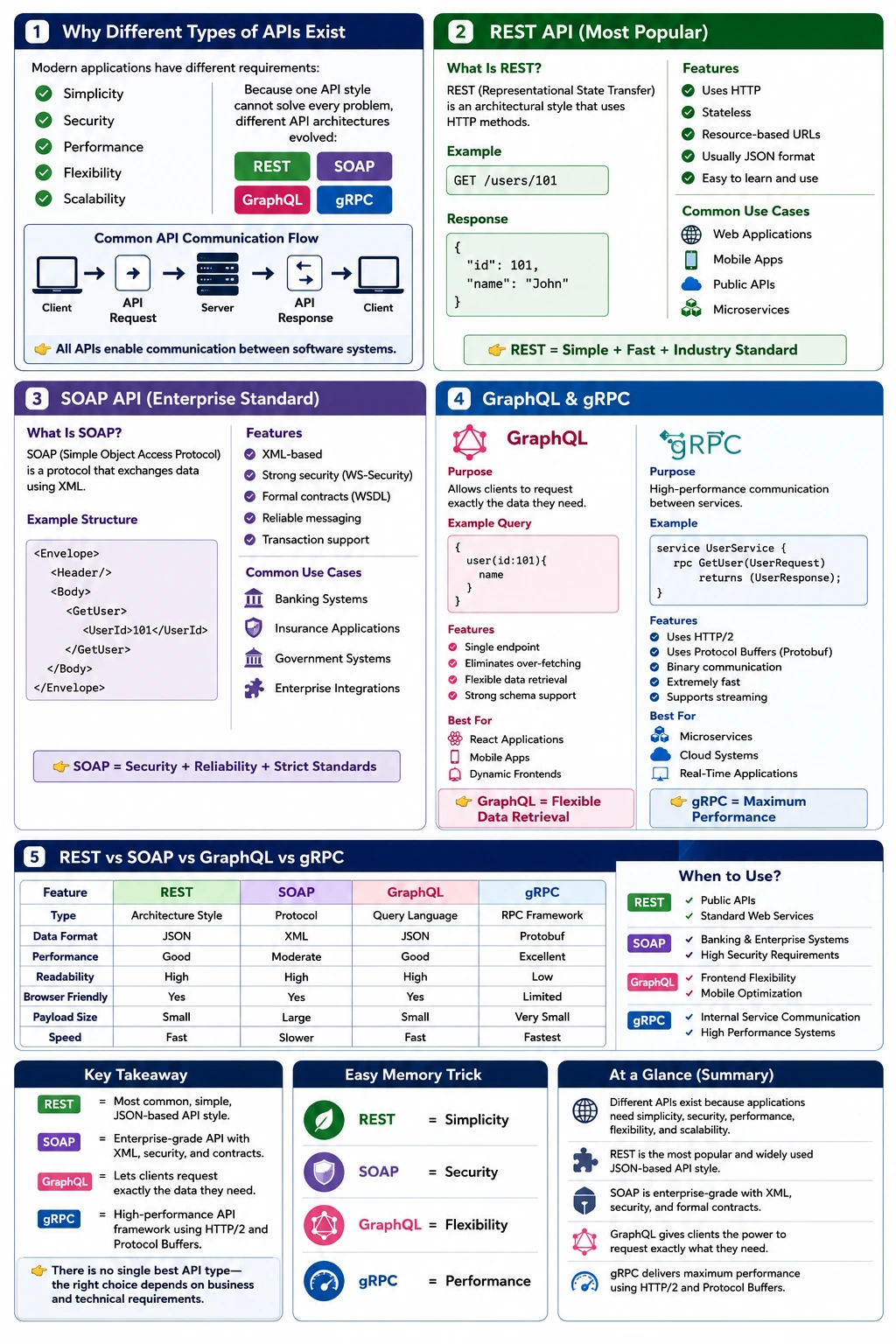
Why Different API Types Exist
Before examining each API type individually, it is important to understand why multiple API styles exist.
Software systems have diverse requirements.
Some applications prioritize:
- Simplicity
- Browser compatibility
- Public accessibility
Others require:
- Enterprise-grade security
- Transaction guarantees
- Formal contracts
Still others focus on:
- High performance
- Low latency
- Minimal bandwidth consumption
No single API architecture satisfies every requirement perfectly.
As technology evolved, different API approaches emerged to address specific challenges.
For example:
- REST simplified web service development.
- SOAP introduced enterprise-level standards.
- GraphQL solved data-fetching inefficiencies.
- gRPC optimized service-to-service communication.
Each style reflects a different philosophy regarding communication between systems.
Understanding APIs Before Comparing Types
An API acts as an intermediary between two software systems.
The general communication flow looks like this:
Client
   ↓
API Request
   ↓
Server
   ↓
API Response
   ↓
Client
The client may be:
- A web browser
- A mobile application
- A desktop application
- Another service
The server processes requests and returns responses.
The API defines:
- How requests are structured
- What operations are available
- Which data formats are used
- How authentication works
- What responses should look like
While all APIs share this general purpose, the implementation varies significantly across REST, SOAP, GraphQL, and gRPC.
REST API (Representational State Transfer)
What Is REST?
REST is an architectural style for designing networked applications that communicate over HTTP.
It is the most widely used API style in the world today and forms the foundation of countless web services and microservice architectures.
REST exposes resources through URLs and uses standard HTTP methods to perform operations on those resources.
Common HTTP methods include:
GET
POST
PUT
PATCH
DELETE
Each method represents a different type of operation.
For example:
- GET retrieves data
- POST creates data
- PUT updates data
- DELETE removes data
REST Example
Request
GET /users/101Response
{
  "id": 101,
  "name": "John"
}
The client requests information about user 101, and the server returns the corresponding data.
Core Characteristics of REST
Uses HTTP
REST relies heavily on standard HTTP protocols.
Stateless
Each request contains all information needed for processing.
The server does not maintain client state between requests.
Resource-Oriented
Everything is treated as a resource.
Examples:
/users
/products
/orders
/payments
Lightweight
REST typically uses JSON, which is compact and easy to process.
Easy to Understand
Its simplicity makes it highly accessible to developers.
Broad Industry Adoption
Most modern public APIs use REST.
Advantages of REST
REST became popular because it offers numerous benefits.
Fast Development
Developers can build REST APIs quickly using standard web technologies.
Easy Integration
Most programming languages provide strong REST support.
Browser Friendly
REST works naturally with web browsers.
Mobile Friendly
JSON responses are efficient for mobile applications.
Industry Standard
REST skills are widely transferable across organizations.
Disadvantages of REST
Despite its popularity, REST has limitations.
Over-Fetching
Clients may receive more data than necessary.
Under-Fetching
Clients may need multiple requests to obtain required data.
Lack of Strict Contracts
REST does not enforce strong service contracts by default.
These limitations contributed to the development of GraphQL.
Common REST Use Cases
REST is commonly used for:
- Web applications
- Mobile applications
- Public APIs
- SaaS platforms
- Microservices
Popular examples include:
- GitHub API
- Twitter API
- Stripe API
SOAP API (Simple Object Access Protocol)
What Is SOAP?
SOAP is a protocol for exchanging structured information using XML messages.
Unlike REST, which is an architectural style, SOAP is a formal protocol with strict standards and specifications.
SOAP was designed to support enterprise-level reliability, security, and interoperability.
SOAP Message Structure
A typical SOAP message contains:
<Envelope>
   <Header>
   </Header>

   <Body>
      <GetUser>
         <UserId>101</UserId>
      </GetUser>
   </Body>
</Envelope>
The structure is standardized and strictly defined.
Core Characteristics of SOAP
Protocol-Based
SOAP follows strict protocol specifications.
XML Only
SOAP messages use XML exclusively.
Strong Standards
Every message follows a predefined structure.
Built-In Security
SOAP supports advanced security mechanisms.
Formal Contracts
SOAP services typically use WSDL (Web Services Description Language).
This contract precisely defines:
- Available operations
- Request structures
- Response structures
- Data types
Advantages of SOAP
SOAP remains important in industries where reliability and compliance are critical.
High Security
SOAP supports enterprise security standards such as WS-Security.
Reliable Messaging
Messages can be guaranteed to arrive.
Transaction Support
SOAP supports distributed transactions.
Strong Contracts
WSDL provides strict interface definitions.
Disadvantages of SOAP
SOAP's strengths also introduce complexity.
Verbose XML
Messages are significantly larger than JSON.
Larger Payloads
Increased bandwidth usage.
Slower Performance
XML parsing adds overhead.
Complex Implementation
Development and maintenance require more effort.
Common SOAP Use Cases
SOAP remains common in:
- Banking systems
- Insurance systems
- Government applications
- Enterprise integrations
These environments often prioritize security and formal standards over simplicity.
GraphQL
What Is GraphQL?
GraphQL is a query language and runtime for APIs developed by Facebook.
Its primary goal is to allow clients to request exactly the data they need and nothing more.
GraphQL addresses some of REST's most common inefficiencies.
The Problem GraphQL Solves
Consider a REST endpoint:
GET /users/101Response:
{
  "id": 101,
  "name": "John",
  "email": "john@example.com",
  "address": "Chicago",
  "phone": "123456789"
}
Suppose the client only needs:
nameThe remaining data is unnecessary.
This is known as over-fetching.
GraphQL Solution
Query
{
  user(id:101){
    name
  }
}
Response
{
  "data": {
    "user": {
      "name": "John"
    }
  }
}
Only requested data is returned.
Core Characteristics of GraphQL
Single Endpoint
Most GraphQL APIs expose one endpoint.
Example:
/graphqlFlexible Queries
Clients determine exactly what data is required.
Strong Schema
GraphQL defines a strongly typed schema.
Client-Controlled Retrieval
Consumers decide response structure.
Advantages of GraphQL
GraphQL offers several benefits.
Eliminates Over-Fetching
Only requested fields are returned.
Eliminates Under-Fetching
Complex data can often be retrieved in a single request.
Efficient Mobile Communication
Reduced bandwidth consumption.
Strong Typing
Schema validation improves reliability.
Disadvantages of GraphQL
GraphQL introduces new challenges.
More Complex Server Implementation
Building GraphQL services can be difficult.
Query Optimization Challenges
Poorly designed queries may impact performance.
Caching Complexity
Caching strategies are more difficult than REST.
Common GraphQL Use Cases
GraphQL is frequently used in:
- Facebook systems
- GitHub GraphQL API
- Single Page Applications
- Mobile applications
It is particularly useful when frontend requirements change frequently.
gRPC (Google Remote Procedure Call)
What Is gRPC?
gRPC is a high-performance Remote Procedure Call framework developed by Google.
Instead of exposing resources like REST, gRPC exposes methods that clients invoke remotely.
The experience resembles calling a local method.
gRPC Service Definition
service UserService {
   rpc GetUser(UserRequest)
       returns (UserResponse);
}
Client invocation:
userService.getUser(101);This looks like an ordinary method call, even though communication occurs across a network.
Core Characteristics of gRPC
Uses HTTP/2
Supports multiplexing and advanced networking capabilities.
Uses Protocol Buffers
Messages are serialized using compact binary format.
Binary Communication
More efficient than JSON or XML.
Extremely Fast
Designed for high-performance systems.
Strongly Typed
Contracts are clearly defined.
Advantages of gRPC
Very High Performance
Binary serialization minimizes overhead.
Small Payload Size
Efficient network usage.
Streaming Support
Supports bidirectional streaming.
Strong Contracts
Protocol Buffers provide strict service definitions.
Disadvantages of gRPC
Harder Manual Testing
Not as simple as invoking REST endpoints.
Limited Browser Support
Designed primarily for service communication.
Less Human Readable
Binary payloads cannot be inspected easily.
Common gRPC Use Cases
gRPC is commonly used in:
- Microservices communication
- Cloud-native systems
- Distributed platforms
- Real-time applications
Examples include:
- Google services
- Kubernetes components
- Large-scale backend systems
Comparing REST, SOAP, GraphQL, and gRPC
| Feature | REST | SOAP | GraphQL | gRPC |
|---|---|---|---|---|
| Type | Architecture Style | Protocol | Query Language | RPC Framework |
| Data Format | JSON | XML | JSON | Protobuf |
| Performance | Good | Moderate | Good | Excellent |
| Learning Curve | Easy | Medium | Medium | Advanced |
| Human Readability | High | High | High | Low |
| Browser Friendly | Yes | Yes | Yes | Limited |
| Contract Support | Optional | Strong | Strong Schema | Strong |
| Payload Size | Small | Large | Small | Very Small |
| Speed | Fast | Slower | Fast | Fastest |
This comparison highlights how each API type targets different requirements.
When Should You Use REST?
Choose REST when:
- Building web APIs
- Creating public APIs
- Developing standard microservices
- Supporting mobile applications
- Maximizing simplicity
For most business applications, REST remains the default choice.
When Should You Use SOAP?
Choose SOAP when:
- Enterprise standards are required
- Security is critical
- Transaction support is mandatory
- Formal contracts are necessary
SOAP remains common in highly regulated industries.
When Should You Use GraphQL?
Choose GraphQL when:
- Frontend teams require flexibility
- Data requirements change frequently
- Mobile bandwidth optimization matters
- Complex UI data structures exist
GraphQL shines in data-intensive frontend applications.
When Should You Use gRPC?
Choose gRPC when:
- Performance is critical
- Services communicate internally
- Low latency is required
- Large-scale distributed systems are involved
gRPC is particularly valuable in microservice ecosystems.
API Types from a Testing Perspective
For API testers and automation engineers, understanding API types is crucial.
REST Testing
Common tools:
- Postman
- Rest Assured
- Karate
Validation focuses on:
- Status codes
- JSON responses
- Headers
- Authentication
SOAP Testing
Validation focuses on:
- XML schemas
- WSDL contracts
- Security headers
GraphQL Testing
Validation focuses on:
- Query correctness
- Schema validation
- Field-level responses
gRPC Testing
Validation focuses on:
- Protobuf contracts
- Method invocations
- Service communication
Modern API testers increasingly encounter all four styles in enterprise environments.
REST Testing in More Detail
REST testing is usually the first API testing style most QA engineers learn because REST APIs are common, readable, and easy to call with standard HTTP tools. A REST API test normally sends a request using a method such as GET, POST, PUT, PATCH, or DELETE, then validates the status code, headers, response body, response time, and business behavior. The test may also check authentication, authorization, input validation, pagination, filtering, sorting, and error responses.
For example, a GET /products/101 test should verify that the endpoint returns the expected product details, uses the correct content type, returns 200 for an existing product, returns 404 for a missing product, and does not expose internal fields that consumers should not see. A POST /orders test should verify valid order creation, missing fields, invalid product ids, insufficient inventory, unauthorized users, duplicate requests, and expected response structure. REST testing is often simple to start, but mature REST testing still requires clear thinking about contracts and business rules.
REST tests are a strong fit for CI/CD because they can be automated with tools such as Postman, REST Assured, Karate, Playwright API testing, or simple HTTP clients. They usually execute faster than UI tests and give clear feedback about service behavior. In most web and mobile applications, REST API testing becomes a central part of regression testing.
SOAP Testing in More Detail
SOAP testing is more common in enterprise, banking, insurance, telecom, healthcare, and government systems. SOAP uses XML messages and formal WSDL contracts. Because the contract is strict, SOAP testing often focuses on XML structure, request envelopes, response envelopes, namespaces, schema validation, service operations, fault messages, and security headers. Testers must be comfortable reading structured XML and understanding the service definition.
A SOAP request is usually more verbose than a REST request. This can make manual testing slower, but it also provides strong contract clarity. The WSDL describes available operations and expected message structures. If the request does not match the contract, the service can reject it clearly. In regulated environments, this strictness is useful because systems need predictable behavior, security standards, and formal integration agreements.
SOAP testing should include positive requests, invalid XML, missing required elements, wrong namespaces, schema violations, authentication failures, authorization failures, SOAP fault responses, and security header validation. Testers should also verify whether the service handles large XML payloads, special characters, encoding issues, and transaction-related scenarios correctly. SOAP may feel older than REST, but it remains important in many enterprise integrations.
GraphQL Testing in More Detail
GraphQL testing is different because the client controls the shape of the response through a query. Instead of calling many fixed endpoints, the client usually sends queries and mutations to a single GraphQL endpoint. The test must validate whether the query returns exactly the requested fields, whether the schema is enforced, whether nested data is resolved correctly, and whether errors are reported in the expected format.
GraphQL is powerful for frontend teams because they can request only the data they need. However, this flexibility changes testing risk. A poorly written query may request too much nested data and affect performance. A resolver may return null unexpectedly. Authorization may be enforced at one field but missed at another. A query may expose sensitive fields if schema permissions are weak. API testers must think beyond simple status codes because GraphQL often returns HTTP 200 even when the response contains application-level errors.
Good GraphQL testing includes schema validation, query validation, mutation testing, field-level authorization, nested object validation, pagination behavior, error response checks, performance checks for complex queries, and backward compatibility checks when schemas evolve. Testers should also verify that clients cannot access fields they are not allowed to see. GraphQL is flexible, but that flexibility must be controlled through strong schema design and careful testing.
gRPC Testing in More Detail
gRPC testing is common in high-performance service-to-service communication. Unlike REST, which commonly uses readable JSON over HTTP, gRPC uses Protocol Buffers and binary serialization over HTTP/2. This makes it efficient and fast, but it also makes manual inspection harder. Testers need tools that understand the protobuf contract and can invoke service methods correctly.
In gRPC, the contract defines services, methods, request messages, and response messages. A client calls a method such as GetUser or CreatePayment almost like calling a local function, although the communication happens across the network. Testing must verify that the method accepts valid messages, rejects invalid data, returns expected response messages, handles errors correctly, and respects deadlines, authentication, and metadata.
gRPC also supports streaming, which introduces additional testing needs. A server-streaming API may send multiple responses for one request. A client-streaming API may receive multiple messages before returning one result. A bidirectional stream allows both sides to send messages independently. These patterns are powerful for real-time systems, but they require testers to validate message order, stream closure, timeout behavior, backpressure, cancellation, and error handling.
Choosing an API Type by Requirement
The right API type depends on the requirement rather than popularity alone. REST is usually a good default for public web APIs, standard CRUD operations, mobile apps, and general business applications. It is easy to understand, easy to test, and widely supported. If a team needs broad compatibility and quick development, REST is often the practical choice.
SOAP is suitable when strict standards, formal contracts, advanced security, reliable messaging, or enterprise interoperability are more important than simplicity. Many banking and insurance systems continue to use SOAP because the ecosystem supports regulated integrations and long-lived contracts. It may not be as lightweight as REST, but it solves different problems.
GraphQL is useful when clients need flexible data selection and when frontend requirements change often. A mobile app with limited bandwidth may benefit from requesting exactly the fields it needs. A dashboard that combines many related data objects may benefit from retrieving them in one query. However, GraphQL requires careful schema governance and performance protection.
gRPC is a strong choice for internal microservices where performance, low latency, streaming, and strong contracts matter. It is less convenient for public browser-facing APIs but highly effective for backend-to-backend communication. In large distributed systems, gRPC can reduce payload size and improve communication speed.
Security Considerations Across API Types
Every API type needs security, but the implementation differs. REST APIs commonly use bearer tokens, OAuth 2.0, API keys, HTTPS, and role-based access checks. SOAP APIs may use WS-Security, XML signatures, encrypted message parts, and enterprise identity systems. GraphQL APIs need token validation plus field-level and resolver-level authorization. gRPC APIs may use TLS, mutual TLS, metadata-based tokens, and service-to-service identity.
API testers should not assume that one successful login test proves security. Each API style has its own risks. REST endpoints may expose resources through predictable ids. SOAP services may mishandle XML security or schema validation. GraphQL schemas may expose fields that should be restricted. gRPC services may trust internal callers too much. Security testing should include missing credentials, invalid credentials, expired tokens, insufficient roles, cross-tenant access, malformed payloads, and sensitive data exposure.
Security testing must also consider error responses. APIs should not leak stack traces, database errors, service paths, token details, or internal class names. Whether the API is REST, SOAP, GraphQL, or gRPC, consumers should receive controlled and useful error information without exposing system internals.
Performance Considerations Across API Types
Performance characteristics differ across API styles. REST usually performs well for common web use cases, especially when responses are reasonably sized and caching is used correctly. SOAP can be slower because XML is verbose and parsing may cost more. GraphQL can reduce over-fetching, but poorly controlled queries can become expensive. gRPC is usually very fast because it uses compact binary messages and HTTP/2 features.
Testing performance requires more than measuring one response time. Testers should evaluate payload size, serialization cost, database behavior, query complexity, caching, pagination, concurrency, rate limits, and downstream service delays. A REST endpoint that returns too much data may become slow on mobile networks. A GraphQL query with deeply nested fields may overload resolvers. A SOAP integration may struggle with large XML payloads. A gRPC stream may need testing under sustained message flow.
The best API type for performance depends on the workload. A public product API may work well with REST. A flexible dashboard may work better with GraphQL. A high-volume internal service may benefit from gRPC. A regulated enterprise integration may accept SOAP overhead because security and standards are more important.
Common Mistakes When Comparing API Types
A common mistake is saying REST is always better because it is popular. REST is excellent for many systems, but it is not the best answer for every requirement. If strict enterprise contracts and advanced security standards are mandatory, SOAP may still be suitable. If frontend clients need flexible data selection, GraphQL may solve problems REST does not solve cleanly. If low-latency service communication is the priority, gRPC may be more appropriate.
Another mistake is choosing GraphQL only because it sounds modern. GraphQL requires schema governance, resolver performance management, authorization discipline, and strong testing. Without those practices, it can become hard to secure and optimize. Similarly, choosing microservices with gRPC without operational maturity can make debugging and tooling more difficult for testers.
Teams also sometimes ignore consumer needs. Public consumers may prefer REST because it is easy to call and inspect. Internal services may prefer gRPC because performance and contract strictness matter more. Enterprise partners may require SOAP because existing systems and compliance processes are built around it. API design should serve real consumers, not just technical preference.
How to Explain API Types in Interviews
In interviews, a strong answer should not only list REST, SOAP, GraphQL, and gRPC. It should explain why they are different. REST is resource-oriented and commonly uses HTTP with JSON. SOAP is a strict XML-based protocol with strong standards and WSDL contracts. GraphQL lets clients query exactly the data they need using a schema-driven query language. gRPC is a high-performance RPC framework using HTTP/2 and Protocol Buffers, mainly for service-to-service communication.
A better answer also includes testing awareness. REST testing focuses on endpoints, status codes, JSON payloads, headers, and authentication. SOAP testing focuses on XML, WSDL, schemas, and SOAP faults. GraphQL testing focuses on queries, mutations, schemas, fields, resolver behavior, and application-level errors. gRPC testing focuses on protobuf contracts, method calls, metadata, deadlines, and streaming behavior.
This kind of answer shows practical understanding. Interviewers are usually not looking for memorized definitions only. They want to know whether you can connect API style to system design, testing approach, tooling, performance, security, and real-world use cases.
Practical QA Strategy for Mixed API Environments
Real enterprise projects often use more than one API style. A public customer-facing platform may expose REST APIs to mobile apps, use GraphQL for a dynamic dashboard, keep SOAP integrations for banking partners, and use gRPC internally between high-performance services. In such environments, testers should not force one testing style onto every interface. The test strategy should respect the communication model and risk of each API type.
For REST, the automation framework should make it easy to build requests, manage tokens, validate JSON, and check common status codes. For SOAP, the framework should handle XML payloads, schema validation, namespaces, WSDL operations, and SOAP faults. For GraphQL, tests should validate queries, mutations, schema changes, field authorization, nested responses, and error objects. For gRPC, tests should understand protobuf contracts, method calls, metadata, deadlines, and streaming behavior.
Reporting should also be adapted. REST failures should show method, URL, payload, status code, and JSON response. SOAP failures should show the operation, envelope, fault, and schema mismatch. GraphQL failures should show the query, variables, response data, and errors array. gRPC failures should show the method, request message, response message, status, and metadata. Clear reporting helps teams debug faster because each API style fails in different ways.
The most mature approach is to combine API-specific testing with shared quality principles. Every API type should be tested for correctness, security, error handling, performance, compatibility, and maintainability. The tools and assertions may differ, but the goal remains the same: prove that consumers can rely on the API under realistic conditions.
This is why testers should learn the concepts behind each API style rather than only memorizing tool commands. Once the communication model is clear, choosing assertions, test data, reports, and automation structure becomes much easier. The best API testers can move between REST, SOAP, GraphQL, and gRPC because they understand the contract, consumer, provider, and risk behind every request in real projects.
Interview Perspective
A common interview question is:
What are the different types of APIs?
A strong answer is:
The four major API types are REST, SOAP, GraphQL, and gRPC. REST is the most widely used API style and typically uses HTTP and JSON. SOAP is a protocol that uses XML and provides strong security and contract support. GraphQL allows clients to request exactly the data they need through a flexible query language. gRPC is a high-performance RPC framework developed by Google that uses HTTP/2 and Protocol Buffers for efficient service-to-service communication.
Conclusion
Modern software systems depend heavily on APIs, and understanding the major API styles is essential for developers, testers, architects, and DevOps professionals. REST, SOAP, GraphQL, and gRPC each solve different communication challenges and offer distinct advantages depending on the application's requirements.
REST remains the most popular due to its simplicity and broad adoption. SOAP continues to serve enterprise environments requiring strong standards and security. GraphQL provides flexible and efficient data retrieval for modern frontend applications, while gRPC delivers exceptional performance for distributed systems and microservices.
There is no universally "best" API type. The optimal choice depends on factors such as performance requirements, security needs, client flexibility, scalability goals, and system architecture.
Understanding how each API style works—and when to use it—is a critical skill for building, testing, and maintaining modern software systems successfully.